


North Korea to Soon Unveil ‘Next-Stage’ Nuclear Plans, Kim Says

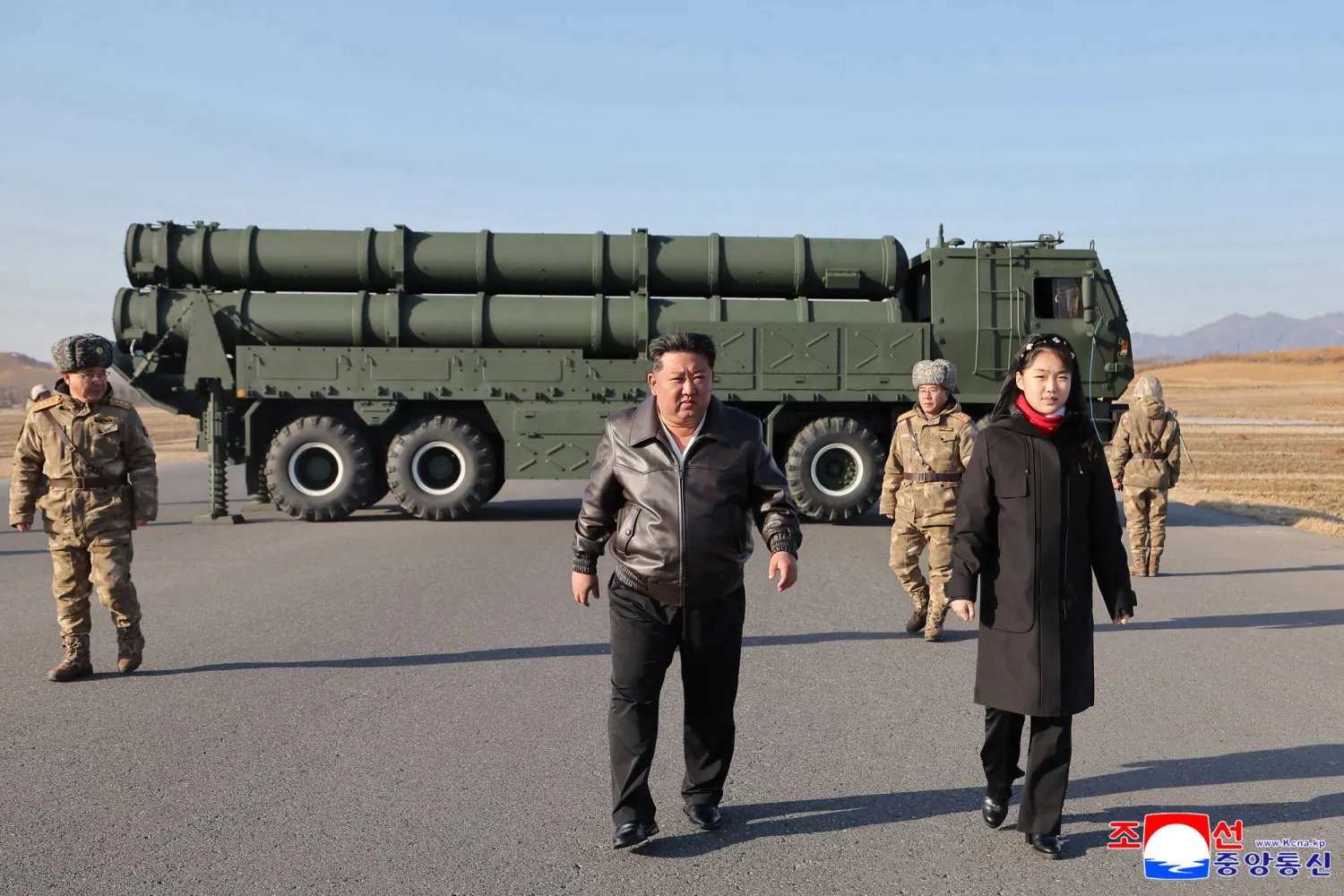
A photo released by the official Korean Central News Agency (KCNA) shows North Korean leader Kim Jong Un (C), accompanied by his daughter Kim Ju Ae (R), overseeing a test-fire of a large-caliber multiple-rocket launcher system at an unknown location in North Korea, 27 January 2026. (EPA/KCNA)
TT

North Korea to Soon Unveil ‘Next-Stage’ Nuclear Plans, Kim Says

A photo released by the official Korean Central News Agency (KCNA) shows North Korean leader Kim Jong Un (C), accompanied by his daughter Kim Ju Ae (R), overseeing a test-fire of a large-caliber multiple-rocket launcher system at an unknown location in North Korea, 27 January 2026. (EPA/KCNA)

North Korean leader Kim Jong Un will unveil plans to bolster his nuclear forces at an upcoming ruling party meeting, state media reported Wednesday, after a missile launch he said would bring "excruciating mental agony" to his enemies.

The landmark congress of North Korea's ruling Workers Party is expected in the coming weeks and is its first in five years.

Kim has ordered the "expansion" and modernization of the country's missile production ahead of that meeting.

Overseeing a ballistic missile test on Tuesday, Kim said the party congress "will clarify the next-stage plans for further bolstering up the country's nuclear war deterrent", the state-run Korean Central News Agency (KCNA) said.

Kim, accompanied by senior North Korean officials as well as his young daughter, watched the test-firing of a "large-caliber" multiple rocket launcher that fired four missiles, KCNA said.

"The result and significance of this test will be a source of excruciating mental agony and serious threat to the forces that attempt to provoke a military confrontation with us," Kim said.

While acknowledging that development of the rocket launcher system had "not been plain sailing", Kim said the test was "of great significance in improving the effectiveness of our strategic deterrent".

Photos released by state media showed Kim and his daughter, who analysts believe is called Ju Ae, watching the missile launch.

The rockets "hit a target" in waters 358.5 kilometers (222.7 miles) away, according to the North Korean leader.

The ballistic missiles were fired toward the Sea of Japan, with two missiles landing outside the country's Exclusive Economic Zone, Japanese state news agency Jiji Press had reported, citing defense ministry sources.

Lee Ho-ryung, principal researcher at the Korea Institute for Defense Analyses, told AFP the upcoming congress would likely see Kim announce "that the goal is now to maximize nuclear operational prowess".

"Kim Jong Un has used past party congresses to stress the completion of the country's nuclear capability, and this time he is expected to declare that such capability has now reached its peak," she said.

- Second test in January -

The test was Pyongyang's second of the month, following a volley of missiles fired hours before South Korea's leader headed to China for a summit.

It followed a high-level visit to Seoul by the Pentagon's number three official, Elbridge Colby, who hailed South Korea as a "model ally".

Ties between the United States and South Korea, longstanding treaty allies, were forged in the bloodshed of the Korean War.

Washington still stations 28,500 troops in South Korea as a deterrent against the nuclear-armed North.

"Pyongyang may have been signaling to Washington that it possesses response capabilities on an entirely different level from those of countries such as Venezuela," Hong Min, an analyst at the Korea Institute for National Unification, told AFP.

Last month, Kim bashed Seoul's push to develop its own nuclear-powered submarines with the United States, calling it a "threat" that "must be countered".

During his first term, US President Donald Trump met with Kim three times, in an effort to reach a denuclearization deal.



Turkish Authorities Arrest 6 on Suspicion of Spying for Iran

A ferry sails along the Bosphorus next to the Golden Horn, in Istanbul, Türkiye, Friday, Jan. 23, 2026. (AP)
TT

Turkish Authorities Arrest 6 on Suspicion of Spying for Iran

A ferry sails along the Bosphorus next to the Golden Horn, in Istanbul, Türkiye, Friday, Jan. 23, 2026. (AP)

Turkish authorities have arrested six people, including an Iranian national, on suspicion of spying for Iran, the state-run Anadolu Agency reported on Wednesday.

The arrests followed coordinated operations carried out by Türkiye's National Intelligence Organization and counterterrorism police across five provinces.

The suspects are believed to have been in contact with members of Iran’s Revolutionary Guard and are accused of gathering information on military bases and other sensitive sites in Türkiye, Anadolu reported. They allegedly conducted surveillance of NATO's Incirlik air base in southern Türkiye.

All six were brought before a judge in Istanbul, who ordered them held in pretrial detention on charges of political and military espionage.

There was no immediate comment from the Iranian Embassy in Ankara.

The arrests come as regional tensions have risen over fears of a possible US military strike on Iran.

Turkish government officials have warned against foreign intervention in neighboring Iran, saying it could spark instability and trigger a refugee influx.


Greenland Says More Surveillance and Security Needed in Region

Greenland's Prime Minister Jens-Frederik Nielsen and Denmark's Prime Minister Mette Frederiksen arrive to take part in a conference at Sciences Po University in Paris, France, January 28, 2026. (Reuters)
TT

Greenland Says More Surveillance and Security Needed in Region

Greenland's Prime Minister Jens-Frederik Nielsen and Denmark's Prime Minister Mette Frederiksen arrive to take part in a conference at Sciences Po University in Paris, France, January 28, 2026. (Reuters)

Greenland's prime ​minister said on Wednesday there were red lines that could not be crossed in discussions with the United States, but acknowledged that more needed to be done to boost security in the region amid a more aggressive Russia.

Jens-Frederik Nielsen and Denmark's Prime Minister Mette Frederiksen were in Paris to meet French President Emmanuel Macron to shore up support over US President Donald Trump's push to take over the Arctic island that has been Danish territory for centuries.

Talks between Greenland, Denmark ‌and the United ‌States are due to take place to try ‌to ⁠find ​a solution ‌to the crisis, but Nielsen said Greenland had some red lines that could not be crossed even if he hoped to come to some sort of agreement, without elaborating.

“We are under pressure, serious pressure. We are trying to push back from the outside. We are trying to handle our people who are afraid, scared," he said in a joint conversation with Frederiksen at Sciences Po University.

But he also said: "We need to ⁠do more surveillance and security in our region because of the way Russia acts now."

EUROPE MUST STICK ‌TOGETHER, FREDERIKSEN SAYS

The US demand for control of ‍Greenland has shaken transatlantic relations and ‍accelerated European efforts to reduce dependence on the United States, even as Trump ‍last week withdrew tariff threats and ruled out taking Greenland by force.

Frederiksen said that what the crisis had shown was that the majority of Europeans were on the same page and had been able to unite to push back on Trump's demands, notably his ​threat of additional tariffs on European states.

Saying the world order had changed forever and questioning what may happen in Washington in the future, ⁠she said it was vital for Europe to become stronger, but also urged transatlantic unity given that it was clear Russia did not want peace.

"If we allow Russia to win in Ukraine, they will continue," she said. "The best way forward for the United States, Europe is to stick together."

The diplomatic rift between Denmark and the United States, both founding members of NATO, had seemed in recent weeks to threaten the future of the military alliance, although the conflict has since been moved to a diplomatic track.

Half of the landmass in the Arctic is Russian territory. Since 2005 Moscow has re-opened and modernized tens of Soviet-era military bases, both on its Arctic mainland ‌and on the islands off its northern coast.

Russia says talk of Moscow and Beijing being a threat to Greenland is a myth to whip up hysteria.


Iran Rejects Talks with US Amid Military 'Threats'

Iranian Foreign Minister Abbas Araghchi attends a joint press conference with his Iraqi counterpart Fuad Hussein, in Tehran on January 18, 2026. (AFP)
TT

Iran Rejects Talks with US Amid Military 'Threats'

Iranian Foreign Minister Abbas Araghchi attends a joint press conference with his Iraqi counterpart Fuad Hussein, in Tehran on January 18, 2026. (AFP)

Iran on Wednesday rejected holding negotiations with the United States if it makes threats against the country, after President Donald Trump refused to rule out military intervention over its deadly crackdown on protests. 

A rights group said that it has verified over 6,200 deaths, mostly of protesters killed by security forces, in the wave of demonstrations that rocked the clerical leadership since late December but peaked on January 8-9.

Activists say that the actual toll could be many times higher with an internet shutdown still complicating efforts to confirm information about the scale of the killings.

Trump has not ruled out military action against Iran in response to the crackdown, while appearing to keep his options open. A strike group led by the USS Abraham Lincoln has now arrived in Middle Eastern waters, US Central Command said, without revealing its precise location.

Analysts say options include strikes on military facilities or targeted hits against the leadership under Ali Khamenei in a full-scale bid to bring down the system that has ruled Iran since the 1979 revolution that ousted the shah.

But Foreign Minister Abbas Araghchi said "conducting diplomacy through military threat cannot be effective or useful".

"If they want negotiations to take shape, they must certainly set aside threats, excessive demands and raising illogical issues," he said in televised comments.

Araghchi said he in recent days he had "no contact" with US Middle East envoy Steve Witkoff and that "Iran has not sought negotiations".

New billboards have meanwhile appeared in Tehran showing Iran striking an American aircraft carrier and also slogans of Khamenei denouncing the US, according to AFP journalists.

- 'New dimensions of crackdown' -

In an updated toll, the US-based Human Rights Activists News Agency (HRANA) said it had confirmed that 6,221 people had been killed, including 5,856 protesters, 100 minors, 214 members of the security forces and 49 bystanders.

But the group, which has an extensive network of sources inside Iran and has tracked the protests on a daily basis since they began, added it was still investigating another 17,091 possible fatalities.

At least 42,324 people have been arrested, it said.

HRANA warned that the crackdown was continuing with security forces searching hospitals for wounded protesters, doctors who helped protesters arrested, and "forced confessions" broadcast on state television.

These developments "highlight new dimensions of the continued security crackdown in the aftermath of the protests".

Meanwhile, Iran on Wednesday executed a man arrested in April 2025 on charges of spying for Israel's espionage agency Mossad, the judiciary said.

Rights groups have previously said 12 people have been hanged on similar charges in the wake of Israel's 12-day war with Iran in June.

They have expressed concern that protesters could also face execution. The judiciary has already indicated some of those arrested could face charges of capital crimes.