


Political, Military Activity in Lebanon to Address Weapons, Ceasefire Mechanism Crisis

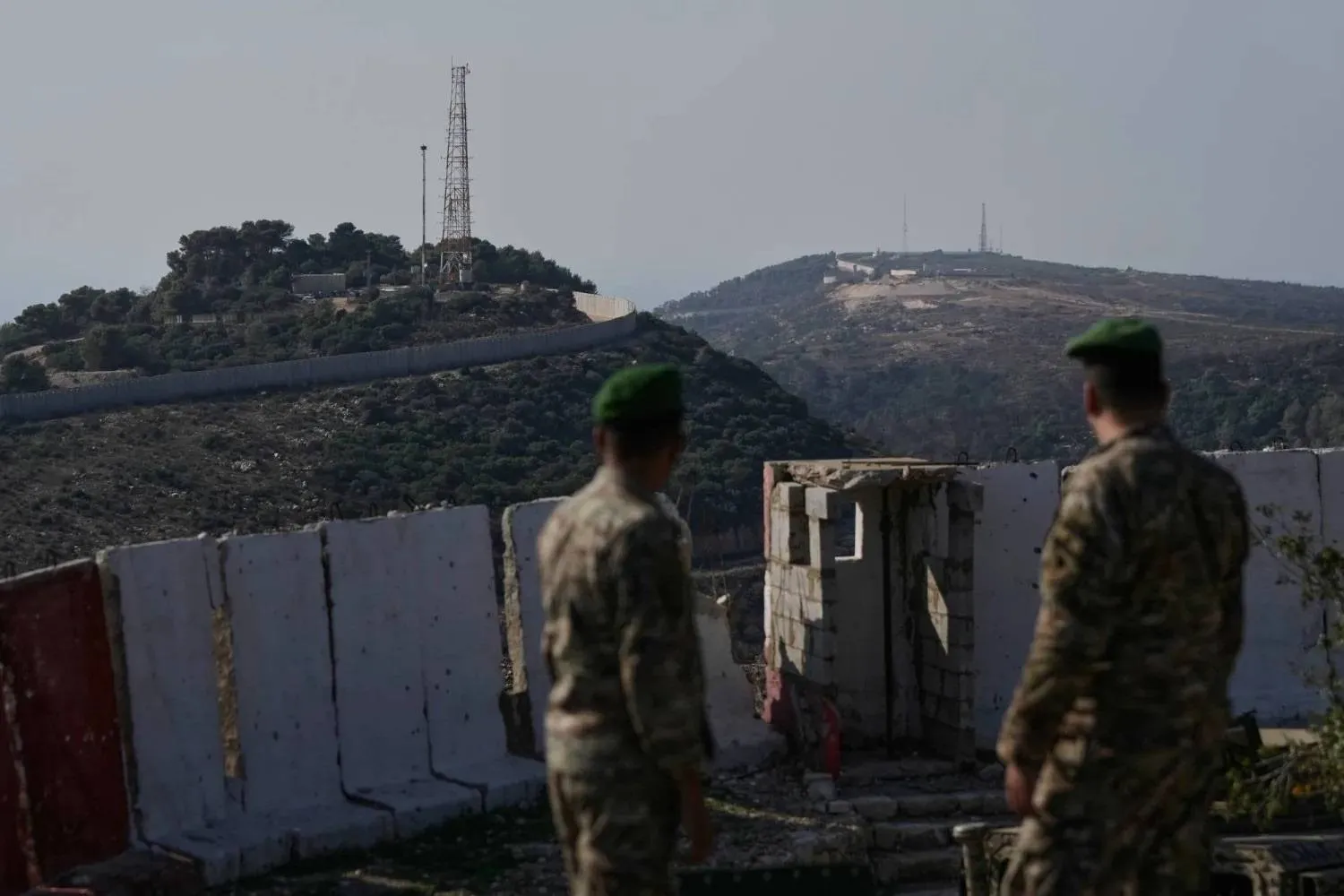
Lebanese army soldiers look toward the Israeli military position of Hanita (left) and the Labbouneh position, part of the five hills occupied by Israeli forces since last year (right), from a Lebanese military post in the village of Alma al-Shaab in southern Lebanon, Nov. 28, 2025. (AP) 
TT

Political, Military Activity in Lebanon to Address Weapons, Ceasefire Mechanism Crisis

Lebanese army soldiers look toward the Israeli military position of Hanita (left) and the Labbouneh position, part of the five hills occupied by Israeli forces since last year (right), from a Lebanese military post in the village of Alma al-Shaab in southern Lebanon, Nov. 28, 2025. (AP) 

Lebanon is preparing political and military conditions to ensure the success of an upcoming visit by Army Commander Gen. Rodolphe Haykal to the United States, consolidate stability at home, and pave the way for a Paris conference in March to support the Lebanese Armed Forces.

The effort involves coordinated steps, beginning with setting a date for the army to present its vision to the government for implementing the second phase of the “exclusive state control of weapons” plan, alongside intensified international contacts to reactivate the work of the ceasefire monitoring mechanism.

Lebanese sources told Asharq Al-Awsat that the success of the Paris conference depends on US backing, while Washington is awaiting the army’s proposed approach for launching the second phase of the weapons plan.

Political and military initiatives aim to unlock multiple obstacles simultaneously, strengthen stability, and enable the army to carry out its government-mandated tasks.

Army Plan Presented to Cabinet

The Cabinet is scheduled to meet Friday afternoon at Baabda Palace under President Joseph Aoun. A key agenda item is the army’s plan for deployment and operations north of the Litani River, which Haykal is expected to present in detail.

The Central News Agency (Al-Markaziah) reported that the briefing will cover the operational framework, implementation stages, assigned missions, and logistical and security requirements, considering recent developments in the south and Lebanon’s state commitments.

Official sources said the plan will define geographic scope, types of weapons, implementation tools, and timelines, and will be reviewed pending approval by relevant parties, an implicit reference to US and Israeli consent.

They noted that exclusive state control of weapons is a government commitment, and that Hezbollah, as part of the government, is expected to adhere to the plan.

During the first phase south of the Litani, the army worked to prevent the transfer of weapons between governorates. Proposals to “contain weapons” north of the Litani — an initiative put forward by Egypt and previously approved by the United States — are also under discussion.

The “Mechanism” Impasse

The resumption of meetings of the ceasefire “mechanism” is seen as the most significant obstacle.

On the military level, a Lebanese army delegation traveled to the United States on Wednesday ahead of Haykal’s planned visit on Feb. 5. Senior officers are expected to meet Gen. Joseph Clairfield, head of the mechanism committee, with sources confirming that no changes have been made to the committee overseeing the ceasefire.

Politically, the Lebanese presidency announced that Aoun’s security and military adviser, retired Brig. Gen. Antoine Mansour, met US Col. David Leon Klingensmith, deputy head of the mechanism committee, in the presence of Defense Attaché Col. Jason Belknap at the US Embassy in Beirut. Discussions focused on the committee’s work, cooperation with the Lebanese side, and preparations for the next meeting.

The meeting also explored whether Israel had responded to Lebanese demands regarding the ceasefire, withdrawal, and prisoner releases. Ministerial sources stressed that the mechanism remains the sole framework for security, military, and political negotiations to implement the agreement.

Next Meeting and Growing Tensions

The next mechanism meeting is scheduled for Feb. 25. While the agenda has not been finalized, official estimates suggest it will focus on security issues rather than political ones, amid continued Israeli violations despite Lebanon’s fulfillment of its commitments.

Lebanese authorities maintain that Lebanon has extended state authority south of the Litani, removed weapons, refrained from firing toward Israel, and advanced phased implementation of exclusive state control of arms — steps taken unilaterally, while Israel has not halted attacks, withdrawn from occupied positions, or released detainees.

Sources stressed the need for international pressure on Israel to honor its obligations and demonstrate good faith in the ceasefire process.


Lebanese Security Arrests Network Smuggling Drugs from Türkiye to Saudi Arabia

 A billboard on the road to Beirut International Airport promoting tourism in Lebanon. (AP) 
 A billboard on the road to Beirut International Airport promoting tourism in Lebanon. (AP) 
TT

Lebanese Security Arrests Network Smuggling Drugs from Türkiye to Saudi Arabia

 A billboard on the road to Beirut International Airport promoting tourism in Lebanon. (AP) 
 A billboard on the road to Beirut International Airport promoting tourism in Lebanon. (AP) 

Lebanese General Security has dismantled an organized network involved in smuggling drugs from Türkiye to Saudi Arabia, as authorities reiterated that Lebanon “will not be a platform or transit route for drug trafficking to sisterly or friendly countries.”

In a statement, the Media Affairs Office of Lebanon's General Security said that, as part of close monitoring of passenger movements at border crossings, officers at Beirut’s Rafic Hariri International Airport arrested four Turkish nationals, three men and one woman, while they were attempting to enter Lebanon on a flight arriving from Istanbul.

According to the statement, suspicions were raised by the suspects’ frequent travel patterns. Acting on instructions from the competent judiciary, the detainees were subjected to security interrogations that revealed they had established an organized network to smuggle narcotics from Türkiye to the Kingdom, in coordination with external parties and in exchange for financial payments.

Investigations also showed that they had carried out several previous operations using professional methods.

The statement added that investigations produced evidence confirming their direct involvement in smuggling activities. The suspects and seized materials were referred to the competent authorities under the supervision of the Mount Lebanon Public Prosecutor’s Office.

Interior and Municipalities Minister Ahmad Al-Hajjar praised “the significant efforts made by the security services, particularly the Directorate General of General Security, in combating drug-trafficking networks,” commending the “high-quality operation carried out at Beirut’s Rafic Hariri International Airport that led to the arrest of an organized network involved in smuggling narcotics.”

He stressed that Lebanon “will never be a platform or transit route for drug trafficking to sisterly or friendly countries, especially the Kingdom of Saudi Arabia,” and will not allow its territory to be used to undermine the security of Arab and international societies.


Yemeni Officer: Drug-Smuggling Networks Linked to Houthi Preventive Security

Colonel Osama al-Assad said that coordination with the Saudi side is at the highest level to safeguard border security (Asharq Al-Awsat). 
TT

Yemeni Officer: Drug-Smuggling Networks Linked to Houthi Preventive Security

Colonel Osama al-Assad said that coordination with the Saudi side is at the highest level to safeguard border security (Asharq Al-Awsat). 

Colonel Osama al-Assad, commander of Yemen’s Security and Protection Battalion at the Al-Wadiah border crossing, said that most drug-smuggling networks operating from Yemen toward Saudi Arabia are directly linked to the Houthi group’s so-called Preventive Security apparatus.

In an interview with Asharq Al-Awsat, al-Assad revealed that his unit recently arrested a senior Houthi figure who attempted to enter Saudi Arabia using a forged passport and a fake Umrah visa. He suggested that the suspect’s motives were security-related rather than religious, as claimed.

Al-Assad said his battalion faces daily attempts of various types of smuggling, including narcotics, human trafficking, forged documents, and unidentified individuals. He stressed that the unit’s experience has enabled it to thwart many illegal activities.

He also highlighted the high level of coordination with Saudi authorities, expressing appreciation for Riyadh’s continued support for Yemen in general and for border security forces in particular.

Battalion’s Mission

Al-Assad explained that the battalion’s core mission is to secure the Al-Wadiah crossing and combat all forms of smuggling. He noted that the unit arrests around 10 individuals daily carrying forged Umrah visas.

The battalion’s security zone extends 30 kilometers west toward the Rayyan area in Al-Jawf governorate, 50 kilometers toward the 11th Border Guard Brigade, and 40 kilometers toward the Al-Abr region. Its tasks also include arresting wanted members of Al-Qaeda and fugitives evading court rulings.

Links to Houthi Networks

According to al-Assad, most contraband-smuggling operations are directly connected to the Houthi Preventive Security apparatus in Sanaa, with interrogations of suspects revealing direct ties.

He said Houthi-linked networks support both human and drug-smuggling operations. During one operation, a network offered one million Saudi riyals in exchange for releasing a smuggler, abandoning the vehicle and seized contraband.

Secret Meetings

Investigations indicate that smugglers affiliated with the Houthi apparatus hold meetings in border areas near Oman. Some secret gatherings reportedly took place in Al-Ghaydah, the capital of Al-Mahra governorate in eastern Yemen. Al-Assad said Ali al-Huraizi plays a prominent role in these networks.

Close Coordination with Saudi Arabia

Al-Assad noted that security cooperation with Saudi Arabia is at the highest level, with continuous information exchange on smuggling cases. He described Saudi security measures as strong and vigilance as high.

He confirmed that the battalion recently arrested a senior Houthi official attempting to enter Saudi Arabia with a forged Umrah visa, describing the operation as “dramatic.”

Drug Production

Al-Assad further claimed that the Houthis, whom he described as an Iranian proxy, have moved to establish drug-production facilities in Sanaa and Saada following the fall of the Assad regime. He cited the dismantling of a drug factory in Al-Mahra, allegedly under the supervision of Ali al-Huraizi, with a production capacity of about 10,000 pills per hour.

Challenges

Al-Assad said the battalion’s main challenge is limited resources, relying heavily on human effort. He called for heavy equipment to build earth barriers and trenches to curb internal smuggling.


Erbil Mediation in Syria Hinges on Sidelining the PKK

Kurdish fighters aboard Syrian Democratic Forces military vehicles flash victory signs in Hasakah (AP)
TT

Erbil Mediation in Syria Hinges on Sidelining the PKK

Kurdish fighters aboard Syrian Democratic Forces military vehicles flash victory signs in Hasakah (AP)

Mediation efforts led from Iraq’s Kurdistan region are gathering pace to avert a new escalation in northeastern Syria, as Damascus presses ahead with a Turkish-backed military campaign and Ankara seeks guarantees that Kurdish forces will be severed from the Kurdistan Workers Party.

The Syrian Democratic Forces have lost areas previously under their control following a military operation launched by Damascus and strongly backed by Ankara, aimed at asserting control over all Syrian territory, as Kurdish factions demand what they describe as fair representation in government.

Observers tend to believe Türkiye’s motivation for supporting the Syrian army’s offensive stems from fears that Kurdish self-rule in Syria could pave the way for secession. Ankara has repeatedly threatened to launch a military operation against Syrian Kurdish areas near its border unless SDF forces are integrated into the Syrian army.

Part of the solution

Politicians in Erbil are pushing to support political tracks that respect good neighborly relations with Türkiye and guarantee the rights of all components in Syria.

Dlawar Faeq, an adviser to the Kurdistan Regional Government, told Asharq Al-Awsat that Kurds in the Kurdistan region would remain part of the solution and a factor of stability in the region, as they have been since 1991.

Faeq said the vision of Kurds in Iraq’s Kurdistan aligns with a new, democratic, constitutional Syria that guarantees the rights of ethnic and religious components, while upholding principles of good neighborliness with Türkiye and other regional states and non-interference in internal affairs.

Kurds in the Kurdistan region are in contact with parties to the Syrian conflict, including actors in self-administration areas, authorities in Damascus, and the United States, Faeq said, adding that the goal of these contacts is to reach a permanent settlement.

In recent weeks, Masoud Barzani has held several contacts with Syrian President Ahmad al-Sharaa, US envoy Tom Barrack, and SDF commander Mazloum Abdi to bolster civil peace through dialogue and mutual understanding, according to statements issued by the Kurdistan Democratic Party since the crisis erupted.

Faeq warned that a military solution would harm Syria’s components and the Syrian state and could increase the likelihood of remnants of ISIS regrouping.

PKK as an obstacle

Despite these efforts, the Kurdistan Workers Party has emerged as a significant obstacle to ongoing understandings.

Abdulsalam Brwari, a member of the Kurdistan Democratic Party, said Erbil’s efforts to resolve the crisis and prevent escalation continue. Still, Türkiye views the situation with Syrian Kurds through the lens of the PKK, which has waged an armed insurgency against it for years.

Türkiye has launched a peace process with the outlawed party, conditional on its disarmament, but clashes in northern Syria now threaten to undermine negotiations between the two sides.

While Erbil understands Ankara’s concerns, it is trying to correct misunderstandings surrounding the Kurdish issue.

Brwari said Kurdish rights in Türkiye and Syria predate even the emergence of the PKK, adding that resolving the issue with the Kurdish people would eliminate any pretexts for escalation.

He described Erbil’s relations with Ankara as good, saying the Kurdistan region is working with Türkiye and the international community to resolve the issue between Syrian Kurds and the Syrian government, calling this the priority.

Developments involving Syrian Kurds have had repercussions inside Türkiye, where hundreds took part in angry protests against military operations in northeastern Syria.

This prompted Turkish authorities in the southeastern province of Mardin, bordering Syria, to impose a six-day ban on all protests and events on Monday.

Mediation moves slowly

Soran al-Dawoudi, a leader in the Patriotic Union of Kurdistan, said Iraq’s Kurdistan region is likely seeking to play an undeclared mediating role between Türkiye and Syrian Kurds, but within carefully calculated limits.

He told Asharq Al-Awsat that this complex role is primarily based on strong political and economic relations with Ankara, and longstanding communication channels with Syrian Kurdish actors, particularly those outside the influence of the PKK.

Al-Dawoudi said there are quiet, unofficial contacts between Erbil and influential Kurdish figures aimed at narrowing differences. Still, these face key obstacles, most notably Türkiye’s stance toward the People’s Protection Units, the armed wing of the Democratic Union Party and the backbone of the Syrian Democratic Forces, which Ankara views as an extension of the PKK.

He also pointed to another division deepening the crisis within the Syrian Kurdish arena between the Syrian Democratic Forces on one side and the Kurdish National Council on the other.

Despite attempts by the Kurdistan region to sustain dialogue, al-Dawoudi said the impact of this mediation remains limited and is moving slowly.

Still, the repeated arrival of key figures involved in the crisis in Erbil has fueled optimism among politicians such as al-Dawoudi that the city could serve as a suitable venue for genuine understanding among Damascus, Ankara, the Kurdish parties, and Washington.
