Supplies Running Out at Syria's al-Hol Camp as Clashes Block Aid Deliveries

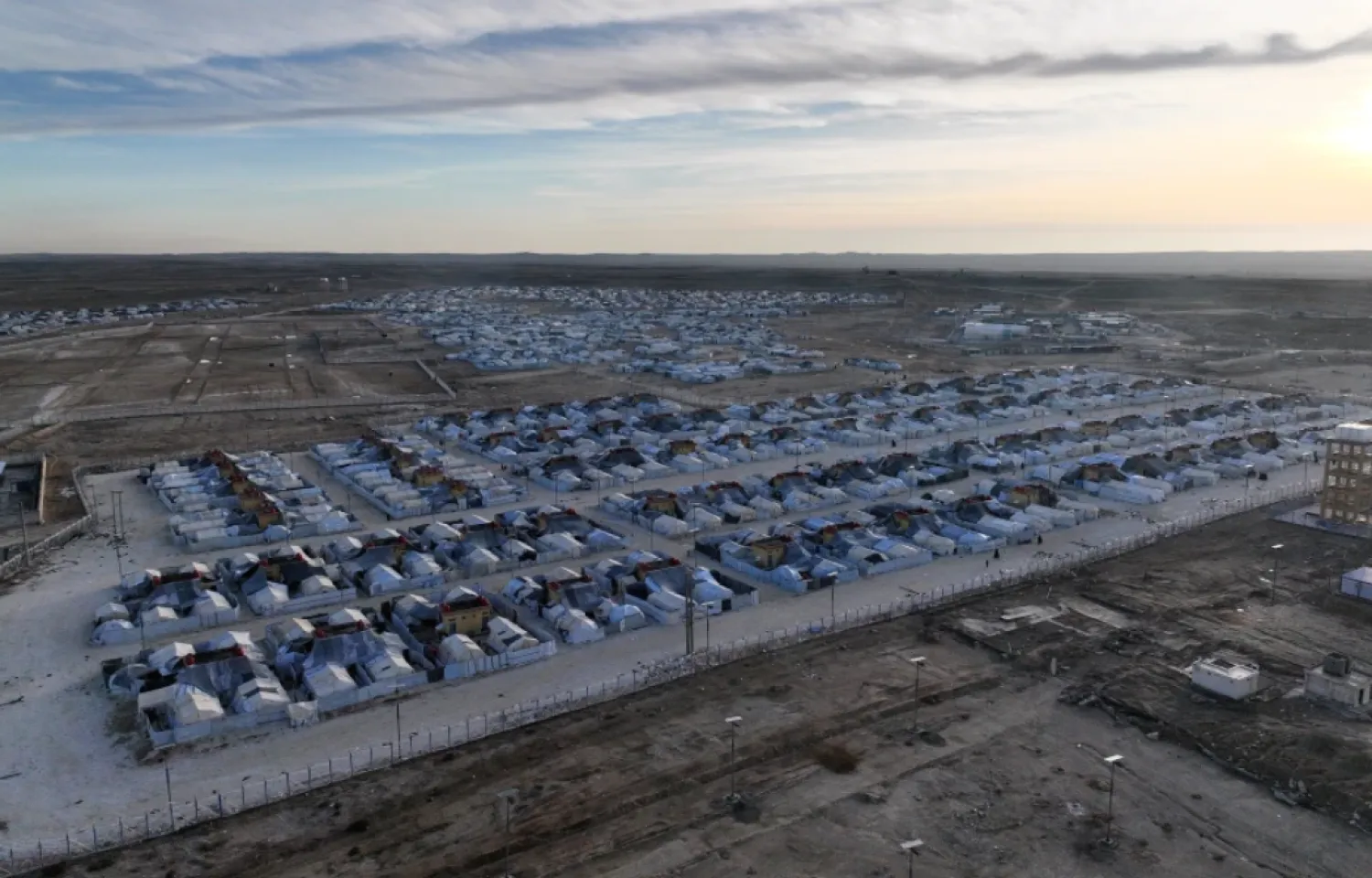
An aerial view shows the al-Hol camp in northeastern Syria’s Hasakeh province, Syria, Wednesday, Jan. 21, 2026, after the withdrawal of the Syrian Democratic Forces (SDF). (AP Photo/Ghaith Alsayed)
TT

Supplies Running Out at Syria's al-Hol Camp as Clashes Block Aid Deliveries

An aerial view shows the al-Hol camp in northeastern Syria’s Hasakeh province, Syria, Wednesday, Jan. 21, 2026, after the withdrawal of the Syrian Democratic Forces (SDF). (AP Photo/Ghaith Alsayed)

An international humanitarian organization has warned that supplies are running out at a camp in northeast Syria housing thousands of people linked to the ISIS group, as the country's government fights to establish control over an area formerly controlled by Kurdish fighters.

The statement by Save the Children came a week after government forces captured al-Hol camp, which is home to more than 24,000 people, mostly children and women, including many wives or widows of ISIS members.

The capture of the camp came after intense fighting earlier this month between government forces and members of the Kurdish-led and US-backed Syrian Democratic Forces during which forces loyal to interim President Ahmad al-Sharaa captured wide areas in eastern and northeastern Syria.

The SDF signed a deal to end the fighting after suffering major defeats, but sporadic clashes between it and the government have continued, The AP news reported.

Save the Children said that “critical supplies in al-Hol camp are running dangerously low” as clashes are blocking the safe delivery of humanitarian aid.

It added that last week’s clashes around the camp forced aid agencies to temporarily suspend regular operations at al-Hol. It added that the main road leading to the camp remains unsafe, which is preventing humanitarian workers from delivering food and water or running basic services for children and families.

“The situation in al-Hol camp is rapidly deteriorating as food, water and medicines run dangerously low,” said Rasha Muhrez, Save the Children Syria country director. “If humanitarian organizations are unable to resume work, children will face still more risks in the camp, which was already extremely dangerous for them before this latest escalation.”

Muhrez added that all parties to the conflict must ensure a safe humanitarian corridor to al-Hol so basic services can resume and children can be protected. “Lives depend on it,” she said.

The SDF announced a new agreement with the central government on Friday, aiming to stabilize a ceasefire that ended weeks of fighting and lay out steps toward integrating the US-backed force into the army and police forces.


Egypt Urges All Parties to Show Restraint before Gaza's Rafah Crossing Reopens

Israeli forces are due to allow the Rafah crossing between Egypt and Gaza to reopen on Sunday - AFP
TT

Egypt Urges All Parties to Show Restraint before Gaza's Rafah Crossing Reopens

Israeli forces are due to allow the Rafah crossing between Egypt and Gaza to reopen on Sunday - AFP

Egypt condemned Israel's latest strikes in Gaza on Saturday and urged all parties to respect a fragile US-brokered ceasefire ahead of the long-awaited reopening of the territory's Rafah border crossing, AFP reported.

In a statement from its foreign ministry, Egypt condemned Israel's "repeated violations" of the truce and demanded all parties "exercise the utmost restraint", after Gaza's civil defense agency said Israeli strikes killed 28 people on Saturday.

Israeli forces are due to allow the Rafah crossing between Egypt and Gaza to reopen on Sunday on a trial basis and to allow only the "limited movement of people", not aid shipments.


NGOs: Türkiye Blocks Aid Convoy to Syria's Kobane

Members of Kurdish-led Syrian Democratic Forces (SDF) arrive in Kobane on January 23, 2026, after withdrawing from areas in eastern Syria. © AFP
TT

NGOs: Türkiye Blocks Aid Convoy to Syria's Kobane

Members of Kurdish-led Syrian Democratic Forces (SDF) arrive in Kobane on January 23, 2026, after withdrawing from areas in eastern Syria. © AFP

Turkish authorities have blocked a convoy carrying aid to Kobane, a predominantly Kurdish town in northern Syria encircled by the Syrian army, NGOs and a Turkish MP said on Saturday.

They said the aid was blocked before it reached the Türkiye -Syria border, despite an agreement announced on Friday between the Syrian government and the country's Kurdish minority to gradually integrate the Kurds' military and civilian institutions into the state.

Twenty-five lorries containing water, milk, baby formula and blankets collected in Diyarbakir, the main city in Türkiye's predominantly Kurdish southeast, "were prevented from crossing the border", said the Diyarbakir Solidarity and Protection Platform, which organized the aid campaign, AFP reported.

"Blocking humanitarian aid trucks carrying basic necessities is unacceptable, both from the point of view of humanitarian law and from the point of view of moral responsibility," said the platform, which brings together several NGOs.

Earlier this week, residents of Kobane told AFP they were running out of food, water and electricity because the city was overwhelmed with people fleeing the advance of the Syrian army.

Kurdish forces accused the Syrian army of imposing a siege on Kobane, also known as Ain al-Arab in Arabic.

"The trucks are still waiting in a depot on the highway," said Adalet Kaya, an MP from Türkiye's pro-Kurdish DEM party who was accompanying the convoy.

"We will continue negotiations today. We hope they will be able to cross at the Mursitpinar border post," he told AFP.

Mursitpinar is located on the Turkish side of the border, across from Kobane.

Turkish authorities have kept the border crossing closed since 2016, while occasionally opening it briefly to allow humanitarian aid to pass through.

DEM and Türkiye's main opposition CHP called this week for Mursitpinar to be opened "to avoid a humanitarian tragedy".

Turkish authorities said aid convoys should use the Oncupinar border crossing, 180 kilometres (110 miles) away.

"It's not just a question of distance. We want to be sure the aid reaches Kobane and is not redirected elsewhere by Damascus, which has imposed a siege," said Kaya.

After months of deadlock and fighting, Damascus and the Syrian Kurds announced an agreement on Friday that would see the forces and administration of Syria's Kurdish autonomous region gradually integrated into the Syrian state.

Kobane is around 200 kilometres from the Kurds' stronghold in Syria's far northeast.

Kurdish forces liberated the city from a lengthy siege by the ISIS group in 2015 and it took on symbolic value as their first major victory against the militants.

Kobane is hemmed in by the Turkish border to the north and government forces on all sides, pending the entry into the force of Friday's agreement.


Lebanon's Government Approves a Deal to Transfer Syrian Prisoners Back to Syria

The main Homs prison was emptied when Assad fell in December 2024. But a year on, its wards are among those in Syria's prisons and lockups that are filling again with security detainees. REUTERS/John Davison
TT

Lebanon's Government Approves a Deal to Transfer Syrian Prisoners Back to Syria

The main Homs prison was emptied when Assad fell in December 2024. But a year on, its wards are among those in Syria's prisons and lockups that are filling again with security detainees. REUTERS/John Davison

Lebanon’s Cabinet approved an agreement to transfer Syrian prisoners serving their sentences in Lebanon back to their home country.

The issue of prisoners has been a sore point as the neighboring countries seek to recalibrate their relations following the ouster of former Syrian President Bashar Assad.

Lebanon and Syria have a complicated history with grievances on both sides. Many Lebanese resent the decades-long occupation of their country by Syrian forces that ended in 2005. Many Syrians resent the role played by the Lebanese militant group Hezbollah when it entered Syria’s civil war in defense of Assad’s government.

A key obstacle to warming relations has been the fate of about 2,000 Syrians in Lebanese prisons, including some 800 held over attacks and shootings, many without trial. Damascus had asked Beirut to hand them over to continue their prison terms in Syria, but Lebanese judicial officials said Beirut would not release any attackers and that each must be studied and resolved separately.

The deal approved late Friday appeared to resolve that tension. Lebanese Information Minister Paul Morcos said other issues remain to be resolved between the two countries, including the fate of Lebanese believed to have been disappeared into Syrian prisons during Assad’s rule and the demarcation of the border between the two countries.

Lebanon’s Deputy Prime Minister Tarek Mitri told reporters after the Cabinet meeting that about 300 prisoners would be transferred as a result of the agreement.

Protesters gathered in a square below the government palace in downtown Beirut ahead of the Cabinet vote to call for amnesty for Lebanese prisoners, including some who joined militant groups fighting against Assad in Syria. Some of the protesters called for the release of cleric Ahmad al-Assir, imprisoned for his role in 2013 clashes that killed 18 Lebanese army soldiers.

“The state found solutions for the Syrian youth who are heroes and belong to the Syrian revolution who have been imprisoned for 12 years,” said protester Khaled Al- Bobbo. “But in the same files there are also Lebanese detainees. ... We demand that just as they found solutions for the Syrians, they must also find solutions for the people of this country.”