


Iran’s Supreme Leader Warns Any US Attack Would Spark ‘Regional War’

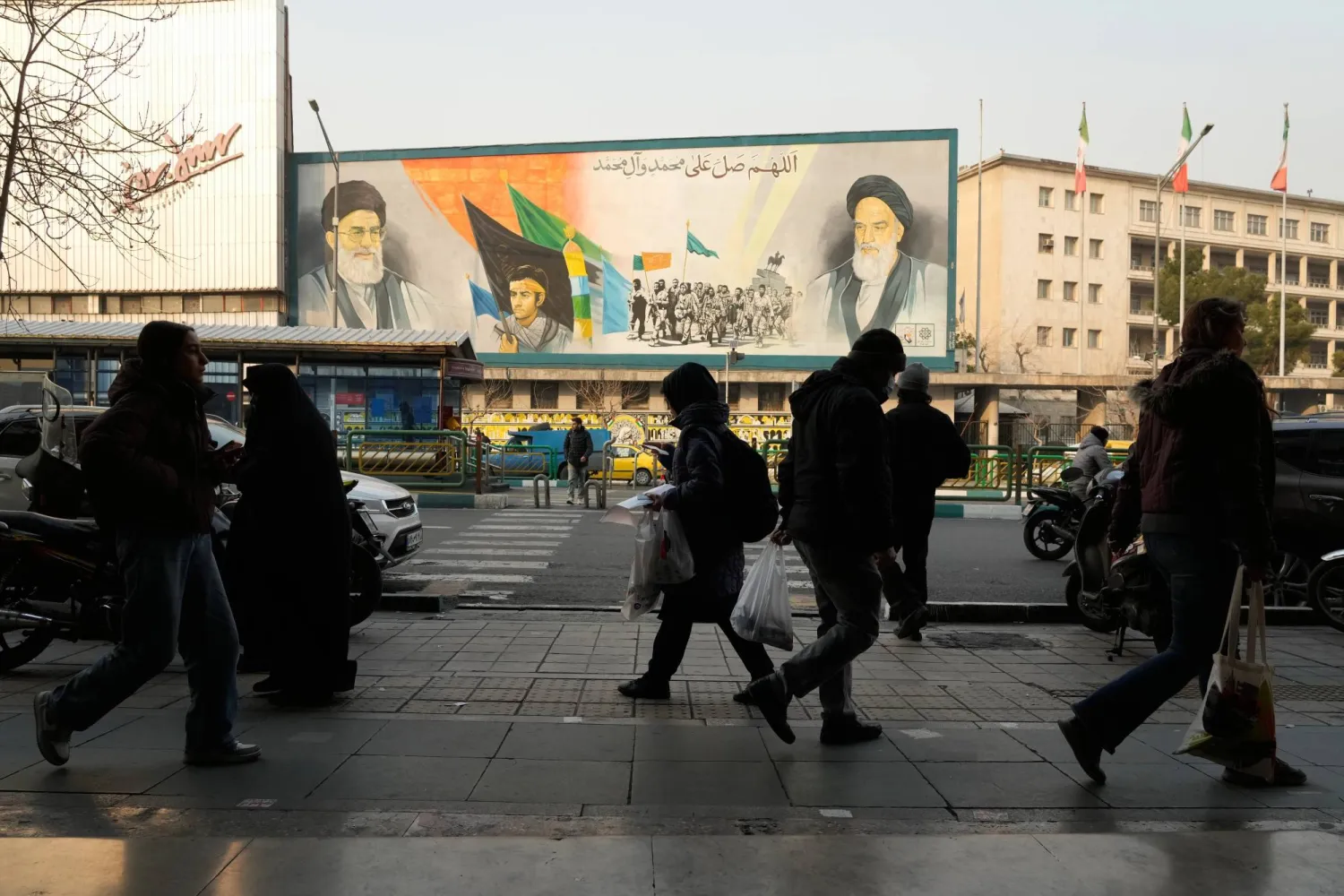
People walk in front of a mural depicting the late Iranian revolutionary founder Khomeini, right, members of the Basij paramilitary force and Supreme Leader Ali Khamenei along Enqelab-e-Eslami Street in Tehran, Iran, Sunday, Jan. 25, 2026. (AP Photo/Vahid Salemi)
TT

Iran’s Supreme Leader Warns Any US Attack Would Spark ‘Regional War’

People walk in front of a mural depicting the late Iranian revolutionary founder Khomeini, right, members of the Basij paramilitary force and Supreme Leader Ali Khamenei along Enqelab-e-Eslami Street in Tehran, Iran, Sunday, Jan. 25, 2026. (AP Photo/Vahid Salemi)

Iran's supreme leader warned Sunday that any attack by the United States would spark a "regional war" in the Middle East, further escalating tensions as President Donald Trump has threatened to militarily strike the country over its crackdown on recent nationwide protests. 

The comments from the 86-year-old Ali Khamenei are the most-direct threat he’s made so far as the aircraft carrier USS Abraham Lincoln and associated American warships are in the Arabian Sea, sent by Trump there after Tehran's bloody crackdown on nationwide protests. 

It remains unclear whether Trump will use force. He's repeatedly said Iran wants to negotiate and has brought up Tehran's nuclear program as another issue he wants to see resolved. 

But Khamenei also referred to the nationwide protests as "a coup," hardening the government's position as tens of thousands of people reportedly have been detained since the start of the demonstrations. Sedition charges in Iran can carry the death penalty, which again renews concerns about Tehran carrying out mass executions for those arrested — a red line for Trump. 

Iran had also planned a live-fire military drill for Sunday and Monday in the strategic Strait of Hormuz, the narrow mouth of the Gulf through which a fifth of all oil traded passes. The US military's Central Command had warned against threatening American warships or aircraft during the drill or disrupting commercial traffic. 

Khamenei warns US  

Khamenei spoke to a crowd at his compound in Tehran as Iran marked the start of a dayslong commemoration of the country's 1979 revolution. He, at one point, described the US as being interested in its oil, natural gas and other mineral resources, saying that they wanted to "seize this country, just as they controlled it before." 

"The Americans must be aware that if they wage a war this time, it will be a regional war," he said. 

The supreme leader added that: "We are not the instigators, we are not going to be unfair to anyone, we don’t plan to attack any country. But if anyone shows greed and wants to attack or harass, the Iranian nation will deal a heavy blow to them." 

Khamenei also hardened his position on the demonstrations after earlier acknowledging some people had legitimate economic grievances that sparked their protests. The demonstrations began Dec. 28, initially over the collapse of Iran's rial currency. It soon grew into a direct challenge to Khamenei's rule. 

"The recent sedition was similar to a coup. Of course, the coup was suppressed," he said. "Their goal was to destroy sensitive and effective centers involved in running the country, and for this reason they attacked the police, government centers, (Revolutionary Guard) facilities, banks and mosques — and burned copies of the Quran. They targeted centers that run the country." 

The US-based Human Rights Activists New Agency, which relies on a network inside Iran to verify its information, reports that over 49,500 people have been detained in the crackdown. It says the violence killed at least 6,713 people, the vast majority of them demonstrators. The Associated Press has been unable to independently assess the death toll and arrest figures, given authorities have cut Iran's internet off from the rest of the world. 

As of Jan. 21, Iran’s government put the death toll at a far lower 3,117, saying 2,427 were civilians and security forces, labeling the rest "terrorists." In the past, Iran’s theocracy has undercounted or not reported fatalities from unrest. 

That death toll exceeds that of any other round of protest or unrest in Iran in decades and recalls the chaos surrounding the 1979 revolution. 

Parliament speaker says EU militaries considered terrorist groups 

The speaker of Iran's parliament, meanwhile, said that Tehran now considers all European Union militaries to be terrorist groups, lashing out after the bloc declared the country's paramilitary Revolutionary Guard a terror group over taking part in the bloody crackdown. 

Mohammad Bagher Qalibaf, a former Guard commander, announced the terror designation, which will likely be mostly symbolic. Iran has used a 2019 law to reciprocally declare other nations' militaries terror groups following the United States declaration of the Guard a terror group that year. 

Qalibaf made the announcement as he and others in parliament wore Guard uniforms in support of the force. The Guard, which also controls Iran's ballistic missile arsenal and has vast economic interests in Iran, answers only to Khamenei. 

"By seeking to strike at the (Guard), which itself has been the greatest barrier to the spread of terrorism to Europe, Europeans have in fact shot themselves in the foot and, once again, through blind obedience to the Americans, decided against the interests of their own people," Qalibaf said. 

Lawmakers at the session later chanted: "Death to America!" and "Death to Israel!" at the session. 

Trump says Iran is ‘seriously talking' to US  

Trump has laid out two red lines for military action: the killing of peaceful protesters or the possible mass execution of those detained in a major crackdown over the demonstrations. He's increasingly begun discussing Iran's nuclear program as well, which the US negotiated over with Tehran in multiple sessions before Israel launched a 12-day war with Iran back in June. 

The US bombed three Iranian nuclear sites during the war. Activity at two of the sites suggests Iran may be trying to obscure the view of satellites as it tries to salvage what remains there. 

Trump on Saturday night declined to say whether he’d made a decision on what he wanted to do regarding Iran. 

Speaking to reporters as he flew to Florida, Trump sidestepped a question about whether Tehran would be emboldened if the US backed away from launching strikes on Iran, saying, "Some people think that. Some people don’t." 

Trump said Iran should negotiate a "satisfactory" deal to prevent the country from getting any nuclear weapons, but said, "I don’t know that they will. But they are talking to us. Seriously talking to us." 


Russian Missile Kills Three on Bus in East Ukraine

This photograph shows residential buildings heavily damaged by a Russian air strike at the beginning of the full-scale invasion, where more than 50 people were killed, in the center of the city of Izium, Kharkiv region on March 10, 2026, amid the Russian invasion of Ukraine. (AFP)
TT

Russian Missile Kills Three on Bus in East Ukraine

This photograph shows residential buildings heavily damaged by a Russian air strike at the beginning of the full-scale invasion, where more than 50 people were killed, in the center of the city of Izium, Kharkiv region on March 10, 2026, amid the Russian invasion of Ukraine. (AFP)

A Russian strike in eastern Ukraine on Friday killed three people on a bus near the embattled town of Kupiansk, which Moscow's army is battling to recapture, investigators said.

The wider Kharkiv region, which borders Russia, was partly occupied when Russian forces invaded in February 2022, but was largely liberated by Ukraine months later.

"Three people were killed as a result of the strike: the bus driver and two passengers," local investigators announced.

The bus was near the village of Nova Oleksandrivka when it was hit by an Iskandr missile, they added. Investigators posted images of a red bus with its windows blown out.

There was no immediate comment from the Kremlin, which claims its forces do not target civilians.

Peace talks spearheaded by the United States aiming to halt more than four years of fighting have been derailed by the US-Israeli war with Iran.

Russia's invasion sparked the bloodiest war in Europe since World War II, forcing the displacement of millions and leaving hundreds of thousands of soldiers and civilians dead on both sides.


Türkiye Says Third Ballistic Missile from Iran Shot Down

 This handout photograph taken and released on March 9, 2026, by Turkish news agency DHA (Demiroren News Agency) shows part of a second Iranian ballistic missile destroyed by NATO in Turkish airspace. (Photo by Handout / DHA (Demiroren News Agency) / AFP)
This handout photograph taken and released on March 9, 2026, by Turkish news agency DHA (Demiroren News Agency) shows part of a second Iranian ballistic missile destroyed by NATO in Turkish airspace. (Photo by Handout / DHA (Demiroren News Agency) / AFP)
TT

Türkiye Says Third Ballistic Missile from Iran Shot Down

 This handout photograph taken and released on March 9, 2026, by Turkish news agency DHA (Demiroren News Agency) shows part of a second Iranian ballistic missile destroyed by NATO in Turkish airspace. (Photo by Handout / DHA (Demiroren News Agency) / AFP)
This handout photograph taken and released on March 9, 2026, by Turkish news agency DHA (Demiroren News Agency) shows part of a second Iranian ballistic missile destroyed by NATO in Turkish airspace. (Photo by Handout / DHA (Demiroren News Agency) / AFP)

Türkiye’s defense ministry on Friday said a ballistic missile from Iran had been shot down in Turkish airspace by NATO forces in the third such incident of the Middle East war. 

"A ballistic munition launched from Iran and entering Turkish airspace was neutralized by NATO air and missile defense assets deployed in the eastern Mediterranean," a ministry statement said. 

Hours earlier, sirens wailed at Türkiye’s southern Incirlik airbase, a key NATO facility where US troops are stationed, state news agency Anadolu reported. 

Local media also reported sirens in Batman, 600 kilometers (370 miles) further east. 

NATO air defenses shot down a first ballistic missile fired from Iran on March 4, with a second intercepted on Monday. 

Residents of the southern city of Adana, next to Incirlik, were woken by sirens at 3:25 am (0025 GMT) and several posted footage of a fast-moving object that appeared to be on fire, the Ekonomim business news website reported. 

Separately, sirens sounded in Batman around 4:00 am, with reporters saying the alarm appeared to be coming from a military drone base next to the city's airport. 

Monday's incident prompted Washington to close its consulate in Adana and urge all US citizens to leave southeastern Türkiye. 

Iranian President Masoud Pezeshkian denied the missile had been fired from Iran in a phone call to Türkiye’s Recep Tayyip Erdogan. 

Since the US-Israeli war on Iran started on February 28, Tehran has retaliated with strikes across the Middle East. 

Incirlik is an important NATO facility used by US troops for decades, but which also hosts military personnel from Spain and Poland, its website says. 

US troops are also stationed at Kurecik, a base in the central Malatya province, where they man an early-warning radar system NATO describes as a "key element" of its missile shield that can detect Iranian missile launches. 

Although Ankara has categorically denied radar data has ever been used to help Israel, its presence has rattled Tehran. 

On Tuesday, Türkiye said a Patriot missile defense system was being deployed in Malatya just days after NATO moved to strengthen its "alliance-wide ballistic missile defense posture". 


Russia Says It Doesn't See Iran Crisis Reducing US Interest in Ukraine Peace Talks

FILE PHOTO: Kremlin spokesman Dmitry Peskov attends a meeting of Russian President Vladimir Putin with Palestinian President Mahmoud Abbas at the Kremlin in Moscow, Russia, January 22, 2026. REUTERS/Ramil Sitdikov/Pool/File Photo
TT

Russia Says It Doesn't See Iran Crisis Reducing US Interest in Ukraine Peace Talks

FILE PHOTO: Kremlin spokesman Dmitry Peskov attends a meeting of Russian President Vladimir Putin with Palestinian President Mahmoud Abbas at the Kremlin in Moscow, Russia, January 22, 2026. REUTERS/Ramil Sitdikov/Pool/File Photo

Russia is not concerned at this point that the Iran crisis will reduce US interest in mediating ‌peace talks ‌on Ukraine, ‌Kremlin ⁠spokesman Dmitry Peskov said ⁠on Friday.

"No, there are no such concerns at ⁠this time; our ‌contacts with ‌our American ‌counterparts provide ‌no grounds for such doubts," Peskov told reporters in ‌response to a question.

Russia is ⁠expecting ⁠a new round of negotiations, but has nothing to announce yet on the timing, he said.
