


Syrian Security Forces Enter Hasakeh City under Deal with Kurds

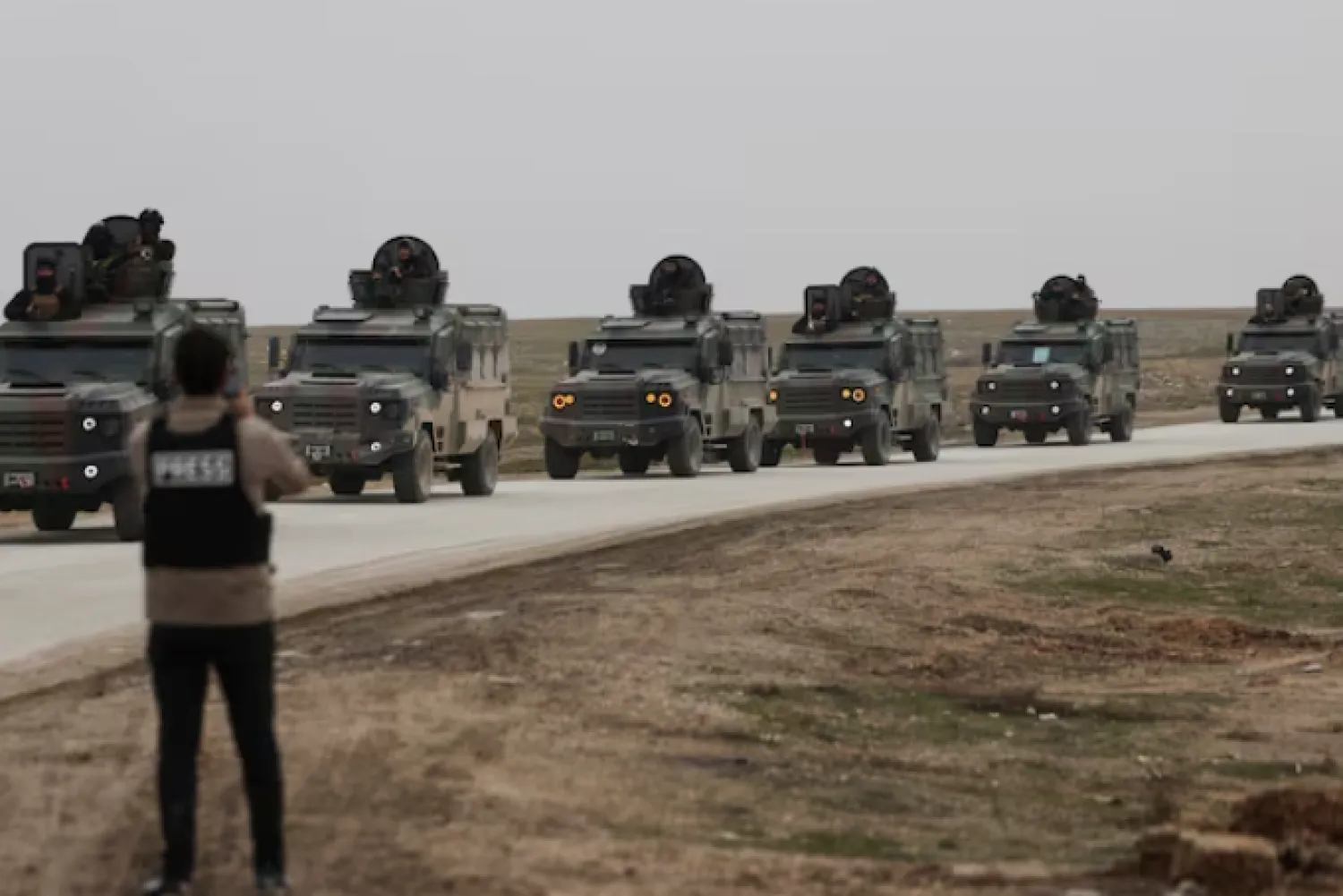
Syrian Interior Ministry security forces vehicles travel to enter the city of Hasakah in northeastern Syria, following an agreement between Damascus and the Syrian Democratic Forces reached on January 30, in Al-hasakah, Syria, February 2, 2026. REUTERS/Khalil Ashawi
TT

Syrian Security Forces Enter Hasakeh City under Deal with Kurds

Syrian Interior Ministry security forces vehicles travel to enter the city of Hasakah in northeastern Syria, following an agreement between Damascus and the Syrian Democratic Forces reached on January 30, in Al-hasakah, Syria, February 2, 2026. REUTERS/Khalil Ashawi

Syrian government security personnel on Monday entered Hasakeh city, a stronghold of Kurdish forces, under an integration deal agreed with the Kurds last week, an AFP team reported. 

The two sides reached a comprehensive agreement on Friday to gradually integrate the Kurds' military and civilian institutions into the state, after Kurdish forces ceded territory to advancing government troops in recent weeks following months of tensions and sporadic clashes. 

The government's push to extend its authority across the entire country comes as a blow to the Kurds, who had sought to preserve their de facto autonomy in parts of the north and northeast that they seized while battling the ISIS group during Syria's civil war. 

Turkish President Recep Tayyip Erdogan, whose country is a key backer of the Syrian government and has long been hostile to Kurdish forces in Syria, warned on Monday that anyone who attempted to "sabotage" the deal between Damascus and the Kurds would be "crushed". 

AFP correspondents saw a convoy of government vehicles cross a Kurdish forces checkpoint on its way into Hakaseh in the northeast, as armed Kurdish personnel stood at the roadside. 

Some residents gathered along the road to welcome the government forces, waving Syrian flags as women ululated. 

Marwan al-Ali, the government's recently appointed head of internal security in Hasakeh province, urged the state forces to carry out their tasks "according to the established plans and fully comply with laws and regulations". 

AFP correspondents saw Kurdish security forces deployed inside Hasakeh as government forces entered the mixed Kurdish-Arab city, which was under a curfew until 6:00 pm (1500 GMT). 

Mazloum Abdi, head of the Kurdish-led Syrian Democratic Forces (SDF), had previously said the deal would be implemented on the ground from Monday, with both sides to pull forces back from frontline positions in parts of the northeast, and from the town of Kobane in the north. 

Later on Monday, state media reported that government security personnel entered the countryside around Kobane, more than 200 kilometers (125 miles) from Hasakeh. 

Hemmed in by the Turkish border and Syrian government forces, the town has long been seen as a symbol of Kurdish fighters' victory against ISIS extremists. 

Syrian state television said a United Nations aid convoy of 20 trucks had reached Kobane on Monday. 

- Airport, oil fields - 

Abdi also said a "limited internal security force" would enter parts of Hasakeh and Qamishli, but that "no military forces will enter any Kurdish city or town". 

A curfew is set to be put in place for the city of Qamishli on Tuesday. 

Friday's deal "seeks to unify Syrian territory", including Kurdish areas, while also maintaining an ongoing ceasefire and introducing the "gradual integration" of Kurdish forces and administrative institutions, according to the text of the agreement. 

It also appeared to include some Kurdish demands, such as establishing brigades of fighters from the SDF. 

Erdogan on Monday said the agreement marked "a new chapter" for Syria, adding that he hoped it would be "sustained through peace, stability, development, and prosperity". 

"We hope that the agreement will be implemented in a manner consistent with its spirit, without resorting to cheap calculations such as obstruction, stalling, or foot-dragging," he said, adding that whoever attempted to "sabotage" the deal would be "crushed". 

The United States, which led a military coalition that backed the Kurds' campaign against ISIS, has drawn close to Syria's new authorities, recently saying the purpose of its alliance with the Kurdish forces was largely over. 

Syrian Information Minister Hamza Mustafa has said the integration deal also includes the handover of oil fields, the Qamishli airport and border crossings to the government within 10 days. 


Australia Orders All 'Non-essential' Officials to Leave Lebanon

A plume of smoke billows following reported Israeli strikes in the southern suburbs of Beirut, after an escalation between Hezbollah and Israel, amid the US-Israeli conflict with Iran, Lebanon, March 13, 2026. (Reuters)
TT

Australia Orders All 'Non-essential' Officials to Leave Lebanon

A plume of smoke billows following reported Israeli strikes in the southern suburbs of Beirut, after an escalation between Hezbollah and Israel, amid the US-Israeli conflict with Iran, Lebanon, March 13, 2026. (Reuters)

Australia has ordered all non-essential officials in Lebanon to leave, Canberra's foreign minister said Friday, after issuing the same command to diplomats in Israel and the United Arab Emirates.

In a post on X, top diplomat Penny Wong said they had been ordered to depart due to the "deteriorating security situation", AFP said.

"Essential Australian officials will remain in-country to support Australians who need it," she added.

The warning came hours after Canberra issued the same order to officials in Israel and the United Arab Emirates.

Canberra has said there are about 115,000 Australian nationals across the Middle East, of whom about 2,600 have returned home.

"We urge Australians in the Middle East to leave if you can and if it's safe to do so," Wong said.

"Don't wait until it's too late. It may be the last chance for some time."

The United States and Israel launched strikes on Iran on February 28 that killed its supreme leader, Ali Khamenei, and triggered a war in the Middle East.

Iran has responded with drone and missile strikes targeting Israel as well as Gulf states like the UAE, Bahrain and Qatar.

Officials said 14 people had been killed in Israel since the start of the Iran war.

Inside Iran, its health ministry said this week that more than 1,200 people have been killed.

Hundreds more people have died in Lebanon.

Australia backed the US-Israeli strikes as necessary to prevent Tehran from acquiring nuclear weapons.

And Canberra said this week it would deploy a long-range military reconnaissance plane to the Gulf to protect civilians.


Israel Destroys Zrariyeh Bridge in South Lebanon, Carries Out Deadly Strikes

13 March 2026, Lebanon, Beirut: A view of a building damaged by an Israeli air strike on Beirut. Photo: Sally Hayden/SOPA Images via ZUMA Press Wire/dpa
TT

Israel Destroys Zrariyeh Bridge in South Lebanon, Carries Out Deadly Strikes

13 March 2026, Lebanon, Beirut: A view of a building damaged by an Israeli air strike on Beirut. Photo: Sally Hayden/SOPA Images via ZUMA Press Wire/dpa

The Israeli military has destroyed a key bridge on the Litani River in south Lebanon as it carried out deadly strikes across the country.

The military’s Arabic spokesman posted on X that the bridge destroyed in the village of Zrariyeh was used by Hezbollah fighters to move between the areas south and north of the river.

The military added that Hezbollah forces near the bridge fired rockets into Israel during the current Israel-Hezbollah war.

It appeared to be the first time in ⁠the ⁠current campaign against Hezbollah that the Israeli military acknowledged it had targeted civilian infrastructure.

Meanwhile, an Israeli strike early Friday hit a car in Jnah, a coastal neighborhood in southwestern Beirut, and killed one person, the Lebanese health ministry said.

Separately, an Israeli strike hit an apartment in the Nabaa neighborhood, leaving it engulfed in flames, local media reported.

Nabaa lies on Beirut’s northern outskirts within the densely populated Burj Hammoud district. No casualties were immediately reported.

It was the first time such an area has been struck in this conflict or during the 2024 war between Hezbollah and Israel.

Following the strikes, the Israeli army said it had targeted a Hezbollah member in Beirut. Both neighborhoods are far from the southern suburbs of Beirut, which the Israeli military has declared unsafe and issued evacuation notices for.

Also Friday, an Israeli strike in eastern Lebanon that was targeting an al-Jamaa al-Islamiya official killed two people.

Lebanon’s state-run National News Agency said the early strike on an apartment in the eastern village of Bar Elias wounded Youssef Dahouk, a local official with al-Jamaa al-Islamiya and two others.

The agency said Dahouk’s two sons were killed in the strike.

Over the past two years, Israel has targeted officials with al-Jamaa al-Islamiya.

Authorities in Lebanon say 800,000 have been forced from their homes. More than 600 have been killed.

Hezbollah said early Friday that it had fired several rocket salvos toward northern Israel and Israeli troops in southern Lebanon.


Lebanon Prepares for Possible Negotiations with Israel: Forming Delegation and Coordinating with Syria

A plume of smoke billows following reported Israeli strikes in the southern suburbs of Beirut, after an escalation between Hezbollah and Israel, amid the US-Israeli conflict with Iran, Lebanon, March 13, 2026. (Reuters)
TT

Lebanon Prepares for Possible Negotiations with Israel: Forming Delegation and Coordinating with Syria

A plume of smoke billows following reported Israeli strikes in the southern suburbs of Beirut, after an escalation between Hezbollah and Israel, amid the US-Israeli conflict with Iran, Lebanon, March 13, 2026. (Reuters)

Lebanon has started to make preparations ahead of the possibility of holding direct negotiations with Israel, based on an initiative proposed by President Joseph Aoun to end Israel’s war on Lebanon.

Diplomatic and political contacts have also been intensifying amid the rapid developments in Lebanon and the region.

Aoun held a joint telephone call with his Syrian President Ahmed al-Sharaa and French President Emmanuel Macron on Wednesday to address the developments. They agreed to keep channels of communication open to follow up on issues, said the Lebanese presidency.

For his part, Macron underscored the importance of coordination launched by the Lebanese and Syrian leaderships, saying France will continue to support it. Sharaa backs the Lebanese authorities’ efforts to reclaim full control of its territories.

Macron called on Israel to cease its attacks on Lebanon, while accusing Hezbollah of making a “major mistake in dragging Lebanon into a confrontation with Israel.”

Ministerial sources close to the presidency told Asharq Al-Awsat that the call was made at Macron’s request, who believes that negotiations should cover various paths and should not be limited to just talks between Lebanon and Israel.

They should also include negotiations between Syria and Israel, border issues and pending affairs between them. Negotiations between Lebanon and Israel, Syria and Israel and between all three could lead to connected results, especially over the border, notably the Shebaa Farms.

Lebanon has yet to receive a receptive response from the concerned parties, particularly Israel and the United States, which should sponsor any possible talks.

Regardless, the sources told Asharq Al-Awsat that Lebanon has kicked off steps to engage in negotiations with Israel. It has started to form a delegation that will head to Cyprus should negotiations get a green light.

The delegation will include Ambassador Abdel Sattar Issa, who was chosen by Prime Minister Nawaf Salam to represent Sunnis, former Ambassador Simon Karam, who will represent Maronites, Shawki Abou Nassar, who will represent the Druze. Discussions are underway to name an Orthodox representative.

No Shiite has been named to the delegation, said the sources, with parliament Speaker Nabih Berri refusing to name one. He instead said that the Mechanism committee should handle talks until a ceasefire is reached.

On the diplomatic level, Foreign Minister Youssef Raggi received a telephone call from Hamish Faulkner, Minister for the Middle East and North Africa at the British Foreign and Commonwealth Office, to discuss the situation in Lebanon.

Faulkner expressed his country’s solidarity with Lebanon, saying it was ready to offer humanitarian support and work with the concerned parties towards a ceasefire.

Raggi also received a similar phone call from his Spanish counterpart Jose Manuel Albares.
