New Tempest Threatens Portugal, One Week After Storm Kristin

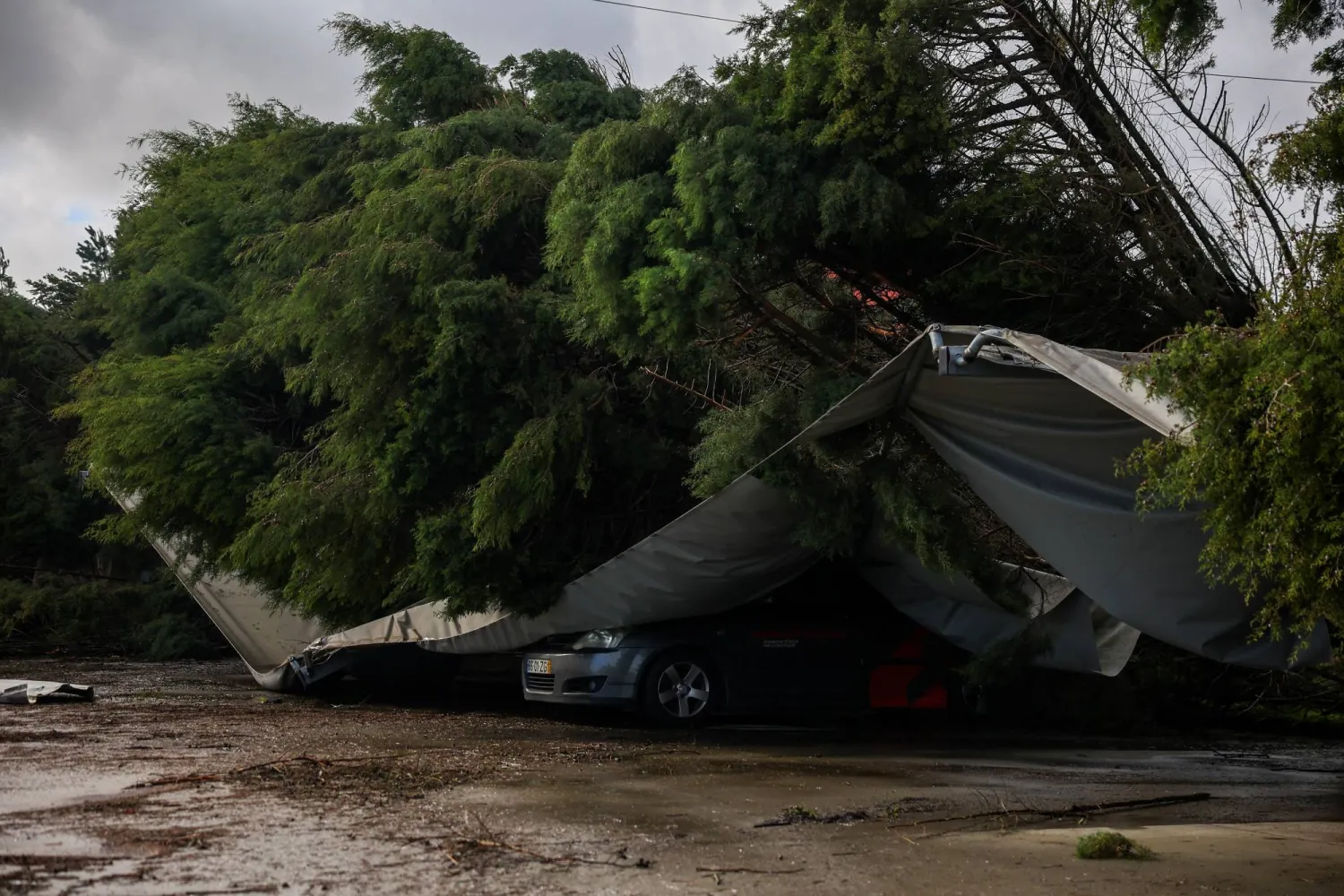
A car is smashed due to storm Kristin, in Leiria, Portugal, February 2, 2026. (Reuters)
TT

New Tempest Threatens Portugal, One Week After Storm Kristin

A car is smashed due to storm Kristin, in Leiria, Portugal, February 2, 2026. (Reuters)

Portugal is bracing for a new storm that authorities warn could trigger floods and further devastation, as the country ​still struggles with the aftermath of Storm Kristin.

The Portuguese Institute of the Sea and the Atmosphere (IPMA) said late Monday that the new storm, named Leonardo, is expected to begin impacting mainland Portugal from Tuesday afternoon through Saturday.

The Iberian Peninsula ‌has experienced a ‌succession of storms bringing ‌heavy ⁠rain, ​thunder, snow ‌and strong gales in the last few months, with southern Spain facing what some residents describe as its wettest winter in 40 years.

IPMA said Leonardo may bring persistent and at times heavy rain, with wind gusts ⁠reaching up to 75 km/h (47 mph) along the coast ‌south of Cabo Mondego in ‍the country's central ‍region, and 95 km/h in the highlands.

The ‍gusts, however, should be less intense than those exceeding 200 km/h unleashed by Storm Kristin, which battered central mainland Portugal from early last Wednesday, ​killing at least six people and leaving a trail of destruction across homes, ⁠factories and critical infrastructure.

Daniela Fraga, deputy commander of national emergency and civil protection authority ANEPC, told reporters late on Monday that heavy rain in the coming days could lead to floods and inundations, mainly in the regions that were affected by Storm Kristin.

Nearly 134,000 households were still without electricity, around 95,000 of them in the Leiria region in ‌the center of the country, power distribution company E-Redes said.


Spain to Ban Social Media Access for Children Under 16

FILE PHOTO: Instagram, TikTok, Snapchat, Kick, YouTube, Facebook, Twitch, Reddit, Threads and X applications are displayed on a mobile phone ahead of new law banning social media for users under 16 in Australia, in this picture illustration taken on December 9, 2025. REUTERS/Hollie Adams/Illustration/File Photo
TT

Spain to Ban Social Media Access for Children Under 16

FILE PHOTO: Instagram, TikTok, Snapchat, Kick, YouTube, Facebook, Twitch, Reddit, Threads and X applications are displayed on a mobile phone ahead of new law banning social media for users under 16 in Australia, in this picture illustration taken on December 9, 2025. REUTERS/Hollie Adams/Illustration/File Photo

Spain will ban access to social media for minors under 16 and platforms will be required to implement ‌age verification ‌systems, Prime ‌Minister ⁠Pedro Sanchez said ‌on Tuesday at the World Government Summit in Dubai.

"Our children are exposed to a space they were never meant to navigate ⁠alone... We will no longer ‌accept that," Sanchez said. "We ‍will protect ‍them from the digital ‍Wild West."

He added that his government would also introduce a new bill next week to hold social media executives accountable for illegal and ⁠hateful content.

Australia in December became the first country to ban social media for children under 16.

It's a move being closely watched by other countries considering similar age-based measures, such as Britain and France.


Saudi Media Ministry and SDAIA Launch Key Initiatives at Saudi Media Forum

Officials are seen at the fifth Saudi Media Forum in Riyadh on Monday. (SPA)
TT

Saudi Media Ministry and SDAIA Launch Key Initiatives at Saudi Media Forum

Officials are seen at the fifth Saudi Media Forum in Riyadh on Monday. (SPA)

The Saudi Ministry of Media, in partnership with the Saudi Data and AI Authority (SDAIA), launched on Monday two key initiatives at the fifth Saudi Media Forum in Riyadh.

The Media Innovation Bootcamp (Saudi MIB) and the AI principles in media document were announced by Minister of Media Salman Al-Dossary and SDAIA President Abdullah Alghamdi.

The initiatives aim to enhance the national media ecosystem and integrate artificial intelligence technologies into content creation.

The bootcamp trains a new generation of journalists and content creators in smart journalism tools, emphasizing automated data collection and deepfake detection for accurate reporting.

The AI track enables participants to collaborate with software engineers to create digital characters that mimic human behavior, facilitating 24/7 multilingual broadcasts with real-time audience interaction.

The AI principles in media document provides guidelines for responsible AI use in the media lifecycle. Developed with SDAIA, the Saudi Broadcasting Authority, and the General Authority for Media Regulation, it aims to ensure content integrity, address challenges posed by misleading content and deepfake technologies, and boost efficiency by leveraging AI to accelerate content production and deliver personalized user experiences.

The initiatives represent a partnership between the Ministry of Media and SDAIA to empower national talent and promote responsible technology use, aligned with Saudi Vision 2030.


China to Ban Hidden Car Door Handles, Setting New Safety Standards

From next year, cars sold in China will need to have door handles with mechanical releases following safety concerns with aerodynamic doors. Hector RETAMAL / AFP/File
TT

China to Ban Hidden Car Door Handles, Setting New Safety Standards

From next year, cars sold in China will need to have door handles with mechanical releases following safety concerns with aerodynamic doors. Hector RETAMAL / AFP/File

China will ban hidden door handles on cars from next year over safety concerns, phasing out the minimalist design popularized by Tesla.

The new rules could prompt carmakers globally to rethink vehicle-door designs as China increasingly positions itself as a standards-setter in the rapidly expanding international EV market, according to analysts.

The rules, announced by the Ministry of Industry and Information Technology on Monday will take effect from January 1, 2027, and require door handles to have both interior and exterior mechanical releases.

Chinese car models already approved for launch will have an additional two years to achieve compliance, the ministry said.

The new regulations will apply to all vehicles but will mostly impact EVs, which are commonly designed with hidden handles, and will "improve the level of automotive safety design", the ministry added.

Safety concerns have risen in China recently over sleek, aerodynamic car doors that reduce drag but are prone to losing operability in the event of a crash.

One high-profile incident occurred in October, when rescuers were shown failing to open the doors of a burning Xiaomi electric vehicle in the southwestern city of Chengdu.

The driver, reported to be under the influence of alcohol, died in the crash.

Electronic or "flush" door handles were introduced with Tesla's 2012 launch of the Model S, later becoming popular with Chinese EV brands prioritizing high-tech features.

Folding into the body of the car, such door handles provide a slight boost to efficiency by reducing drag while the vehicle is in motion.

Banning the handles is part of a pattern in which "China is increasingly acting as a rule-setter rather than a rule-taker in EV and intelligent vehicle regulation," Bill Russo, founder of Shanghai-based consultancy Automobility, told AFP.

He pointed to areas including battery safety standards and remote updating as other examples of this.

Russo said he expects the new door regulations to be "echoed" abroad, particularly in Europe, "as Chinese vehicles and platforms increasingly set the baseline for global EV design".

The new rules stipulate that all doors except the tailgate "shall be equipped with a mechanical release exterior door handle".

Other rules will improve the visibility of interior handles, including by requiring permanent graphic markings, the ministry said.

China is the world's largest EV market, and its dozens of brands have growing operations abroad.

Statistics published last month showed that Chinese firm BYD last year sold more EVs than Tesla, overtaking the US industry pioneer in the annual category for the first time.

China's status as the world's largest passenger vehicle market means the country is "informally" setting global standards, Tu Le, founder of Sino Auto Insights, told AFP.

The new rules on door handles mean that "for companies like Tesla, Kia and other legacy automakers that sell their vehicles in multiple regions, they'll need to decide whether to make the change to the China product only or implement it globally," Le said.

"It's likely a pain for quite a few automakers since some of them have global designs that will need to be reconciled," he added.