


Saudi Media Forum Discusses State of Arab Media, Global Ambitions

Diplomats and media industry experts highlighted the key dimensions of “soft power.” (SPA)
TT

Saudi Media Forum Discusses State of Arab Media, Global Ambitions

Diplomats and media industry experts highlighted the key dimensions of “soft power.” (SPA)

Diplomats and media industry experts shed light on “soft power” and how it can be leveraged to build national reputations and shape public awareness of contemporary international issues, as the Saudi Media Forum hosted candid discussions on the reality of the Arab media sector and the requirements for elevating its global impact.

During the second day of the forum, held in Riyadh, participants offered frank assessments of the challenges facing Arab media and the steps needed for it to meet the demands of the current phase and extend its influence internationally.

Panels and workshops explored a wide range of topics, including the role of citizen journalism in shaping the news agenda, the challenges of keeping pace with digital infrastructure amid rapid content industry transformations, and the craft of producing high-quality journalistic storytelling in an era of technological abundance and fragmented content trends.

Confronting Fake News and Disinformation

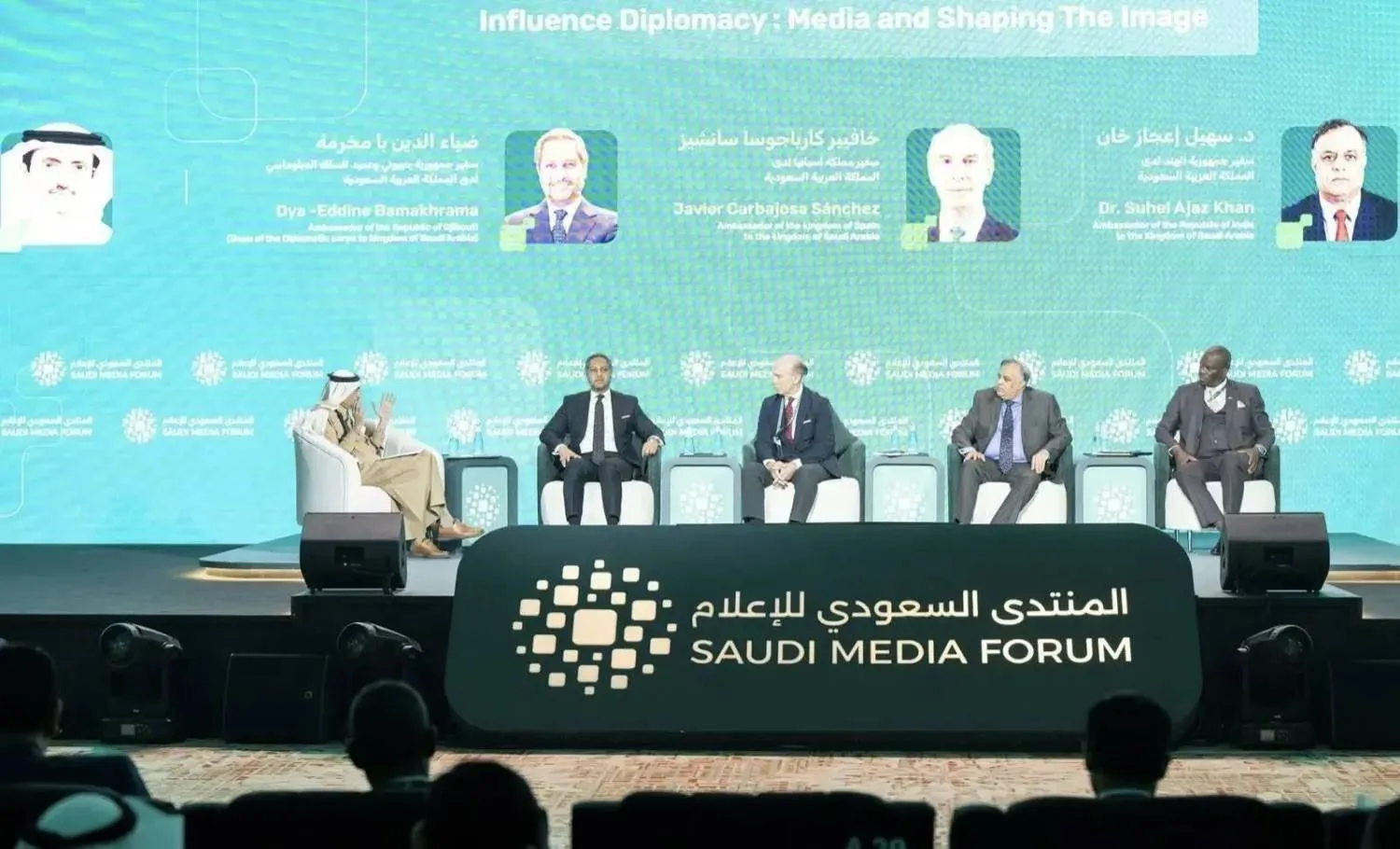
A session titled “Diplomacy of Influence: Media and Image-Making” examined the role of media in shaping perceptions and enhancing states’ soft power, with the participation of several ambassadors accredited to Saudi Arabia.

Diaa Al-Din Bamakhrama, Djibouti’s Ambassador and Dean of the Diplomatic Corps in the Kingdom, said Saudi Arabia offers a prominent model of influence diplomacy through its hosting of international forums and its investment in culture and sports, particularly football, which has helped project Saudi presence across the globe.

“In an increasingly interconnected world that has become a small village, false and fabricated narratives fall quickly and cannot withstand the flow of information and facts,” Bamakhrama said, noting that digital media has made exposing falsehoods faster, and that only truthful narratives can build lasting trust with public opinion.

Spain’s Ambassador to the Kingdom Javier Carbajosa Sánchez stressed that the relationship between media and diplomacy is historic and has grown more complex and influential in the age of modern communications and social media.

Media, he said, has never been merely a transmitter, but an active and influential force, adding that political work cannot be separated from managing media presence.

For his part, Dr. Suhel Ajaz Khan, the Indian Ambassador to Saudi Arabia, said that image-building and perception management lie at the heart of public and cultural diplomacy.

He explained that delivering the right message to the right audience is the key to influence, with art and national cuisine among the most effective soft-power tools.

He added that cultural diplomacy relies on activating soft-power instruments such as arts, music, cinema, and cuisine to enhance human connection and build bridges between peoples.

In Saudi Arabia, he noted, the Indian community, alongside Indian cinema and food culture, plays a major role in shaping perceptions and strengthening partnerships—sometimes with an impact exceeding that of formal diplomatic efforts.

In confronting fake news and digital disinformation, Khan stressed the need for swift, honest, and direct diplomacy to present facts before rumors spread.

South African Ambassador Mogobo David Magabe highlighted mutual respect and dialogue as fundamental pillars of diplomacy, pointing out that the main challenges today are the spread of disinformation and the accelerated pace of modern media, which contrasts with diplomacy’s traditionally gradual, long-term relationship-building approach.

A Candid Look at Arab Media

In a separate dialogue session on the realities of Arab media and the requirements for expanding its global reach, Saudi journalist Jameel Altheyabi said local Arab media is largely inward-looking, driven by a mindset focused on domestic audiences with limited consideration for the global sphere.

He described Arab media as often emotional, with varying approaches to content and engagement across the region.

Writer and journalist Mamoun Fandy said that stories produced in the Arab world are viewed internationally through the lens of their origin and nature, as global audiences apply their own standards of credibility, accuracy, and sourcing.

He added that the Arab world can generate distinctive journalistic stories capable of shaping global discourse through exclusivity and originality, expressing regret that many official Arab institutions still prefer foreign outlets to convey their narratives to the world.



Player Saves Stricken Seagull Hit by Ball During Match in Türkiye

Seagulls fly along the Hudson River while snow falls on February 22, 2026 in Jersey City, New Jersey. (Getty Images/AFP)
TT

Player Saves Stricken Seagull Hit by Ball During Match in Türkiye

Seagulls fly along the Hudson River while snow falls on February 22, 2026 in Jersey City, New Jersey. (Getty Images/AFP)

A footballer's ‌quick thinking brought a seagull back to life after the bird was struck by the ball during a match in Türkiye, Anadolu Agency reported.

The incident occurred in the first half of the Istanbul First Amateur League playoff final between Mevlanakapi Guzelhisar and ‌Istanbul Yurdum ‌Spor in Zeytinburnu.

Istanbul Yurdum ‌Spor ⁠goalkeeper Muhammet Uyanik ⁠cleared the ball up the pitch and it struck a seagull, sending it plummeting to the turf.

Team captain Gani Catan rushed over and seeing that the ⁠bird was unresponsive, he ‌began cardiopulmonary ‌resuscitation (CPR) and chest compressions in an attempt ‌to revive it.

The seagull responded ‌and showed movement before Catan cradled it and rushed to the touchline to hand it over to medical ‌staff.

"Our captain Gani Catan brought the seagull back to ⁠life ⁠thanks to the cardiopulmonary resuscitation (CPR) he performed on the field," the club said on Instagram.

Although Istanbul Yurdum Spor lost the game, Catan had no regrets.

"We missed out on the championship, but helping save a life is a good thing," he said. "This was more important than the championship."


Northeast US Digs Out from Brutal Snowstorm That Disrupted Flights and Canceled School 

A snow plow crosses Second Avenue and heads down 19th Street to clear it after a snowstorm, Monday, Feb. 23, 2026, in New York. (AP)
TT

Northeast US Digs Out from Brutal Snowstorm That Disrupted Flights and Canceled School 

A snow plow crosses Second Avenue and heads down 19th Street to clear it after a snowstorm, Monday, Feb. 23, 2026, in New York. (AP)

Neighbors, government workers and a powerful railroad snow-clearing machine nicknamed “Darth Vader” scrambled to dig out much of the northeastern United States from a brutal and — in some areas — record-breaking storm that blanketed the region with snow and resulted in thousands of flight cancellations.

But as the snow moved northward and tapered off in other areas Tuesday, forecasters warned that another storm could be right around the corner.

Monday’s storm that meteorologists are calling the strongest in a decade dumped more than 2 feet (61 centimeters) of snow in parts of the Northeast. More than 3 feet (91 centimeters) fell in Rhode Island — surpassing snow totals from the historic Blizzard of 1978 that struck the Northeast, the National Weather Service said.

By Tuesday morning, roads were beginning to reopen, mass transportation was coming back online in some cities and power had returned for some of the hundreds of thousands who had lost electricity in Massachusetts, New Jersey, Delaware and Rhode Island.

Amtrak canceled some trains between Boston and New York and between New York and Philadelphia on Tuesday morning.

Some schools reopening while others stick with online learning In New York City, which canceled classed Monday, Mayor Zohran Mamdani announced that schools would reopen for in person learning on Tuesday, raising questions about how feasible that is with snow still piled along sidewalks.

Staten Island Borough President Vito Fossella said school should remain closed, while Michael Mulgrew, president of the United Federation of Teachers, described the situation as “a big mess.”

“There's going to be low attendance of students. You're going to have low attendance of staff because people don't know if they can travel, if they can get to schools,” he said.

Spokespersons for Mamdani didn’t respond to an email seeking comment but his schools chief, Chancellor Kamar Samuels, said in a post on X, that they were “confident in our decision to reopen.”

Philadelphia switched to online learning Monday and Tuesday. Districts on Long Island and elsewhere in the New York suburbs said they would cancel school again Tuesday.

Another storm is on the way

The weather service said it's tracking another storm that could bring more snow to the region later this week. A combination of rain and snow is expected Wednesday, with up to a couple of inches of possible snow.

While the new storm is not expected to be as strong, even a few extra inches of snow on top of hard-hit areas could make cleanup more difficult, said Frank Pereira, meteorologist for the weather service in College Park, Maryland.

“Any additional snow at this point is probably not going to be welcome,” he said.

Bomb cyclone cancels thousands of flights

The weather service referred to Monday’s storm as a “classic bomb cyclone/nor’easter off the Northeast coast.” A bomb cyclone happens when a storm’s pressure falls by a certain amount within a 24-hour period, occurring mainly in the fall and winter when frigid Arctic air can reach the south and clash with warmer temperatures.

More than 2,000 flights in and out of the United States were canceled Tuesday, according to the flight tracking website FlightAware. Most of the cancellations involved airports in New York, New Jersey and Boston.

Rhode Island’s T.F. Green International Airport paused its airport operations Monday as it dealt with nearly 38 inches (97 centimeters) of snow, according to the Weather Service, breaking a record of 28.6 inches (72.6 centimeters) set in 1978. The pause continued through Tuesday morning as the airport assessed conditions.

Central Park in New York City recorded 19 inches (48 centimeters) of snow. Warwick, Rhode Island, exceeded 3 feet (91 centimeters), topping the nation so far. The highest wind gust of 84 mph (135 kph) was recorded in Montauk Point, New York.

New York, Philadelphia and other cities, as well as several states, declared emergencies.

The Boston Globe management called off printing its daily newspaper for the first time in its more than 150-year history because snow and winds kept staff from safely getting to its printing plant, the newspaper said in an article on its website.

Christa Prince and two others were out in Brooklyn on Monday afternoon with shovels and an electric snowblower.

“We’re just making a path for this car,” Prince said. “It’s not our car but you know, we’re just doing our neighbor a kind deed.”


Rights Group Slams Treatment of Viral Japanese Monkey 

This photo taken on February 19, 2026 shows a seven month-old male macaque monkey named Punch, who was abandoned by his mother shortly after birth, sitting with a stuffed orangutan toy at Ichikawa City Zoo and Botanical Gardens in Chiba Prefecture. (AFP/Jiji Press)
TT

Rights Group Slams Treatment of Viral Japanese Monkey 

This photo taken on February 19, 2026 shows a seven month-old male macaque monkey named Punch, who was abandoned by his mother shortly after birth, sitting with a stuffed orangutan toy at Ichikawa City Zoo and Botanical Gardens in Chiba Prefecture. (AFP/Jiji Press)

The plight of a baby monkey in Japan who has become an internet sensation shows the cruelty of zoos, an animal rights group said, as sales of the plush IKEA orangutan the animal clings to boomed.

Punch, a baby macaque abandoned by its mother, shot to stardom after being pictured getting bullied by other monkeys and seeking comfort from the orangutan toy at Ichikawa City Zoo outside Tokyo.

"Zoos are not sanctuaries -- they are places where animals are confined, deprived of autonomy, and denied the complex environments and social lives they would have in the wild," said People for the Ethical Treatment of Animals (PETA).

"What some are calling 'cute' is actually a glimpse into the trauma of a young, highly social primate coping with isolation and loss," the group's Asia director, Jason Baker, said in a statement.

"Until facilities stop treating sentient beings as attractions, animals like Punch will continue to suffer in captivity," Baker said, calling for Punch to be moved to a "reputable sanctuary, where he could live in a more natural environment".

Spurned by its mother, Punch was raised in an artificial environment after being born in July, and began training to rejoin his troop last month.

Punch's predicament sparked huge interest online, spawning a devoted fanbase under the hashtag #HangInTherePunch, as large crowds thronged the zoo.

Meanwhile, Swedish interior furnishings giant IKEA, the maker of the orangutan soft toy, said it was seeing "unprecedented" interest and "significantly" higher sales than usual.

"As a result, the product is currently out of stock in some markets, including Japan and the United States," Ingka Group, the holding company controlling most of IKEA's stores, told AFP by email.

Over a long holiday weekend in Japan, fans queued for up to an hour to catch a glimpse of Punch, the Ichikawa zoo said in a post on X, with more than 5,000 visitors recorded on Monday.

The zoo said it had set up a "restricted zone" around part of the monkey enclosure to reduce stress for the animals.

A large number of people have asked how they can donate cash or goods, it added.

In an update on Punch's plight on Sunday, the zoo said he "was meticulously groomed by two monkeys and is steadily fitting into the group".