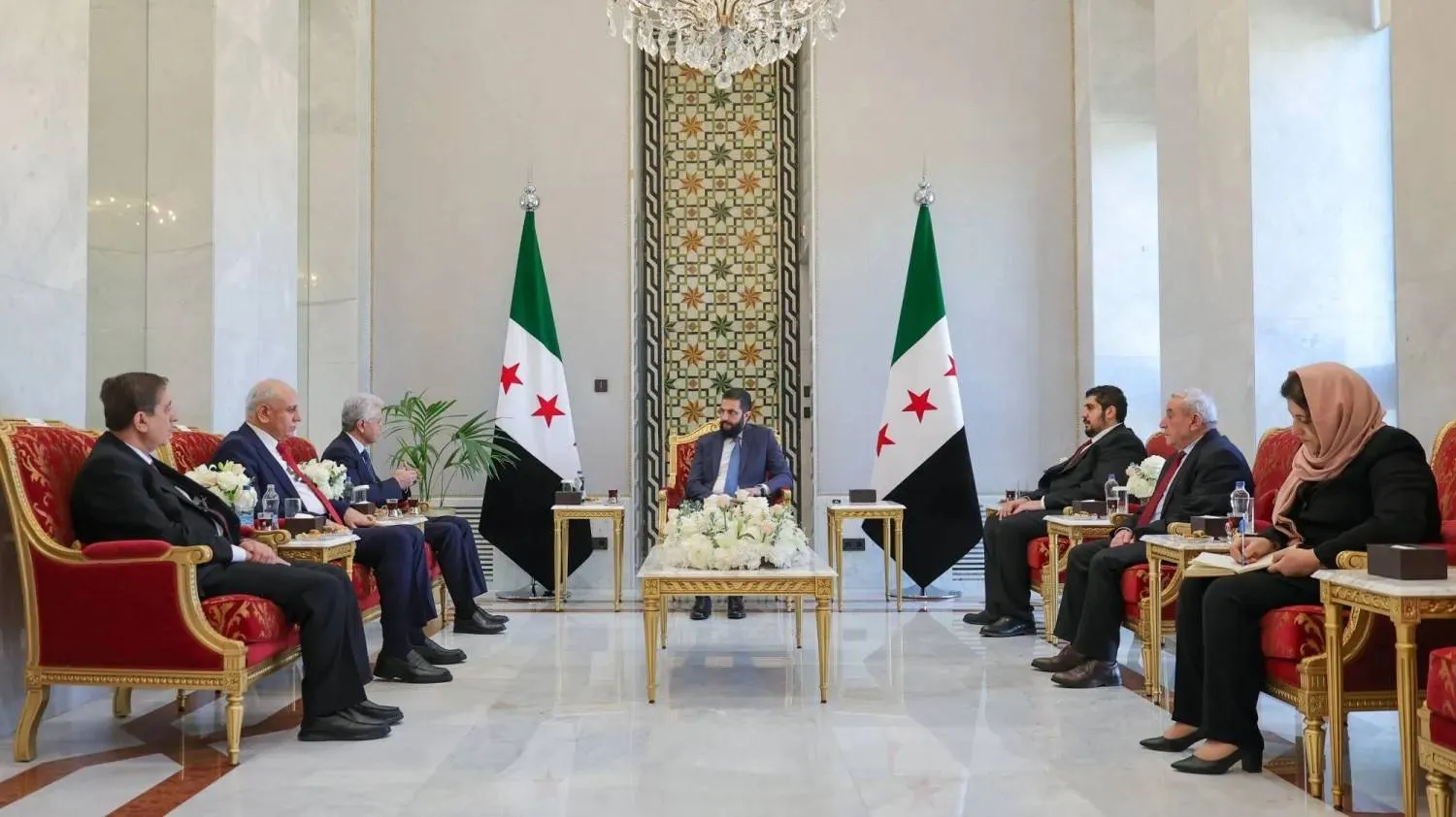
Syrian President Meets Kurdish National Council Delegation, Reaffirms Commitment to Kurdish Rights

Syrian President Ahmed al-Sharaa meets with a delegation from the Kurdish National Council on Tuesday (Syrian Presidency)
TT

Syrian President Meets Kurdish National Council Delegation, Reaffirms Commitment to Kurdish Rights

Syrian President Ahmed al-Sharaa meets with a delegation from the Kurdish National Council on Tuesday (Syrian Presidency)

Syrian President Ahmed al-Sharaa on Tuesday received a delegation from the Kurdish National Council, reaffirming the state’s commitment to guaranteeing the rights of Kurds within the framework of the constitution, according to a statement issued by the presidency.

The meeting follows the issuance of Decree No. 13 on December 16, which affirmed that Syrian Kurds are an integral and authentic part of the Syrian people, and that their cultural and linguistic identity constitutes an inseparable part of Syria’s diverse and unified national identity.

Founded in October 2011, the Kurdish National Council is a Syrian political coalition representing a broad spectrum of Kurdish parties and political forces.

The delegation welcomed Decree No. 13, describing it as an important step toward strengthening rights and safeguarding Kurdish cultural and social identity.

Speaking to Asharq Al-Awsat, Shalal Kaddo, head of the Kurdish Centrist Party in Syria and a member of the Council’s general secretariat, said the visit came in response to an official invitation from the Syrian Foreign Ministry.

He explained that the talks aim to hold bilateral meetings with senior Syrian officials, foremost among them al-Sharaa.

Kaddo said the Council has repeatedly emphasized that Decree No. 13 represents a positive step that can be built upon and developed, ultimately to be incorporated into Syria’s permanent constitution in a way that guarantees the national, political, and cultural rights of Syrian Kurds within a unified and democratic Syria.

He added that recent meetings reflected the Council’s growing political presence and its central role in representing the Kurdish cause on the national stage.

Discussions also stressed the need for constitutional recognition of the Kurdish people as genuine partners in Syria, as well as opening a serious political dialogue that places the Kurdish issue in its proper context as a just national cause that cannot be ignored in any future political settlement.

Separately, Abdulaziz Tamo, head of the Association of Independent Syrian Kurds, expressed disappointment that his organization was not invited to meetings in Damascus, despite what he described as its prominent role within the Syrian opposition and revolutionary movement.

He said the Association had been the only Kurdish political body to participate fully in the revolutionary and opposition forces and to openly support recent military operations that led to the liberation of Syrian cities, from Aleppo to Damascus.


Iran’s Proxy in Iraq Rakes in Hundreds of Millions Through Oil Smuggling

Iraqi Prime Minister Ali al-Zaidi is seen at an event in Baghdad on Sunday. (INA)
TT

Iran’s Proxy in Iraq Rakes in Hundreds of Millions Through Oil Smuggling

Iraqi Prime Minister Ali al-Zaidi is seen at an event in Baghdad on Sunday. (INA)

Iran's most powerful armed ally in Iraq has been raking in hundreds of millions of dollars from oil stolen from the state, Iraqi officials say, prompting the prime minister to ready his security forces to confront the armed faction.

Prime Minister Ali al-Zaidi has launched his toughest challenge yet to the group Kataib Hezbollah by cracking down on an oil smuggling network it has run for years, senior security, army, police and oil officials told Reuters.

They said the smuggling, carried out with accomplices among some security and oil officials, has robbed the government of hundreds of millions of dollars dating back to 2021.

Kataib Hezbollah, branded a terrorist organization by the US, is one of dozens of armed pro-Iranian groups that have semi-official status in Iraq. It denies the smuggling and calls the crackdown part of a campaign to seize its weapons.

"We are therefore being subjected to the greatest campaign of blackmail aimed at forcing us to relinquish the weapons of dignity that have upheld sovereignty and ‌protected the rights ‌of Iraqis at multiple stages," the group said in a statement.

The Iranian-backed armed groups have resisted repeated calls by both al-Zaidi and US President Donald Trump to disarm, and have struck US troops and targets in Saudi Arabia and the United Arab Emirates in solidarity with Tehran since the United States and Israel launched their war against Iran in February.

Jasim al-Bahadli, an Iraqi security analyst specializing in studying armed Shiite groups aligned with Iran, said the government anti-smuggling campaign has become a political confrontation with the faction.

"Al-Zaidi is effectively challenging a group with deep security, political and economic influence, and that carries significant risks for both sides," he said.

"More broadly, it appears to ⁠be an attempt to contain the influence of Iran-backed armed groups by targeting economic networks that underpin ‌their power, particularly after Kataib Hezbollah resisted government efforts to bring armed factions more firmly ‌under state control."

GOVERNMENT INVESTIGATION

In 2021, a drone attack targeted Mustafa al-Kadhimi, then prime minister, in what his office said was an assassination attempt after security forces ‌clashed with supporters of pro-Iranian factions.

So far, nine senior security and oil officials have been dismissed following a high-level government investigation into oil ‌smuggling, focused on Jurf al-Sakhar in Babil province, a Kataib Hezbollah stronghold about 50 km (30 miles) south of Baghdad.

Al-Zaidi has ordered all suspects to be referred to the courts, and dismissed the Babil police chief, the province's intelligence and security commanders and the director of the state-run Oil Pipelines Company (OPC).

Now he has ordered senior military and security commanders to deploy additional forces around Jurf al-Sakhar and prepare for the entry of government troops into the town, potentially bringing ‌the government into a direct confrontation with fighters.

SIPHONED CRUDE

The groups have built up arsenals that include assault rifles, machineguns, anti-tank guided missiles, mortars, rockets, armed drones and, according to Iraqi ⁠security reports and assessments, some short-range ballistic ⁠and cruise missile capabilities supplied by Iran or derived from Iranian systems.

Two security sources who took part in an inspection mission on Saturday to Jurf al-Sakhar said investigators had found evidence that smugglers had punctured a crude oil pipeline and siphoned crude into makeshift storage pits dug in the ground.

The 26-inch pipeline carries at least 200,000 barrels per day of crude, according to an Iraqi Oil Ministry document reviewed by Reuters.

The sources said investigators found concealed pumping equipment inside several hangars used to avoid aerial surveillance while loading tanker trucks with siphoned crude. Investigators also found a small oil refinery concealed in the area, the sources said.

Two Iraqi oil officials with direct knowledge of the investigation said it was too early to quantify losses without knowing how long the tapping points had been operational, but estimated the value of crude potentially siphoned since 2021 could amount to hundreds of millions of dollars.

The crackdown is set against a backdrop of mounting US pressure on Iraq over the role of pro-Iranian groups in the country's oil sector.

In May, Washington sanctioned Iraq's deputy oil minister, alleging he had facilitated the diversion of Iraqi oil for the benefit of Iran and its proxy militias. Sanctions were also imposed on armed faction leaders and networks Washington said were exploiting Iraq's oil wealth to finance Tehran-aligned groups.

Reuters reported in 2024 that a fuel oil smuggling network had raked in $1 billion for Iran and its proxies.


Yemen Govt Forces Beef up Defenses in Lahj

Houthi forces take over from Dhubab to Bab al-Mandeb after government forces withdraw from the area, in Taiz Governorate, Yemen, in this still image taken from a handout video released November 15, 2026. (Reuters)
TT

Yemen Govt Forces Beef up Defenses in Lahj

Houthi forces take over from Dhubab to Bab al-Mandeb after government forces withdraw from the area, in Taiz Governorate, Yemen, in this still image taken from a handout video released November 15, 2026. (Reuters)

The military confrontation between Yemeni government forces and the Houthi group is entering a new phase following the withdrawal of Southern and Joint Forces from positions along the West Coast and Bab al-Mandab.

In Mari and Taiz, the battles continue amid escalating airstrikes targeting the group’s positions and military capabilities.

The Yemeni parliament, manhole, is moving to finalize a draft law classifying the Houthis as a terrorist organization and criminalizing their activities and funding sources.

Field sources said that fierce fighting erupted between government forces and the Houthis on the western fronts of Raghwan district in Marib province. The clashes lasted for hours across several sectors.

To the south in Lahij, government and Southern forces are reorganizing their deployment lines and reinforcing fortifications following their withdrawal from the Bab al-Mandeb and Dhubab airport axes through the Kahboub and Al-Suqya areas.

According to field sources, current missions are focused on reinforcing defensive lines in Lahij and securing the western and northern entrances to the interim capital, Aden, and fortifying positions and monitoring passages to prevent infiltration attempts or any potential Houthi military movements.

This deployment follows an announcement by Southern forces that they are repositioning, as Lahij’s fronts undergo field shifts after the Houthis seized Al-Maqatirah district and areas in Al-Madaribah district. These developments make securing Aden’s western entrances and reinforcing defensive positions a top priority.

Politically, the parliament has stepped up efforts to finalize a draft law classifying the Houthis as a terrorist organization. The move aims to criminalize the group’s activities, dry up its funding sources, and prosecute those involved in its operations both locally and internationally.

In a statement following a virtual meeting chaired by Speaker Sultan al-Barakani, parliament said completing the legislative process has become a national, regional, and international necessity after peace opportunities and political options were exhausted, and as the group continues attacking civilians, state institutions, waterways, and economic interests.

Parliament noted that the draft bill to designate the Houthis was first introduced during a session in the city of Seiyun in April 2019, before a decision was postponed to give peace efforts a chance.

However, according to the statement, the group pressed ahead with its military operations and attacks inside and outside Yemen, including targeting Saudi Arabia and its civilian and economic facilities.


Israel Strikes East Lebanon, Says Targeting Hezbollah Arms

Smoke rises from the site of an Israeli strike that targeted the southern Lebanese village of Kfar Tebnit on May 21, 2026. (AFP)
TT

Israel Strikes East Lebanon, Says Targeting Hezbollah Arms

Smoke rises from the site of an Israeli strike that targeted the southern Lebanese village of Kfar Tebnit on May 21, 2026. (AFP)

Israel struck a mountainous area in eastern Lebanon on Monday, according to Lebanese state media, with the Israeli military saying it was targeting a shipment of weapons headed for Hezbollah.

"Enemy aircraft launched a strike at dawn against the Al-Shaara region, in the highlands of the Anti-Lebanon mountain range, without resulting in victims or damage," Lebanon's official National News Agency (NNA) said.

The Israeli military said it "struck a weapons shipment transferred from Syria to Lebanon, intended for the Hezbollah terrorist organization".

Hezbollah, which is backed by Iran, emerged badly weakened from two successive wars with Israel since 2023.

The ousting in 2024 of Syrian president Bashar al-Assad, a key ally of the group, cut off a major weapons route.

Hezbollah lawmakers have nonetheless maintained that the group is rebuilding its military capacities, as fighting with Israel has wound down since June.

In October, Lebanese security forces seized a half-ton of explosives transported in a truck from east Lebanon towards Beirut.

Hezbollah acknowledged ownership of the explosives, saying they were intended for "resistance" against Israel.

Lebanese authorities have announced a plan to disarm Hezbollah, but the group has refused to lay down its weapons.