



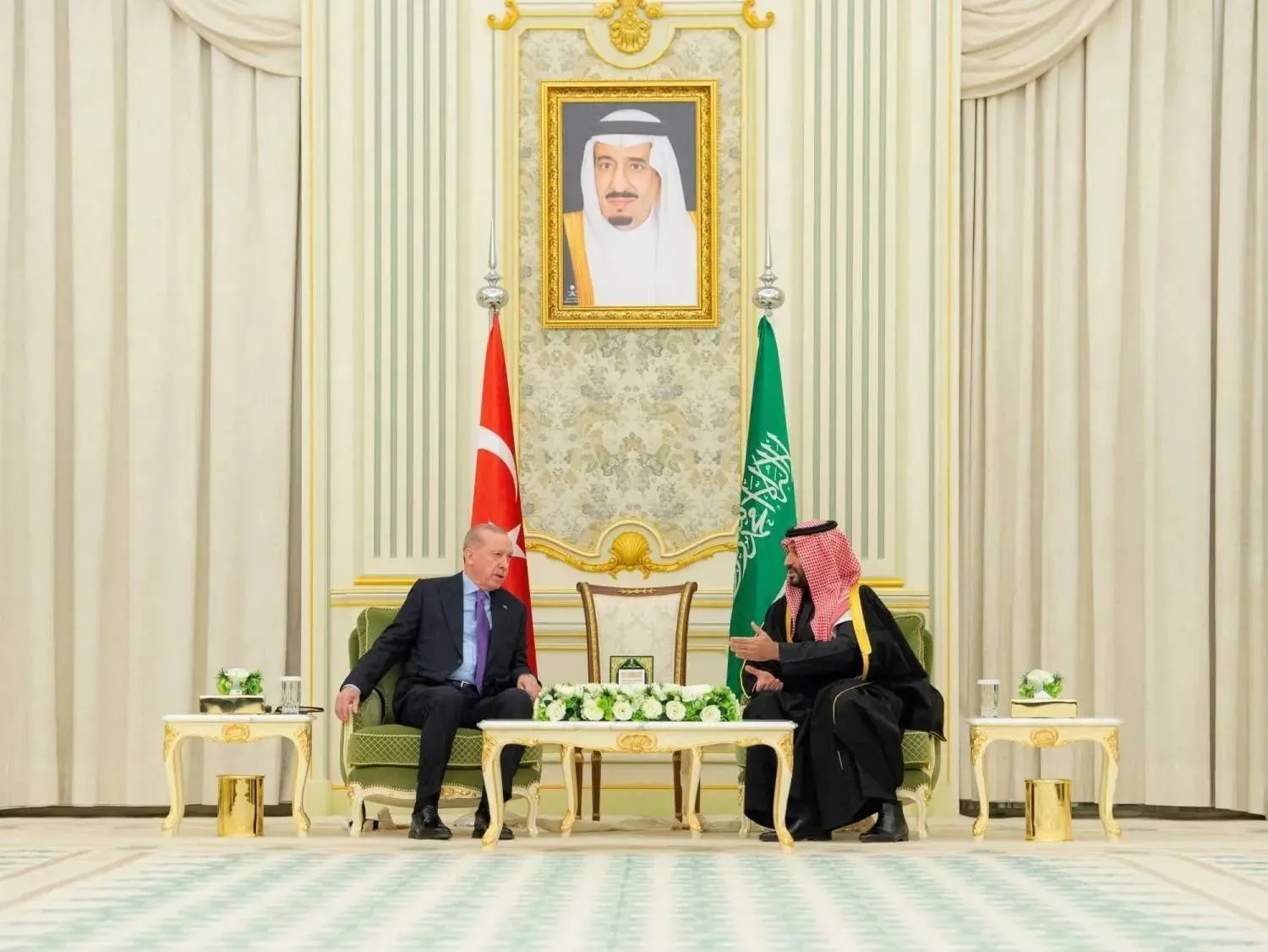

Türkiye President Recep Tayyip Erdogan’s visit to Saudi Arabia has given fresh momentum to economic ties between the two countries and opened new avenues for cooperation in trade, energy, and joint investments.
A joint statement issued at the end of Erdogan’s visit to Riyadh on Wednesday said the two sides were determined to move ahead with strengthening their political and economic partnership.
The statement said that Erdogan and Saudi Crown Prince Mohammed bin Salman “held a session of official talks during which they reviewed the historical relations between the two brotherly countries and ways to develop them in all fields.”
The statement showed Saudi-Turkish alignment on deepening economic and investment cooperation and on capitalizing on opportunities offered by Saudi Vision 2030 and the Century of Türkiye Vision.
“In the economic, trade, and investment sectors, both sides commended the strength of the economic ties between the two countries and agreed on further strengthening them, particularly in sectors of mutual priority. They also agreed to capitalize on the investment opportunities offered by the (Saudi Vision 2030) and (Century of Türkiye Vision), for the mutual benefit of both economies,” the statement read.
Emphasizing boosting non-oil trade and activating the Saudi-Turkish Business Council, the statement said the leaders “praised the level of trade exchange and stressed the importance of continued joint efforts to develop the non-oil trade volume, intensify mutual visits between officials in the public and private sectors, and hold trade events in both countries through the (Saudi-Turkish Business Council).”
Energy cooperation
Energy featured prominently in the discussions, with both sides stressing the importance of cooperation in oil, petrochemicals, and renewable energy, and exploring electricity interconnection, clean hydrogen, and energy supply chains to enhance energy security and sustainability.
“Both sides agreed to enhance cooperation in the fields of oil, oil derivatives, and petrochemical supply, and to work together to exploit investment opportunities in the petrochemical and agricultural nutrients sectors, as well as to cooperate on innovative uses of hydrocarbons,” the statement read.
“Both sides affirmed their desire to enhance cooperation in the fields of electricity and renewable energy, leveraging both countries’ extensive experience in renewable energy integration and the Kingdom’s large-scale energy investments.”
“They committed to expediting feasibility studies for electrical interconnection between the two countries, exchanging expertise in electricity and renewable energy technologies and grid automation, electrical grid security and resilience, renewable energy projects, grid interconnection, energy storage technologies, and promoting the participation of companies from both sides in implementing these projects,” it affirmed.
“They also emphasized the importance of strengthening cooperation in energy efficiency and conservation, raising awareness of its importance, and exchanging expertise in the energy services sector and capacity building in this field.”
The two sides also underscored cooperation in mining and the production of critical minerals in support of the global energy transition.
“Both sides agreed to strengthen cooperation in the exploration, extraction, and processing of mineral resources. They also emphasized the importance of international cooperation and joint ventures in critical minerals to ensure the security of supply chains essential for the global energy transition.”
Several agreements and memoranda of understanding were signed during a meeting of the Saudi-Turkish Coordination Council on the sidelines of the visit, covering energy, justice, space, and research and development.
Regarding the Saudi-Turkish Coordination Council, the statement said: “Both sides commended the level of coordination and cooperation within the framework of the (Saudi-Turkish Coordination Council), aimed at achieving shared interests and advancing them to new horizons across all sectors.”
“They emphasized the importance of strengthening cooperation and partnership in the following areas: digital economy, artificial intelligence, emerging technologies, and space technologies; transportation, logistics, and civil aviation; law and justice; culture; tourism; sports and youth; scientific and educational cooperation; media; environment, water, agriculture, and food security; customs, defense industries; Health.”
Reflecting the strong desire to deepen strategic energy cooperation, Saudi Energy Minister Prince Abdulaziz bin Salman and Turkish Energy and Natural Resources Minister Alparslan Bayraktar signed an agreement to collaborate on renewable power generation projects totaling about $2 billion in investment.
The agreement aims to enhance cooperation in renewable energy and green technologies and to support the development and implementation of high-quality projects that help diversify the energy mix, strengthen energy security, and accelerate the shift toward a low-carbon economy in line with both countries’ priorities.
It includes the development and implementation of solar power plants in Türkiye with a total installed capacity of up to 5,000 megawatts in two phases.
The first phase includes two solar projects in the Turkish provinces of Sivas and Karaman, with a combined capacity of 2,000 megawatts. In contrast, the second phase covers additional projects under agreed frameworks, adding an extra 3,000 megawatts.
Projects under the first phase will offer electricity prices that are highly competitive with those of other renewable plants in Türkiye. With investments of about $2 billion, the plants will supply electricity to more than two million Turkish households.
A state-owned Turkish company will purchase the electricity generated by the plants for 30 years, while the projects will maximize the use of locally sourced equipment and services during implementation.
Boost to foreign investment
Turkish Treasury and Finance Minister Mehmet Simsek said the agreement would significantly boost foreign direct investment inflows into Türkiye.
Writing on X on Wednesday, Simsek said "the pace of FDI is picking up, underscoring the growing credibility of our economic program."
"An FDI inflow of USD2bn in Türkiye’s renewable energy projects will accelerate the green transition, enhance energy security, and structurally reduce reliance on energy imports," he added.
Simsek also noted that foreign direct investment in Türkiye reached $12.4 billion in the first 11 months of 2025, up 28% from the same period in 2024.
Economic relations between Saudi Arabia and Türkiye have seen substantial growth over the past two years, reflected in rising trade volumes.
Türkiye’s interest in further strengthening ties was evident in Erdogan’s decision to bring a large business delegation of around 200 company heads and representatives to Riyadh, alongside officials from regional offices of Turkish companies.
The private sector plays a central role in the Saudi-Turkish partnership. Participants at the Saudi-Turkish Economic Forum, held on the sidelines of Erdogan’s visit, stressed the need to enter a new phase focused on implementing joint projects.
Trade growth accelerates
Turkish direct investments in Saudi Arabia have exceeded $2 billion, concentrated in manufacturing, real estate, construction, agriculture, and trade.
Nail Olpak, head of Türkiye’s Foreign Economic Relations Board, said trade with Saudi Arabia was growing at a rapid pace, noting that despite a slowdown in overseas activity by Turkish contractors, they continue to carry out major projects in the kingdom.
According to the latest official Saudi data, total trade between the two countries reached about $8 billion in 2025, up 14% from the previous year. By the end of last year, 1,473 investment licenses had been issued to active Turkish companies.
Saudi Arabia exports crude oil and petrochemical products to Türkiye and imports a range of goods, including carpets, processed stone for construction, tobacco products, food, and furniture.
Data from the Turkish Statistical Institute showed bilateral trade of $5.59 billion in 2015, $5.007 billion in 2016, $4.845 billion in 2017, $4.954 billion in 2018, and $5.107 billion in 2019.
After a decline in 2020 and 2021 due to the COVID-19 pandemic, trade rebounded to $6.493 billion in 2022 and $6.825 billion in 2023, exceeding $7 billion in 2024.
Türkiye’s exports to Saudi Arabia rose to $3.1496 billion in 2025, out of the total bilateral trade of about $8 billion.


