

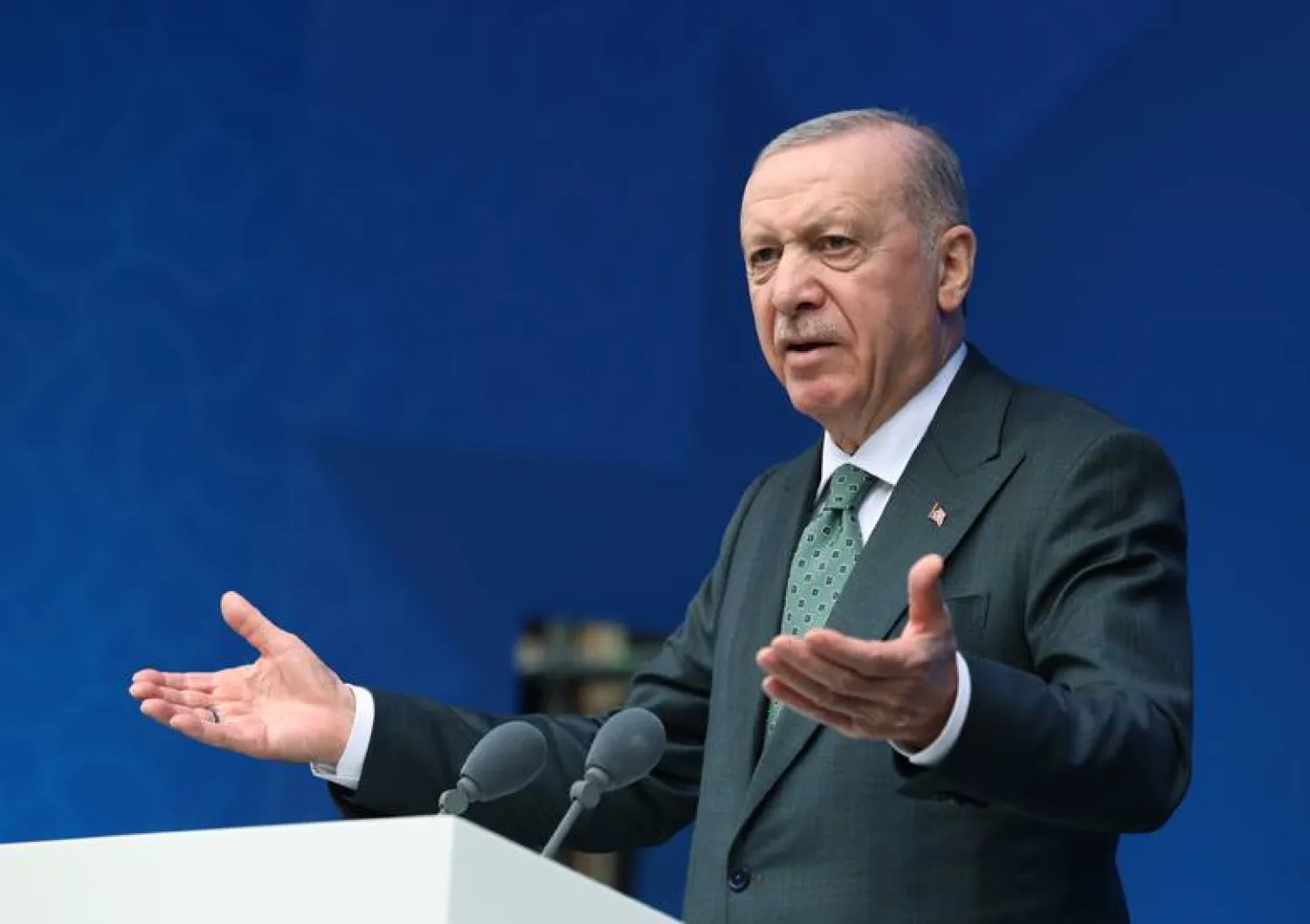

Erdogan: Türkiye is Doing its Best to Prevent US-Iran Conflict

FILED - 28 May 2025, Azerbaijan, Lachin: Türkiye's President Recep Tayyip Erdogan speaks during Lachin's trilateral summit of Azerbaijani, Turkish and Pakistani leaders. Photo: Turkish Presidency/dpa
TT

Erdogan: Türkiye is Doing its Best to Prevent US-Iran Conflict

FILED - 28 May 2025, Azerbaijan, Lachin: Türkiye's President Recep Tayyip Erdogan speaks during Lachin's trilateral summit of Azerbaijani, Turkish and Pakistani leaders. Photo: Turkish Presidency/dpa

President Tayyip Erdogan said Türkiye is working hard to prevent US-Iran tensions from tipping the Middle East into a new conflict, as the two adversaries signal that disagreement over Tehran’s missile arsenal threatens to torpedo a deal.

Speaking to reporters on a return flight from a visit to Egypt, Erdogan added that talks at the level of the US and Iranian leadership would be helpful after lower-level nuclear negotiations due in Oman on Friday, according to a transcript of his comments shared by his office on Thursday.

Türkiye was doing its best to prevent an escalation, said Erdogan, who has spent years cultivating a close relationship with US President Donald Trump while expanding Ankara's diplomatic influence across the Middle East and beyond. Iran and the US remain at odds over Washington's insistence that negotiations include Tehran's missile arsenal and Iran's vow to discuss only its nuclear program, in a standoff that has led to mutual threats of airstrikes.

The ‌differences over the ‌talks' scope and venue have raised doubts whether the meeting would take place, leaving open ‌the possibility ⁠that Trump could ‌carry out a threat to strike Iran.

Asked on Wednesday whether Iran's Supreme Leader Ali Khamenei should be worried, Trump told NBC News: "I would say he should be very worried. Yeah, he should be." He added that "they're negotiating with us" but did not elaborate.

After Trump spoke, US and Iranian officials said the two sides had agreed to shift the talks' location to Muscat after initially accepting Istanbul.

But there was no indication they had found common ground on the agenda.

German Chancellor Friedrich Merz said on Thursday that worries about a further escalation in conflict with Iran characterized his talks during a trip to the Gulf region.

He urged Iran to end what he called aggression and enter into talks, saying Germany would do everything it could ⁠to de-escalate the situation and work towards regional stability.

"In all my conversations yesterday and today, great concern has been expressed about a further escalation in the conflict with Iran," he said during ‌a press conference in Doha.

China meanwhile said it supported Iran's legitimate right to the peaceful use of nuclear energy and opposed ‍the "threat of force and sanction pressure."

China would continue to promote the proper resolution of the Iranian nuclear issue, Liu Bin, China's assistant foreign minister, told Iran's deputy foreign minister in Beijing, the Chinese ministry said.

Tensions are high across the region as the US builds up forces there, and regional players seek to avoid a military confrontation that many fear could escalate into a wider war.

TRUMP WARNED OF 'BAD THINGS' IF NO IRAN DEAL AGREED

Iran says the talks must be confined to its long-running nuclear dispute with Western powers, rejecting a US demand to also discuss Tehran's missiles, and warning that pushing issues beyond the nuclear program could jeopardize the talks.

But US Secretary of State Marco Rubio said ⁠on Wednesday that talks would have to include the range of Iran’s ballistic missiles, its support for armed proxy groups around the Middle East and its treatment of its own people, besides nuclear issues. Iranian sources say the US is demanding Tehran limits the range of Iran's missiles to 500 km (310 miles).

Tehran's regional sway has been weakened by Israel's attacks on its proxies - from Hamas in Gaza to Hezbollah in Lebanon, the Houthis in Yemen and militias in Iraq - and by the ousting of Iran's close ally, former Syrian President Bashar al-Assad.

While the talks were originally set for Türkiye, Iran wanted the meeting to take place in Oman as a continuation of previous talks held in the Gulf Arab country that had focused strictly on Tehran's nuclear program, a regional official said.

Iran says its nuclear activities are meant for peaceful, not military purposes, while the US and Israel have accused it of past efforts to develop nuclear weapons.

The diplomatic efforts follow Trump's threats of military action against Iran during its bloody crackdown on protesters last month and the deployment of more naval power to the Gulf.

The US has sent thousands of troops to the Middle East, as well ‌as an aircraft carrier, other warships, fighter jets, spy planes and air refueling tankers.

Trump has warned that "bad things" would probably happen if a deal could not be reached, ratcheting up pressure on the Iranian Republic.



‘Surprise Strikes’ Loom If US–Iran Talks Collapse

A combined image of US President Donald Trump, Iran’s Supreme Leader Ali Khamenei, and Israeli Prime Minister Benjamin Netanyahu (AFP). 
TT

‘Surprise Strikes’ Loom If US–Iran Talks Collapse

A combined image of US President Donald Trump, Iran’s Supreme Leader Ali Khamenei, and Israeli Prime Minister Benjamin Netanyahu (AFP). 

As anticipation grows over the resumption of US–Iran negotiations in Oman, Israeli Prime Minister Benjamin Netanyahu convened an emergency meeting of Israel’s security cabinet on Thursday to assess scenarios in the event the talks fail and to consider the possibility of renewed military escalation.

Ahead of the meeting, Netanyahu briefed a confidential subcommittee of the Knesset’s Foreign Affairs and Defense Committee, stressing that the Israeli military is prepared to launch a major strike against Iran—one he said could be harsher than the so-called Twelve-Day War.

Israeli media later reported that the discussions reflected growing concern in Jerusalem over the direction of diplomacy with Tehran.

Channel 12 quoted a source familiar with the security cabinet deliberations as saying there is “full coordination with the United States” on Iran-related matters.

At the same time, The Jerusalem Post reported that Israel’s Chief of Staff, Eyal Zamir, told US officials that Israel is ready to carry out “surprise strikes” against targets inside Iran should Tehran “choose the path of war.”

According to the report, Zamir emphasized that any US concessions on Iran’s ballistic missile program would cross a red line for Israel, alongside other red lines linked to Iran’s nuclear activities.

This stance, the newspaper said, helps explain US Secretary of State Marco Rubio’s insistence that the ballistic missile program be included in the agenda of upcoming talks with Tehran. Rubio reiterated earlier this week that negotiations should address both Iran’s nuclear and missile programs.

Iran, however, has pushed back firmly. Ebrahim Rezaei, spokesman for the Iranian parliament’s National Security Committee, said both uranium enrichment and the ballistic missile program are non-negotiable “red lines” for Tehran.

Netanyahu said he does not yet know what decision US President Donald Trump will take regarding a possible military strike on Iran, but expressed confidence that Washington will adopt a tougher approach in the current round of negotiations.

Channel 12 described Israeli satisfaction with the US position as having taken on a “deep strategic dimension,” noting a recent secret visit by Zamir to Washington that Israeli officials have portrayed as significant.

Former national security adviser Tzachi Hanegbi shed further light on the background in remarks at a policy seminar in Herzliya. He said Netanyahu had previously sought to persuade former President Joe Biden to authorize a strike on Iran, but Biden rejected the idea, preferring to exhaust diplomatic options.

Netanyahu later made similar appeals during Trump’s second term, warning of an approaching “zero hour,” yet Trump initially resisted military action, opting instead for sanctions and warnings.

Hanegbi said Trump’s position shifted in June after reviewing the results of Israeli strikes on Iran ahead of the Twelve-Day War and the successful interception of two large-scale Iranian attacks with US assistance, without American casualties or disruption to shipping in the Strait of Hormuz.

He added that Trump was impressed by Israel’s military performance and eventually gave the green light for war, agreeing to join its final phase.

Meanwhile, Israeli political sources told the news site Walla that there is a growing sense in Jerusalem that Washington entered the current negotiations at a poor moment and from a weak position.

They argued that Iran today is more confident and assertive than in 2015, believing its threats of regional escalation were enough to push the United States back to diplomacy.


Senior Russian Officer Hospitalized after Being Shot in Moscow

A person walks along an embankment of the Moskva River near the Kremlin wall in Moscow, Russia February 5, 2026. REUTERS/Anastasia Barashkova
TT

Senior Russian Officer Hospitalized after Being Shot in Moscow

A person walks along an embankment of the Moskva River near the Kremlin wall in Moscow, Russia February 5, 2026. REUTERS/Anastasia Barashkova

A senior Russian officer, Lieutenant General Vladimir Alexeyev, was rushed to hospital after being shot in Moscow on Friday, officials said.

Alexeyev is deputy chief of the Main Directorate of the General Staff at ‌the Defense ‌Ministry.

When mercenary ‌chief Yevgeny ⁠Prigozhin staged ‌a short-lived mutiny in June 2023, Alexeyev was one of the top officials who were sent to negotiate with him.

The Moscow prosecutor's office said Alexeyev ⁠had been shot several times at a ‌residential building in ‍northwest Moscow ‍by an unidentified assailant who fled ‍the scene.

Investigative Committee spokesperson Svetlana Petrenko didn’t say who could be behind the attack on Alekseyev.

Several senior Russian officers have been assassinated since the start of the war in Ukraine, with Moscow blaming the attacks on Kyiv. In some cases, ⁠Ukrainian military intelligence has claimed responsibility.

The most recent officer to be killed was the head of the General Staff's army training directorate, Lieutenant General Fanil Sarvarov, who was killed by a bomb under his car on December 22.

Friday’s attack came a day after Russian, Ukrainian and US negotiators wrapped up two days of talks in Abu Dhabi. The Russian delegation was led by the military intelligence chief, Adm. Igor Kostyukov.


In Show of Support, Canada, France Open Consulates in Greenland

A flag of Greenland hangs from a crane in the city of Nuuk, western Greenland, on January 28, 2026. (Photo by Ina FASSBENDER / AFP)
TT

In Show of Support, Canada, France Open Consulates in Greenland

A flag of Greenland hangs from a crane in the city of Nuuk, western Greenland, on January 28, 2026. (Photo by Ina FASSBENDER / AFP)

Canada and France, which both adamantly oppose Donald Trump's wish to control Greenland, will open consulates in the Danish autonomous territory's capital on Friday, in a strong show of support for the local government.

Since returning to the White House last year, Trump has repeatedly insisted that Washington needs to control the strategic, mineral-rich Arctic island for security reasons.

The US president last month backed off his threats to seize Greenland after saying he had struck a "framework" deal with NATO chief Mark Rutte to ensure greater American influence, reported AFP.

A US-Denmark-Greenland working group has been established to discuss ways to meet Washington's security concerns in the Arctic, but the details of the talks have not been made public.

While Denmark and Greenland have said they share Trump's security concerns, they have insisted that sovereignty and territorial integrity are a "red line" in the discussions.

"In a sense, it's a victory for Greenlanders to see two allies opening diplomatic representations in Nuuk," said Jeppe Strandsbjerg, a political scientist at the University of Greenland.

"There is great appreciation for the support against what Trump has said."

French President Emmanuel Macron announced Paris's plans to open a consulate during a visit to Nuuk in June, where he expressed Europe's "solidarity" with Greenland and criticized Trump's ambitions.

The newly-appointed French consul, Jean-Noel Poirier, has previously served as ambassador to Vietnam.

Canada meanwhile announced in late 2024 that it would open a consulate in Greenland to boost cooperation.

The opening of the consulates is "a way of telling Donald Trump that his aggression against Greenland and Denmark is not a question for Greenland and Denmark alone, it's also a question for European allies and also for Canada as an ally, as a friend of Greenland and the European allies also," Ulrik Pram Gad, Arctic expert at the Danish Institute of International Studies, told AFP.

"It's a small step, part of a strategy where we are making this problem European," said Christine Nissen, security and defense analyst at the Europa think tank.

"The consequences are obviously not just Danish. It's European and global."

- Recognition -

According to Strandsbjerg, the two consulates -- which will be attached to the French and Canadian embassies in Copenhagen -- will give Greenland an opportunity to "practice" at being independent, as the island has long dreamt of cutting its ties to Denmark one day.

The decision to open diplomatic missions is also a recognition of Greenland's growing autonomy, laid out in its 2009 Self-Government Act, Nissen said.

"In terms of their own quest for sovereignty, the Greenlandic people will think to have more direct contact with other European countries," she said.

That would make it possible to reduce Denmark's role "by diversifying Greenland's dependence on the outside world, so that it is not solely dependent on Denmark and can have more ties for its economy, trade, investments, politics and so on", echoed Pram Gad.

Greenland has had diplomatic ties with the European Union since 1992, with Washington since 2014 and with Iceland since 2017.

Iceland opened its consulate in Nuuk in 2013, while the United States, which had a consulate in the Greenlandic capital from 1940 to 1953, reopened its mission in 2020.

The European Commission opened its office in 2024.