

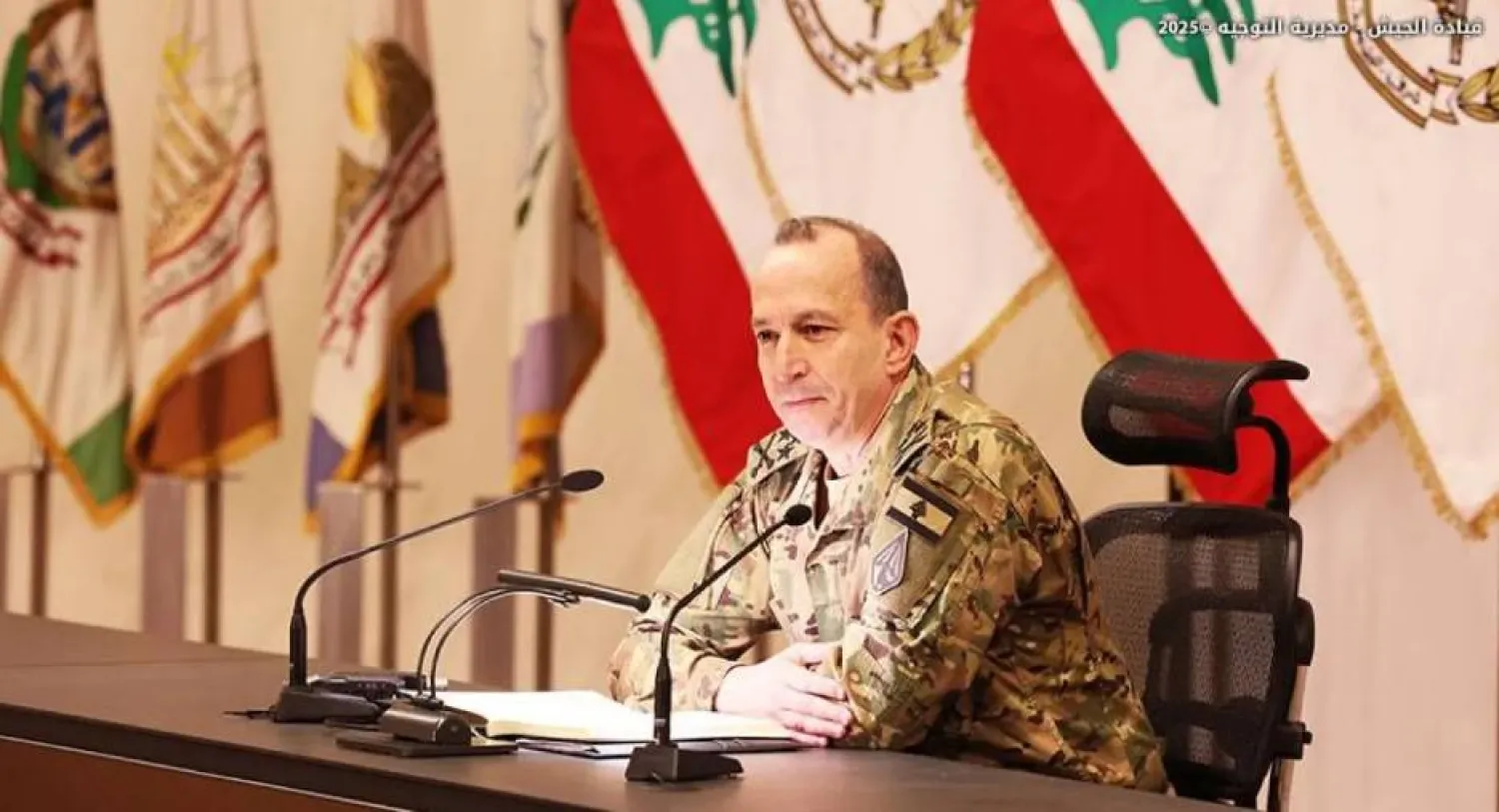

Top US Military Officer Met with Lebanese Counterpart

Lebanese army chief General Rodolphe Haykal. Photo: Army command
TT

Top US Military Officer Met with Lebanese Counterpart

Lebanese army chief General Rodolphe Haykal. Photo: Army command

Top US military officer General Dan Caine met with Rodolphe Haykal this week, a spokesman said Thursday, after a previously planned visit by the Lebanese army commander to Washington was scrapped.

Caine held talks with Haykal on Tuesday and Qatar's defense chief the day before, "reaffirming the importance of the United States' enduring defense relationships in the Middle East," US Joint Staff spokesman Joseph Holstead said in a statement, without providing further details.

Haykal was scheduled to visit Washington in November 2025, but the trip was called off after US political and military officials canceled their meetings with him just hours before he was scheduled to depart, a military source told AFP at the time.

Those who canceled included influential Republican Senator Lindsey Graham, who at the time slammed what he said was Haykal's "almost non-existent effort to disarm Hezbollah."

On Thursday, Graham said on X he had abruptly cut their meeting short after asking Haykal whether the Lebanese military considered Hezbollah to be "a terrorist organization."

Graham said that Haykal replied, "No, not in the context of Lebanon."

The Lebanese military announced last month that it had completed the first phase of its plan to disarm the militant group, covering the area between the Israeli border and the Litani River.

Under a November 2024 truce that sought to end more than a year of hostilities, Iran-backed Hezbollah must withdraw its forces north of the Litani and have its military infrastructure dismantled in the evacuated areas, while Israeli forces must exit Lebanon.

But Hezbollah has rejected calls to surrender its weapons, and Israel has kept up regular strikes on Lebanon while maintaining troops in five areas near the border that it deems strategic.



Defense Cooperation Between Egypt and Türkiye: Increasing Influence by Shifting Regional Power Balances

Egyptian President Abdel Fattah el-Sisi receives Turkish President Recep Tayyip Erdogan in Cairo on Wednesday (Egyptian Presidency).
TT

Defense Cooperation Between Egypt and Türkiye: Increasing Influence by Shifting Regional Power Balances

Egyptian President Abdel Fattah el-Sisi receives Turkish President Recep Tayyip Erdogan in Cairo on Wednesday (Egyptian Presidency).

Cairo and Ankara are moving to deepen military and defense cooperation, a key focus of Turkish President Recep Tayyip Erdogan’s visit to Egypt on Wednesday.

Analysts told Asharq Al-Awsat that the growing partnership aims to restore Egyptian-Turkish influence by reshaping regional power balances, particularly amid concerns over expanding Israeli influence, which they say increasingly threatens the interests of both countries.

The latest step was a military cooperation agreement signed in Cairo in the presence of Egyptian President Abdel Fattah el-Sisi and Erdogan. The deal was signed by Egypt’s Minister of Defense, Lieutenant General Abdel Mageed Saqr, and Türkiye’s Minister of National Defense, Yasar Guler.

Military ties between Egypt and Türkiye have expanded steadily since 2023, following the full restoration of diplomatic relations and reciprocal presidential visits. This rapprochement has extended into the defense industry, with the two countries recently resuming joint military exercises under the name “Sea of Friendship.”

They have also agreed to cooperate on the joint production of unmanned aerial vehicles, while Cairo has joined Türkiye’s fifth-generation stealth fighter jet program, KAAN.

Bashir Abdel Fattah, an Egyptian academic specializing in international relations, said defense cooperation between the two countries covers several areas. The first involves regular joint exercises aimed at enhancing combat readiness and exchanging military expertise.

The second centers on joint defense manufacturing, including advanced systems such as air defense, missiles, ammunition, drones, and potentially fighter aircraft.

A third dimension, he added, lies in security and intelligence cooperation, particularly through information sharing in counterterrorism efforts, combating piracy in the Mediterranean, and coordination on regional issues such as Libya and Sudan.

Egyptian national security expert Major General Mohamed Abdel Wahid said both countries are keen to strengthen ties because they face similar challenges, including shifting regional power balances and the emergence of new actors.

He argued that these changes have made it necessary for Egypt and Türkiye to reassert their influence, especially in response to Israel’s growing role, prompting a focus on building joint defense capabilities.

Abdel Wahid noted that Türkiye has shown flexibility in transferring technology, without putting strict political conditions often imposed by Western countries or the European Union.

He added that a Turkish company has already been established in Cairo and will cooperate with Egypt’s Arab Organization for Industrialization.

At the Egypt Defense Expo (EDEX 2025) in Cairo, Bayraktar drones were displayed bearing the Egyptian flag.

Egypt and Türkiye also signed an agreement last August to jointly produce vertical takeoff and landing drones, while production of unmanned ground vehicles has begun through a partnership between the Turkish company Havelsan and Egypt’s Kader Factory.

Türkiye’s defense electronics firm Aselsan recently announced the opening of a regional office in Egypt, describing the move as a “new chapter” in expanding cooperation and providing direct, on-the-ground support to Egyptian partners.


Lindsey Graham Cuts Meeting Short with Lebanon Army Chief over Hezbollah Designation

US Republican Senator Lindsey Graham (Reuters)
TT

Lindsey Graham Cuts Meeting Short with Lebanon Army Chief over Hezbollah Designation

US Republican Senator Lindsey Graham (Reuters)

Influential Republican Senator Lindsey Graham has said that he cut his meeting short with Lebanese army chief Gen. Rodolphe Haykal after the commander refused to consider Hezbollah a terrorist organization.

On Thursday, Graham said on X he "had a very brief meeting" in Washington after asking Haykal whether the Lebanese military considered Hezbollah to be "a terrorist organization."

Graham said that Haykal replied, "No, not in the context of Lebanon."

“They are clearly a terrorist organization. Hezbollah has American blood on its hands. Just ask the US Marines,” he said about the bombing of the US Marine Corps barracks in Beirut on October 23, 1983. The suicide attack killed 241 US service members.

Hezbollah has “been designated as a foreign terrorist organization by both Republican and Democrat administrations since 1997 – for good reason,” he said.

“As long as this attitude exists from the Lebanese Armed Forces, I don’t think we have a reliable partner in them. I am tired of the double speak in the Middle East. Too much is at stake,” Graham added.


Slain Son of Former Libya Ruler Gaddafi to Be Buried South of Capital

FILED - 11 February 2008, Berlin: Saif al-Islam Gaddafi, son of then Libya's leader Muammar el Gadafi, arrives at the charity gala "Cinema for Peace" at the Konzerthaus am Gendarmenmarkt. Photo: Peer Grimm/dpa-Zentralbild/dpa
TT

Slain Son of Former Libya Ruler Gaddafi to Be Buried South of Capital

FILED - 11 February 2008, Berlin: Saif al-Islam Gaddafi, son of then Libya's leader Muammar el Gadafi, arrives at the charity gala "Cinema for Peace" at the Konzerthaus am Gendarmenmarkt. Photo: Peer Grimm/dpa-Zentralbild/dpa

The slain son of former Libyan ruler Muammar Gaddafi will be buried in a town south of the capital that remains loyal to the family, relatives said Thursday.

Seif al-Islam Gaddafi, once seen by some as Libya's heir apparent, was shot dead in his home in the northwestern city of Zintan on Tuesday.

His family said the burial will be held on Friday in the town of Bani Walid, some 175 kilometers (110 miles) south of Tripoli.

Half-brother Mohamed Gaddafi said on Facebook the plan reflected "our respect" for the town, which has remained loyal to the elder Gaddafi years after he was toppled and killed in Libya's 2011 Arab Spring uprising.

Libya has struggled to recover from chaos that erupted after the uprising.

It remains split between Prime Minister Abdelhamid Dbeibah's UN-backed government based in Tripoli and an eastern administration backed by Khalifa Haftar.

Dbeibah condemned the killing in a statement Thursday: "Assassinations never provided stability... but rather deepen division."

"The Libya we are working towards is a state of law and institutions, where disputes are managed through dialogue and by resorting to the will of the people, not through violence or by reproducing the tragedies of the past," he added.

Interior Minister Imad Trabelsi said local Bani Walid authorities will "ensure the security of the funeral".

Each year, the town of 100,000 people celebrates the anniversary of a 1969 coup that brought Muammar to power, parading through the streets with portraits of the ex-leader and Libya's all-green flag from before the Arab Spring.

Saadi Gaddafi, a younger brother, said his dead sibling will be "buried among the Werfalla", an influential local tribe, in a grave "next to his brother Khamis Gaddafi", who died during the 2011 unrest.

Marcel Ceccaldi, a French lawyer who had been representing Seif al-Islam, told AFP a "four-man commando" killed him. Authorities said they were probing his death as the assailants remain on the run.

Under the elder Gaddafi's 40-year rule, he was described as the de facto prime minister, cultivating an image of moderation and reform despite holding no official position.