


Gold Bounces Back on Softer Dollar, US-Iran Concerns; Silver Rebounds

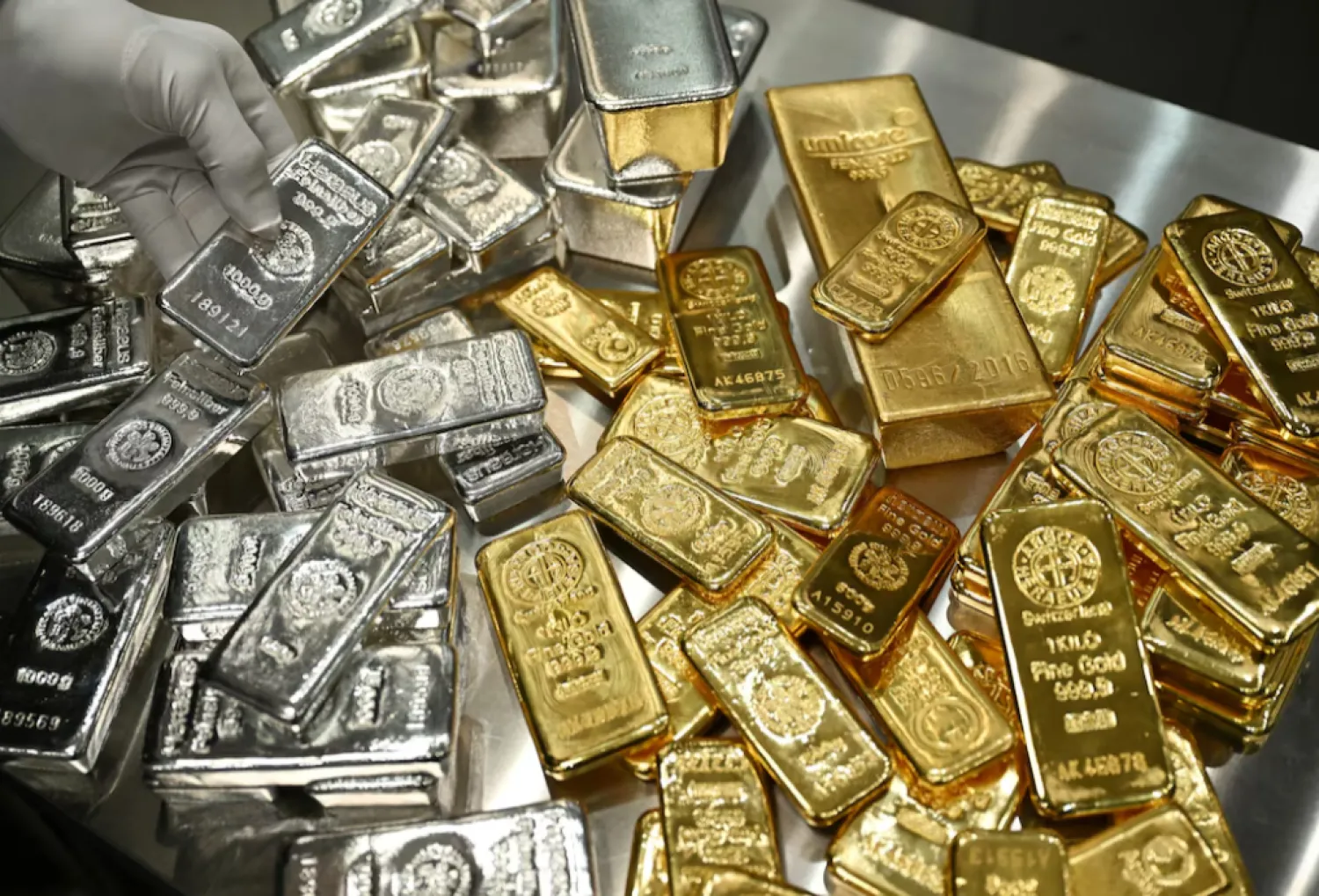
Gold and silver bars are stacked in the safe deposit boxes room of the Pro Aurum gold house in Munich, Germany, January 10, 2025. REUTERS/Angelika Warmuth
TT

Gold Bounces Back on Softer Dollar, US-Iran Concerns; Silver Rebounds

Gold and silver bars are stacked in the safe deposit boxes room of the Pro Aurum gold house in Munich, Germany, January 10, 2025. REUTERS/Angelika Warmuth

Gold rebounded on Friday and was set for a weekly gain, helped by bargain hunting, a slightly weaker dollar and lingering concerns over US-Iran talks in Oman, while silver recovered from a 1-1/2-month low.

Spot gold rose 3.1% to $4,916.98 per ounce by 09:31 a.m. ET (1431 GMT), recouping losses posted during a volatile Asia session that followed a fall of 3.9% on Thursday. Bullion was headed for a weekly gain of about 1.3%.

US gold futures for April delivery gained 1% to $4,939.70 per ounce.

The US dollar index fell 0.3%, making greenback-priced bullion cheaper for the overseas buyers.

"The gold market is seeing perceived bargain hunting from bullish traders," said Jim Wyckoff, senior analyst at Kitco Metals.

Iran and the US started high-stakes negotiations via Omani mediation on Friday to try to overcome sharp differences over Tehran's nuclear program.

Wyckoff said gold's rebound lacks momentum and the metal is unlikely to break records without a major geopolitical trigger.

Gold, a traditional safe haven, does well in times of geopolitical and economic uncertainty.

Spot silver rose 5.3% to $74.98 an ounce after dipping below $65 earlier, but was still headed for its biggest weekly drop since 2011, down over 10.6%, following steep losses last week as well.

"What we're seeing in silver is huge speculation on the long side," said Wyckoff, adding that after years in a boom cycle, gold and silver now appear to be entering a typical commodity bust phase.

CME Group raised margin requirements for gold and silver futures for a third time in two weeks on Thursday to curb risks from heightened market volatility.

Spot platinum added 3.2% to $2,052 per ounce, while palladium gained 4.9% to $1,695.18. Both were down for the week.



Saudi Air Connectivity Program, Saudia Boost Operational Capacity to China and the US

The Saudi flag. Asharq Al-Awsat
TT

Saudi Air Connectivity Program, Saudia Boost Operational Capacity to China and the US

The Saudi flag. Asharq Al-Awsat

Saudi Air Connectivity Program (ACP), in collaboration with Saudia, has announced an increase in seat capacity across several international routes in 2026.

The new step reflects ongoing efforts to strengthen the Kingdom’s air connectivity with global markets, keep pace with growing travel demand, facilitate access to Saudi Arabia, and provide travelers with broader and more flexible travel options.

Direct routes between Saudi Arabia and China have seen increased seat capacity.

An additional weekly flight has been added to the Guangzhou-Jeddah (CAN-JED) route, bringing the total to four weekly flights and providing more than 124,000 seats annually in both directions.

An additional weekly flight has also been added to the Beijing Daxing-Riyadh (PKX-RUH) route, bringing the total to three weekly flights, with annual capacity exceeding 93,000 seats in both directions.

In addition, direct connectivity between Saudi Arabia and the United States has been enhanced with three additional weekly flights on the New York-Jeddah (JFK-JED) route, bringing the total to seven weekly flights and providing more than 211,000 seats annually in both directions.

These efforts build on the ongoing collaboration between the Air Connectivity Program and Saudi national carriers to expand the international destination network and strengthen the Kingdom’s connectivity with priority markets.

They also aim to meet growing travel demand, increase seat capacity, provide travelers with more diverse and flexible options, and facilitate the arrival of more international visitors to the Kingdom.

These efforts contribute to achieving the objectives of the National Tourism Strategy and the Aviation Sector Strategy, in alignment with the goals of Saudi Vision 2030.

The Air Connectivity Program aims to support the growth of Saudi Arabia’s tourism sector by strengthening air connectivity with global markets, developing existing air routes, and launching new international destinations.

These efforts contribute to the Kingdom’s target of connecting to 250 international destinations by 2030.

The program serves as an executive enabler of the National Tourism Strategy and the Aviation Program by building partnerships with government and private-sector entities across the tourism and aviation ecosystems, strengthening Saudi Arabia’s position as a leading global tourism destination.


Gold Retreats after Scaling over 2-month Peak on US Treasury Move

 AFP_A photo shows gold bangles and necklaces for sale at a gold shop at the Grand Baazar in Istanbul
AFP_A photo shows gold bangles and necklaces for sale at a gold shop at the Grand Baazar in Istanbul
TT

Gold Retreats after Scaling over 2-month Peak on US Treasury Move

 AFP_A photo shows gold bangles and necklaces for sale at a gold shop at the Grand Baazar in Istanbul
AFP_A photo shows gold bangles and necklaces for sale at a gold shop at the Grand Baazar in Istanbul

Gold fell on Thursday as investors booked profits after prices climbed to a more than two-month peak on a surprise US Treasury liquidity-support announcement for long-duration bonds, which weakened the dollar and lowered Treasury yields.

Spot gold was down 0.7% to $4,488.19 per ounce by 0750 GMT. Earlier, bullion was at $4,525.79, its highest since June 2, after a more than 4% advance on Wednesday.

US gold ‌futures were little ‌changed at $4,546.30. The US Treasury Department said ‌it ⁠would double the ⁠size of liquidity support buyback operations for longer-dated notes and bonds. That came after a major bond selloff as investors demanded higher returns on the back of increased inflationary risks stemming from the US-Israeli war on Iran.

The US dollar was hovering near three-month lows.

"There was obviously a huge rally (in gold), and ⁠there's going to be a degree of digestion ‌in markets after a big ‌move like that," said Ilya Spivak, head of global macro at Tastylive.

"The $4,400 ‌to $4,500 price range has been cleared. If prices hold above ‌this range, the upward momentum is likely to continue." Meanwhile, total US debt outstanding topped $40 trillion for the first time, drawing fresh warnings of fiscal crisis.

"Increasing concern about the financial stability of the market with ‌borrowing and debt and the inability to cut spending on the fiscal side is very ⁠bullish for ⁠gold," said Edward Meir, Marex analyst. Concerns over inflation deepened at the Federal Reserve's meeting last month, with "several" policymakers ready to raise interest rates, minutes of the session showed on Wednesday.

Traders are currently pricing in a 69% chance of a Fed hold and a 31% chance of a rate hike in September, according to the CME FedWatch Tool.

While gold is typically seen as a hedge against inflation, higher interest rates tend to diminish non-yielding bullion's appeal.

Among other metals, spot silver fell 0.5% to $66.60 per ounce, platinum dropped 1.6% to $1,794.91, and palladium slid 0.5% to $1,325.94.


Oil Hits 3-week High on Middle East Supply Concerns amid War Impasse

Oil platforms operated by Australian company Santos (Company website)
TT

Oil Hits 3-week High on Middle East Supply Concerns amid War Impasse

Oil platforms operated by Australian company Santos (Company website)

Oil prices climbed to three-week highs on Thursday, driven by concerns that the impasse in the Iran war will continue to disrupt supply from the key Middle Eastern producing region.

Brent crude futures for October delivery rose $1.20, or 1.3%, to $92.82 a barrel by 0813 GMT, while US West Texas Intermediate crude futures for September added 92 cents to $86.75 a barrel. The more-active October WTI contract was ‌up $1.13, or 1.3%, ‌to $85.52.

Both Brent and WTI benchmarks hit their highest ‌since ⁠late July during the ⁠session, gaining for a fifth straight session and having settled on Wednesday at their highest since July 24. The September WTI contract expires later on Thursday, Reuters said.

"Tensions in the Middle East remain high, leaving room for further supply disruptions," said UBS analyst Giovanni Staunovo. "Lower oil exports from the Middle East are once again tightening the oil market." The UAE's decision to suspend all financial and economic transactions with Iran until ⁠further notice has refocused the spotlight on fraught ties between ‌the major Gulf Arab oil producer and Iran.

"Oil ‌prices remained elevated as the market is supported by sporadic attacks in the Middle ‌East but lacks fresh momentum without a major escalation," said Hiroyuki Kikukawa, chief strategist ‌of Nissan Securities Investment.

"The market is likely to maintain a gradual upward trend given uncertainty over peace talks and tensions ...," he added. On Tuesday, US President Donald Trump said no talks were taking place with Iran ‌and that the Strait of Hormuz was open. Iran, however, said the waterway remained shut. Trump on Wednesday warned of ⁠economic consequences against ⁠any country that provided "any type of lifeline to Iran". Shipping traffic through the strait on Wednesday was unchanged from the day before as discussions to end the conflict remained deadlocked, according to the latest shipping data.

Prior to the war that began with US and Israeli strikes on Iran on February 28, shipments equal to about one-fifth of global consumption moved through the waterway. Current flows are far below pre-war levels.

The war has also impacted the supply of refined fuels and drawn down inventories with less crude available to refiners.

US stockpiles of distillate fuel, including diesel and heating oil, fell last week for a third week, the Energy Information Administration said on Wednesday. However, crude inventories unexpectedly rose by 4.4 million barrels.