


Is Iran Pushing Houthis Toward Military Action Against Washington?

Houthis continue mobilization, fundraising, and declare combat readiness (AP) 
TT

Is Iran Pushing Houthis Toward Military Action Against Washington?

Houthis continue mobilization, fundraising, and declare combat readiness (AP) 

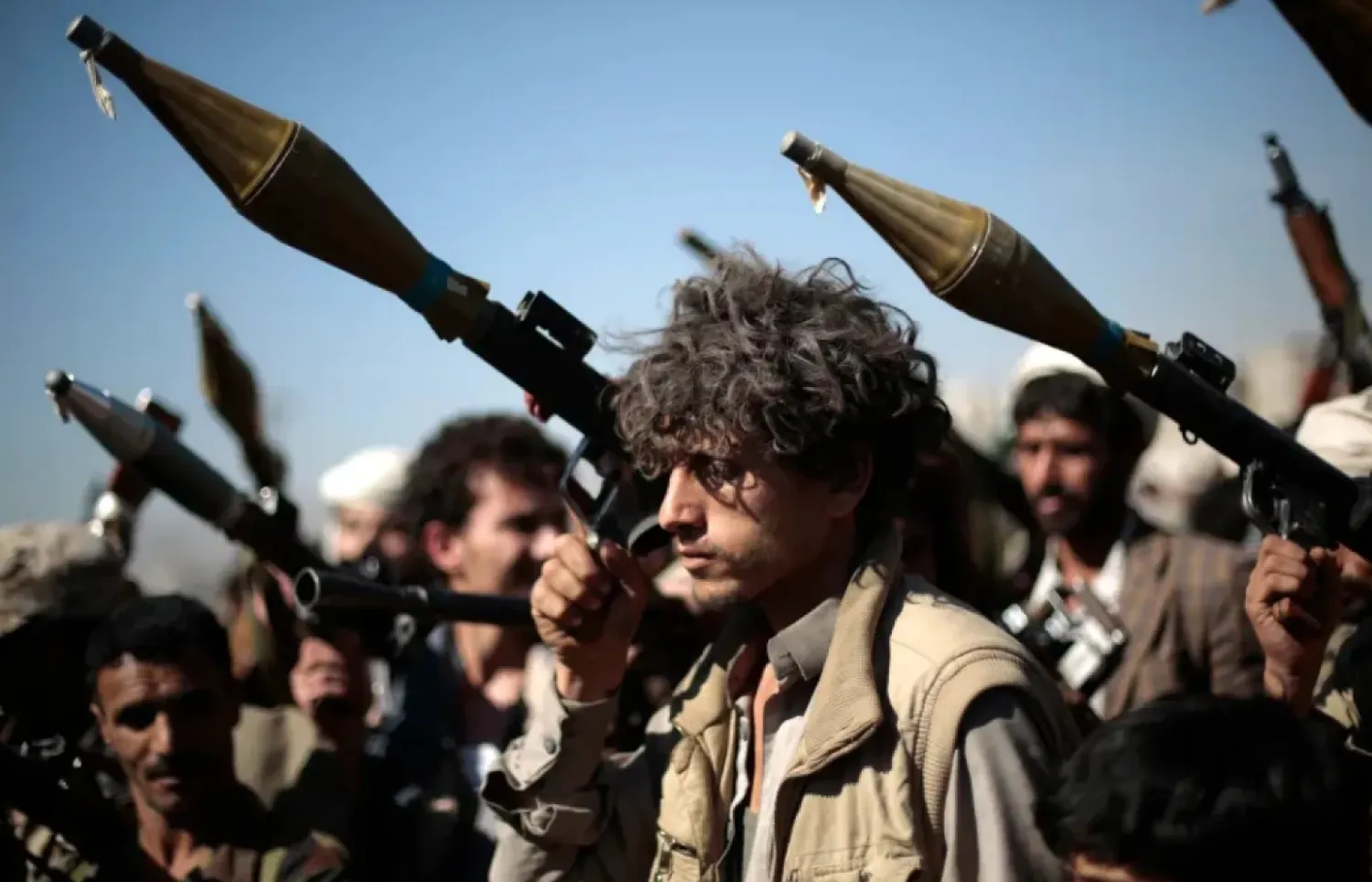
As US military movements intensify in the Middle East and the possibility of strikes on Iran looms, Yemen’s Houthi group has continued military preparations, mobilizing fighters and establishing new weapons sites.

The Houthi mobilization comes at a time when the group is widely viewed as one of Iran’s most important regional arms for retaliation.

Although the Iran-backed group has not issued any official statement declaring its position on a potential US attack on Iran, its leaders have warned Washington against any military action and against bearing full responsibility for any escalation and its consequences.

They have hinted that any response would be handled in accordance with the group’s senior leadership's assessment, after evaluating developments and potential repercussions.

Despite these signals, some interpret the Houthis’ stance as an attempt to avoid drawing the attention of the current US administration, led by President Donald Trump, to the need for preemptive action in anticipation of a potential Houthi response.

The Trump administration previously launched a military campaign against the group in the spring of last year, inflicting heavy losses.

Islam al-Mansi, an Egyptian researcher specializing in Iranian affairs, said Iran may avoid burning all its cards unless absolutely necessary, particularly given US threats to raise the level of escalation should any Iranian military proxies intervene or take part in a confrontation.

Iran did not resort to using its military proxies during its confrontation with Israel or during a limited US strike last summer because it did not perceive an existential threat, al-Mansi said.

That calculation could change in the anticipated confrontation, potentially prompting Houthi intervention, including targeting US allies, interests, and military forces, he told Asharq Al-Awsat.

Al-Mansi added that although Iran previously offered, within a negotiating framework, to abandon its regional proxies, including the Houthis, this makes it more likely that Tehran would use them in retaliation, noting that Iran created these groups to defend its territory from afar.

Many intelligence reports suggest that Iran’s Revolutionary Guard has discussed with the Houthis the activation of alternative support arenas in a potential US-Iran confrontation, including the use of cells and weapons not previously deployed.

Visible readiness

In recent days, Chinese media outlets cited an unnamed Houthi military commander as saying the group had raised its alert level and carried out inspections of missile launch platforms in several areas across Yemen, including the strategically important Red Sea region.

In this context, Yemeni political researcher Salah Ali Salah said the Houthis would participate in defending Iran against any US attacks, citing the group’s media rhetoric accompanying mass rallies, which openly supports Iran’s right to defend itself.

While this rhetoric maintains some ambiguity regarding Iran, it repeatedly invokes the war in Gaza and renews Houthi pledges to resume military escalation in defense of the besieged enclave’s population, Salah told Asharq Al-Awsat.

He noted that Iran would not have shared advanced and sophisticated military technologies with the Houthis without a high degree of trust in their ability to use them in Iran’s interest.

In recent months, following Israeli strikes on the unrecognized Houthi government and several of its leaders, hardline Houthi figures demonstrating strong loyalty to Iran have become more prominent.

On the ground, the group has established new military sites and moved equipment and weapons to new locations along and near the coast, alongside the potential use of security cells beyond Yemen’s borders.

Salah said that if the threat of a military strike on Iran escalates, the Iranian response could take a more advanced form, potentially including efforts to close strategic waterways, placing the Bab al-Mandab Strait within the Houthis’ target range.

Many observers have expressed concern that the Houthis may have transferred fighters and intelligence cells outside Yemen over recent years to target US and Western interests in the region.

Open options

After a ceasefire was declared in Gaza, the Houthis lost one of their key justifications for mobilizing fighters and collecting funds. The group has since faced growing public anger over its practices and worsening humanitarian conditions, responding with media messaging aimed at convincing audiences that the battle is not over and that further rounds lie ahead.

Alongside weekly rallies in areas under their control in support of Gaza, the Houthis have carried out attacks on front lines with Yemen’s internationally recognized government, particularly in Taiz province.

Some military experts describe these incidents as probing attacks, while others see them as attempts to divert attention from other activities.

In this context, Walid al-Abara, head of the Yemen and Gulf Studies Center, said the Houthis entered a critical phase after the Gaza war ended, having lost one of the main justifications for their attacks on Red Sea shipping.

As a result, they may seek to manufacture new pretexts, including claims of sanctions imposed against them, to maintain media momentum and their regional role.

Al-Abara told Asharq Al-Awsat that the group has two other options. The first is redirecting its activity inward to strengthen its military and economic leverage, either to impose its conditions in any future settlement or to consolidate power.

The second is yielding to international and regional pressure and entering a negotiation track, particularly if sanctions intensify or its economic and military capacity declines.

According to an assessment by the Yemen and Gulf Studies Center, widespread protests in Iran are increasingly pressuring the regime’s ability to manage its regional influence at the same pace as before, without dismantling its network of proxies.

This reality is pushing Tehran toward a more cautious approach, governed by domestic priorities and cost-benefit calculations, while maintaining a minimum level of external influence without broad escalation.

Within this framework, al-Abara said Iran is likely to maintain a controlled continuity in its relationship with the Houthis through selective support that ensures the group remains effective.

However, an expansion of protests or a direct military strike on Iran could open the door to a deeper Houthi repositioning, including broader political and security concessions in exchange for regional guarantees.


Russia Shifts Tactics with Round-the-clock Attacks on Kyiv, Disrupting Daily Life

A resident Nataliia and her daughter Elia, 6, sit at a site of an apartment building damaged by a Russian missile strike, amid Russia's attack on Ukraine, in the town of Borispil, Ukraine September 1, 2026. REUTERS/Stringer
TT

Russia Shifts Tactics with Round-the-clock Attacks on Kyiv, Disrupting Daily Life

A resident Nataliia and her daughter Elia, 6, sit at a site of an apartment building damaged by a Russian missile strike, amid Russia's attack on Ukraine, in the town of Borispil, Ukraine September 1, 2026. REUTERS/Stringer

For much of the war, Russian drone and missile attacks in Kyiv followed a particular rhythm. They almost always came at night.

The warnings would begin on monitoring channels on Telegram in the late evening. They announced drones moving south, missiles being launched, air defenses working. Ukrainian civilians judged whether it was prudent to stay indoors or make for shelter in the metro based on the severity of the threat, The Associated Press said.

Now, Russia has changed tactics with the use of fast-flying, jet-powered drones, and the expectation that daylight brings a return to normal life has been shattered. Since last week, attacks have come day and night, compounding the terror of overnight strikes with the exhaustion of constant daytime disruption.

In Kyiv, the recurring wail of air-raid sirens has become part of daily life. It has interrupted commutes, shopping trips and children’s school, intruded on life’s biggest moments, from weddings to funerals, and, as these attacks always have, taken lives. The relentless alerts are exhausting residents, leaving some wondering how long they can stay.

Air raids are woven into the routine of daily life

An alert sounds. People look at their phones or up at the sky. Moments later, in the distance, the familiar sounds of air defenses intercepting drones resound.

Plumes of smoke can often be seen rising in the distance. Photos quickly spread across Telegram channels, showing where the destruction has occurred.

An hour or two later, another siren echoes.

In malls, banks and other businesses, air-raid protocols require customers and staff to leave when an alert sounds. A bank transaction can be interrupted midconversation; a shopping trip can become a cycle of entering a store, evacuating, returning and evacuating again.

Getting the shopping done has become a nightmare for Volodymyr Bovsunovskyi, who recounts a recent family trip to a mall to buy clothes for his nearly 4-year-old daughter. They had been inside for about 20 minutes when the alert sounded. They rushed out and saw smoke rising nearby.

They never got to purchase the clothes.

“A lot has changed in the last seven days,” he said. Like many residents, he hopes the attacks will relent. But, they have not yet, as Ukraine struggles to find an effective way to counter them.

Train journeys that would normally take a few hours have stretched much longer. In some cases, passengers have found themselves walking for hours through grassy fields after trains stopped on the tracks, carrying their belongings while one air-raid alert followed another.

The same uncertainty extends to getting around the city.

When GPS signals are disrupted to jam drones, using a taxi app becomes an absurd process. A car that appears to be nearby can suddenly appear to be on the other side of the world.

A pickup that seemed imminent suddenly shows an arrival time of thousands of minutes.

Life’s biggest moments are interrupted

One Kyiv couple went ahead with their wedding despite the sirens. On Wednesday morning, when Iryna Baranova, 38, returned home from hair and makeup to finish getting ready, explosions were sounding across the city.

“We heard two explosions, the alarm ended, we got together and went to the registration ceremony," she said, wearing a white satin gown with strands of pearls draped around her neck.

Afterward, she and Evhen Mytsyk walked hand in hand in a botanical garden in the city.

Mytsyk, 40, said the attacks did not diminish the day.

“If you wake up in the morning, you have to make the most of that day, because there might not be another chance," he said. "At a time like this, you appreciate life and the love of your family more, and you give love more openly yourself."

In the same garden, Tetyana Shevchenko meditated inside a small wooden gazebo modeled on a Buddhist prayer space. She has practiced for years, and she says it helps her remain calm even as air raids sound around her.

“When the air raids first started, we couldn’t stand the sound at all. It was very loud, disturbing, depressing," she said. "The body works in a way, it gets used to everything, including nighttime attacks, spending the night on the floor in the corridor, and insomnia.”

Meditation has also helped her stay calm as she navigates the tedium of bureaucracy, made even more difficult by the attacks.

Shevchenko has been trying to obtain documents to recover state funds owed to her mother, who died last year. While she waited in a long line for an appointment on a recent day, an air-raid alert sounded, causing her to miss her slot. She was sent to the back of the line and forced to start the process again.

“In this period of adjustments and grieving all of us are united, united in our suffering,” she said.

As she spoke, a siren blared. Moments later a thud was heard in the distance.

A week of relentless attacks has some considering leaving the city Ivan Datsiv, an IT worker, was in his apartment in Kyiv’s Podil district when a Russian drone tore through the floor on Tuesday, charring the ceilings and walls of his apartment and completely destroying the one next door.

Datsiv tries to joke about it, saying he had been meaning to repaint the walls anyway.

The alerts have become so frequent that he no longer sees the point of repeatedly going to a shelter. At this rate, he said, the only alternative would be to live in the basement.

“The alarms sound constantly,” he said. “You don’t even have time to go down and come back up. It’s just a waste of time running back and forth."

He is thinking of leaving Kyiv. “I’m thinking of living in another city, somewhere quiet and without this danger,” he said.

From the blown-out apartment next door, the view looks down onto a playground and basketball court where children are still playing.

Then a siren sounds again. Minutes later, the white zigzagging trail of an intercepted drone can be seen against the sky.

Bovsunovskyi is also considering leaving the city for a while, hoping to give his family — including his pregnant wife — a chance to rest.

The kindergarten his daughter attends must move the children to a shelter whenever an air-raid alert sounds. The alerts have become so frequent that he now simply picks her up halfway through the day.

“There is no stability,” he said.


Nothing Left: Nepal Flood Survivors Face Loss and Uncertainty

An aerial view shows houses standing amid debris during a helicopter flight from Nuwakot to Rasuwa following the deadly flash floods and mudslides in Nepal, September 3, 2026. (Reuters)
TT

Nothing Left: Nepal Flood Survivors Face Loss and Uncertainty

An aerial view shows houses standing amid debris during a helicopter flight from Nuwakot to Rasuwa following the deadly flash floods and mudslides in Nepal, September 3, 2026. (Reuters)

In Nepal's flood-ravaged Rasuwa district, Yangee Tamang grapples with grief and uncertainty, days after deadly torrents swept away entire villages, leaving a landscape of mud, rock and debris.

From a helicopter flying up the valley of destruction, the ground below resembles a puzzle with missing pieces. Entire sections of settlements have vanished.

Picturesque villages of green paddy fields and houses sit beside vast chunks of land washed away.

Tamang's house sits on a hillside in Syabrubesi in Rasuwa district, but the flood swept away the settlement below, where her relatives lived and markets were.

"It is all gone, nothing is left. No one is left," Tamang told AFP, after tracing the route of the August 26 destruction by air on Thursday, with roads below washed out.

Rescue teams in Nepal have recovered more than 1,250 bodies, and more than 5,000 are missing, after the gigantic wave triggered by a rock and ice avalanche roared down the China-Nepal border.

What were once busy villages, markets, green hillsides and winding roads in Rasuwa have been transformed into vast stretches of mud, broken rock and debris.

"It wasn't really water, it was gas-like, all black and it moved like boiling water," she said.

"It was all so sudden, it was not possible for anyone to run away."

- 'Hope has died' -

About 100 people are feared trapped in hydropower tunnels.

Tamang's husband is safe, but his workplace, the nearby Chilime Hydropower Project, which was smashed by the flood.

"I don't know what we will do. Nothing is left here for us to live," she said.

The river, still flowing brown, traces a path of destruction, and the enormous amount of debris has changed the shape and course of the waterways.

The floodwaters, carrying huge quantities of mud and rocks, rushed through river valleys with tremendous force.

In narrow gorges between the lush green hills, soil lies exposed where the flood stripped away trees and grass.

Roads that once connected remote communities have been washed away, while bridges lie destroyed or have completely disappeared.

Vehicles remain stranded on washed-out roads along hillsides.

Along the route, many surviving buildings are buried beneath thick layers of mud.

Some remain standing but are left empty, the people gone.

Risang Tamang, another resident, said for those left, the future is bleak.

"It is difficult -- roads are is such a state, so many bridges have been swept away. Now, even if you have money, there is nowhere to buy anything," he told AFP.

"Any hope that we can live here has died."


Ali al-Taher Ridge Emerges as Flashpoint in Israel-Hezbollah War

A photograph taken from the southern Lebanese area of Nabatieh shows smoke as it rises from the site of Israeli strikes that targeted the hilltops of the mountainous area of the strategic Ali al-Taher Ridge on August 14, 2026.  (Photo by AFP) /
A photograph taken from the southern Lebanese area of Nabatieh shows smoke as it rises from the site of Israeli strikes that targeted the hilltops of the mountainous area of the strategic Ali al-Taher Ridge on August 14, 2026. (Photo by AFP) /
TT

Ali al-Taher Ridge Emerges as Flashpoint in Israel-Hezbollah War

A photograph taken from the southern Lebanese area of Nabatieh shows smoke as it rises from the site of Israeli strikes that targeted the hilltops of the mountainous area of the strategic Ali al-Taher Ridge on August 14, 2026.  (Photo by AFP) /
A photograph taken from the southern Lebanese area of Nabatieh shows smoke as it rises from the site of Israeli strikes that targeted the hilltops of the mountainous area of the strategic Ali al-Taher Ridge on August 14, 2026. (Photo by AFP) /

The Ali al-Taher ridge in southern Lebanon, which is named after a Shi'ite Muslim scholar whose shrine sits at its summit, has become one of the most contested pieces of ground in the Israel-Hezbollah war.

The cluster of hills is not especially large. But what it overlooks in southern Lebanon — and what Hezbollah is suspected to have built beneath it — thrust it to the center of the fight between Israel and the Iran-backed militant group.

WHERE IS IT?

Located about 15 km (10 miles) from the Israeli border, the Ali al-Taher ridge has a commanding view of a broad sweep of southeastern Lebanon. Israel held it during a 22-year occupation of south Lebanon that ended in 2000.

After the current war erupted on March 2, Israeli troops pushed deep into southern Lebanon and seized key hilltops, including the historic Beaufort Castle on the ‌route to Ali al-Taher.

In ‌June, Israel's military described the ridge as one of its "primary operational focuses," ‌and ⁠included it in ⁠a map of an expanded, self-declared buffer zone where its troops are operating.

The ridge has effectively become a dividing point between a swathe of Lebanese territory occupied by Israeli troops to the south, and towns to the north that Israel's air force has bombed heavily, including Nabatieh.

WHY IS IT STRATEGIC?

Hezbollah is believed to have built an underground command center and weapons stores within the ridge itself, Lebanese security sources told Reuters in July. At 600 meters above sea level, it granted Hezbollah an advantage in launching short-range missiles and drones towards northern Israel, according to analysts.

Ali al-Taher also connects border areas ⁠in southern Lebanon to the hilly Iqlim al-Tuffah region further north, which has long ‌served as a key logistical and operational base for Hezbollah, the ‌Lebanese security sources said.

The Israeli air force has struck the ridge heavily in recent months.

In June, an Israeli military official, ‌speaking on the condition of anonymity, told Reuters that Hezbollah fighters were stuck underground without food or water. The ‌Times of Israel, citing a military probe, said on June 20 that one Israeli soldier was killed and 13 wounded during operations to capture a major underground Hezbollah facility beneath the ridge.

Hezbollah has said that Israel has sought to advance but that its fighters still had "full control over the area and are at complete readiness to confront any attempt by the enemy forces to ‌advance or infiltrate."

In July, the Israeli military said it would "not allow Hezbollah terrorists to emerge from the underground terrorist infrastructure and operate in the area or pose ⁠a threat" to Israeli soldiers.

WHAT ⁠IS THE POLITICAL SIGNIFICANCE?

Ali al-Taher lies near Zawtar Al Gharbiyeh, a town from which Israeli troops withdrew in July as part of a US-brokered roadmap that would see Israeli troops gradually withdraw from southern Lebanon as Lebanese troops disarm Hezbollah.

But with Hezbollah refusing to give up its weapons — and Israel saying it won't withdraw until the group disarms — that plan has ground to a halt.

As Israeli elections planned for October draw closer, capturing Ali al-Taher could be an attractive prize for Israeli Prime Minister Benjamin Netanyahu's government.

"Before the elections, Israel needs a big win in an area that has always been seen as a Hezbollah stronghold," said Andrea Tenenti, a strategic communications expert and former spokesperson for the UN force in Lebanon, UNIFIL.

Still, it may prefer a slow siege to avoid Israeli troop casualties, said Hassan Jouni, a Lebanese analyst and retired army general.

"Israel is hesitant to storm Ali al-Taher for fear of casualties, especially at this sensitive moment before elections," Jouni told Reuters.

The deadlock in Lebanon mirrors the wider Middle East standoff — negotiations between the United States and Iran remain stalled, with no breakthrough in sight.