


Over 2,200 ISIS Detainees Transferred to Iraq from Syria, Says Iraqi Official

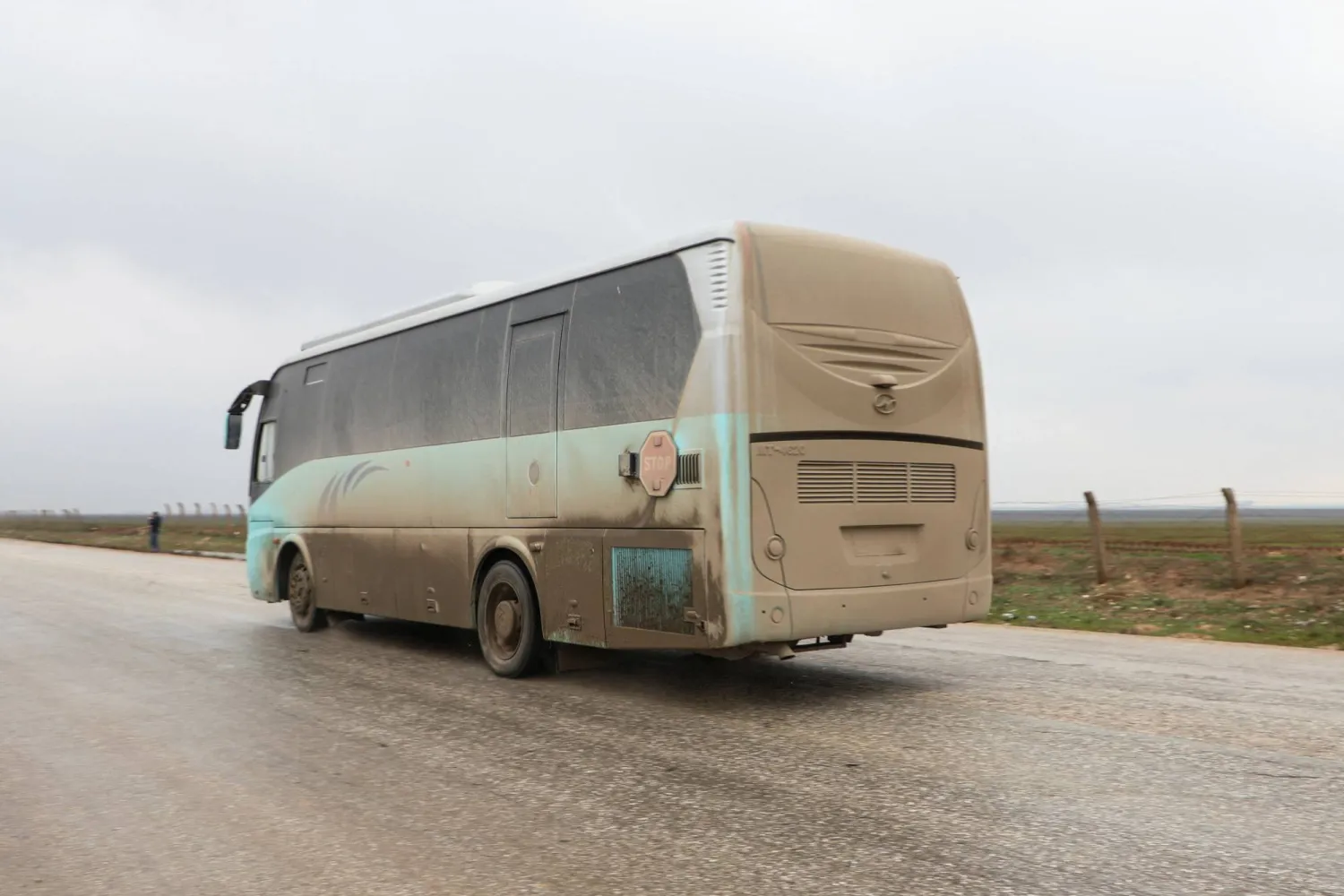
 One of the American buses transporting ISIS fighters, according to a security source from the Syrian Democratic Forces, heads from Syria towards Iraq, in Qamishli, Syria, February 7, 2026. (Reuters)
One of the American buses transporting ISIS fighters, according to a security source from the Syrian Democratic Forces, heads from Syria towards Iraq, in Qamishli, Syria, February 7, 2026. (Reuters)
TT

Over 2,200 ISIS Detainees Transferred to Iraq from Syria, Says Iraqi Official

 One of the American buses transporting ISIS fighters, according to a security source from the Syrian Democratic Forces, heads from Syria towards Iraq, in Qamishli, Syria, February 7, 2026. (Reuters)
One of the American buses transporting ISIS fighters, according to a security source from the Syrian Democratic Forces, heads from Syria towards Iraq, in Qamishli, Syria, February 7, 2026. (Reuters)

Iraq has so far received 2,225 ISIS group detainees, whom the US military began transferring from Syria last month, an Iraqi official told AFP on Saturday.

They are among up to 7,000 ISIS detainees whose transfer from Syria to Iraq the US Central Command (CENTCOM) announced last month, in a move it said was aimed at "ensuring that the terrorists remain in secure detention facilities".

Previously, they had been held in prisons and camps administered by the Kurdish-led Syrian Democratic Forces (SDF) in northeast Syria.

The announcement of the transfer plan last month came after US envoy to Syria Tom Barrack declared that the SDF's role in confronting ISIS had come to an end.

Saad Maan, head of the security information cell attached to the Iraqi prime minister's office, told AFP on Saturday that "Iraq has received 2,225 terrorists from the Syrian side by land and air, in coordination with the international coalition", which Washington has led since 2014 to fight IS.

He said they are being held in "strict, regular detention centers".

A Kurdish military source confirmed to AFP the "continued transfer of ISIS detainees from Syria to Iraq under the protection of the international coalition".

On Saturday, an AFP photographer near the Kurdish-majority city of Qamishli in northeastern Syria saw a US military convoy and 11 buses with tinted windows.

- Iraq calls for repatriation -

ISIS seized swathes of northern and western Iraq starting in 2014, until Iraqi forces, backed by the international coalition, managed to defeat it in 2017.

Iraq is still recovering from the severe abuses committed by the extremists.

In recent years, Iraqi courts have issued death and life sentences against those convicted of terrorism offences.

Thousands of Iraqis and foreign nationals convicted of membership in the group are incarcerated in Iraqi prisons.

On Monday, the Iraqi judiciary announced it had begun investigative procedures involving 1,387 detainees it received as part of the US military's operation.

In a statement to the Iraqi News Agency on Saturday, Maan said "the established principle is to try all those involved in crimes against Iraqis and those belonging to the terrorist ISIS organization before the competent Iraqi courts".

Among the detainees being transferred to Iraq are Syrians, Iraqis, Europeans and holders of other nationalities, according to Iraqi security sources.

Iraq is calling on the concerned countries to repatriate their citizens and ensure their prosecution.

Maan noted that "the process of handing over the terrorists to their countries will begin once the legal requirements are completed".



EU Announces Restrictions on Trading Sudanese Gold

An artisanal miner operates an ore-processing machine used to separate gold-bearing material at a mining site in Dalago Mahas, Sudan’s Northern State, Thursday, May 7, 2026.(AP Photo/Mohnd Blal)
TT

EU Announces Restrictions on Trading Sudanese Gold

An artisanal miner operates an ore-processing machine used to separate gold-bearing material at a mining site in Dalago Mahas, Sudan’s Northern State, Thursday, May 7, 2026.(AP Photo/Mohnd Blal)

The European Union announced on Monday new sanctions against Sudan by targeting the country's gold trade, which it said was being used ‌to finance ‌the military conflict ‌in ⁠the country, reported Reuters.

"The decision ⁠introduces a ban on the purchase, import or transfer of gold originating ⁠in Sudan. It ‌also ‌bans the sale, supply, ‌transfer or export ‌of mercury and cyanide to Sudan," said a statement by the ‌Council of the European Union.

The ⁠conflict ⁠between Sudan's army and the paramilitary Rapid Support Forces began more than three years ago, and it has caused a vast humanitarian crisis.


Iran Further Undermines Yemen’s Sovereignty as Houthis Violate the Truce

Smoke rises following airstrikes on Sanaa airport in Sanaa, Yemen, 13 July 2026. (EPA)
TT

Iran Further Undermines Yemen’s Sovereignty as Houthis Violate the Truce

Smoke rises following airstrikes on Sanaa airport in Sanaa, Yemen, 13 July 2026. (EPA)

Yemen's legitimate government said it struck Houthi-controlled Sanaa airport on Monday, its biggest flare-up in years with the militants.

The government said it had wanted to prevent an Iranian plane from landing in the capital, after failing to convince a Houthi delegation that went to Tehran for the late Iranian supreme leader's funeral to board a Yemenia flight instead.

The latest escalation threatens to unravel a truce that has been holding since 2022 despite expiring, and comes at a time of heightened tensions as the United States and Iran trade attacks impacting the Gulf and traffic in the Strait of Hormuz.

Yemen's Defense Ministry accused the Houthis of "allowing an Iranian plane to violate Yemeni territory; consequently, the airport runway was targeted".

Following the strikes, the head of Yemen's Presidential Leadership Council, Dr. Rashad al-Alimi, said he had "ordered that the scope of the confrontation not be expanded".

He held the Houthis “fully accountable for the escalation,” saying they had insisted on welcoming a new Iranian flight despite objections and attempts to contain the crisis and avert more tensions.

The government had run out of political and legal options before the arrival of the flight. He added that the government had offered to operate the flight through the Yemenia airline seeing as it is the national carrier.

The Houthis rejected the proposal and insisted on welcoming the Iranian plane outside official channels, stated al-Alimi, saying this was evidence that the militants “were not serving the people or easing their suffering, but deepening the division and imposing a status quo that serves foreign agendas.”

He ordered the army and security forces “to be on the highest level of alert and take the necessary political, diplomatic, legal and military measures allowed by the constitution and international law to protect Yemen’s airspace and land and sea ports.”

Prime Minister and Foreign Minister Shaya al-Zindani held an extraordinary government meeting in the interim capital Aden to discuss the escalation.

The cabinet tasked the Foreign Ministry with intensifying its contacts with friendly nations and regional and international organizations to urge them against the use of Yemen’s airspace outside official channels.

Smoke rises after reports of an airstrike hitting near the Sanaa International Airport, as seen from Sanaa, Yemen, July 13, 2026. (Reuters)

It held the Houthis “fully responsible for the escalation and its consequences”, accusing them of “undermining peace efforts and exposing Yemen and the region to more dangers”.

It also held the Iranian regime responsible for the escalation given its continued support to the Houthis.

Ahead of the strike, the Defense Ministry had urged citizens to evacuate the airport and its vicinity for their safety.

It vowed that it would “deal with any party or plane that tries to violate Yemen’s airspace or orders issued by relevant authorities.”

Government authorities had for days warned that flights to Sanaa should only take place through state institutions.

Houthi sources later said the plane, which was carrying a Houthi delegation, landed in Hodeidah airport.

Yemeni authorities held the Houthis responsible for the escalation for insisting on imposing their own arrangements away from official regulations.

Monday’s escalation took place after the Houthis insisted on receiving Iranian flights at Sanaa airport amid the government’s refusal to operate flights outside official channels.

The United Nations Special Envoy for Yemen, Hans Grundberg, urged the parties to turn to diplomacy, saying his office has "contacted military representatives from all sides".

Earlier in the day, the Yemeni government accused the Houthis of preventing an International Committee of the Red Cross (ICRC) aircraft from leaving Sanaa airport and holding the pilot and co-pilot "hostage".

"All ICRC staff and the crew of the plane are safe and accounted for," ICRC spokesman for the Middle East Hachem Osseiran told AFP.


Spanish PM to Visit Algeria in Bid to Mend Ties

Spain's Prime Minister Pedro Sanchez talks to media during a visit in the area of a wildfire that killed at least 13 people, at the command post set in Turre, Almeria Province, on July 13, 2026. (AFP)
TT

Spanish PM to Visit Algeria in Bid to Mend Ties

Spain's Prime Minister Pedro Sanchez talks to media during a visit in the area of a wildfire that killed at least 13 people, at the command post set in Turre, Almeria Province, on July 13, 2026. (AFP)

Spanish Prime Minister Pedro Sanchez will travel to Algeria next week for an official visit aimed at ending years of tensions between the two countries over the Western Sahara dispute, his office said on Monday.

The visit on July 20 will be Sanchez's first trip to Algeria since relations deteriorated in 2022 after Madrid shifted its longstanding position of neutrality on Western Sahara and backed Morocco's autonomy plan for the disputed territory.

Spain's move was part of a diplomatic rapprochement with Morocco, ending its decades of ambiguity on the issue but angering Algeria, which supports the pro-independence Polisario Front, which opposes Rabat's claim over the former Spanish colony.

Western Sahara, a mineral-rich desert territory with significant phosphate reserves and fishing resources, was controlled by Spain until 1975.

Morocco now controls most of the territory.

In response to the policy shift in Madrid, Algeria suspended a 2002 friendship treaty with Spain and restricted trade ties between the two countries.

Relations have gradually improved since 2025, with commercial exchanges beginning to recover.