

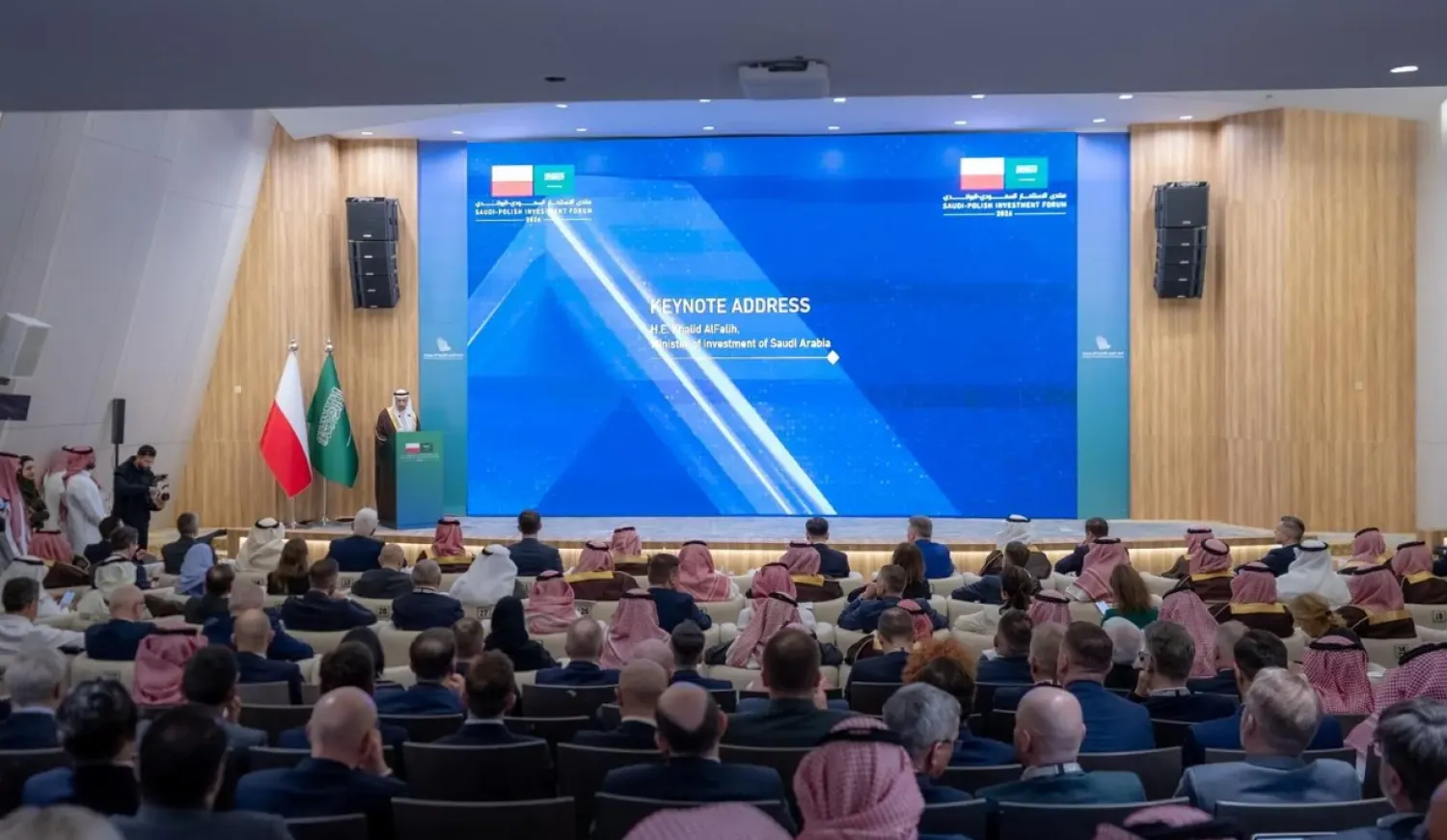

Saudi-Polish Investment Forum Explores Prospects for Economic and Investment Cooperation

The forum brought together government officials, business leaders, and investors from both countries with the aim of enhancing economic cooperation - SPA
TT

Saudi-Polish Investment Forum Explores Prospects for Economic and Investment Cooperation

The forum brought together government officials, business leaders, and investors from both countries with the aim of enhancing economic cooperation - SPA

The Saudi-Polish Investment Forum was held today at the headquarters of the Federation of Saudi Chambers in Riyadh, with the participation of Minister of Investment Khalid Al-Falih, Minister of Finance of the Republic of Poland Andrzej Domański, and Vice President of the Federation of Saudi Chambers Emad Al-Fakhri.

The forum brought together government officials, business leaders, and investors from both countries with the aim of enhancing economic cooperation, expanding investment partnerships in priority sectors, and exploring high-quality investment opportunities that support sustainable growth in Saudi Arabia and Poland.

During a dedicated session, the forum reviewed economic and investment prospects in both countries through presentations highlighting promising opportunities, investment enablers, and supportive legislative environments.

Several specialized roundtables addressed strategic themes, including the development of the digital economy, with a focus on information and communication technologies (ICT), financial technologies (fintech), and artificial intelligence-driven innovation, SPA reported.

Discussions also covered the development of agricultural value chains from production to market access through advanced technologies, food processing, and agricultural machinery. In addition, participants examined ways to enhance the construction sector by developing systems and materials, improving execution efficiency, and accelerating delivery timelines. Energy security issues and the role of industrial sectors in supporting economic transformation and sustainability were also discussed.

The forum witnessed the announcement of two major investment agreements. The first aims to establish a framework for joint cooperation in supporting investment, exchanging information and expertise, and organizing joint business events to strengthen institutional partnerships.

The second agreement focuses on supporting reciprocal investments through the development of financing and insurance tools and the stimulation of joint ventures to boost investment flows.

The forum concluded by emphasizing the importance of continued coordination and dialogue between the public and private sectors in both countries to deepen Saudi-Polish economic relations and advance shared interests.


US Says it Will Not Hit Iran Energy Sector

FILE PHOTO: US President Donald Trump and Secretary of Energy Chris Wright attend a roundtable on the Ratepayer Protection Pledge in the Indian Treaty Room in the Eisenhower Executive Office Building on the White House campus in Washington, D.C., US, March 4, 2026. REUTERS/Nathan Howard/File Photo
TT

US Says it Will Not Hit Iran Energy Sector

FILE PHOTO: US President Donald Trump and Secretary of Energy Chris Wright attend a roundtable on the Ratepayer Protection Pledge in the Indian Treaty Room in the Eisenhower Executive Office Building on the White House campus in Washington, D.C., US, March 4, 2026. REUTERS/Nathan Howard/File Photo

The United States will spare Iran's energy infrastructure as it wages war with Israel against Tehran, Energy Secretary Chris Wright said Sunday.

With oil prices rising dramatically, he told CNN that disruptions to the petroleum and gas industry will be short lived -- "worst case, that's a few weeks. That's not months."

Israel attacked oil storage facilities Saturday in and around Tehran, sparking huge fires in the first such attacks reported since the war started last weekend. Wright seemed to downplay them.

"These are Israeli strikes, these are local fuel depots to fill up the gas tank," Wright said.

He added: "The US is targeting zero energy infrastructure. There are no plans to target Iran's oil industry, their natural gas industry, or anything about their energy industry."

The war has all but shut down the Strait of Hormuz, through which nearly 20 percent of the world's crude oil and about 20 percent of liquefied natural gas usually transit.

Energy markets have been roiled by this disruption and oil prices shot up. West Texas Intermediate, the US benchmark for oil, rose 12 percent just on Friday and is up 36 percent in a week.

"They shouldn't go much higher than they are here because the world is very well supplied with oil," Wright told CBS. "There's no energy shortage in all of the Western hemisphere."

US insurer AAA said US gasoline prices at the pump have gone up 16 percent in a week and diesel by 22 percent.

The website GasBuddy says diesel fuel, used extensively in trucking, had not been this expensive since February 2023.

Gasoline prices are closely watched in this country where cars are king and they could become a factor as America heads toward mid-term elections in November. Trump's approval rating was low even before the war.

"What you're seeing is emotional reactions and fear that this is a long term war," Wright said on CBS, according to AFP. "This is not a long-term war."

He said the United States is now talking with shipping companies eager to get their vessels out of the Gulf.

"Early tankers probably will involve some direct protection by the US military" to get through the Strait of Hormuz, he said, adding that he thinks traffic will return to normal "relatively soon."

Iran accounts for about four percent of world oil production, according to the US Energy Information Administration.

Its oil industry is subject to international sanctions but some is still exported, mainly to China, oil industry data shows.

US Treasury Secretary Scott Bessent said Friday the government was considering lifting sanctions on more Russian oil, a day after it temporarily authorized India to buy from Moscow as global oil prices surged.

The US International Development Finance Corporation also said Friday it is creating a reinsurance mechanism of up to $20 billion to cover risk associated with travel through the Strait of Hormuz.


Iraqi Oil Production Collapses as Hormuz Still Blocked by US-Iran War, Sources Say

Pumping station at the end of the Druzhba oil pipeline in Schwedt, Germany (AP)
TT

Iraqi Oil Production Collapses as Hormuz Still Blocked by US-Iran War, Sources Say

Pumping station at the end of the Druzhba oil pipeline in Schwedt, Germany (AP)

Iraqi oil production from its main southern oilfields has fallen by 70% to just 1.3 million barrels per day as the country is unable to export oil via the Strait of Hormuz due to the Iran war, 3 industry sources said on Sunday.

According to Reuters, production from the fields stood at around 4.3 million bpd before the war.


Egyptian Pound Hits Record Low as Mideast War Roils Markets

One of the ATMs in downtown Cairo, the Egyptian capital (AFP)
TT

Egyptian Pound Hits Record Low as Mideast War Roils Markets

One of the ATMs in downtown Cairo, the Egyptian capital (AFP)

Egypt's currency fell to a record low, trading at over 52 to the US dollar on Sunday, as the economic fallout of the war in the Middle East hits the region's most populous country.

The US-Israeli war on Iran has expanded across the Gulf and beyond, upending global energy markets and trade, and virtually halting traffic in the Strait of Hormuz, through which a fifth of the world's crude oil travels.

President Abdel Fattah al-Sisi last week warned that the country was in a "state of near-emergency", warning of renewed inflationary pressures.

Despite Egypt not having been directly hit by the war, the fighting has nonetheless pushed some shipping companies away from its Suez Canal, a key source of foreign currency.

Egypt's import-dependent economy has proved highly sensitive to currency fluctuations in the past.

Inflation -- 11.9 percent in January -- peaked at nearly 40 percent in August 2023, on the back of a punishing economic crisis that has since eased, thanks in part to an over $50 billion bailout.