


Israeli Drone Strike Kills 2 Cyclists in Gaza as Death Toll Mounts Despite Ceasefire

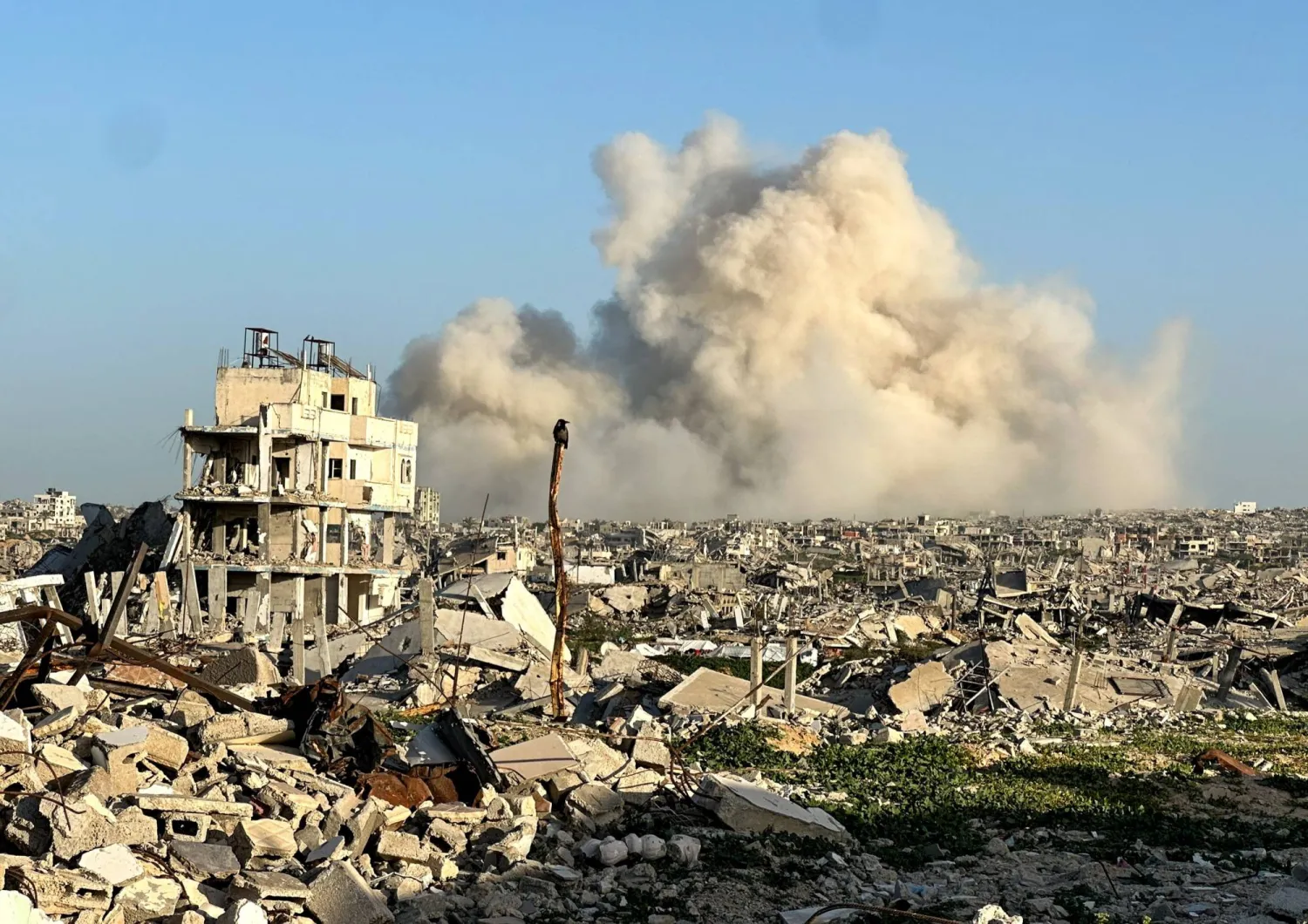
 Smoke rises following an explosion, within the "yellow line" zone, which is controlled by Israel, in Khan Younis in the southern Gaza Strip, February 10, 2026. (Reuters)
Smoke rises following an explosion, within the "yellow line" zone, which is controlled by Israel, in Khan Younis in the southern Gaza Strip, February 10, 2026. (Reuters)
TT

Israeli Drone Strike Kills 2 Cyclists in Gaza as Death Toll Mounts Despite Ceasefire

 Smoke rises following an explosion, within the "yellow line" zone, which is controlled by Israel, in Khan Younis in the southern Gaza Strip, February 10, 2026. (Reuters)
Smoke rises following an explosion, within the "yellow line" zone, which is controlled by Israel, in Khan Younis in the southern Gaza Strip, February 10, 2026. (Reuters)

An Israeli drone strike killed two Palestinians on bicycles Tuesday, hospital officials said, marking the latest deaths since an October ceasefire that hasn't halted deadly attacks in the Gaza Strip.

Al-Aqsa Martyrs Hospital said the two men were hit near the ceasefire line that divides Gaza, with one half under Israeli military control. They were hit in eastern Deir al-Balah, the hospital said, adding that it also received the body of a woman who was killed by Israeli gunfire in central Maghazi refugee camp.

Israel's military did not immediately respond to questions about either strike. It has previously said its forces respond to ceasefire violations or attacks on its soldiers.

Gaza's Health Ministry on Tuesday said reported 586 Palestinians had been killed since the start of the ceasefire, bringing the cumulative toll to 72,037 killed since the start of Israel's offensive. The ministry, which is part of the Hamas-led government, maintains detailed casualty records that are seen as generally reliable by UN agencies and independent experts.

Deadly Israeli strikes have repeatedly disrupted the truce since it took effect on Oct. 10. The escalating Palestinian toll has prompted many in Gaza to say it feels like the war has continued unabated.

Yet parts of the agreement outlined in last year’s ceasefire are moving forward. After a chaotic first week, officials say more Palestinians are entering and leaving Gaza for Egypt via the reopened Rafah crossing. Plans for an international peacekeeping force meant to provide security in Gaza are also beginning to take shape.

Indonesia — the world's most populous Muslim-majority country — said Tuesday that its military had begun training personnel to serve in Gaza, specifically for reconstruction and humanitarian response. Its army chief of staff said between 5,000 and 8,000 troops were preparing to deploy.

Vahd Nabyl Achmad Mulachela, a spokesperson for Indonesia’s Foreign Affairs Ministry, said Indonesian troops would not take part in disarmament — one of the most contentious and unresolved elements of the peace plan.

Indonesia’s President Prabowo Subianto told the UN General Assembly in October that his country planned to contribute troops, even as details about the force’s role and mandate was unclear. The commitment came as Prabowo sought closer ties with US President Donald Trump.

Israel and Hamas remain divided over the timeline and scope of Israel’s withdrawal and the demilitarization of the enclave after nearly two decades of Hamas rule.

The temporary International Stabilization Force outlined last year in Trump’s 20-point peace plan — among the key components of the demilitarization effort— is envisioned as a later phase of the plan.

The war began when Hamas-led fighters stormed into southern Israel and killed around 1,200 people, mostly civilians, on Oct. 7, 2023. The 251 hostages taken in the attack were returned to Israel in various ceasefire agreements, with the remains of Israeli police officer Ran Gvili — the final body in Gaza — were found and returned in January, paving the way for the advance of the ceasefire agreement. The war has sparked worldwide protests and brought allegations of genocide that Israel denies.



China, Jordan Call for Maintaining US-Iran Ceasefire

China's President Xi Jinping, right, and King Abdullah II of Jordan shake hands after a signing ceremony at the Great Hall of the People in Beijing, Monday, Aug. 24, 2026. (Andres Martinez Casares/Pool Photo via AP)
TT

China, Jordan Call for Maintaining US-Iran Ceasefire

China's President Xi Jinping, right, and King Abdullah II of Jordan shake hands after a signing ceremony at the Great Hall of the People in Beijing, Monday, Aug. 24, 2026. (Andres Martinez Casares/Pool Photo via AP)

China and Jordan on Monday said the ceasefire between the US and Iran should be maintained, and that the normal passage through the Strait of ⁠Hormuz should be restored, ⁠the two countries said in a jointed statement, according to China's Xinhua ⁠news agency.

Chinese President Xi Jinping met with Jordan's King Abdullah in Beijing on Monday.

China and Jordan said "a comprehensive solution capable of eliminating the root causes" of regional tensions should be reached through dialogue and negotiations.

The two ⁠also expressed "deep ⁠concern over Israel's dangerous escalatory actions in the West Bank and East Jerusalem."

China's President Xi Jinping, left, and King Abdullah II of Jordan review the honor guard during a welcoming ceremony at the Great Hall of the People in Beijing, Monday, Aug. 24, 2026. (Andres Martinez Casares/Pool Photo via AP)

Xi told King Abdullah that China values Jordan's "unique and important role in the region,” which was thrown into crisis after the United States and Israel launched strikes against Iran on February 28.

"China has always advocated for a comprehensive ceasefire (and) resolving disputes through political and diplomatic means," Xi said, according to a Chinese foreign ministry statement.

"(China) believes the sovereignty and security of regional countries including Jordan should be respected," Xi said.

The Chinese president also urged on Monday a "comprehensive, just and lasting solution to the Palestinian issue,” the foreign ministry statement said.

China supports "promoting the resumption of Israeli-Palestinian peace talks anchored on the correct direction of the 'two-state solution'," Xi said.

The two sides also signed several agreements on diplomacy, trade and supply chains, China's foreign ministry said.


Iraq Pushes Back Deadline for Factions to Disarm

This handout photograph taken and released by the Iraq's Prime Minister Media Office on August 19, 2026 shows Iran's Parliament Speaker Mohammad Bagher Ghalibaf (R) shaking hands with Iraq's Prime Minister Ali al-Zaidi before their meeting in Baghdad. (Iraq's Prime Minister Media Office / AFP)
TT

Iraq Pushes Back Deadline for Factions to Disarm

This handout photograph taken and released by the Iraq's Prime Minister Media Office on August 19, 2026 shows Iran's Parliament Speaker Mohammad Bagher Ghalibaf (R) shaking hands with Iraq's Prime Minister Ali al-Zaidi before their meeting in Baghdad. (Iraq's Prime Minister Media Office / AFP)

A senior Iraqi official pushed back a September 30 deadline for pro-Iran factions to hand over their weapons, without offering an explanation for the move or providing a new date.

Iraq has come under pressure from the United States to rein in armed factions, particularly those close to Iran.

The US and Iran have been at war since February 28, drawing in other countries in the region as well as non-state groups backed by the Islamic republic.

For several months, Iraq's government has stood by its deadline, but on Sunday, the security adviser to the prime minister, Qasim al-Araji, told state media the process would only begin at the end of next month.

"September 30 is the date for the international coalition to depart, not the deadline to hand over weapons," Araji told the Al Iraqiya broadcaster, referring to the coalition of US-led forces.

Government spokesman Haider al-Aboudi had made a similar announcement to local media on Friday, despite announcing in June that factions had until the end of September to disarm.

September 30, he said, was "the date for the international coalition to end its presence, not the deadline for armed factions... Perhaps people are confusing the two."

Since taking office in May, Prime Minister Ali al-Zaidi has pledged to ensure the armed factions that emerged in the years that followed the US-led invasion hand over their weapons to the state.

While some factions have in recent weeks said they would join state institutions, others, in particular those closer to Iran, are refusing.

"The situation is extremely complicated," a government official told AFP, requesting anonymity because he was not authorized to speak on the matter.

"The government is insisting on closing the weapons file; but faction leaders are determined to hold onto their weapons because they believe disarming would serve Israel and the United States."

The most powerful armed factions in Iraq include Kataib Hezbollah, a part of Iran's so-called "Axis of Resistance" against the US and Israel.

Another Iraqi source told AFP that Iran views its proxies in the region, "especially in Iraq, as a source of strength it refuses to give up".


Syria Sentences Assad-Era Top Muslim Cleric to Life Imprisonment

Ahmed Hassoun during proceedings before the Fourth Criminal Court in Damascus. (SANA file photo)
TT

Syria Sentences Assad-Era Top Muslim Cleric to Life Imprisonment

Ahmed Hassoun during proceedings before the Fourth Criminal Court in Damascus. (SANA file photo)

A Syrian court on Monday handed a life sentence to Ahmed Hassoun, the country's former grand mufti under ousted leader Bashar al-Assad, convicting him of crimes including inciting sectarian strife and exploiting his position. 

Hassoun, the 10th Assad-era figure to be sentenced under the new authorities, was Syria's top Muslim cleric for 16 years. 

He was known for his close ties to the former president and frequent appearances alongside him on religious occasions. 

Judge Fakhr al-Din al-Aryan said Hassoun, 77, was guilty of a raft of charges including "inciting civil war and sectarian strife", for which he was jailed for life. 

The cleric was also convicted of "incitement to intentional homicide", "principal complicity in intentional homicide", and "inciting sectarian and racial strife", for which he was handed additional terms ranging from three to 20 years. 

The court also decided to confiscate Hassoun's assets and hand them to the public treasury. 

His sentencing is the first against a religious figure since Syrian authorities began trying Assad-era officials in April. 

On August 11, Syria sentenced Bashar al-Assad, his brother Maher and five other security officials to death in absentia for atrocities committed during Syria's civil war, the first such ruling under the new authorities. 

The former president fled Syria as his government fell in December 2024 and is believed to be in Russia. 

Authorities have also handed death sentences to Atif Najib and Wassim al-Assad, cousins of the former ruler who were tried in person. 

Hassoun, a native of Aleppo whose late father was also an important religious figure, was arrested at Damascus airport in March last year as he tried to flee the country. 

Though he held the post of grand mufti for more than a decade, Hassoun lost the title in 2021 when Syria abolished the position. 

Syria began legal proceedings in April against Bashar al-Assad and other officials accused of atrocities during the civil war, which erupted in 2011 with brutal repression of pro-democracy protesters. 

More than half a million people were killed and millions displaced during the conflict, while tens of thousands disappeared.