Eisenkot Vows to Bring About New Israeli Government Swiftly

Gadi Eisenkot celebrates with his party members after a voting session for the new Knesset speaker at the Knesset, the Israeli parliament, in Jerusalem, Israel, 17 November 2026. (EPA)
TT

Eisenkot Vows to Bring About New Israeli Government Swiftly

Gadi Eisenkot celebrates with his party members after a voting session for the new Knesset speaker at the Knesset, the Israeli parliament, in Jerusalem, Israel, 17 November 2026. (EPA)

Gadi Eisenkot, who has been tasked with forming the next Israeli government, on Friday vowed not to let coalition-building talks drag on as his wide-ranging bloc faces divisions on the way forward.

The former military chief's remarks appear as a warning to his own camp, which is split over whether to forge alliances with the ultra-Orthodox parties, Arab-majority lists, or whether to form a national unity government with caretaker prime minister Benjamin Netanyahu.

"I have no intention of letting this drag on. When the time is right, I will bring a new government before the Knesset for its approval, a good government that I will lead," Eisenkot wrote on X in a message about ongoing negotiations.

Eisenkot has until next month to form a government to replace Netanyahu, after the October election failed to deliver a clear majority for either of them.

While denying any attempt to force through a coalition, Eisenkot stressed the need to act fast.

"We are in very dangerous territory. The outgoing prime minister is acting in ways we have never seen before," he said.

"Military priorities have become entangled with political interests, and the timetable for military operations with the political calendar," he added.

Members of Israel's opposition suspect Netanyahu could launch a new military operation against Iran in order to derail talks and remain in power.

Should efforts to create a broad-based government fail, Eisenkot said he would be prepared to put forward a minority national emergency government for a parliamentary vote.

"Every member of the Knesset will have to follow their conscience and decide whether to allow a new government to take office or whether they are prepared to drag Israel and its citizens into another election with Netanyahu still serving as caretaker prime minister," he said.

These remarks were the clearest sign yet of Eisenkot's growing impatience nearly two weeks after being tasked by President Isaac Herzog with forming a government.

Eisenkot's 48-seat bloc is well short of the 61 needed for a majority in parliament and its members are divided over how to proceed.

Eisenkot appears ready to form a minority government with external backing from the 19 lawmakers in the Arab-majority Raam and Joint List.

But nationalist Avigdor Liberman, who sits in Eisenkot's bloc, has repeatedly refused such an option and instead said he is open to working with the two ultra-Orthodox parties, Shas and United Torah Judaism (UTJ).

Complex negotiations have been underway since.

Netanyahu, meanwhile, is pushing hard for a national unity government, an option that also seems favored by Eisenkot's most important partner, former prime minister Naftali Bennett.


Young Protesters Hit the Streets Across Europe

People use flares and display a banner as they take part in a march as part of a general strike, in Milan, Italy, 20 November 2026. (EPA)
TT

Young Protesters Hit the Streets Across Europe

People use flares and display a banner as they take part in a march as part of a general strike, in Milan, Italy, 20 November 2026. (EPA)

Protesters rallied across Europe Friday to vent their anger over issues from high living costs to military spending and the climate crisis, ramping up pressure on political leaders they accuse of ignoring the concerns of young people.

Demonstrators hit the streets in cities from Italy to Germany, Austria and Britain, many waving signs emblazoned with "fight for our future", setting off flares and burning cardboard models of tanks.

The rallies, coordinated by a youth-led coalition of over 50 groups, are fueled by grievances that vary from place to place, including Israel's war in Gaza, high rents and deteriorating learning conditions at schools and universities.

But a common theme runs through them -- a sense that governments across the continent are too busy with geopolitical crises and helping big business and not investing enough in the well-being of younger generations.

Olivia Ferrario, an 18-year-old high school student at a protest in the Italian city of Milan, told AFP that young people were displaying their "dynamism and determination" by taking to the streets.

"If the government does not listen to us, we cannot remain silent," she said at the demonstration that attracted tens of thousands of protesters.

Police are deploying in large numbers due to fears of a repeat of the street violence that has marred recent major protests in France and other countries.

- 'Lost so much hope' -

In Berlin, about 1,000 university students and school pupils protested over concerns including Germany's rapid rearmament, which has fueled fears of a return to compulsory military service.

"I simply think it's indefensible... to force someone to learn how to fight and kill, and then send them to war," Helena Kossatz, 18, who finished high school last year, told AFP.

While Europe seeks to rearm in the face of a hostile Russia, organizers of the continent-wide protests say funds allocated to rearmament should be spent on education, youth policies and housing.

Several hundred protesters, some in school uniform, gathered at demonstrations in London outside parliament and in nearby Trafalgar Square, waving placards that said "save higher education" and "Fight for our futures not their wars".

"I've lost so much hope," Eliz, who had taken the day off from college and gave only one name, told AFP.

The 18-year-old said she was unsure whether she would go to university, "because of money. Because most jobs are getting taken over by AI. Everyone's just kind of more depressed".

There were scuffles between groups of right-wing and anti-fascist demonstrators, and AFP saw a handful of arrests.

Chants of "Palestine will live forever" rang out at the London protests, and Palestinian flags were on display at several of the demonstrations across Europe.

In Rome, high school students marched behind a banner that read: "We will take freedom if no one gives it to us -- against the government, the war and the high cost of living."

There were scuffles in the Italian capital, with some protesters throwing bottles and smoke bombs at police.

- 'Dreadful' schools -

Demonstrators called for more funding for education and railed against increased military spending during protests in the Spanish capital Madrid.

Gabriela Gimeno Serrano, a 16-year-old high school student, said there were 33 students in her class with just one teacher.

"Classrooms are very small, the facilities are in an absolutely dreadful state," she told AFP, adding some schools were even plagued by rats and cockroaches.

Protests are set to extend into the weekend, with trade unions and housing associations calling for further demonstrations.

The protests come around the anniversary of the Yellow Vests movement in France, which rattled President Emmanuel Macron in 2018 and 2019. Demonstrations are planned there on Saturday.

The protests in European countries have in part been inspired by recent demonstrations in France, which have sometimes turned violent.

Those began when students demonstrated at high schools in mid-September to demand better learning conditions, fueling a nationwide campaign against soaring prices, inadequate public services and police brutality.


Eisenkot Vows to Bring About New Israeli Government Swiftly

Gadi Eisenkot celebrates with his party members after a voting session for the new Knesset speaker at the Knesset, the Israeli parliament, in Jerusalem, Israel, 17 November 2026. (EPA)
TT

Eisenkot Vows to Bring About New Israeli Government Swiftly

Gadi Eisenkot celebrates with his party members after a voting session for the new Knesset speaker at the Knesset, the Israeli parliament, in Jerusalem, Israel, 17 November 2026. (EPA)

Gadi Eisenkot, who has been tasked with forming the next Israeli government, on Friday vowed not to let coalition-building talks drag on as his wide-ranging bloc faces divisions on the way forward.

The former military chief's remarks appear as a warning to his own camp, which is split over whether to forge alliances with the ultra-Orthodox parties, Arab-majority lists, or whether to form a national unity government with caretaker prime minister Benjamin Netanyahu.

"I have no intention of letting this drag on. When the time is right, I will bring a new government before the Knesset for its approval, a good government that I will lead," Eisenkot wrote on X in a message about ongoing negotiations.

Eisenkot has until next month to form a government to replace Netanyahu, after the October election failed to deliver a clear majority for either of them.

While denying any attempt to force through a coalition, Eisenkot stressed the need to act fast.

"We are in very dangerous territory. The outgoing prime minister is acting in ways we have never seen before," he said.

"Military priorities have become entangled with political interests, and the timetable for military operations with the political calendar," he added.

Members of Israel's opposition suspect Netanyahu could launch a new military operation against Iran in order to derail talks and remain in power.

Should efforts to create a broad-based government fail, Eisenkot said he would be prepared to put forward a minority national emergency government for a parliamentary vote.

"Every member of the Knesset will have to follow their conscience and decide whether to allow a new government to take office or whether they are prepared to drag Israel and its citizens into another election with Netanyahu still serving as caretaker prime minister," he said.

These remarks were the clearest sign yet of Eisenkot's growing impatience nearly two weeks after being tasked by President Isaac Herzog with forming a government.

Eisenkot's 48-seat bloc is well short of the 61 needed for a majority in parliament and its members are divided over how to proceed.

Eisenkot appears ready to form a minority government with external backing from the 19 lawmakers in the Arab-majority Raam and Joint List.

But nationalist Avigdor Liberman, who sits in Eisenkot's bloc, has repeatedly refused such an option and instead said he is open to working with the two ultra-Orthodox parties, Shas and United Torah Judaism (UTJ).

Complex negotiations have been underway since.

Netanyahu, meanwhile, is pushing hard for a national unity government, an option that also seems favored by Eisenkot's most important partner, former prime minister Naftali Bennett.


Bessent Says Still Living at US Military Base, Vows to Squeeze Iran

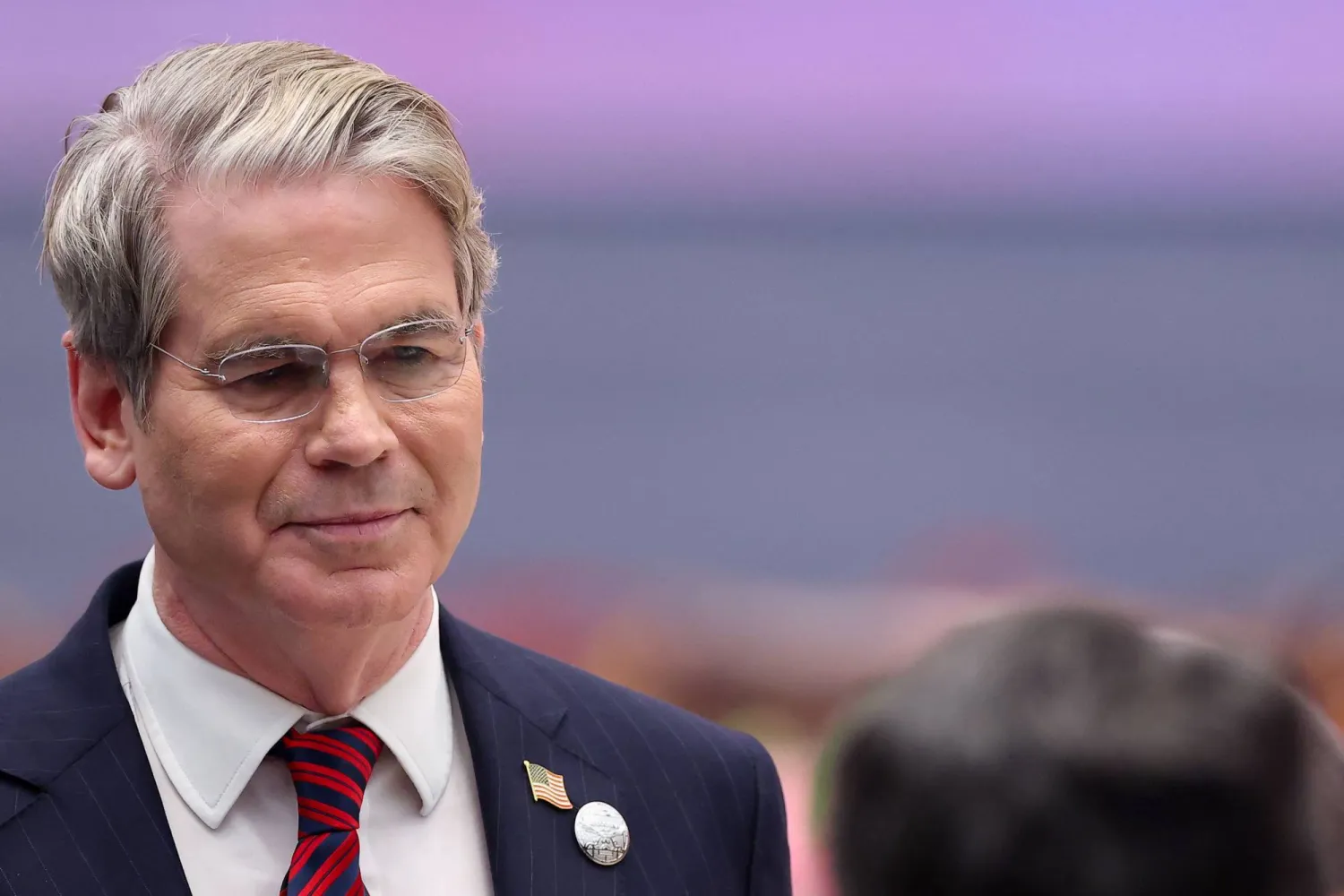
 US Treasury Secretary Scott Bessent attends a welcome banquet for the Asia-Pacific Economic Cooperation (APEC) Economic Leaders' Meeting at the Shenzhen International Communication Center in Shenzhen, Guangdong province on November 18, 2026. (AFP)
US Treasury Secretary Scott Bessent attends a welcome banquet for the Asia-Pacific Economic Cooperation (APEC) Economic Leaders' Meeting at the Shenzhen International Communication Center in Shenzhen, Guangdong province on November 18, 2026. (AFP)
TT

Bessent Says Still Living at US Military Base, Vows to Squeeze Iran

 US Treasury Secretary Scott Bessent attends a welcome banquet for the Asia-Pacific Economic Cooperation (APEC) Economic Leaders' Meeting at the Shenzhen International Communication Center in Shenzhen, Guangdong province on November 18, 2026. (AFP)
US Treasury Secretary Scott Bessent attends a welcome banquet for the Asia-Pacific Economic Cooperation (APEC) Economic Leaders' Meeting at the Shenzhen International Communication Center in Shenzhen, Guangdong province on November 18, 2026. (AFP)

Treasury Secretary Scott Bessent said on Friday he was still living at a US military base after receiving unspecified threats ‌from Iran, ‌but vowed ‌to continue ⁠squeezing the country ⁠economically.

"If the Iranians are after me, it means that they ⁠are being squeezed. We're ‌going ‌to continue squeezing ‌them," Bessent ‌said in an interview with CNBC.

The Treasury has been tightening sanctions ‌on Iran. The US and Israel launched ⁠strikes ⁠against Iran in February and the conflict is simmering in the region despite intermittent talks on a resolution.

SINGAPORE AND MALAYSIA

Separately, US Treasury Department officials met with government authorities in Singapore and Malaysia this week, including regulators and national security bodies, to warn of potential risks they could face if they do not comply with US sanctions on Iran. 

Washington is urging the countries, as well as law firms and banks operating there, to stay alert for Iranian front companies, as it steps up efforts to enforce sanctions in Asia and bring about a speedy end to the conflict in the Middle East. 

The US is urging additional scrutiny on "high-risk" sectors such as maritime transport, aviation services and procurement networks, "to make sure they're not fronting for Iran," said a Treasury Department official. 

"We want it to be understood too, that we're going to target these lifelines, and it's ‌not going to ‌be a negotiation when we find a lifeline that needs to be targeted," ‌the ⁠official said. 

Since the ⁠US and Israel commenced strikes on Iran in February, the US has intensified actions to throttle Tehran's business interests overseas. 

In August, President Donald Trump's administration launched Operation Economic Outcast, resulting in a barrage of sanctions against targets spanning Canadian digital currency platforms to a major Russian banking group. 

OIL ON WATER 

For years, tankers have regularly made stops in the waters around Malaysia, Singapore and Indonesia to make ship-to-ship transfers of Iranian oil that help obscure its origin. 

Last year, Malaysian authorities said they would more tightly enforce rules around these transfers and in February seized two tankers and their cargoes. 

Since ⁠April, the US Navy has imposed a blockade on shipping reaching Iran through ‌the Strait of Hormuz, and this month has cracked down on ‌movement over Iran's land borders and through the Caspian Sea. 

In July, the Treasury Department sanctioned dozens of individuals, vessels and companies ‌based in Singapore, Hong Kong, the UAE, the Marshall Islands and St Kitts and Nevis linked to Iranian ‌oil magnate Mohammad Hossein Shamkhani. 

These efforts were starting to disrupt Iran's source of revenue, the US official said, citing data showing that the country is currently undergoing the worst GDP contraction in four decades and the highest rate of inflation since World War II. 

IRANIAN AIRLINES 

However, the official said there was still work to be done. 

"There's an Iranian airline that flies ‌to Malaysia, or has, recently, so we raised this," the US official said, without naming the carrier. 

Using public flight records, Reuters identified a regularly scheduled flight between ⁠Tehran and Kuala Lumpur ⁠operated by Iran Airtour, which flew as recently as November 14. A scheduled flight on November 17 did not depart, the records also show. 

Iran Airtour did not respond to an emailed request for comment sent outside of business hours on Friday. 

Most Iranian airlines largely stopped flying to Malaysia in 2022 due to US sanctions on refueling Iranian planes. However, Iran Airtour, a privately owned airline, resumed flights to Malaysia in November 2025, according to Iranian media. 

On September 8, the US imposed sanctions on dozens of companies in the UAE, Britain, Malaysia, Türkiye and Kazakhstan it said were supporting Iran's aviation sector to move weapons, personnel and illicit cargo. 

The following day, Iran Air officials met with Malaysia's ambassador to Iran to discuss resuming direct flights between Iran and Kuala Lumpur. 

'DOING OUR PART' 

Both Malaysia and Singapore implement UN Security Council sanctions on Iran. 

Singapore's government said in a statement it "is firmly committed to doing our part" and "preventing bad actors from abusing our corporate vehicles," citing its efforts to strengthen vigilance in the maritime and financial industries this year. 

The Malaysian government did not respond to requests for comment.