


Trump Hints at Second Carrier in Middle East as Iran and US Near Talks 

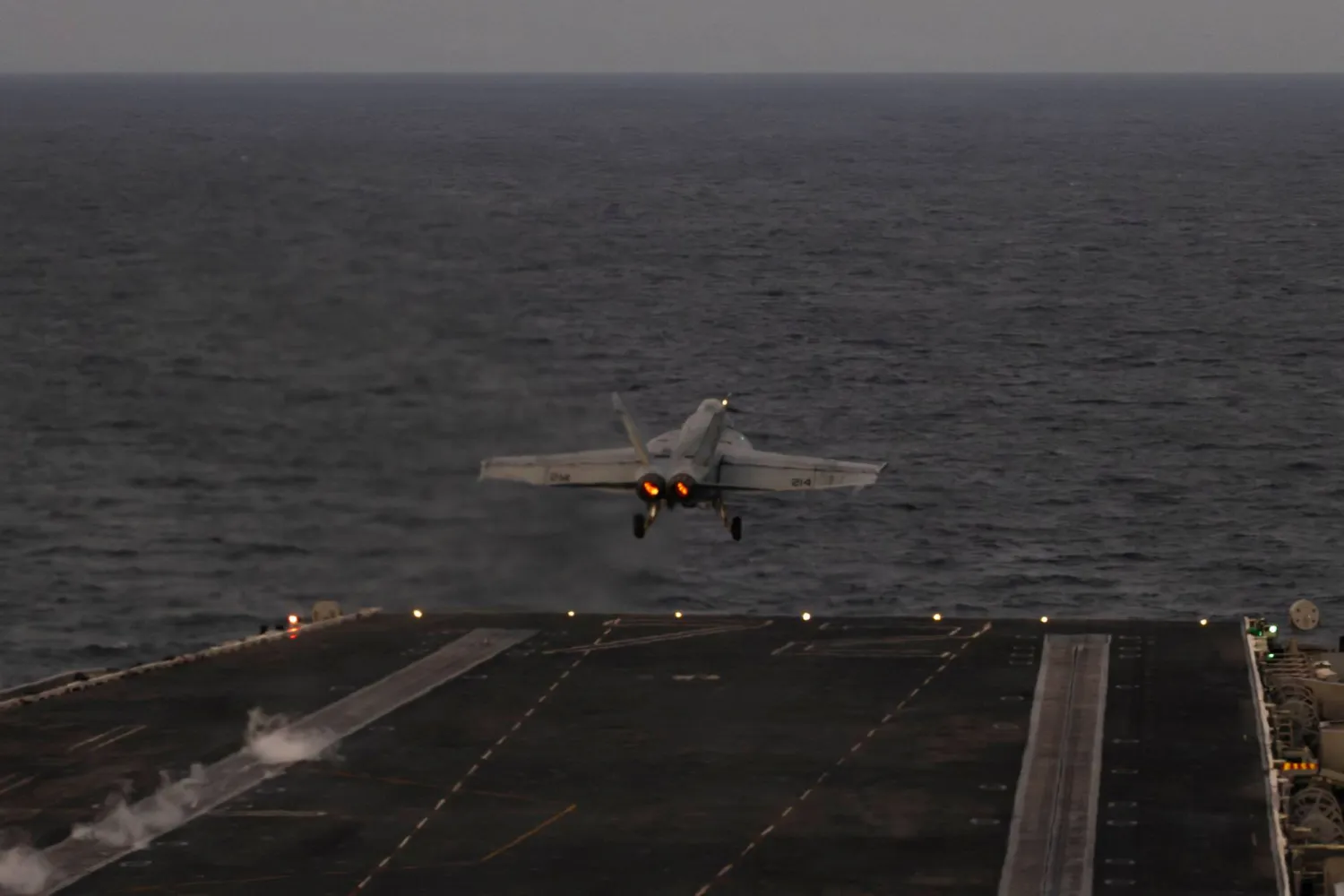
In this handout photograph released by the US Navy on February 5, 2026, an F/A-18E Super Hornet, attached to Strike Fighter Squadron (VFA) 14, launches from the flight deck of Nimitz-class aircraft carrier USS Abraham Lincoln in the Arabian Sea on February 3, 2026. (AFP / US Navy / Mass Communication Specialist Seaman Zoe Simpson)
TT

Trump Hints at Second Carrier in Middle East as Iran and US Near Talks 

In this handout photograph released by the US Navy on February 5, 2026, an F/A-18E Super Hornet, attached to Strike Fighter Squadron (VFA) 14, launches from the flight deck of Nimitz-class aircraft carrier USS Abraham Lincoln in the Arabian Sea on February 3, 2026. (AFP / US Navy / Mass Communication Specialist Seaman Zoe Simpson)

US President Donald Trump on Tuesday said he was considering sending a second aircraft carrier to the Middle East, even as Washington and Tehran prepare to resume negotiations aimed at averting a new conflict.

Oman facilitated talks between Iran and the US last week, which a spokesperson for Iran's foreign ministry said had allowed Tehran to gauge Washington's seriousness and showed enough consensus for diplomacy to continue.

The talks came after Trump had positioned one aircraft carrier in the region, raising fears of new military action. Trump, who joined an Israeli bombing campaign last year and hit Iranian nuclear sites, had threatened last month to intervene militarily during a bloody government crackdown on nationwide protests in Iran, but ultimately held off.

In interviews with Israeli media, Trump said the United States would have to do "something very tough" if a deal is not reached with Iran.

"Either we reach a deal or we'll have ‌to do something very tough," ‌Israel's Channel 12 quoted him as saying.

The date and venue of the next ‌round ⁠of US-Iran talks have ‌yet to be announced.

Trump told Channel 12 and Axios that he was also considering sending a second aircraft carrier to the Middle East.

The USS George Washington in Asia and the USS George HW Bush on the US east coast are the most likely candidates, officials have told Reuters, but each is at least a week away from the Middle East. The Pentagon could also deploy the Ford carrier from the Caribbean.

"After the talks, we felt there was understanding and consensus to continue the diplomatic process," said the Iranian foreign ministry spokesman, Esmaeil Baghaei.

Baghaei said Tuesday's trip to Oman by Ali Larijani, an adviser to Supreme Leader Ali Khamenei, had been pre-planned, and that Larijani would travel next ⁠to Qatar, which has also mediated in several Middle East crises.

Oil prices eased on Tuesday as traders remained focused on Iran-US tensions.

A Reuters analysis of satellite images showed a ‌recent build-up of aircraft and other military equipment across the region.

DIFFERENCE ‍OVER WHETHER TO DISCUSS MISSILE STOCKPILE

Oman's state news agency said Larijani and Omani Sultan Haitham bin Tariq discussed ways to reach a "balanced and just" agreement between Iran and the US, stressing the importance of returning to dialogue to bridge differences and promote regional and global peace and security.

The US is seeking to expand the scope of negotiations with Iran beyond the nuclear issue to curb Iran's ballistic missile program, one of the biggest in the Middle East.

Tehran says its missile arsenal has been rebuilt since last year's 12-day bombing campaign by Israel and the US, and that its stockpile is non-negotiable.

Israeli Prime Minister Benjamin Netanyahu is expected to use a ⁠meeting with Trump in Washington on Wednesday to push for any US-Iran deal to include limitations on Tehran's missiles.

Baghaei said the US "must act independently of foreign pressures, especially Israeli pressures that ignore the interests of the region and even the US."

In any negotiations, Iran would continue to demand the lifting of financial sanctions and insist on its nuclear rights including enrichment, Iranian President Masoud Pezeshkian has said.

Washington has demanded Iran relinquish its stockpile of uranium enriched to up to 60% fissile purity, a small step away from the 90% that is considered weapons grade.

VANCE SAYS TRUMP WILL DECIDE RED LINES

The head of Iran's Atomic Energy Organization, Mohammad Eslami, said on Monday: "The possibility of diluting 60% enriched uranium ... depends on whether, in return, all sanctions are lifted or not."

Asked whether the US would allow limited uranium enrichment by Iran, US Vice President JD Vance said during a visit to Armenia on Monday: "I think President Trump is going to make the ultimate determination about where we draw the red lines in the negotiations."

Iran and the US held five rounds of talks last year on curbing Tehran's nuclear program, with the ‌process breaking down mainly due to disputes over uranium enrichment inside Iran.

Since Trump struck Iran's facilities, Tehran has said it has halted enrichment activity. It has always said its nuclear program is solely for peaceful purposes.



Zelenskiy Says US Too often Asks Ukraine, Not Russia, for Concessions

Ukrainian President Volodymyr Zelenskiy speaks during the Munich Security Conference (MSC) in Munich, Germany, February 14, 2026. REUTERS/Liesa Johannssen
TT

Zelenskiy Says US Too often Asks Ukraine, Not Russia, for Concessions

Ukrainian President Volodymyr Zelenskiy speaks during the Munich Security Conference (MSC) in Munich, Germany, February 14, 2026. REUTERS/Liesa Johannssen

Ukrainian President Volodymyr Zelenskiy voiced hope on Saturday that US-brokered peace talks next week in Geneva would be serious and substantive, but said Ukraine was being asked "too often" to make concessions in the negotiations.

Ukrainian, Russian and American delegations are due to meet in the Swiss lakeside city on Tuesday and Wednesday as US President Donald Trump seeks to push through a deal to end Europe's biggest war since 1945.

"We truly hope that the trilateral meetings next week will be serious, substantive, helpful for all us but honestly sometimes it feels like the sides are talking about completely different things," Zelenskiy said in a speech at the annual Munich Security Conference.

Ukraine and Russia, which invaded its neighbour in February 2022, have engaged in two recent rounds of talks brokered by Washington in Abu Dhabi described by the sides as constructive but achieving no major breakthroughs.

Zelenskiy called for greater action from Ukraine's allies to press Russia into making peace - both in the form of tougher sanctions and more weapons supplies.

Recalling his appeal four years ago, when he spoke at the same conference days before tens of thousands of Russian forces poured into Ukraine, Zelenskiy said there was too much talk by Western officials and not enough action.

Trump has the power to force Putin to declare a ceasefire and needed to do so, Zelenskiy said. Ukrainian officials have said a ceasefire is required to hold a referendum on any peace deal, which would be organised alongside national elections.

The Ukrainian leader, a former television entertainer, acknowledged he was feeling "a little bit" of pressure from Trump, who yesterday said Zelenskiy should not miss the "opportunity" to make peace soon and urged him "to get moving".

"The Americans often return to the topic of concessions and too often those concessions are discussed only in the context of Ukraine, not Russia," Zelenskiy said.

Instead, Zelenskiy said, he wanted instead to hear what compromises Moscow would be ready for, as Ukraine had already made many of its own.

DEADLOCK OVER TERRITORY

Land remains the major sticking point in negotiations, with Russia demanding that Ukraine cede the remaining 20% of the eastern area of Donetsk that Moscow has failed to capture - something Kyiv steadfastly refuses to do.

Zelenskiy said he was instead ready to discuss a US proposal for a free trade zone in that region, while freezing the rest of the 1,200-km (745-mile) front line.

Russia occupies about 20% of Ukraine's national territory, including Crimea and parts of the eastern Donbas region seized before the full-scale invasion in 2022.

Analysts say Moscow has gained about 1.5% of Ukrainian territory since early 2024. Its recent air strikes on Ukraine's cities and electricity infrastructure have left hundreds of thousands of Ukrainians without heating and power during the course of a bitterly cold winter.

Ukrainian officials have repeatedly expressed concern in recent weeks that US. congressional mid-term elections in November could focus the Trump administration on domestic political issues after the summer.

Zelenskiy said he hoped the US would stay involved in the negotiations, and that there would be an opportunity for Europe, which he said was currently sidelined, to play a bigger role.

'EUROPE NOT PRESENT'

"Europe is practically not present at the table. It's a big mistake to my mind," he said.

Russia said its delegation to Geneva would be led by Putin adviser Vladimir Medinsky, a change from negotiations in Abu Dhabi at which Russia's team was led by military intelligence chief Igor Kostyukov.

Ukrainian sources have criticised Medinsky's handling of previous talks, accusing him of delivering history lessons to the Ukrainian team instead of engaging in substantive negotiations.

Zelenskiy, who has long argued that the best way to achieve peace is to force Russia to the table with military and economic pressure, said he had discussed with French President Emmanuel Macron and European Commission chief Ursula von der Leyen punitive steps against tankers that export Russian oil.

Oil exports are a key revenue source for the Russian state, and in recent months some empty tankers have been targeted by Ukrainian drones.

On Saturday France's foreign minister said some G7 countries have expressed readiness to enact a maritime services ban on Russian oil and that Paris was "reasonably optimistic" it would be included in the European Union's next sanctions package.


Nobel Winner Transferred to Prison in Northern Iran

A photo provided by the Narges Mohammadi Foundation on October 2, 2023 shows Iranian human rights activist Narges Mohammadi. © AFP
TT

Nobel Winner Transferred to Prison in Northern Iran

A photo provided by the Narges Mohammadi Foundation on October 2, 2023 shows Iranian human rights activist Narges Mohammadi. © AFP

Iranian authorities have, without prior warning, transferred Nobel Peace Prize winner Narges Mohammadi to a prison in the north of the country as concern grows over her health, her husband said on Saturday.

Mohammadi, who won the peace prize in 2023 in recognition for more than two decades of campaigning, was arrested on December 12 in the eastern city of Mashhad after speaking out against the clerical authorities at a funeral ceremony, AFP reported.

She spent time on hunger strike earlier this month and had been hospitalized before being returned to prison.

The Norwegian Nobel Committee said this week it was "deeply appalled" by reports detailing "physical abuse and ongoing life-threatening mistreatment" of Mohammadi both during her arrest and in detention.

Since her arrest, Mohammadi had been held in Mashhad at the detention facility of the intelligence ministry and had only been allowed one phonecall with a brother inside Iran and another to her Iranian lawyer.

But she has now been transferred to prison in the city of Zanjan in the north of the country, said her husband Taghi Rahmani, who is based in Paris.

"This action was carried out without informing her family or her lawyer," he said on X, adding it was "intended to exile and displace Narges".

On December 7, she was handed a further six years in prison on charges of harming national security and was also given a one-and-a-half-year prison sentence for propaganda against Iran's Islamic system.

On February 2 she began a hunger strike to protest the conditions of her imprisonment and the inability to make phone calls to lawyers and family but then ended the action after a week.

Her foundation has described her physical condition as "deeply alarming", saying she was transferred to hospital in Mashhad but then returned to prison "before completing her treatment".

Mohammadi was arrested before protests erupted nationwide later in December. The movement peaked in January, with authorities launching a crackdown that activists say has left thousands dead.

Over the past quarter-century, Mohammadi, 53, who was born in Zanjan, has been repeatedly tried and jailed for her campaigning against Iran's use of capital punishment and the mandatory dress code for women.


About 200,000 Join Iran Demonstration in Munich

Protesters wave flags - with a lion and a sun against horizontal green, white and red stripes, the emblem of the monarchy overthrown in 1979- during a demonstration in Munich (Reuters).
TT

About 200,000 Join Iran Demonstration in Munich

Protesters wave flags - with a lion and a sun against horizontal green, white and red stripes, the emblem of the monarchy overthrown in 1979- during a demonstration in Munich (Reuters).

About 200,000 people joined a demonstration against the Iranian government in Munich on Saturday, police said, as world leaders gathered nearby for a security conference, AFP reported. 

The protesters rallied on Munich's Theresienwiese fairgrounds, denouncing the leadership of Iran's Islamic Republic following the deadly repression of nationwide protests in January.

Some waved flags with a lion and a sun against horizontal green, white and red stripes, the emblem of the monarchy overthrown in 1979.

Human rights groups have reported that thousands of protesters have been killed in Iran.

Rallies calling for international action against Tehran are also planned in Toronto and Los Angeles on Saturday.

The exiled son of the former shah of Iran, Reza Pahlavi, spoke at the Munich Security Conference on Saturday and called on US President Donald Trump to "help" the Iranian people.

Pahlavi, who has lived in exile since his father was overthrown in the 1979 revolution, urged an outside "humanitarian intervention to prevent more innocent lives being killed" in Iran.

The Theresienwiese, which hosts the huge annual Oktoberfest folk gathering, is located less than three kilometres (1.8 miles) from the security conference venue.

Last week, an estimated 10,000 people gathered in Berlin in response to a call from the MEK, an exiled opposition group considered "terrorist" by Tehran.