




Oman stressed on Tuesday the importance of the resumption of dialogue and negotiations between the United States and Iran in wake of talks hosted in Muscat on Friday between the two sides. Tehran said last week’s indirect talks allowed it to assess how serious Washington was about resuming that path.
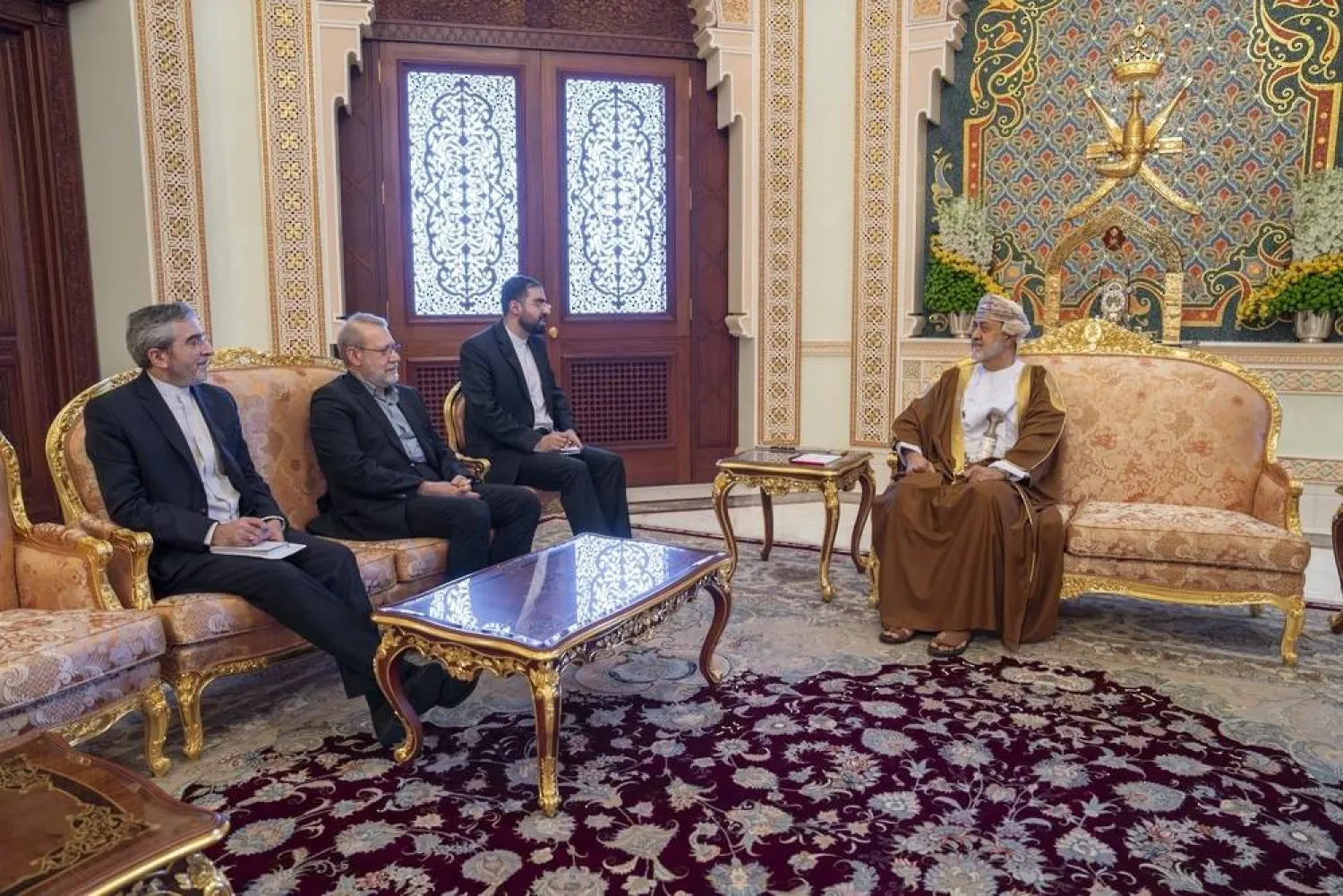
Oman’s Sultan Haitham bin Tarik received in Muscat on Tuesday Ali Larijani, a former Iranian parliament speaker who now serves as the secretary to the country's Supreme National Security Council, for talks on the latest developments of the Iranian-American negotiations, reported the Sultanate’s official news agency ONA.
The nearly three-hour meeting also addressed paths toward achieving a balanced and equitable agreement for all parties.
It underscored the critical importance of resuming dialogue and returning to the negotiating table to bridge divides and resolve outstanding differences through peaceful means. Such efforts are fundamental to promoting and sustaining peace and security both in the region and the world at large, said ONA.
Sultan Haitham later sent a cable of greetings to Iran’s President Masoud Pezeshkian on his country's National Day.
He expressed his sincere wishes for Iran to achieve further accomplishments. He hoped relations of cooperation and partnership would grow and expand across various sectors in a manner that serves the interests of both countries.
Oman’s Foreign Minister Badr Albusaidi later received Larijani for a “productive” meeting on recent developments, especially the Iran-US talks, he wrote on X.
“Regional peace and security is our priority, and we urge restraint and wise compromise,” he stressed.
Larijani's entourage shared photos of him meeting with the FM, the chief intermediary in the US-Iran talks, with what appeared to be a letter sheathed in plastic and sitting alongside the Omani diplomat.
Iranian media had said Larijani would deliver an important message. However, Iranian state television hours after that meeting described Albusaidi as having “handed over a letter” to Larijani. It did not elaborate from where the letter came.
Iran talks a global focus
Iran and the US held new nuclear talks last week in Oman. Foreign Minister Abbas Araghchi, speaking Sunday to diplomats at a summit in Tehran, signaled that Iran would stick to its position that it must be able to enrich uranium — a major point of contention with US President Donald Trump. Israel’s war on Iran in June disrupted earlier rounds of nuclear talks between Washington and Tehran.
“The Muscat meeting, which was not a long one, it was a half-day meeting. For us it was a way to measure the seriousness of the other side, and to find out how we could continue the process. Therefore we mostly addressed the generalities,” Iranian Foreign Ministry spokesman Esmail Baghaei told journalists at a news conference Tuesday in Tehran.
“Our principles are clear. Our demand is to secure the interests of the Iranian nation based on international norms and the Non-Proliferation Treaty and peaceful use of nuclear energy,” Baghaei said. “So as for the details, we should wait for the next steps and see how this diplomatic process will continue.”
Israeli Prime Minister Benjamin Netanyahu also arrived in Washington for talks with Trump. Iran is expected to be the major subject of discussion.
Larijani accused Israel of trying to play a “destructive role” in the talks.
“Americans must think wisely and not allow him, through posturing, to imply before his flight that ’I want to go and teach Americans the framework of the nuclear negotiations,” Larijani said in a post on X.
Elsewhere, US Ambassador to Israel Mike Huckabee said there is “extraordinary alignment” between Washington and Israel over the talks with Tehran.
“Everyone would love to see something that would resolve without a war, but it’ll be up to Iran,” said Huckabee before he boarded a flight to Washington with Netanyahu.
The United States has moved the aircraft carrier USS Abraham Lincoln, ships and warplanes to the Middle East to pressure Iran into an agreement and have the firepower necessary to strike the country should Trump choose to do so.
Already, US forces shot down a drone they said got too close to the Lincoln and came to the aid of a US-flagged ship that Iranian forces tried to stop in the Strait of Hormuz, the narrow mouth of the Arabian Gulf.
The US Transportation Department's Maritime Administration issued a new warning Monday to American vessels in the strait to “remain as far as possible from Iran’s territorial sea without compromising navigational safety.”
Anti-government chants from people's homes
Meanwhile, people in various neighborhoods of Iran’s capital chanted “death to the dictator” from windows and rooftops on the eve of the anniversary of the 1979 revolution, witnesses said, turning the annual celebration into a protest.
State television in recent days has routinely encouraged people to chant pro-government slogans accompanied by fireworks across the city, an annual ritual in the country. The government plans to hold rallies Wednesday to celebrate the anniversary.
The move came nearly one month after a bloody crackdown in Iran on anti-government protests that led to the deaths of thousands of people and tens of thousands more being detained.


