


Von der Leyen: EU Must 'Tear Down Barriers' to Become 'Global Giant'

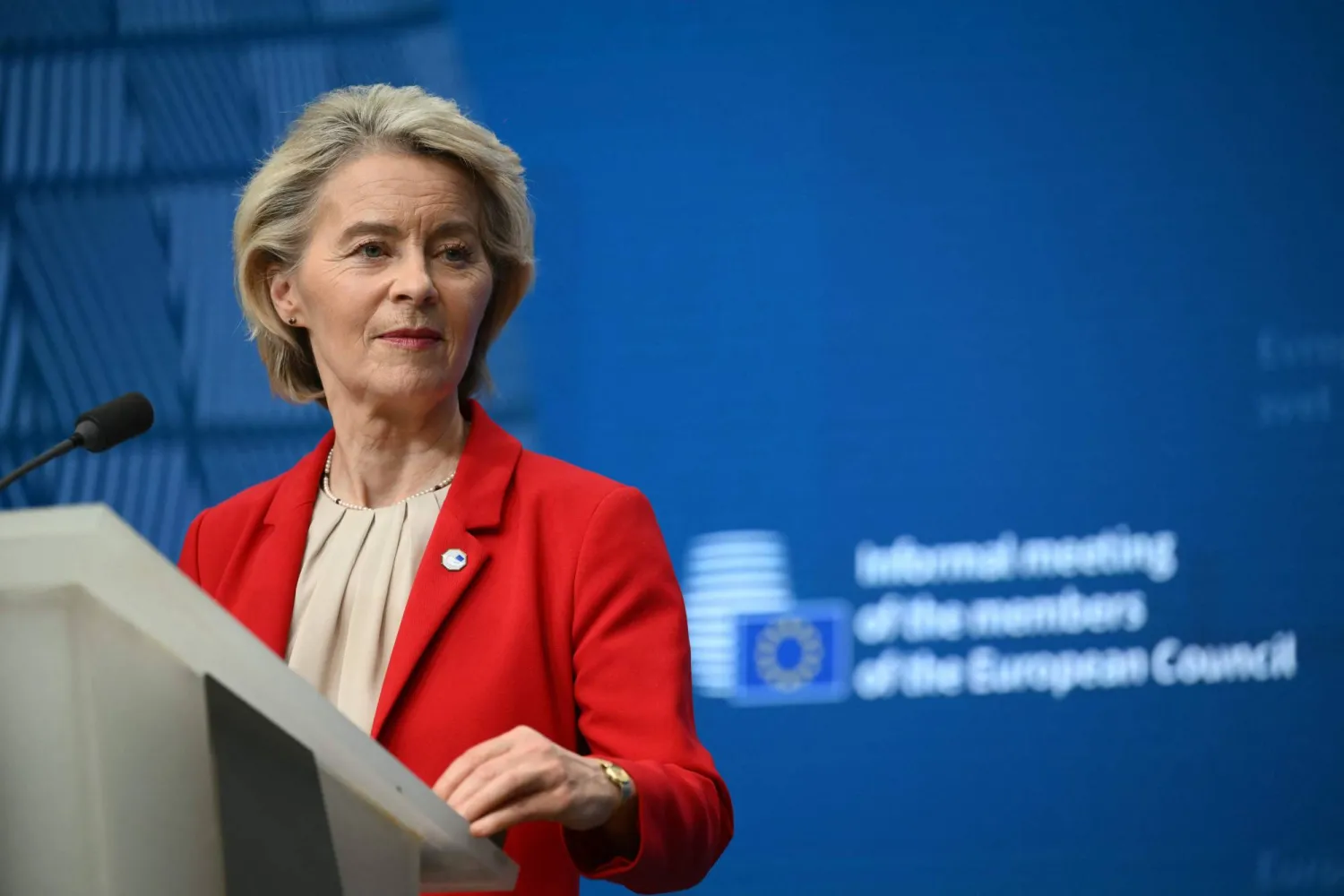
(FILES) European Commission President Ursula von der Leyen delivers a speech in Brussels, on January 22, 2026. (Photo by NICOLAS TUCAT / AFP)
TT

Von der Leyen: EU Must 'Tear Down Barriers' to Become 'Global Giant'

(FILES) European Commission President Ursula von der Leyen delivers a speech in Brussels, on January 22, 2026. (Photo by NICOLAS TUCAT / AFP)

The EU must "tear down the barriers" that prevent it from becoming a truly global economic giant, European Commission chief Ursula von der Leyen said Wednesday, ahead of leaders' talks on making the 27-nation bloc more competitive.

"Our companies need capital right now. So let's get it done this year," the commission president told EU lawmakers as she outlined key steps to bridging the gap with China and the United States.

"We have to make progress one way or the other to tear down the barriers that prevent us from being a true global giant," she said, calling the current system "fragmentation on steroids."

Reviving the moribund EU economy has taken on greater urgency in the face of geopolitical shocks, from US President Donald Trump's threats and tariffs upending the global trading to his push to seize Greenland from Denmark.

AFP said that Von der Leyen delivered her message before heading with EU leaders including France's Emmanuel Macron and Germany's Friedrich Merz to a gathering of industry executives in Antwerp, held on the eve of a summit on bolstering the bloc's economy.

A key issue identified by the EU is the fact that European companies face difficulties accessing capital to scale up, unlike their American counterparts.

To tackle this, Plan A would be to advance together as 27 states, von der Leyen said, but if they cannot reach agreement, the EU should consider "enhanced cooperation" between those countries that want to.

Von der Leyen said Europe should ramp up its competitiveness by "stepping up production" on the continent and "by expanding our network of reliable partners", pointing to the importance of signing trade agreements.

After recent deals with South American bloc Mercosur and India, she said more were on their way -- with Australia, Thailand, the Philippines and the United Arab Emirates.

One of the biggest -- and most debated -- proposals for boosting the EU's economy is to favor European firms over foreign rivals in "strategic" fields, which von der Leyen supports.

"In strategic sectors, European preference is a necessary instrument... that will contribute to strengthen Europe's own production base," she said -- while cautioning against a "one-size-fits-all" approach.

France has been spearheading the push, but some EU nations like Sweden are wary of veering into protectionism and warn Brussels against going too far.

The EU executive will also next month propose the 28th regime, also known as "EU Inc", a voluntary set of rules for businesses that would apply across the European Union and would not be linked to any particular country.

Brussels argues this would make it easier for companies to work across the EU, since the fragmented market is often blamed for why the economy is not better.

The commission is also engaged in a massive effort to cut red tape for firms, which complain EU rules make it harder to do business -- drawing accusations from critics that Brussels is watering down key legislation on climate in particular.



Egypt’s Investment Ministry Says Next Phase Demands Shift Beyond Fintech

Mohamed Farid, Minister of Investment and Foreign Trade, at the “Disruptech Sharm 2026 – Fintech and Beyond” conference. (Egyptian Ministry of Investment).
TT

Egypt’s Investment Ministry Says Next Phase Demands Shift Beyond Fintech

Mohamed Farid, Minister of Investment and Foreign Trade, at the “Disruptech Sharm 2026 – Fintech and Beyond” conference. (Egyptian Ministry of Investment).

Egypt’s Minister of Investment and Foreign Trade Mohamed Farid said the next phase of the country’s investment climate requires moving beyond traditional financial technology toward more advanced applications, including supervisory technology (SupTech) and TradeTech, to boost market efficiency, competitiveness and support for investment and trade.

Speaking at the fourth edition of the “Disruptech Sharm 2026 – Fintech and Beyond” conference, Farid said TradeTech would play a central role in strengthening domestic and export trade.

The event was attended by 16 global, regional and local investment funds, as well as senior executives from Egyptian and regional investment banks.

Farid explained that TradeTech can enhance data collection and analysis, improve supply chain and logistics management, and connect exporters and traders with service providers. He said that these developments would help reduce costs and raise the competitiveness of Egyptian products in global markets.

He highlighted the government’s coordinated efforts to support innovation, citing regulatory frameworks issued by the Financial Regulatory Authority and the Central Bank of Egypt, alongside recent decisions by the ministerial committee for entrepreneurship, including the Startup Charter.

Together, he said, these measures reflect a clear policy direction toward fostering a more supportive environment for innovation and startups.

The minister revealed that the ministry is studying the establishment of regulatory sandboxes in cooperation with relevant authorities, including the General Organization for Export and Import Control. The initiative aims to facilitate exporters’ operations, enhance investor confidence, and better integrate importers and exporters into logistics and trade services by testing and supporting innovative solutions to upgrade Egypt’s foreign trade system.

Egypt has made notable progress in updating legislative and regulatory frameworks that support innovation and entrepreneurship, particularly within financial oversight institutions, Farid noted.

These reforms have contributed to a more flexible and competitive market, reflected in strong growth in companies operating across consumer finance, microfinance and trade finance, including factoring, he went on to say.

Moreover, he said that the digitization of trade policies and programs will be a priority in the coming period, with an emphasis on building accurate and integrated databases to support decision-making and strengthen economic competitiveness.

Farid also pointed to upcoming steps to ease access to financing for startups that have moved beyond the idea stage, in cooperation with investment funds, enabling them to expand and grow sustainably.

He underscored his personal commitment to following up on the implementation of these initiatives and strengthening engagement with investors and the business community, as Egypt seeks deeper integration into regional and global value chains.


Safran to Open Landing Gear Plant in Morocco

Safran Group logo is seen in this illustration taken July 26, 2025. REUTERS/Dado Ruvic/Illustration
TT

Safran to Open Landing Gear Plant in Morocco

Safran Group logo is seen in this illustration taken July 26, 2025. REUTERS/Dado Ruvic/Illustration

Safran Landing Systems, a subsidiary of French aerospace group Safran, signed a deal with Morocco to set up a landing gear factory near Casablanca worth 280 million euros ($332 mln) to supply the Airbus A320, Safran Chair Ross McIness said.

The new plant will help Safran support the production pace of the Airbus A320 family and prepare the next generation of short and medium-haul aircraft, McIness said at the deal's signing ceremony chaired by Morocco's King Mohammed VI at the Royal Palace in Casablanca.

The plant is a step forward in Morocco's plan to strengthen its position in global aerospace industry supply chains, Moroccan industry minister Ryad Mezzour said on the same occasion.

The factory, set to be one of the largest of its kind, is expected to start production in 2029, Safran's communications said.

In October, Safran signed deals with the Moroccan government to set up a new engine assembly line for Airbus jets and a new maintenance and repair plant in Midparc, an industrial zone near Casablanca dedicated to aerospace manufacturers.

With 150 firms, Morocco's aerospace sector employs 25,000 people. Its exports rose to 29 billion dirhams ($3 billion) in 2025 from 26.4 billion dirhams a year earlier.


China to Scrap Tariffs for Most of Africa from May

Visitors walk past illuminated lantern displays ahead of Lunar New Year in Beijing, China, Wednesday, Feb. 11, 2026. (AP Photo/Vincent Thian)
TT

China to Scrap Tariffs for Most of Africa from May

Visitors walk past illuminated lantern displays ahead of Lunar New Year in Beijing, China, Wednesday, Feb. 11, 2026. (AP Photo/Vincent Thian)

Beijing's scrapping of tariffs for all but one African country will start May 1, Chinese President Xi Jinping said Saturday, according to state media.

China already has a zero-tariff policy for imports from 33 African countries, but Beijing said last year it would extend the policy to all 53 of its diplomatic partners on the continent.

China is Africa's largest trading partner and a key backer of major infrastructure projects in the region through its vast "Belt and Road" initiative.

From May 1, zero levies will apply to all African countries except Eswatini, which maintains diplomatic relations with Taiwan.

China claims the democratic island as its own and does not rule out using force to take it.

Many African countries are increasingly looking to China and other trading partners since US President Donald Trump imposed steep tariffs worldwide last year.

Xi said the zero-tariff deal "will undoubtedly provide new opportunities for African development", announcing the date as leaders across the continent gathered in Ethiopia for the annual African Union summit.

The announcement came as Africa’s top regional body hosted its annual summit in Ethiopia this weekend to discuss the future of the continent of some 1.4 billion people.