


Record Heat and Raging Fires Ring in 2026 Across the Southern Hemisphere 

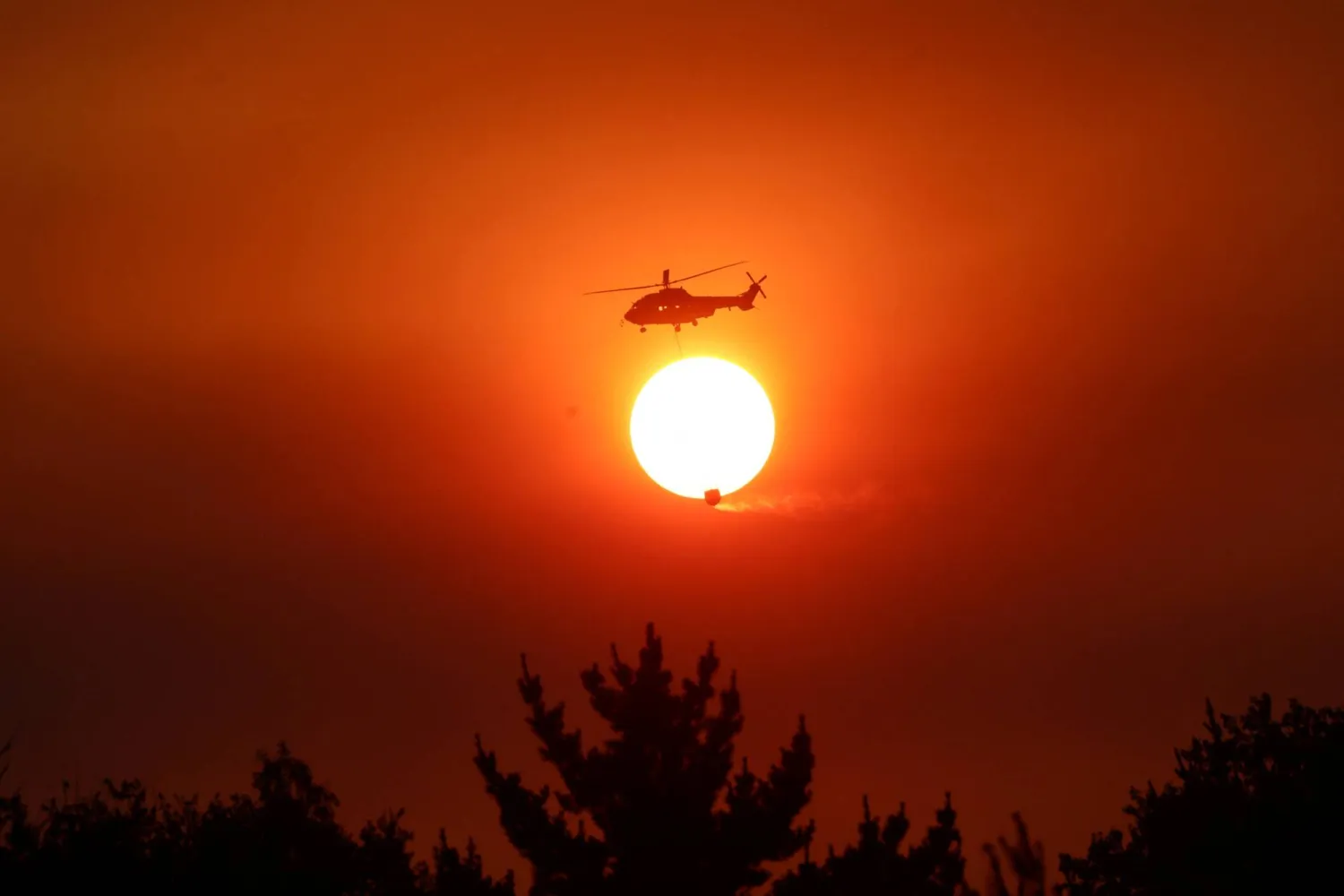
A helicopter battles a forest fire in the Biobio region, where multiple wildfires have prompted emergency evacuations, in Florida, Chile, January 21, 2026. (Reuters)
TT

Record Heat and Raging Fires Ring in 2026 Across the Southern Hemisphere 

A helicopter battles a forest fire in the Biobio region, where multiple wildfires have prompted emergency evacuations, in Florida, Chile, January 21, 2026. (Reuters)

From Argentina to Australia to South Africa, record heat and raging wildfires are rampaging through the Southern Hemisphere at the start of 2026, with scientists predicting that even more extreme temperatures could lie ahead - and possibly another global annual high - after three of the hottest years on record.

In January, a record-setting heat dome enveloped Australia, sending temperatures near 50 degrees C (122 degrees F) while heat and catastrophic wildfires gripped parts of South America, setting remote parts of Argentina's Patagonia ablaze and killing 21 people in coastal towns in Chile. In addition, South Africa has been experiencing its worst wildfires in years.

The extremes are occurring even as the world remains under the cooling influence of a weak La Nina, a climate cycle marked by cooler waters in the central and eastern Pacific that began in December 2024. Despite this moderating factor, temperatures are reaching record highs in various locales.

"This means the effect of human-caused climate change is overwhelming natural variability," said climate scientist Theodore Keeping of Imperial College London and the international research collaboration World Weather Attribution, who specializes in research on wildfires and extreme heat.

"As we transition into a neutral or even El Nino phase, we'll expect the incidence of extreme heat events around the world to be further amplified," Keeping added.

El Nino typically has the opposite effect of La Nina, warming the central and eastern Pacific and boosting global temperatures.

This year is forecast to be about 1.46 degrees C (2.6 degrees F) above pre-industrial levels, which would make it the fourth consecutive year to be higher than 1.4 degrees C (2.5 degrees F) above pre-industrial levels, according to Adam Scaife, head of the long-range prediction at the United Kingdom's national weather ‌and climate service.

The 2015 ‌international climate treaty, known as the Paris Agreement, aimed to keep warming below 1.5 degrees C (2.7 degrees F) above pre-industrial levels.

"If a big ‌El Nino ⁠were to develop ⁠quickly in 2026 then it's still possible 2026 could be a record," Scaife said. The World Meteorological Organization said last month that the past three years were the warmest on record.

FIRE RAGES FROM WOODS TO WATER

While most wildfires are caused by human activity, they are also a natural part of many ecosystems. Persistent heat, drought and extreme temperatures, however, are turning once-manageable fires into increasingly uncontrollable and destructive events.

Many ecosystems are not adapted to such hot, dry conditions, allowing fires to grow larger and more intense, often causing permanent damage, Keeping said.

The fires that burned through Argentina's Los Alerces National Park illustrate the shift, according to meteorologist Carolina Vera of the Center for Ocean and Atmospheric Research at the University of Buenos Aires.

The park, a UNESCO World Heritage site, is home to trees that have lived more than 3,000 years.

Local officials determined that a lightning strike caused the fire. The blaze initially was under control. But Vera said a heat wave and strong winds caused it to spread about 20 km (12 miles) in a single day, making it the worst wildfire there ⁠in two decades.

The region has been drought-stricken since 2008. Temperatures during the first two weeks of January were about 6 degrees C (11 degrees F) above ‌normal.

"These fires used to burn themselves out and form part of the forest's natural dynamics," Vera said.

"This is an example of ‌how climate change can alter a natural fire, because it appeared to be caused by lightning," Vera said.

There are no towns in that remote area.

Fires erupted in the southern part of neighboring Chile later in January and ‌crossed into the greater Concepcion area, the country's third-largest metropolitan region, destroying hundreds of homes and killing 21 people in coastal communities.

Keeping said the blazes mirrored recent disasters in places such as ‌Los Angeles, Athens and the Hawaiian island of Maui.

"Where there's been the greatest loss of life, it almost always comes down to evacuation being difficult or impossible," Keeping said. "That's particularly true in regions affected by strong downslope winds toward the coast."

WHIRLWINDS OF FIRE

About 80% of Punta de Parra, a small coastal town in southern Chile surrounded by hills and forests, was destroyed.

Punta de Parra residents said they had little time to evacuate. Doralisa Silva, 34, said she heard about a fire in a nearby community the night the blaze reached the town.

"Out of nowhere, the forest started burning and all the houses caught fire," Silva said. "The fire was on us in the blink ‌of an eye. There was nothing we could do."

Silva said her family was among the last to try to flee because they had no vehicle. Silva said flames blocked their exit as embers rained down as she and her partner Hermes Barrientos fled with their ⁠2-year-old daughter.

Barrientos said winds of nearly 70 km ⁠per hour (43.5 mph) whipped through the area, creating whirlwinds of fire that spread to the beach and trapped residents. The family and others eventually found refuge in a large dirt field at the center of town, and spent the night watching their community burn.

A FUTURE FILLED WITH FIRES

Record-breaking heat in southeastern Australia has also fueled the country's worst fires since the deadly 2019-2020 season, when 33 people were killed.

In addition, the 2025-2026 fire season has been the most severe in South Africa in a decade, according to officials, killing wildlife and hitting tourist destinations such as Mossel Bay and Franschhoek.

"The hot, dry and windy conditions that drive the most extreme wildfires are becoming more intense and more likely," Keeping said. "And it's happening all around the world."

The Southern Hemisphere has warmed by about 0.15 to 0.17 degrees C (0.27 to 0.30 degrees F) per decade since the 1970s, compared to 0.25 to 0.30 degrees C (0.45 to 0.54 degrees F) in the Northern Hemisphere - largely because its vast oceans absorb heat more slowly and because of Antarctic meltwater.

Still, southern land masses are now warming at similar rates to northern land masses, and contrasts between warming land and cold meltwater can intensify weather patterns, leading to prolonged heat waves, droughts or flooding.

Keeping said adaptation is critical, including authorities managing vegetation near cities and developing effective evacuation plans, and builders using fire-resistant materials. Wildfires are inflicting mounting economic damage. A 2026 report by insurance broker Aon estimated global insured wildfire losses at $42 billion in 2025, up from an average of $4 billion annually between 2000 and 2024. The Los Angeles fires last year were the costliest on record.

Swiss Re, the world's second-largest reinsurer, found that wildfires accounted for about 1% of global insured losses from natural disasters before 2015, but now represent 7%, with economic losses linked to fires rising by about $170 million a year since 1970.

"You actually cannot stop a lot of these really large intense wildfires. They're simply too big," Keeping said.

The most important way forward, Keeping said, is to "have a serious conversation about limiting future climate change to prevent this issue from worsening."



Coffee Regions Hit by Extra Days of Extreme Heat, Say Scientists 

17 April 2012, North Rhine-Westphalia, Vluyn: A general view of Arabica Coffee beans. (dpa)
TT

Coffee Regions Hit by Extra Days of Extreme Heat, Say Scientists 

17 April 2012, North Rhine-Westphalia, Vluyn: A general view of Arabica Coffee beans. (dpa)

The world's main coffee-growing regions are roasting under additional days of climate change-driven heat every year, threatening harvests and contributing to higher prices, researchers said Wednesday.

An analysis found that there were 47 extra days of harmful heat per year on average in 25 countries representing nearly all global coffee production between 2021 and 2025, according to independent research group Climate Central.

Brazil, Vietnam, Colombia, Ethiopia and Indonesia -- which supply 75 percent of the world's coffee -- experienced on average 57 additional days of temperatures exceeding the threshold of 30C.

"Climate change is coming for our coffee. Nearly every major coffee-producing country is now experiencing more days of extreme heat that can harm coffee plants, reduce yields, and affect quality," said Kristina Dahl, Climate Central's vice president for science.

"In time, these impacts may ripple outward from farms to consumers, right into the quality and cost of your daily brew," Dahl said in a statement.

US tariffs on imports from Brazil, which supplies a third of coffee consumed in the United States, contributed to higher prices this past year, Climate Central said.

But extreme weather in the world's coffee-growing regions is "at least partly to blame" for the recent surge in prices, it added.

Coffee cultivation needs optimal temperatures and rainfall to thrive.

Temperatures above 30C are "extremely harmful" to arabica coffee plants and "suboptimal" for the robusta variety, Climate Central said. Those two plant species produce the majority of the global coffee supply.

For its analysis, Climate Central estimated how many days each year would have stayed below 30C in a world without carbon pollution but instead exceeded that level in reality -- revealing the number of hot days added by climate change.

The last three years have been the hottest on record, according to climate monitors.


Dog Gives Olympics Organizers Paws for Thought

A dog wanders on the ski trail during the women's team cross country free sprint qualification event of the Milano Cortina 2026 Winter Olympic Games at Tesero Cross-Country Skiing Stadium in Lago di Tesero (Val di Fiemme), on February 18, 2026. (Photo by Anne-Christine POUJOULAT / AFP)
TT

Dog Gives Olympics Organizers Paws for Thought

A dog wanders on the ski trail during the women's team cross country free sprint qualification event of the Milano Cortina 2026 Winter Olympic Games at Tesero Cross-Country Skiing Stadium in Lago di Tesero (Val di Fiemme), on February 18, 2026. (Photo by Anne-Christine POUJOULAT / AFP)

A dog decided he would bid for an unlikely Olympic medal on Wednesday as he joined the women's cross country team free sprint in the Milan-Cortina Games.

The dog ran onto the piste in Tesero in northern Italy and gamely, even without skis, ran behind two of the competitors, Greece's Konstantina Charalampidou and Tena Hadzic of Croatia.

He crossed the finishing line, his moment of glory curtailed as he was collared by the organizers and led away -- his owner no doubt will have a bone to pick with him when they are reunited.


Olives, Opera and a Climate-Neutral Goal: How a Mural in Greece Won ‘Best in the World’ 

A building with the mural entitled “Kalamata” depicting opera legend Maria Callas by artist Kleomenis Kostopoulos is seen in Kalamata town, about 240 kilometers (150 miles) southwest of Athens, Monday, Feb. 9, 2026. (AP) 
TT

Olives, Opera and a Climate-Neutral Goal: How a Mural in Greece Won ‘Best in the World’ 

A building with the mural entitled “Kalamata” depicting opera legend Maria Callas by artist Kleomenis Kostopoulos is seen in Kalamata town, about 240 kilometers (150 miles) southwest of Athens, Monday, Feb. 9, 2026. (AP) 

Long known for its olives and seaside charm, the southern Greek city of Kalamata has found itself in the spotlight thanks to a towering mural that reimagines legendary soprano Maria Callas as an allegory for the city itself.

The massive artwork on the side of a prominent building in the city center has been named 2025’s “Best Mural of the World” by Street Art Cities, a global platform celebrating street art.

Residents of Kalamata, approximately 240 kilometers (150 miles) southwest of Athens, cultivate the world-renowned olives, figs and grapes that feature prominently on the mural.

That was precisely the point.

Vassilis Papaefstathiou, deputy mayor of strategic planning and climate neutrality, explained Kalamata is one of the few Greek cities with the ambitious goal of becoming climate-neutral by 2030. He and other city leaders wanted a way to make abstract concepts, including sustainable development, agri-food initiatives, and local economic growth, more tangible for the city’s nearly 73,000 residents.

That’s how the idea of a massive mural in a public space was born.

“We wanted it to reflect a very clear and distinct message of what sustainable development means for a regional city such as Kalamata,” Papaefstathiou said. “We wanted to create an image that combines the humble products of the land, such as olives and olive oil — which, let’s be honest, are famous all over the world and have put Kalamata on the map — with the high-level art.”

“By bringing together what is very elevated with ... the humbleness of the land, our aim was to empower the people and, in doing so, strengthen their identity. We want them to be proud to be Kalamatians.”

Southern Greece has faced heatwaves, droughts and wildfires in recent years, all of which affect the olive groves on which the region’s economy is hugely dependent.

The image chosen to represent the city was Maria Callas, widely hailed as one of the greatest opera singers of the 20th century and revered in Greece as a national cultural symbol. She may have been born in New York to Greek immigrant parents, but her father came from a village south of Kalamata. For locals, she is one of their own.

This connection is also reflected in practice: the alumni association at Kalamata’s music school is named for Callas, and the cultural center houses an exhibition dedicated to her, which includes letters from her personal archive.

Artist Kleomenis Kostopoulos, 52, said the mural “is not actually called ‘Maria Callas,’ but ‘Kalamata’ and my attempt was to paint Kalamata (the city) allegorically.”

Rather than portraying a stylized image of the diva, Kostopoulos said he aimed for a more grounded and human depiction. He incorporated elements that connect the people to their land: tree branches — which he considers the above-ground extension of roots — birds native to the area, and the well-known agricultural products.

“The dress I create on Maria Callas in ‘Kalamata’ is essentially all of this, all of this bloom, all of this fruition,” he said. “The blessed land that Kalamata itself has ... is where all of these elements of nature come from.”

Creating the mural was no small feat. Kostopoulos said it took around two weeks of actual work spread over a month due to bad weather. He primarily used brushes but also incorporated spray paint and a cherry-picker to reach all edges of the massive wall.

Papaefstathiou, the deputy mayor, said the mural has become a focal point.

“We believe this mural has helped us significantly in many ways, including in strengthening the city’s promotion as a tourist destination,” he said.

Beyond tourism, the mural has sparked conversations about art in public spaces. More building owners in Kalamata have already expressed interest in hosting murals.

“All of us — residents, and I personally — feel immense pride,” said tourism educator Dimitra Kourmouli.

Kostopoulos said he hopes the award will have a wider impact on the art community and make public art more visible in Greece.

“We see that such modern interventions in public space bring tremendous cultural, social, educational and economic benefits to a place,” he said. “These are good springboards to start nice conversations that I hope someday will happen in our country, as well.”