

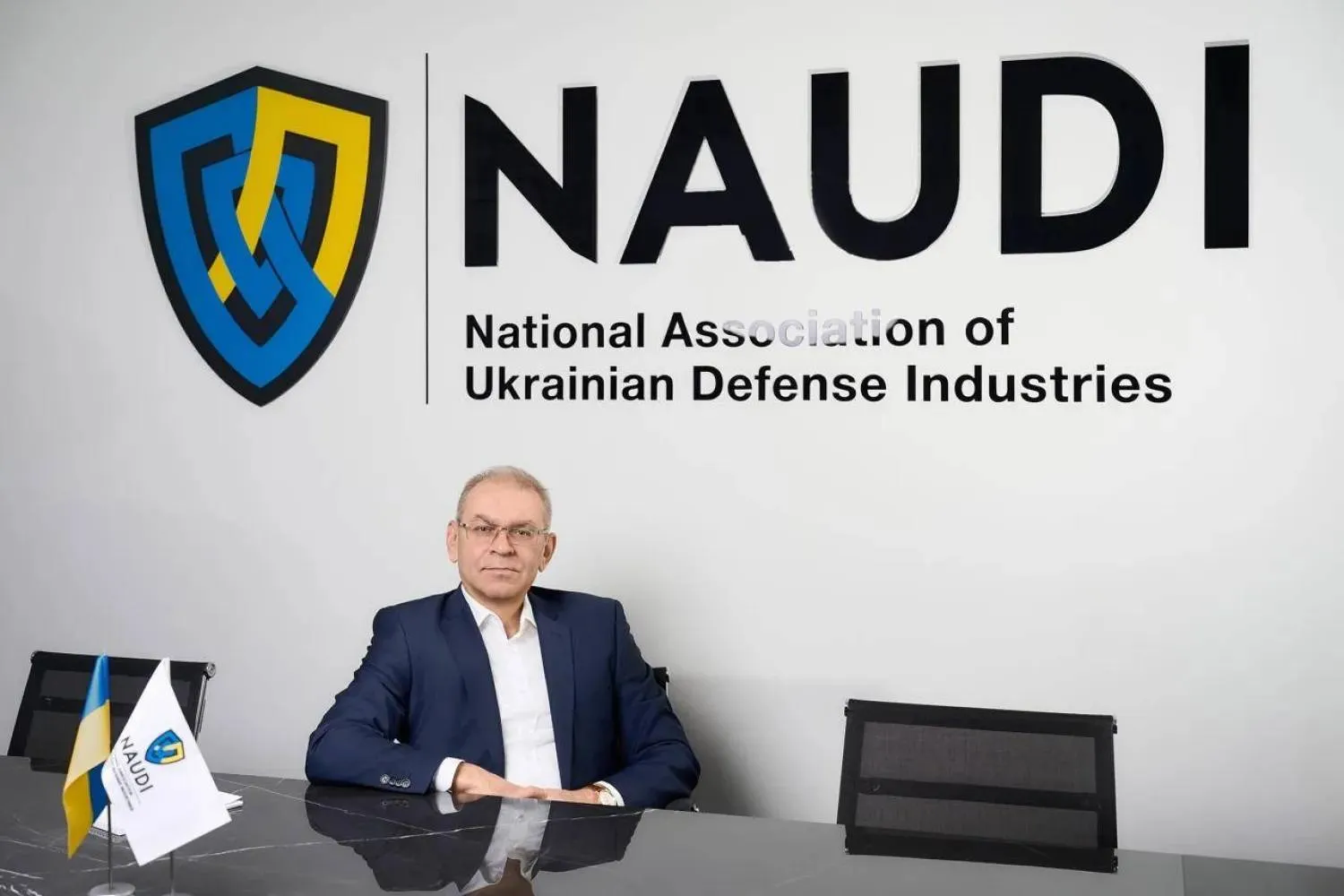

NAUDI Chairman to Asharq Al-Awsat: Ukraine Aims to Resume, Expand Defense Cooperation with Saudi Arabia

Chairman of the National Association of Ukrainian Defense Industries (NAUDI) Serhii Pashynskyi. (Asharq Al-Awsat)
TT

NAUDI Chairman to Asharq Al-Awsat: Ukraine Aims to Resume, Expand Defense Cooperation with Saudi Arabia

Chairman of the National Association of Ukrainian Defense Industries (NAUDI) Serhii Pashynskyi. (Asharq Al-Awsat)

Chairman of the National Association of Ukrainian Defense Industries (NAUDI) Serhii Pashynskyi revealed that Kyiv was counting on Saudi Arabia to achieve peace and stability in Ukraine given its role as a “significant and authoritative regional leader”.

In an interview to Asharq Al-Awsat, he said: “We aim in the near future to define concrete plans for the renewal and further expansion of Ukrainian-Saudi defense cooperation.”

He made his remarks as NAUDI took part in the World Defense Show 2026 in Riyadh.

“We are open to considering opportunities for establishing joint ventures, developing specific technologies, and localizing production on the territory of Saudi Arabia. We are ready to deepen cooperation that has been actively developing since 2014,” Pashynskyi said.

“Our participation in World Defense Show 2026 has a clear objective: to demonstrate the technological capability of Ukraine’s defense sector, which has undergone real testing in wartime conditions. At the joint NAUDI stand, we present our latest developments with confirmed combat experience, share practical insights into their operational use, and discuss tactics of employment,” he explained.

“Today, member companies of the Association already maintain dozens of international contracts in the format of industrial cooperation, and the geography of our partnerships continues to expand. This is precisely the message we seek to convey to our international and regional partners,” he stated.

Saudi-Ukrainian military cooperation

Commenting on military cooperation between Saudi Arabia and Ukraine, he said: “Prior to the full-scale invasion, there was active and effective cooperation between Ukraine’s defense-industrial complex and the Kingdom’s defense institutions and companies.”

“We are interested in restoring these contacts. In line with the position of Ukrainian President Volodymyr Zelenskyy, regarding controlled exports, we aim in the near future to define concrete plans for the renewal and further expansion of Ukrainian-Saudi defense cooperation,” he went on to say.

Moreover, Pashynskyi revealed that an official intergovernmental agreement between the Ukrainian and Saudi governments on cooperation in the field of defense was signed in Kyiv on February 5, 2020, and duly approved by the respective governments.

“The agreement establishes a comprehensive legal framework for bilateral defense interaction. It covers cooperation between the defense industries of both countries, military education and personnel training, exchange of information in the field of defense technologies, transfer of specific military technologies and equipment, including electronic, radar, and telecommunications systems, as well as issues related to defense medical support,” he explained.

“Ukraine highly values the principled and consistent position of Saudi Arabia, which is based on unwavering respect for the provisions of the UN Charter and the fundamental principles of international law, particularly with regard to ensuring territorial integrity and protecting state sovereignty,” he added.

“An important moral and humanitarian component of Ukrainian-Saudi relations is the Kingdom’s sincere solidarity with the Ukrainian people, which is reflected in the humanitarian assistance provided, particularly to support internally displaced persons,” he told Asharq Al-Awsat.

Ukrainian products at the World Defense Show

Elaborating on the Ukrainian products displayed at the World Defense Show, Pashynskyi said: “NAUDI member companies produce a full spectrum of defense products, from 7-inch FPV drones to the Bohdana self-propelled artillery system, which is physically displayed at the exhibition.”

“Ukraine has become a global pioneer in the mass combat use of FPV drones, as well as in the development and deployment of maritime unmanned platforms. We possess unique and extremely valuable experience in operating these systems under real combat conditions,” he stressed. “The private sector accounts for more than 70% of Ukraine’s total defense-industrial production.”

Among the key exhibits are the Bohdana self-propelled howitzer, manufactured in significant quantities by the company Ukrainian Armor and actively employed in combat operations; the Varta armored vehicle; the Protector unmanned ground system; the MAC maritime drone; reconnaissance UAVs Shark, PD-2, mini Shark, and Furia; the Krechet air defense command-and-control system; heavy drones Kazhan and Shmavik; UAV munitions produced by UBM; FPV drones manufactured by General Cherry; and electronic warfare systems developed by Piranya Tech.

Preserving lives

Pashynskyi revealed that more than 50% of the needs of Ukraine’s Defense Forces are currently met by the domestic defense-industrial complex, from FPV drones to cruise missiles, 155-mm artillery systems, ammunition, electronic warfare (EW) and electronic intelligence (ELINT) systems.

“According to last year’s results, NAUDI member companies supplied the Defense Forces with products worth approximately EUR 4 billion,” he said. “Since 2022, the industry has undergone large-scale relocation and deployment of new production facilities. Today, Ukraine is without exaggeration one of the world’s leaders in the pace of weapons and ammunition production.”

“Our primary priority is preserving the lives of service members. That is why special emphasis is placed on unmanned systems that enhance soldier effectiveness without replacing the soldier,” he continued.

“A key advantage is the direct connection with frontline units. This allows manufacturers to receive real-time feedback and rapidly modernize their solutions. While R&D processes in other countries may take years, for Ukrainian companies the path from concept to serial production often takes just 3 to 6 months.”

“Some companies have increased FPV drone production from several thousand units in 2023 to over 500,000 units in 2025 and these are not isolated cases,” Pashynskyi revealed.

Mohammed bin Salman Heads to Paris to Deepen Ties, Advance Strategic Partnership

An expanded meeting between the Saudi crown prince and the French president in Riyadh on Dec. 2, 2024 (SPA) 
TT

Mohammed bin Salman Heads to Paris to Deepen Ties, Advance Strategic Partnership

An expanded meeting between the Saudi crown prince and the French president in Riyadh on Dec. 2, 2024 (SPA) 

Saudi Crown Prince and Prime Minister Mohammed bin Salman is making an official visit to France on Sunday and Monday at the invitation of President Emmanuel Macron, whose state visit to Saudi Arabia in December 2024 resulted in a broad range of agreements and understandings and the launch of the Saudi-French Strategic Partnership Council.

The visit will be Mohammed bin Salman’s third to Paris, following trips in July 2022 and June 2023.

The crown prince left Saudi Arabia for France on Friday. The Saudi Royal Court said the visit was being made at the direction of Custodian of the Two Holy Mosques King Salman bin Abdulaziz and in response to Macron’s invitation.

First Strategic Partnership Council meeting

The visit comes in the wake of a major expansion in bilateral relations after the two countries signed a strategic partnership agreement, followed by a memorandum serving as a roadmap for cooperation across political, economic, cultural, artistic and sports fields.

In a statement issued late on Thursday into Friday, the Élysée Palace described the visit as “reflecting the vitality of the dialogue between France and the Kingdom of Saudi Arabia” and saying it would help strengthen the strategic partnership between the two countries. It added that Macron and Mohammed bin Salman would, for the first time, convene the French-Saudi Strategic Partnership Council.

Their first meeting will take place Sunday evening, Aug. 23, at the Grand Palais near the Champs-Élysées, where they will attend the closing ceremony of the Esports World Cup, hosted in France for the first time at Saudi Arabia’s request.

The French presidency noted that hosting the major international tournament reflected France’s renewed appeal as a venue for major sporting events following the success of the Paris 2024 Olympic and Paralympic Games.

It is the first time the competition has been held outside the Saudi capital. Sunday evening’s ceremony will include the presentation of prizes after seven weeks of competition involving 2,000 players from 100 countries and 200 clubs, including prominent Saudi teams. Organizers say total prize money amounts to $75 million.

Monday will include an official welcome for Mohammed bin Salman at the Élysée Palace, followed by bilateral talks in the afternoon. Macron and the crown prince will then co-chair the Strategic Partnership Council, which is expected to conclude with the signing of several agreements.

The two leaders will subsequently attend the closing session of a Saudi-French business forum being held in Paris to coincide with the official visit. The day will conclude with an official dinner at the Élysée Palace in honor of Mohammed bin Salman and his accompanying delegation.

According to the French presidency, talks will focus on the major economic and strategic issues underpinning the French-Saudi partnership. The two leaders will also exchange views on key regional challenges amid a situation that requires close coordination between France and its Gulf partners to support stability and peace in the Near and Middle East.

Regional crises on the agenda

French presidential sources said the visit comes amid “a regional crisis that erupted several months ago and whose outcome no one can foresee,” adding that Paris considers the crown prince’s decision to travel to France an “important signal.”

Macron and Mohammed bin Salman are expected to discuss the closure of the Strait of Hormuz, its repercussions and ways of ending the situation, with particular attention to efforts to diversify energy supply routes and improve links between the Middle East and Europe.

Élysée sources stressed that progress had been made on several projects but declined to provide details.

Lebanon will also figure prominently. Paris has called what French sources described as a “preparatory and technical” meeting involving the chiefs of staff of 15 countries, with the United States expected to attend.

France says it is working “closely” with Saudi Arabia on Lebanon and that both countries share a commitment to Lebanese sovereignty and support for the country’s authorities.

Élysée sources also referred to other projects being pursued away from public attention. Indications suggest these concern the expiry of the mandate of the UN Interim Force in Lebanon, UNIFIL, with France and Italy working on a formula aimed at preventing a vacuum. The United Nations has proposed several options.

Syria will also be on the agenda. Paris says it is working with Riyadh on the issue and noted that Macron recently paid an official visit to Syria.

Asked about the defense agreement signed in Makkah on Aug. 8 between Saudi Arabia, Pakistan and Türkiye, Élysée sources described it as “an illustration of the new regional architecture” and said it would be “extremely important to hear the Saudi view” of the development.

Searching for a way out of the war

Observers in Paris generally describe Saudi-French relations as “close and productive,” with regular communication between Mohammed bin Salman and Macron and ongoing coordination on Middle East issues, from the US-Iran war to Lebanon, Gaza, Yemen and maritime security in the Strait of Hormuz, Bab el-Mandeb and the Red Sea.

Bertrand Besancenot, a former French ambassador to Saudi Arabia, said the crown prince’s visit should be viewed in three contexts.

The first is the evolving regional situation, as Gulf leaders consider the best way out of the crisis gripping the region. While they recognize the central role of the United States, they also believe they must explore additional ways to safeguard their security and interests.

The second is Europe’s presence in the region, where European countries have political, economic and strategic interests and a role to play. Coordination with Riyadh, Besancenot said, can help them do so.

He pointed in particular to France’s importance as one of the European countries playing a leading role in the Middle East. Consultation and coordination with Paris could therefore help identify ways out of the current impasse, while also engaging other influential actors, including Pakistan and Türkiye.

Besancenot expects the tripartite Saudi-Pakistani-Turkish security agreement to feature in the Élysée talks.

The third context is the broad strategic partnership between France and Saudi Arabia and the economic, cultural, educational and sports projects they have launched together.

Besancenot also expects other major issues to be discussed, above all the Palestinian file in Gaza and the West Bank.

France and Saudi Arabia last year launched an initiative to revive the two-state solution, which won broad support at the United Nations and prompted major countries, led by France and Britain, to recognize the Palestinian state.

Lebanon and Syria are also expected to feature in the talks, particularly as Paris plans to host a preparatory meeting on Sept. 17 dedicated to supporting the Lebanese Armed Forces and Internal Security Forces.

Maritime security is another issue likely to feature. Riyadh convened a conference attended by 43 delegations that led to the launch of a maritime defense coalition to safeguard the Red Sea, Bab el-Mandeb and the Gulf of Aden, with 14 countries committing to participate.

On Aug. 14, Saudi Arabia formally announced the establishment of the Red Sea Maritime Defense Coalition.

A key question now is whether coordination can be established between the European Union’s Aspides naval mission in the Red Sea, launched in February 2024, and the Saudi-led coalition, particularly as both pursue the same objective. That issue could also feature in Monday’s Élysée talks.


Muslim World League Condemns Israel’s ‘E1’ Settlement Plan

The Muslim World League (MWL) logo
TT

Muslim World League Condemns Israel’s ‘E1’ Settlement Plan

The Muslim World League (MWL) logo

The Muslim World League (MWL) strongly condemned Israel's settlement policies in Palestinian territories ‌and said ‌they categorically ‌rejected ⁠the residential property project ⁠called 'E1' in the occupied West Bank, the Saudi Press Agency reported Saturday.

In a statement, MWL Secretary-General and Chairman of the Organization of Muslim Scholars Sheikh Dr. Mohammed Al-Issa condemned the dangerous plan, warning that it threatens the establishment of an independent Palestinian state. He also denounced Israeli settlement policies in the occupied Palestinian territories and Israel’s support for and protection of settler violence against Palestinians and their property.

He said these actions form part of Israel’s continued approach of violating relevant international laws and resolutions and undermining all peace efforts.

He stressed the urgent need for the international community to assume its legal and moral responsibilities to immediately halt Israel’s acts of violence, violations, settlement policies, and other measures aimed at altering the geographic and demographic character of the occupied Palestinian territories.

He also commended the statement issued by the foreign ministers of Saudi Arabia, Jordan, Qatar, Egypt, Pakistan, Türkiye, the United Arab Emirates, and Indonesia on the matter, praising their steadfast support for the Palestinian people and their legitimate right to an independent, sovereign state based on the two-state solution and relevant international resolutions as the only path to lasting peace in the region.


Saudi Arabia, Arab and Muslim Countries Condemn Israeli E1 Settlement Plan

Israeli settlers move into the former Israeli settlement of Kadim near the West Bank city of Jenin, 20 August 2026. (EPA)
TT

Saudi Arabia, Arab and Muslim Countries Condemn Israeli E1 Settlement Plan

Israeli settlers move into the former Israeli settlement of Kadim near the West Bank city of Jenin, 20 August 2026. (EPA)

The foreign ministers of Saudi Arabia, Jordan, the United Arab Emirates, Indonesia, Pakistan, Türkiye, Qatar, and Egypt condemned on Friday “Israel’s continued illegal settlement policies in the Occupied Palestinian Territory, categorically rejecting the E1 settlement plan and related settlement activities east of occupied East Jerusalem.”

In a statement, they further reiterated their condemnation “of the violations and acts of violence perpetrated by settlers, with the support of the Israeli occupying authorities, against the Palestinian people and their property.”

They stressed that such acts “in no way diminish the inalienable rights of the Palestinian people and constitute violations of international law and relevant United Nations resolutions, while posing a serious threat to regional and international peace and security.”

The ministers warned that the E1 settlement plan “constitutes a dangerous escalation that further advances settlement expansion and annexation and undermines the geographical contiguity of the Occupied Palestinian Territory, particularly between the West Bank and East Jerusalem, thereby threatening the viability and realization of an independent, contiguous Palestinian State based on the 1967 lines with East Jerusalem as its capital.”

Such actions “are a direct challenge to international efforts aimed at achieving peace,” foremost among them US President Donald Trump’s Comprehensive Plan, “including its unequivocal rejection of annexation and forced displacement, and the mechanisms envisaged for its implementation through the Board of Peace.”

It is also a violation Trump’s “firm commitment to not allow annexation of the West Bank, with a view to achieving stability and bringing the conflict to an end.”

The ministers reaffirmed that the two-state solution, in accordance with international law and relevant United Nations resolutions, “remains the only viable path towards a just, comprehensive and lasting peace.”

They warned that “actions aimed at undermining this solution risk further escalating tensions, threatening regional and international peace and security, and jeopardizing prospects for lasting peace and stability in the region.”

The ministers expressed their support for “all efforts aimed at ensuring accountability, including through appropriate international measures and sanctions against entities and individuals responsible for illegal settlement activities, including the E1 settlement plan, as well as those supporting, facilitating or implementing policies of settlement expansion and annexation.”

They called for an end to “any support or financing that contributes to the establishment, expansion or entrenchment of illegal settlements.”

They stressed that “the lack of accountability contributes to the continuation of violations and further undermines prospects for a just and comprehensive peace.”

The ministers called for “immediate action” to halt the E1 settlement plan, rescind all measures taken in connection with it, and cease all settlement activities and other measures “aimed at altering the geographic and demographic character of the Occupied Palestinian Territory.”

They called on the UN Security Council, all states and relevant international actors “to uphold their responsibilities under international law and take urgent and effective measures to halt illegal settlement expansion, and to ensure the protection of the Palestinian people, safeguard their inalienable rights, including their right to self-determination, and realize their independent state, in accordance with international law and relevant UN resolutions."
