

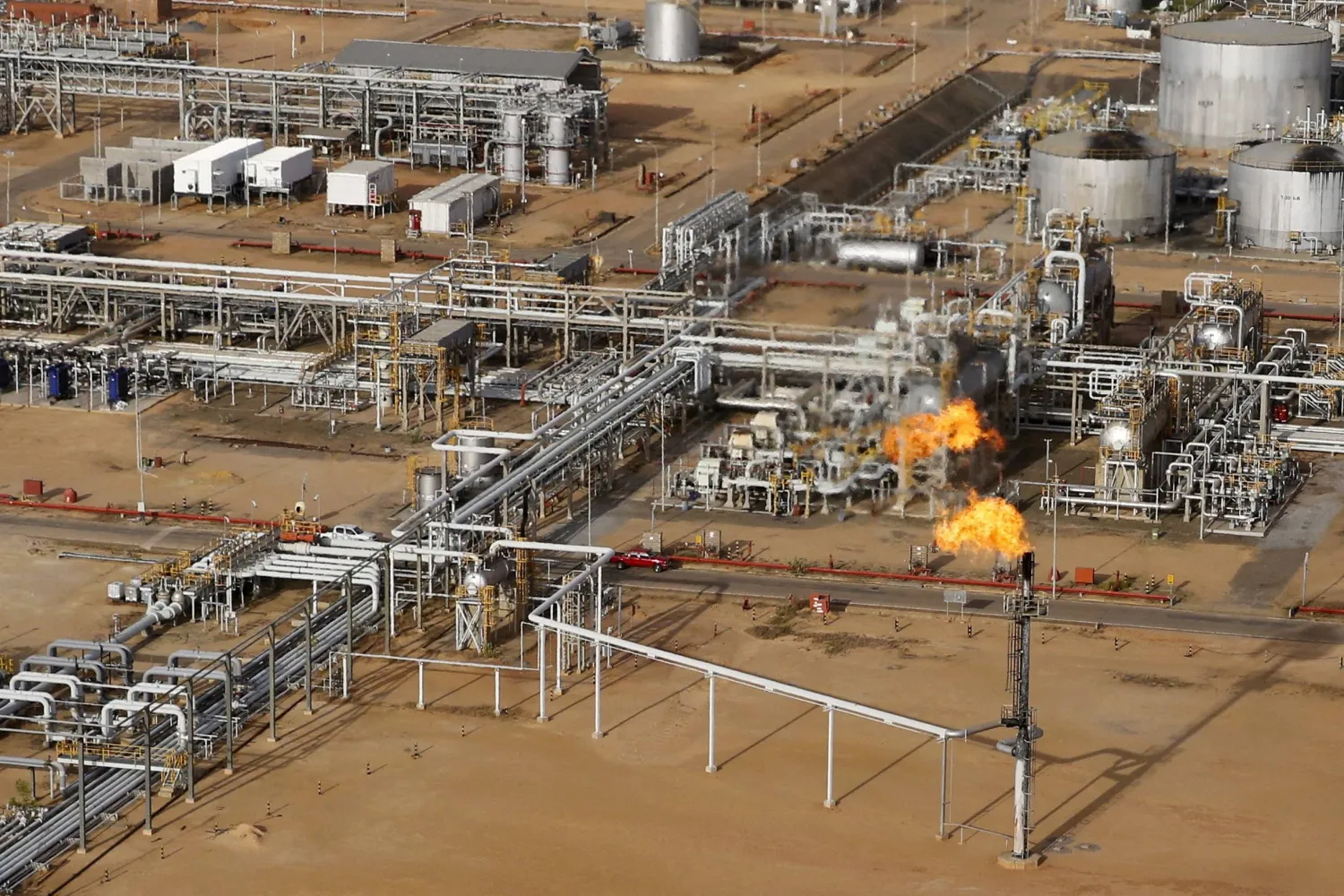

US Allows Oil Majors to Resume Venezuela Operations, Broadly Okays New Energy Investments

A flame burning natural gas is seen at an heavy-crude treatment plant operated by Venezuela's state oil company PDVSA, in the oil rich Orinoco belt, near Cabrutica at the state of Anzoategui April 16, 2015. (Reuters)
TT

US Allows Oil Majors to Resume Venezuela Operations, Broadly Okays New Energy Investments

A flame burning natural gas is seen at an heavy-crude treatment plant operated by Venezuela's state oil company PDVSA, in the oil rich Orinoco belt, near Cabrutica at the state of Anzoategui April 16, 2015. (Reuters)

The US eased sanctions on Venezuela's energy sector on Friday, issuing two general licenses that allow global energy companies to resume oil and gas operations in the OPEC member and for other companies to negotiate contracts on investments in new energy operations.

The Treasury Department's Office of Foreign Assets Control issued a general license allowing Chevron, BP, Eni, Shell and Repsol to resume ‌oil and gas ‌operations in Venezuela. Those companies still have offices in the ‌country.

The ⁠authorization for the ⁠oil majors' resumption of operations requires payments for royalties and Venezuelan taxes to go through the US-controlled Foreign Government Deposit Fund.

The other license allows companies around the world to enter contracts with state oil company PDVSA for new investments in Venezuelan oil and gas. The contracts are contingent on separate permits from OFAC.

The authorization does not allow transactions with companies in Russia, Iran, or China or entities owned or controlled ⁠by joint ventures with people in those countries.

The move ‌was the biggest relaxation of sanctions on Venezuela ‌since US forces captured and removed President Nicolas Maduro last month.

The US has had ‌sanctions on Venezuela since 2019 when President Donald Trump imposed them during his ‌first administration.

Trump is now seeking $100 billion in investments by energy companies in Venezuela's oil and gas sector. US Energy Secretary Chris Wright said on Thursday, during his second day of a trip to Venezuela, that oil sales from the country since Maduro's capture have hit $1 ‌billion and would hit another $5 billion in months.

Wright said the US will control the proceeds from the sales until Venezuela ⁠stands up ⁠a "representative government."

Since last month, the Treasury issued several other general licenses to facilitate oil exports, storage, imports and sales from Venezuela. It also authorized the provision of US goods, technology, software or services for the exploration, development or production of oil and gas in Venezuela.

The Venezuelan government seized assets of Exxon Mobil and ConocoPhillips in 2007 under then-President Hugo Chavez. The Trump administration is trying to get those companies to invest in Venezuela as well. At a meeting at the White House with Trump last month, Exxon Mobil CEO Darren Woods said Venezuela was "uninvestable" at the moment.

Wright said on Thursday that Exxon, which no longer has an office in Venezuela, is in talks with the government there and gathering data about the oil sector. Exxon did not immediately comment.



China to Scrap Tariffs for Most of Africa from May

Visitors walk past illuminated lantern displays ahead of Lunar New Year in Beijing, China, Wednesday, Feb. 11, 2026. (AP Photo/Vincent Thian)
TT

China to Scrap Tariffs for Most of Africa from May

Visitors walk past illuminated lantern displays ahead of Lunar New Year in Beijing, China, Wednesday, Feb. 11, 2026. (AP Photo/Vincent Thian)

Beijing's scrapping of tariffs for all but one African country will start May 1, Chinese President Xi Jinping said Saturday, according to state media.

China already has a zero-tariff policy for imports from 33 African countries, but Beijing said last year it would extend the policy to all 53 of its diplomatic partners on the continent.

China is Africa's largest trading partner and a key backer of major infrastructure projects in the region through its vast "Belt and Road" initiative.

From May 1, zero levies will apply to all African countries except Eswatini, which maintains diplomatic relations with Taiwan.

China claims the democratic island as its own and does not rule out using force to take it.

Many African countries are increasingly looking to China and other trading partners since US President Donald Trump imposed steep tariffs worldwide last year.

Xi said the zero-tariff deal "will undoubtedly provide new opportunities for African development", announcing the date as leaders across the continent gathered in Ethiopia for the annual African Union summit.

The announcement came as Africa’s top regional body hosted its annual summit in Ethiopia this weekend to discuss the future of the continent of some 1.4 billion people.


Trump to Roll Back Some Tariffs on Steel, Aluminum

A worker in the coal fields at US Steel's Clairton Coke Works in Clairton, Pa., on Wednesday, Nov. 19, 2025. (Quinn Glabicki/Pittsburgh's Public Source via AP)
TT

Trump to Roll Back Some Tariffs on Steel, Aluminum

A worker in the coal fields at US Steel's Clairton Coke Works in Clairton, Pa., on Wednesday, Nov. 19, 2025. (Quinn Glabicki/Pittsburgh's Public Source via AP)

US President Donald Trump plans to scale back some tariffs on steel and aluminum goods, the Financial Times reported on Friday, citing people familiar with the matter.

Officials in the Commerce Department and US trade representative’s office believe the tariffs are hurting consumers by raising prices for goods including pie tins and food-and-drink cans, the FT report said.

Voters nationwide are worried about prices, and cost-of-living concerns are expected to be a major factor for Americans heading into the November midterm elections.

A recent Reuters/Ipsos poll showed that 30% of Americans approved of Trump’s handling of the rising cost of living, while 59% disapproved, including nine in 10 Democrats and one in five Republicans.

Trump hit steel and aluminum imports with tariffs of up to 50% last year and has repeatedly used levies as a negotiating tool with a range of trading partners.

The Trump administration is now reviewing a list of products affected by the levies and plans to exempt some items, halt the expansion of the lists and instead launch more targeted national security probes into specific goods, the FT report added.

Trump recently touted his economic record in Detroit, aiming to refocus attention on US manufacturing and his efforts to tackle high consumer costs as the White House seeks to show it is addressing the economic anxieties gripping US households.

The US Commerce Department last year hiked steel and aluminum tariffs on more than 400 products including wind turbines, mobile cranes, appliances, bulldozers and other heavy equipment, along with railcars, motorcycles, marine engines, furniture and hundreds of other products.

Prices Sink in Markets

Aluminum prices sank to a one-week low on Friday after the report Trump may trim some import tariffs.

On the London Metal Exchange, the benchmark three-month aluminum contract slipped more than 1.18% to $3,063.50 a ton by 0740 GMT, while the most-active contract on the Shanghai Futures Exchange fell 1.76% to 23,195 yuan ($3,355.27) a ton.

The metal has also recently received support from South32, an Australian company, which announced that it would place the Mozal aluminum plant in Mozambique, under care and maintenance next month.

Traders said the removal of tariffs would help ease the flow of aluminum into global markets, but the decision’s impact on supply and demand is limited.

On Friday, the price of aluminum dropped as trading has slowed in China since the Shanghai Futures Exchange will be closed from February 15 for the nine-day Lunar New Year break and reopen on February 24.

The most-active copper contract on the Shanghai Futures Exchange tumbled 2.24% to 100,380 yuan a metric ton.

In return, the three-month benchmark copper price rose slightly by 0.02% to $12,878 per ton, still hovering below the $13,000 level.


Saudi Industry Minister, European Commission Discuss Enhancing Economic Partnership

The meetings discussed cooperation between the two sides. SPA
TT

Saudi Industry Minister, European Commission Discuss Enhancing Economic Partnership

The meetings discussed cooperation between the two sides. SPA

Saudi Minister of Industry and Mineral Resources Bandar Alkhorayef has held separate meetings with European Commissioner for the Mediterranean Dubravka Suica and European Commissioner for Trade and Economic Security Maros Sefcovic in Brussels.

The meetings discussed on Friday cooperation between the two sides to strengthen the Kingdom's position as a pivotal partner in advancing economic security and integrating global supply chains, ensuring the smooth flow of international trade and securing supplies of critical minerals worldwide.

During his meeting with the European commissioner for the Mediterranean, the minister explored ways to strengthen bilateral economic cooperation and broaden the horizons of partnership between the Kingdom and the EU, affirming Saudi support for regional and global economic security and its commitment to enhancing coordination on issues of mutual interest, thereby reinforcing economic stability and resilience amid global changes and transformations.

In his meeting with the European commissioner for trade and economic security, Alkhorayef discussed prospects for trade, strengthening global supply chain security, securing supplies of critical minerals, exploring opportunities to integrate industrial value chains between the Kingdom and European Union countries, and expanding joint investments in priority sectors.

Alkhorayef’s visit to Belgium aims to exchange expertise, enhance cooperation with European countries in advanced industries, and attract high-quality investments to the Kingdom in support of the objectives of Saudi Vision 2030.

Earlier, he held a meeting with Belgium’s Deputy Prime Minister and Minister of Employment, Economy and Agriculture David Clarinval and Minister of the Middle Class, Self-Employed, and SMEs Éléonore Simonet to discuss strengthening economic ties and enhancing cooperation in the industrial and mining sectors.

The meeting underscored the distinguished bilateral economic relations between the two kingdoms and reviewed opportunities to expand investment partnerships in the industrial sector.

Discussions also explored avenues for cooperation in exchanging expertise, transferring knowledge, and adopting innovative solutions and advanced technologies in vital industries, as well as enabling SMEs to benefit from the opportunities offered by the National Industrial Strategy and the Strategy for the Mining Sector in the Kingdom, thereby promoting sustainable economic development and advancing shared interests.