



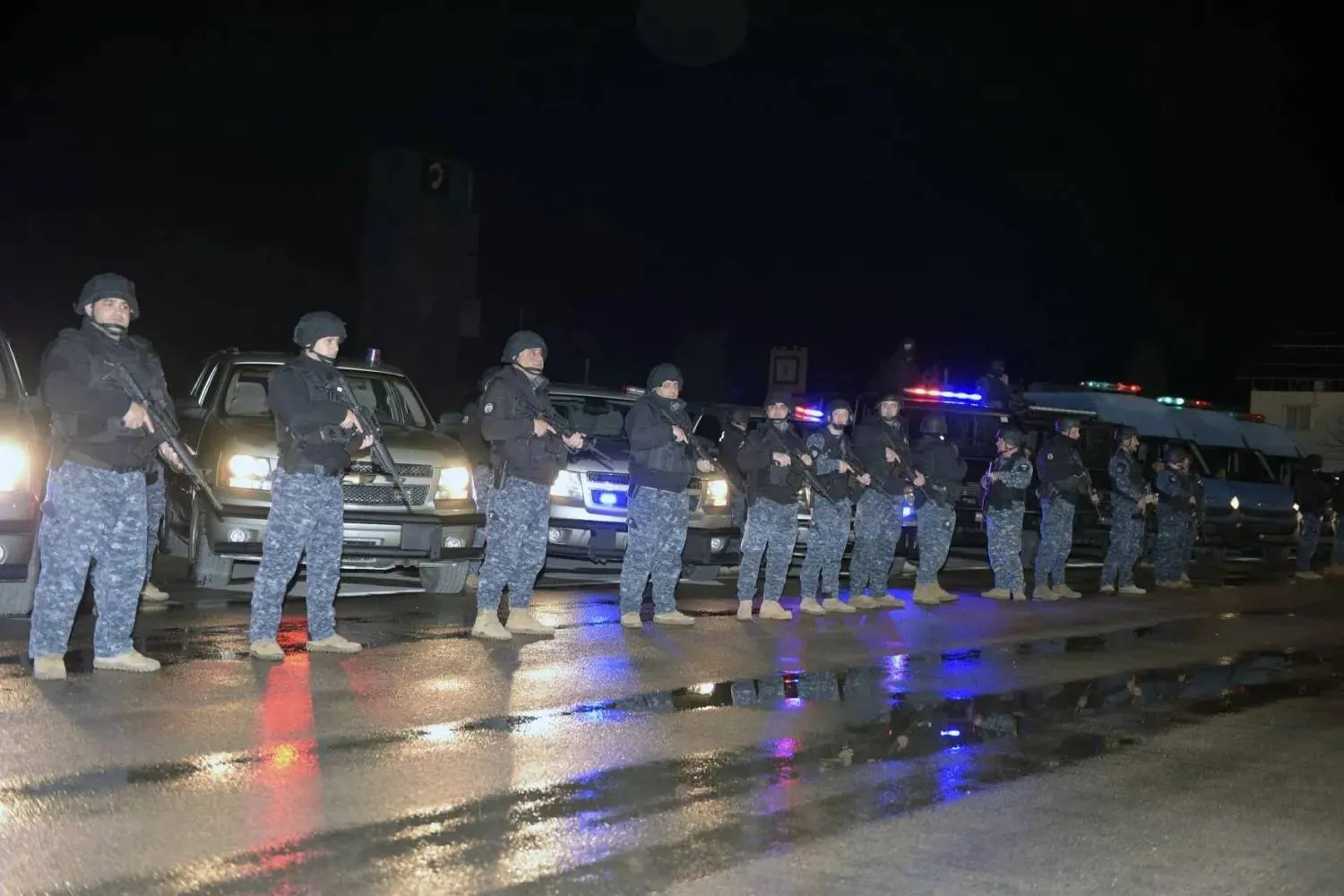

Lebanon’s Internal Security Forces (ISF) said on Friday they carried out a raid as part of efforts to combat the illicit trade in military-grade weapons, targeting the Chiyah area in Beirut’s southern suburbs.
The operation led to the arrest of several individuals and the seizure of a quantity of weapons, ammunition, maintenance parts, and other items.
The ISF Directorate said the raid resulted in the confiscation of various military rifles and pistols in working order, as well as disassembled pistols prepared for machining or modification, assorted live ammunition of different calibers, rifle and pistol magazines, weapon maintenance parts, wooden and antiquities items, and two motorcycles.
Security Clampdown
A Lebanese security source told Asharq Al-Awsat that the raids in Chiyah, which uncovered apartments used to store, maintain, and trade weapons, fall within efforts to combat organized crime and maintain security, and carry no political or partisan overtones.
The source said the case concerns arms dealers and illicit trafficking networks, and is unrelated to any political party or to the issue of weapons north of the Litani River.
It is not the first time the ISF has carried out such operations, the source added, noting that a similar raid took place in recent months.
Security moves of this kind fall within the ISF’s mandate to pursue organized crime, in parallel with the duties of other security agencies, the source said, stressing that the aim is to maintain order and prevent the uncontrolled spread of the arms trade outside any legal framework.
He added that the competent agencies operate continuously based on available intelligence.
Ongoing Decision
In a political and security reading of the developments, a ministerial source told Asharq Al-Awsat that the recent security raids to seize weapons and pursue traffickers are part of the government’s decision to intensify efforts to combat crime and curb the proliferation of uncontrolled weapons across Lebanese territory, rather than temporary or exceptional measures.
The source said the operations are consistent with the inaugural address and ministerial statement, which stressed strengthening state authority and extending security control.
The adopted approach seeks to prevent uncontrolled weapons from becoming a direct threat to stability, whether through individual crimes or organized networks engaged in the trade, storage, and maintenance of arms, the source added.
The ministerial source said the immediate security objective is to dry up sources of illegal weapons and reduce the ability of criminal groups to use them in robberies, extortion, celebratory gunfire, and security chaos, thereby protecting civil peace and reassuring citizens.
In what appeared to be an effort to frame the raids within a broader context, the source said the government’s approach is not limited to a specific file or region, but addresses the phenomenon of weapons outside state control in all its manifestations, through ongoing political and security tracks.
He stressed that the reference point remains the protection of Lebanese security and the prevention of the use of any weapon to undermine stability.
Weapons Monopoly Plan
Retired Brig. Gen. Saeed Qazah offered a different reading of linking these operations to the issue of restricting arms to the state, particularly when they occur in areas politically and security-wise considered within the influence of Hezbollah.
Qazah told Asharq Al-Awsat that uncovering weapons depots or apartments used to store arms in areas seen as within the party’s sphere of influence should not automatically be read as part of a plan to confine weapons to the state, but rather as part of combating organized crime.
Such phenomena are unrelated to the issue of regulating or controlling strategic weapons, he said, noting that the army’s plan has not been presented in a way that allows every security incident to be linked to it.
Qazah said the new presidency and government appear to be on a clear path to crack down firmly on manifestations of security disorder, pointing to an official decision to combat organized crime, drug trafficking, and arms smuggling across all Lebanese territory without discrimination.
He also highlighted new measures related to licensing individual weapons, saying that including the weapon’s serial number and type on the license constitutes an essential regulatory step to curb chaos in transport and circulation.
Previously, licenses were used as cover to move large quantities of weapons between regions, opening the door to illicit trade and complicating efforts to trace the source of firearms used in crimes, he said.


