


After Two Years of War, Tally of Israel-Hamas Prisoner Swaps

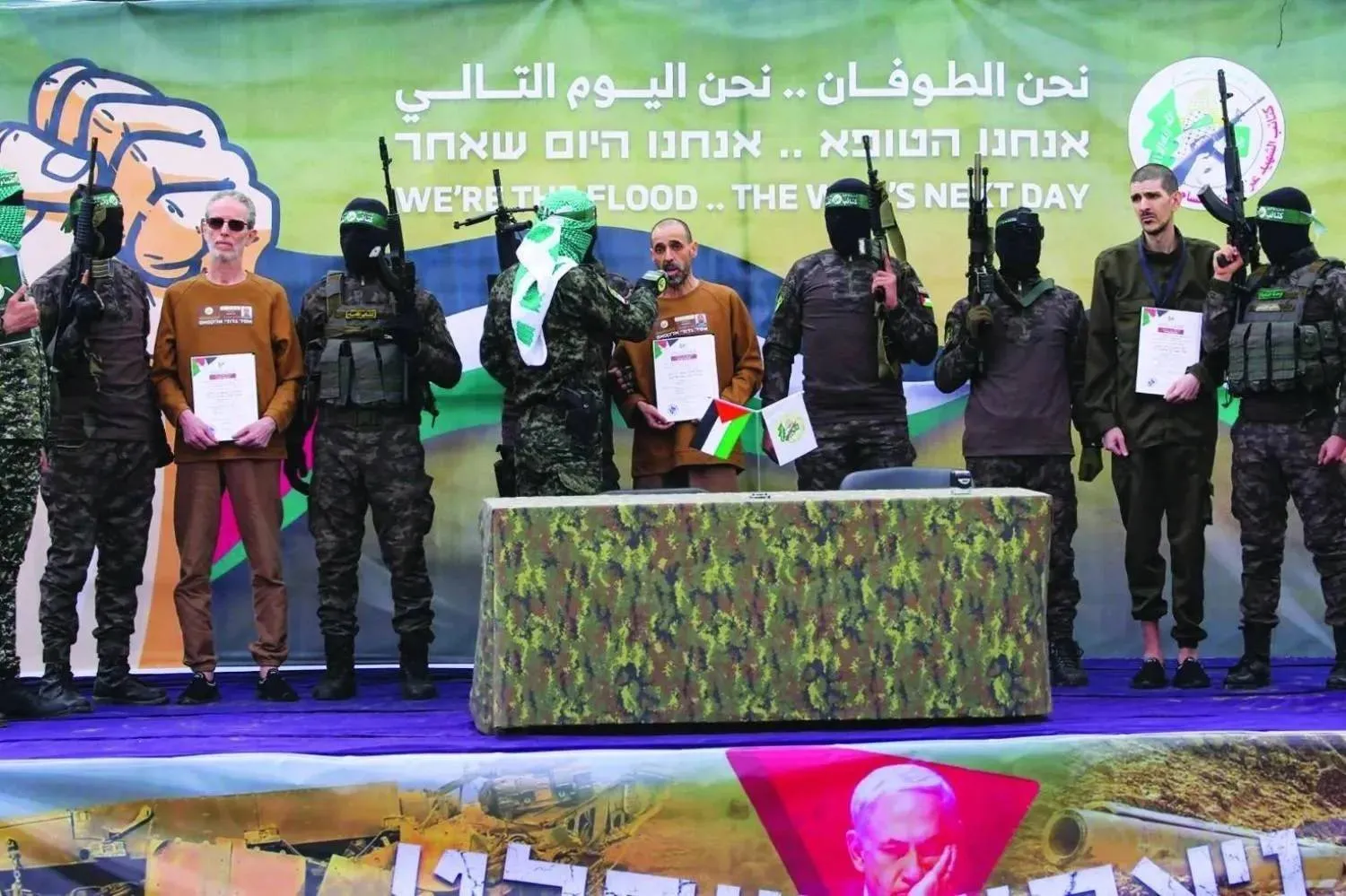
A Hamas banner reading “We Are the Flood… We Are the Day After” during the handover of a group of Israeli hostages (file photo – AFP)
TT

After Two Years of War, Tally of Israel-Hamas Prisoner Swaps

A Hamas banner reading “We Are the Flood… We Are the Day After” during the handover of a group of Israeli hostages (file photo – AFP)

Israel’s military on Friday released new footage of the rescue of two hostages, Fernando Simon Marman and Norberto Louis Har, Israeli nationals who also hold Argentine citizenship, from a house in the southern Gaza city of Rafah.

The operation was carried out on Feb. 12, 2024, amid intense gunbattles with their captors from the Qassam Brigades, the armed wing of Hamas. Several of the gunmen were killed, along with other Palestinian civilians.

Since Oct. 7, 2023, when Hamas launched a surprise attack on Israeli towns and military sites along the Gaza border, and through the same month in 2025, three prisoner exchange deals were conducted between Israel and the Palestinian group.

The swaps took place during a two-year war in which Tel Aviv failed to recover additional hostages alive, although it retrieved numerous bodies.

Israel made several attempts to retrieve hostages by force. The army succeeded on three occasions, including the Rafah operation. In October 2023, it rescued soldier Ori Megidish from Al-Shati refugee camp west of Gaza City in a swift raid.

In June 2024, it recovered four hostages from the Nuseirat refugee camp in central Gaza during a large-scale military operation. The military also recovered the bodies of other captives in separate operations deep inside the enclave.

Across the three agreements, Hamas returned a total of 252 Israeli and foreign hostages, dead and alive, according to Israeli figures. Four of them had been captured in 2014, including two soldiers later confirmed dead, and two civilians who had crossed into Gaza and were said to have suffered from mental illness; both were returned alive.

In exchange, Israel released more than 3,985 Palestinians from Gaza, the West Bank, and Jerusalem.

They included 486 serving life sentences, 319 serving long-term sentences, among them 13 detained since before the Oslo Accords, 114 women, and 279 minors. Forty-one had previously been freed in the 2011 deal that secured the release of Israeli soldier Gilad Shalit and were later rearrested.

Another 22 had not yet been sentenced.

Of the total, 2,724 were detained in Gaza after Oct. 7, 2023.

Negotiations were repeatedly marred by disputes over exchange ratios. Hamas demanded higher numbers in return for Israeli soldiers, at one stage seeking 500 Palestinian prisoners per soldier.

Israeli and mediator pressure led to agreed formulas of 30 prisoners for each civilian hostage and 50 for each soldier. However, Israel continued to release only 30 in some cases.

The first swap followed a six-day temporary truce in late November 2023. Hamas and other Palestinian factions released 50 Israeli hostages classified as humanitarian cases, including women and children, in exchange for 240 Palestinian prisoners, among them 169 boys and 71 women.

During the third week of the war, Hamas also freed four elderly Israeli women without compensation. Separately, 10 Thai workers and one Filipino were released alive during the deal through mediation efforts.

Efforts to extend the truce and secure further releases collapsed, and the war resumed with greater intensity for Gaza’s population.

After prolonged mediation, a three-phase ceasefire agreement was reached in mid-January 2025. The plan provided for the release of living civilian hostages in the first phase, soldiers in the second, and bodies in the third.

It stipulated the release of 30 Palestinian prisoners, including some serving life sentences, for each civilian freed by Hamas, and 50 Palestinians for each soldier, including 30 serving life terms and 20 serving long sentences.

Hamas released 25 living hostages classified as humanitarian cases, including women, children, civilians over 50, and wounded or sick non-combatants. It also handed over the bodies of eight hostages and freed five Thai workers without compensation.

After those releases, Israel refused to free the agreed number of Palestinians in exchange for soldiers and insisted on classifying Arbel Yehoud, whom Palestinians described as a soldier, as a civilian. Her release had been scheduled for late January, and the dispute temporarily stalled the deal.

Mediators later intervened, and she was freed after Israel maintained she was a civilian, allowing displaced residents to return from southern to northern Gaza after Israel had linked their return to her release.

During that phase, five female soldiers abducted from the Nahal Oz site east of Gaza were freed and classified as humanitarian cases, with 30 Palestinians released in exchange for each. At the time, at least 13 Israeli soldiers remained in Hamas captivity, including the highest-ranking officer, Asaf Hamami, commander of the Southern Brigade in the Gaza Division, who was later confirmed dead.

In that deal, Hamas surprised Israel with the number of hostages returned alive, despite Israeli assessments that some had been killed. They included Avera Mengistu and Hisham al-Sayed, who had entered Gaza in 2014 and were captured at the time. After years in captivity, both were confirmed alive upon their release.

Israel freed 1,778 Palestinians in that agreement, including 1,024 Gazans detained during the war. It also released 294 prisoners serving life or long-term sentences, among them 71 women.

On March 18 of the same year, Israel resumed its military campaign after talks to extend the truce failed.

On May 12, Hamas handed over hostage Edan Alexander, an Israeli soldier with US citizenship, as a goodwill gesture toward US President Donald Trump, in exchange for improvements to Gaza’s humanitarian conditions and progress in negotiations, without securing the release of Palestinian prisoners. Israel did not implement those understandings.

Following arduous negotiations, a comprehensive agreement to end the war was reached in October 2025. Israel recovered the remaining 20 living hostages in a single batch and retrieved the dead in stages after searches. The last was Israeli police officer Ran Gvili, whose body was found on Jan. 26 after weeks of efforts to recover it.

In return, Israel released 1,968 Palestinian prisoners, including 1,718 detained during the Gaza war. The group included 250 prisoners, among them 192 serving life sentences and 25 serving long terms. Most were deported outside Gaza to other countries.



Cargo Ship Hit in Strait of Hormuz, Crew Evacuating

The Callisto tanker sits anchored as the traffic is down in the Strait of Hormuz, amid the US-Israeli conflict with Iran, in Muscat, Oman, March 10, 2026. REUTERS/Benoit Tessier
TT

Cargo Ship Hit in Strait of Hormuz, Crew Evacuating

The Callisto tanker sits anchored as the traffic is down in the Strait of Hormuz, amid the US-Israeli conflict with Iran, in Muscat, Oman, March 10, 2026. REUTERS/Benoit Tessier

A projectile hit a cargo ship Wednesday in the Strait of Hormuz, setting the vessel ablaze after the United States targeted Iranian minelaying vessels that could target the narrow mouth of the Arabian Gulf.

The United Kingdom Maritime Trade Operations center, run by the British military, said the vessel had been hit just north of Oman in the strait.

"It has been reported that a cargo vessel has been hit by an unknown projectile in the Straits of Hormuz which has resulted in a fire onboard," the security agency said.

It added that the crew was evacuating the ship.

US President Donald Trump said in social media posts there were no reports of Iran planting explosives in the Strait of Hormuz, through which 20% of the world’s oil is shipped.

The US said it took out more than a dozen minelaying Iranian vessels Tuesday to help prevent any attempt to close the waterway.

Iran's vow not to allow any oil through the strategic strait has led to market volatility and fears of shortages, especially in Asia, which is dependent on oil shipped from the region.

Some tankers, believed linked to Iran, are continuing to get through the Strait of Hormuz.

Some of the ships getting through are so-called “dark” transits, meaning they aren’t turning on their Automatic Identification System tracks, which show where vessels are.

Vessels carrying sanctioned Iranian crude often turn off their AIS trackers.

The security firm Neptune P2P Group said Wednesday that seven ships had passed through the strait since March 8. Of those, five were linked to Iranian-associated shipping, it said.

The commodity-tracking firm Kpler said Iran has restarted crude exports through its Jask oil terminal on the Gulf of Oman.

A tanker loaded roughly 2 million barrels at Jask on March 7, the firm said.


Iraqi Judiciary Signals Action Against Factions Over Embassy Attacks

Members of Kataeb Hezbollah attend the funeral in Baghdad of comrades killed in a strike on the Syrian border (file photo – Reuters)
TT

Iraqi Judiciary Signals Action Against Factions Over Embassy Attacks

Members of Kataeb Hezbollah attend the funeral in Baghdad of comrades killed in a strike on the Syrian border (file photo – Reuters)

Pro-Iran factions are facing possible prosecution and conviction by Iraq’s Supreme Judicial Council, as US strikes continue to target their positions in areas suspected of launching attacks on diplomatic missions and American interests in the Kurdistan region.

On Monday evening, an attack targeted the United Arab Emirates consulate and Erbil airport near a US base, according to videos and eyewitnesses, while the Iraqi government is moving toward announcing the names of those responsible after attempts to halt the attacks, which have continued for about a week, failed.

A drone struck the UAE consulate in the Mass City area on the road linking Erbil with the Salahaddin district, without causing any reported damage.

Condemnations

Iraq’s foreign ministry on Tuesday condemned attacks targeting diplomatic missions and consulates in Baghdad and the Kurdistan region, reaffirming its rejection of any assault on diplomatic missions and saying the competent authorities would take legal action against those involved.

In a statement, the ministry said Iraq’s position was firm in rejecting any attacks against diplomatic and consular missions and stressed its commitment to providing full protection to ensure they can continue operating and carrying out their duties in a safe environment, in line with relevant international obligations.

The ministry added that Iraqi authorities were closely monitoring any incidents affecting diplomatic missions and would take the necessary legal measures against those responsible to safeguard their security and prevent such attacks from recurring.

The UAE also condemned the drone attack on its consulate in the Kurdistan region, saying the targeting of diplomatic missions and premises constituted a violation of international norms and laws.

It called on the governments in Baghdad and Erbil to reveal the circumstances of the attack and hold those responsible accountable.

Saudi Arabia’s foreign ministry on Tuesday expressed solidarity with the UAE and likewise condemned the targeting of the Emirati consulate general in the Kurdistan region, saying the attack violated international norms and laws and stressing the need to respect the sanctity of diplomatic mission buildings.

Judicial measures

In a later development, Iraqi Foreign Minister Fuad Hussein met on Tuesday with Faiq Zaidan, head of Iraq’s Supreme Judicial Council, to discuss “judicial and legal measures taken against the perpetrators of terrorist crimes represented by attacks on diplomatic missions, institutions and citizens in Iraq,” according to a statement.

It is one of the rare occasions in Iraq when firm positions are voiced against the conduct of the factions, while observers note that the targeting of diplomatic missions could turn into a judicial case leading to trials of members and leaders of these Iran-aligned groups.

However, observers doubt the government’s ability to confront the Iran-backed armed factions that continue launching rockets and drones at various sites across Iraq. Many of the attacks have focused on the Kurdistan region, which has been hit by more than 200 strikes targeting various locations, infrastructure and foreign consulates.

The group known as the Islamic Resistance in Iraq said on Tuesday it had carried out 37 military operations within the past 24 hours inside Iraq and elsewhere in the region.

As the attacks persist, reliable sources say the failure of attempts to curb the factions may push the Iraqi government to “expose the groups involved in the attacks by name,” according to Iraqi officials cited by sources.

The government of Prime Minister Mohammed Shia al-Sudani, whose term is ending, is facing local, regional and international pressure to rein in the armed groups. Authorities have shown little capacity to act effectively and often limit their responses to mere condemnations, placing the government in an embarrassing position before citizens and the international community.

On Sunday, Bafel Talabani, leader of the Patriotic Union of Kurdistan party, presented Baghdad with what he said was a list of names of some of the armed groups attacking the region, though federal authorities have yet to take serious action.

The US Consulate General in Erbil confirmed on Tuesday that US Secretary of State Marco Rubio spoke by phone with al-Sudani.

It said Rubio strongly condemned the terrorist attacks carried out by Iran and terrorist militias allied with it in Iraq, including the Kurdistan region, referring to attacks targeting US diplomatic missions and facilities in Iraq and the Kurdistan region.

Both sides stressed the importance of the Iraqi government taking all necessary measures to protect US personnel and diplomatic facilities.

“Deep state”

Kifah Mahmoud, media adviser to Masoud Barzani, leader of the Kurdistan Democratic Party, said he doubted the federal government’s ability to confront the armed factions.

“What is strange about these attacks is that the government forms investigation committees involving parliament and security agencies — most of them from influential Shiite forces — then they investigate and identify those responsible, but they do not announce the results or take any action against them,” Mahmoud told Asharq Al-Awsat.

Mahmoud said Iraqi actors may be deliberately covering up the results of investigations or are too weak to hold the perpetrators accountable.

“It is difficult to hold these groups accountable because they form a deep state that possesses all the means necessary to practice its terrorism against the state and its legitimate institutions,” he said.

Kidnapping risk

Meanwhile, the US embassy in Baghdad warned American citizens in Iraq on Tuesday of rising security risks, saying they face threats including kidnapping and attacks targeting US citizens and their interests, and urging them to leave the country when conditions permit.

In a security alert, the embassy said Iran and armed groups loyal to it continue to pose a serious threat to public security, urging US citizens to exercise caution, avoid drawing attention to themselves and stay away from locations associated with the US or where Americans gather.

The alert said previous attacks had targeted American citizens and interests in Iraq, warning that US nationals face kidnapping risks. US companies, hotels frequented by foreigners and other facilities linked to the United States have also been attacked in the past.

The embassy added that citizens who choose to remain in Iraq should be prepared to shelter in place for extended periods and ensure they have food, water, medicines and other essential supplies.


Israel Strikes Apartment Building in Central Beirut

Emergency services inspect the damage after an Israeli strike targeted an apartment at a building in the Aisha Bakkar neighborhood, Beirut, Lebanon, 11 March 2026. (EPA)
TT

Israel Strikes Apartment Building in Central Beirut

Emergency services inspect the damage after an Israeli strike targeted an apartment at a building in the Aisha Bakkar neighborhood, Beirut, Lebanon, 11 March 2026. (EPA)

An Israeli strike hit an apartment in central Beirut on Wednesday, state media reported, the second targeting of the heart of the Lebanese capital since the latest war with Iran-backed group Hezbollah broke out. 

Israeli media said the strike targeted an office used by the Jamaa Islamiya group that has ties with Hezbollah. They said four people were killed and four others wounded. 

Lebanon was drawn into the Middle East war last week when Hezbollah attacked Israel in response to the killing of Iranian supreme leader Ali Khamenei in US-Israeli strikes. 

Israel, which kept up strikes targeting Hezbollah despite a 2024 ceasefire, has since launched attacks across Lebanon and sent ground troops into border areas. 

Lebanon's state-run National News Agency (NNA) said that "the enemy targeted an apartment in the Aisha Bakkar area" in central Beirut, a densely populated neighborhood close to one of the city's biggest shopping malls. 

AFPTV's live broadcast showed the sound of an airstrike followed by a fireball erupting in an apartment within a multi-story residential building in Beirut. 

An AFP correspondent saw destroyed walls in a building's seventh and eighth floors with damaged cars nearby and security forces present at the scene. 

Last week the Israeli army targeted a hotel in central Beirut, with Iran's permanent mission to the United Nations saying it killed four of its diplomats. 

- Southern suburbs - 

Earlier on Wednesday, the NNA reported an Israeli strike on Beirut's southern suburbs, where Hezbollah holds sway. 

The Israeli military had said in a statement it "has begun strikes against Hezbollah infrastructure" in the area. 

It reiterated on Tuesday its call for residents to evacuate the southern suburbs before launching strikes. 

Hezbollah said in separate statements on Tuesday that its fighters had attacked Israeli troops near the southern border towns of Khiam and Odaisseh, and launched rockets at Israel including at a "missile defense site" south of Haifa. 

It later said it was engaging an Israeli force near the border town of Aitaroun "with light and medium weapons". 

Lebanese authorities said Tuesday that 759,300 people had been registered as displaced, with 122,600 staying in shelters. 

The health ministry on Wednesday said that "successive raids launched by the Israeli enemy" on the southern town of Qana, Tyre district, killed five people and wounded five others. 

In Hennawiyeh, Tyre district, the ministry said the night prior that an Israeli strike wounded two people, and a follow-up attack killed them, along with a rescuer who came to the scene. 

A strike on Zalaya in the southeast killed one, per the ministry.