



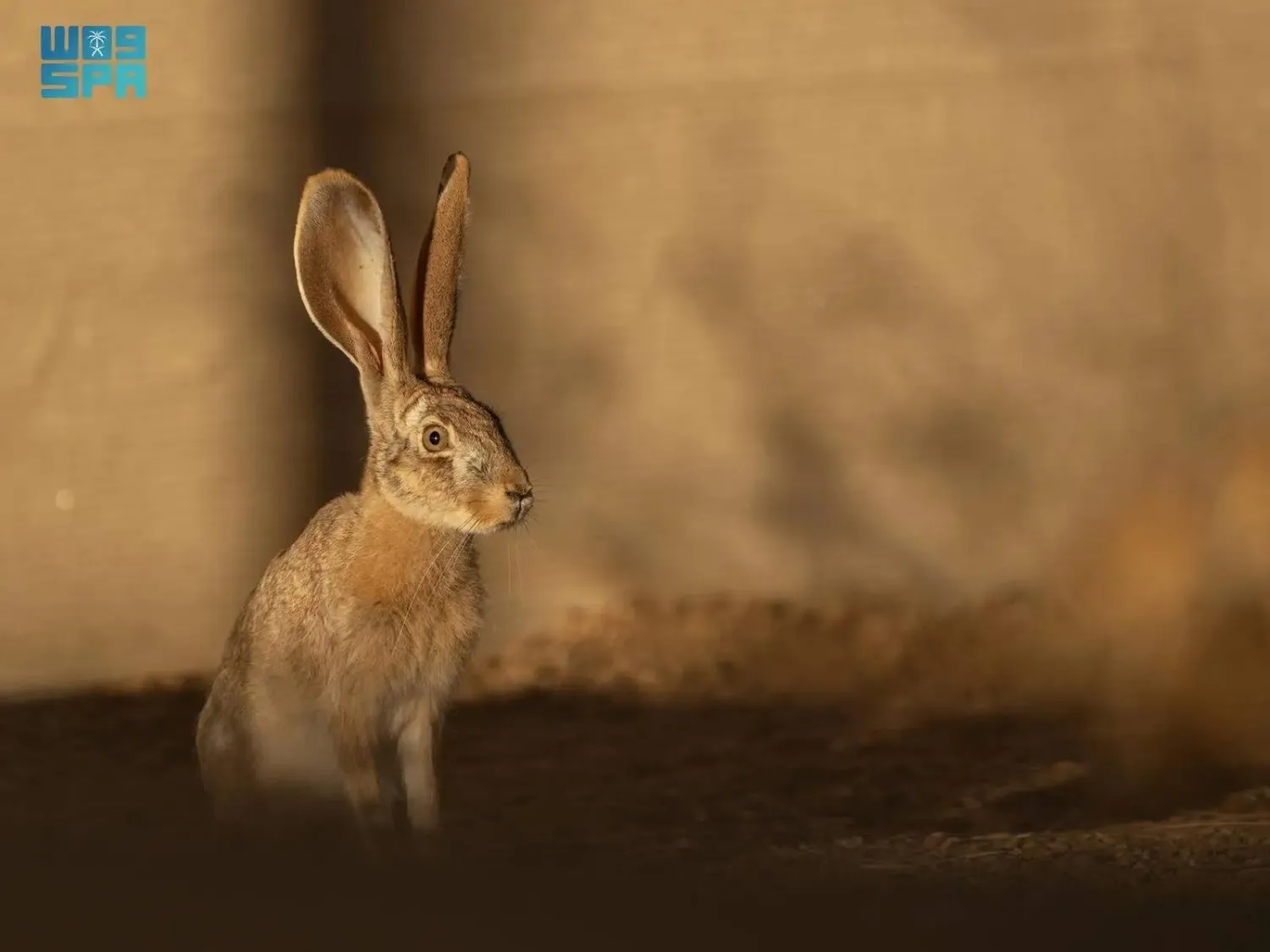

Saudi Arabia’s Prince Mohammed bin Salman Royal Reserve has reintroduced the Arabian hare (Lepus capensis arabicus) to be the 14th native species returned to the reserve since the ReWild Arabia program began in winter 2022, reported the Saudi Press Agency on Sunday.
The reintroduction of this primary consumer supports the re-establishment of a critical layer of the trophic food web, restoring energy pathways from vegetation to predators. It also supports the recovery of ecosystem functioning at the landscape scale.
Arabian hares sit at a crucial link in the food chain, influencing ecosystem processes both up and down the trophic pyramid. As herbivores, they graze and disperse seeds, helping to regulate vegetation across the reserve’s ecosystems. For desert predators, they are a principal food source, transferring energy upward from scarce desert plant biomass with a high ectotrophic efficiency, sustaining higher-level wildlife.
Reserve CEO Andrew Zaloumis said: “True rewilding restores processes, not just populations. By bringing back the Arabian hare - a keystone prey for the Prince Mohammed bin Salman Royal Reserves' jackals, foxes, wildcats and hyenas, and ecosystem shaper - we strengthen the connections that allow desert life to recover and flourish. This is the foundation of ReWild Arabia.”
Twenty Arabian hares, carefully selected to boost genetic diversity, have been introduced through the reserve’s rewilding program. Due to their ecological significance, the animals will initially remain in purpose-built breeding enclosures to accelerate population growth before release. The first leveret (hare young) has already been born. These introductions will strengthen the reserve’s existing sparse population by increasing numbers and diversifying genetics.
Unlike many desert species that retreat underground to escape extreme heat, Arabian hares are uniquely adapted to life on the land’s surface, hence their other name, the desert hare. They are among the few mammals able to survive extreme temperatures without burrowing.
Their cryptic coloration provides effective camouflage, reducing detection by predators. Large ears, which can reach up to 17 centimeters in length, 30% of their total body length, act as efficient cooling systems and provide acute hearing, with pinnae capable of rotating independently. Combined with near-360-degree vision, these adaptations enable early detection of predators.
When threatened, Arabian hares can reach speeds of up to 80 kilometers per hour, zig-zagging sharply to evade pursuit. Despite these defenses, predation rates in desert environments can reach up to 90 percent, underscoring their importance as a primary prey species.
Since the ReWild Arabia program began, 14 species have been successfully reintroduced. The Arabian hare marks the sixth species to breed within the program. To date, the reserve has recorded over 100 sand gazelle births, 19 mountain gazelle births, the first two Nubian ibex kids, 36 Arabian oryx calves, and a Persian onager foal.
These milestones reflect the reserve’s long-term objective: to establish self-sustaining wildlife populations and build founder populations capable of supporting restoration efforts across Saudi Arabia and the wider region.
Large-scale rewilding across the reserve is guided by its Integrated Development Management Plan, which delivers habitat-wide restoration across 24,500 square kilometers of marine and terrestrial ecosystems. Supported by an advanced ranger program and strong community engagement, this work advances Vision 2030 and the Saudi Green Initiative, contributing to national commitments to restore biodiversity and protect 30% of the Kingdom’s land and sea by 2030.
The 24,500 km² Prince Mohammed bin Salman Royal Reserve stretches from the lava plains of the Harrats to the deep Red Sea in the west, connecting NEOM, Red Sea Global, and AlUla. It is home to the magnificent Wadi al-Disah and Red Sea Global’s AMAALA destination.
The reserve encompasses 15 distinct ecosystems. At just 1% of the Kingdom’s terrestrial area and 1.8% of its marine area, it boasts over 50% of the Kingdom’s species, making it one of the most biodiverse protected areas in the Middle East.
The reserve is committed to restoring and conserving the natural and cultural environment. This includes the reintroduction of 23 historically occurring native species, 14 of which have already been reintroduced, including the Arabian oryx, Persian onager, sand gazelle and mountain gazelle, as part of a wide-ranging rewilding program.
The Prince Mohammed bin Salman Royal Reserve is overseen by the Royal Reserves Council, chaired by Prince Mohammed bin Salman, Crown Prince and Prime Minister. Its program is integrated with Saudi Arabia’s wider sustainability and conservation programs, including the Saudi Green and Middle East Green Initiatives.
