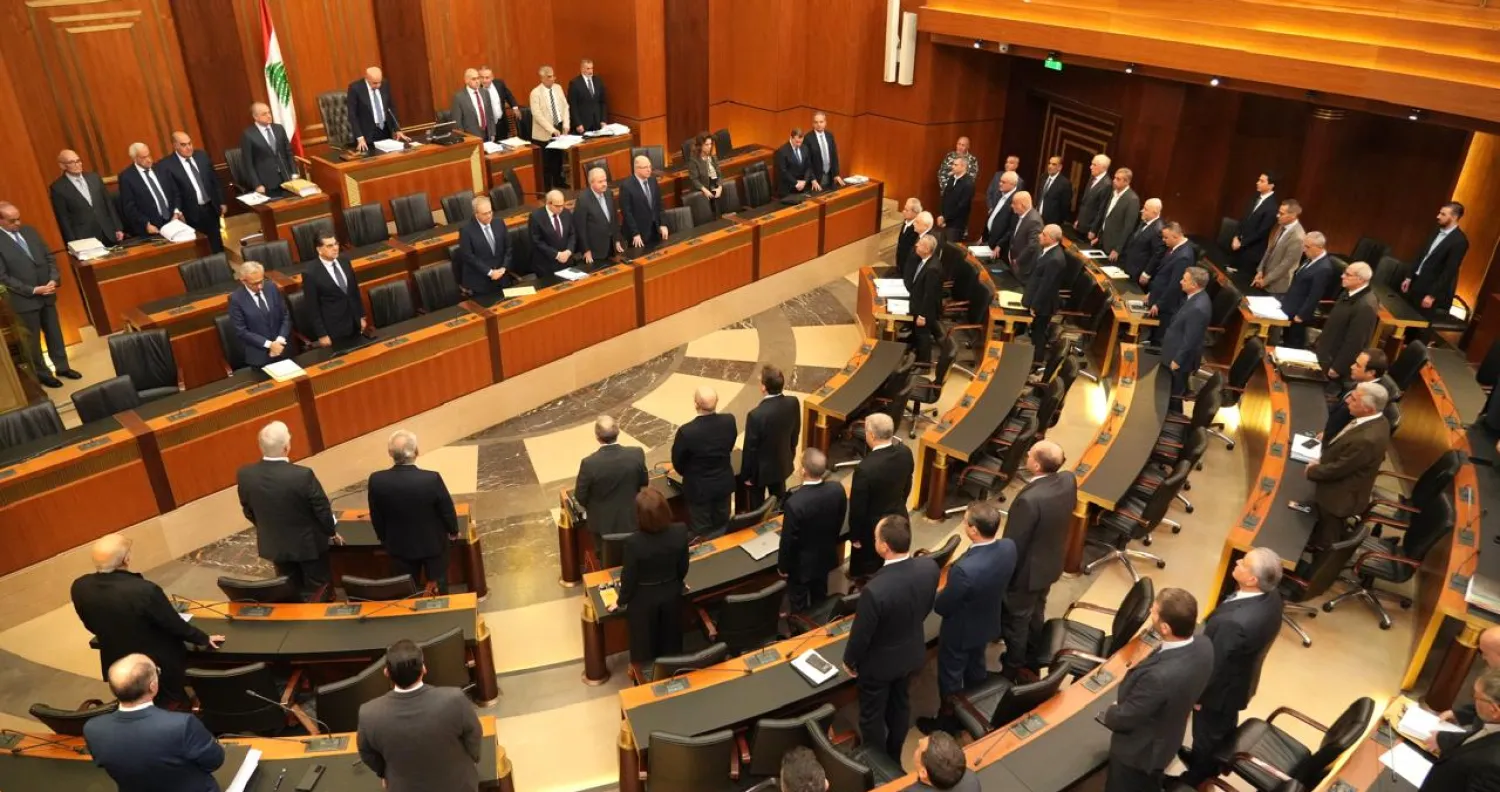

Berri to Asharq Al-Awsat: An Unnamed Party Has Plans to Block Parliamentary Elections

A previous session of the Lebanese Parliament (National News Agency) 
TT

Berri to Asharq Al-Awsat: An Unnamed Party Has Plans to Block Parliamentary Elections

A previous session of the Lebanese Parliament (National News Agency) 

A legal opinion issued by Lebanon’s Ministry of Justice’s Legislation and Consultations Authority, responding to a query from Interior and Municipalities Minister Brig. Gen. Ahmad Hajjar on expatriate voting, has further unsettled the electoral scene in the country.

The opinion addresses whether Lebanese citizens abroad may vote from their country of residence for all 128 seats in Parliament. If adopted by the government, it could spark a confrontation with a parliamentary bloc that rejects it, potentially jeopardizing the holding of elections scheduled for May.

Parliament Speaker Nabih Berri reacted sharply, describing the opinion as “rejected, baffling, and not open to interpretation.”

Speaking to Asharq Al-Awsat, Berri said it was unprecedented “for a judge to suspend the implementation of a law rather than ensure its application,” adding that the law cannot be bypassed by a non-binding advisory opinion.

He went further, alleging that the opinion “reveals the existence of a plan to prevent parliamentary elections from taking place on time,” saying it was prompted by an “unnamed party”.

Berri stressed that the move “did not come out of nowhere,” but rather as part of advance planning to halt elections that must be held under the current electoral law.

He said he personally opened nominations for the polls to “cut off claims that I favor extending Parliament’s term,” rejecting suggestions that his Amal Movement fears waning popularity.

“We have chosen to submit to the ballot box,” he said, insisting he remains committed to holding elections on schedule and urging all sides to facilitate, not obstruct, the process.

Hajjar, who requested the opinion, is reportedly proceeding cautiously. Sources close to him told Asharq Al-Awsat he prefers consultations with President Joseph Aoun and Prime Minister Nawaf Salam before deciding whether to place the issue on the Cabinet agenda.

It remains unclear whether the government will embrace the advisory opinion - non-binding by nature - or use it to broker a compromise over proposed amendments to the electoral law.

Political sources downplayed the likelihood of a major clash, citing the country’s fragile conditions and escalating Israeli attacks, as well as the need for stability ahead of a Paris-hosted international conference on March 5 to support the Lebanese Armed Forces and Internal Security Forces. They noted that adopting the opinion would require legislative change.

Looking ahead, uncertainty persists over whether elections could be delayed under the pretext of disagreement on the law.

Sources point to waning international pressure to hold the vote on time, as foreign envoys now prioritize the state’s monopoly on arms - particularly north of the Litani River to the Awali - over electoral timelines.

While the international community is unlikely to demand a postponement, it appears to favor sequencing elections after progress on disarmament, arguing this would weaken Hezbollah’s leverage and advance the project of rebuilding the state.


Prosecutors Plan to Charge an Israeli Settler with Killing a Palestinian Activist in the West Bank

 Israeli's sit on the roof next to a flag, as they monitor a weekly settlers' tour in Hebron, in the Israeli-occupied West Bank, February 14, 2026. (Reuters)
Israeli's sit on the roof next to a flag, as they monitor a weekly settlers' tour in Hebron, in the Israeli-occupied West Bank, February 14, 2026. (Reuters)
TT

Prosecutors Plan to Charge an Israeli Settler with Killing a Palestinian Activist in the West Bank

 Israeli's sit on the roof next to a flag, as they monitor a weekly settlers' tour in Hebron, in the Israeli-occupied West Bank, February 14, 2026. (Reuters)
Israeli's sit on the roof next to a flag, as they monitor a weekly settlers' tour in Hebron, in the Israeli-occupied West Bank, February 14, 2026. (Reuters)

Israeli prosecutors said Monday that they plan to charge a settler in the killing of a Palestinian activist during a confrontation that was caught on video, opening a rare prosecution of violence by Jewish settlers in the occupied West Bank.

Attacks from settlers and home demolitions by authorities have spiked dramatically over the past two years, but the death in July of Awdah Hathaleen has drawn particular attention due to his involvement in the 2025 Oscar-winning film “No Other Land,” which chronicled Palestinian villagers’ fight to stay on their land. The case also stands out because the confrontation between Palestinians and Yinon Levi, an internationally sanctioned settler, was captured on video from multiple vantage points.

In a video that family members say was taken by Hathaleen himself, Levi could be seen firing toward the person holding the camera. Another showed Levi firing two shots without showing where the bullets struck.

An Israeli judge released Levi from custody six months ago, citing a lack of evidence that he fired the shots that killed Hathaleen.

Israel’s State Attorney General’s office confirmed in a statement Monday that it had initiated proceedings to indict Levi. It did not specify the charges.

Eitan Peleg, an attorney for Hathaleen’s family, said the office had informed them it planned to indict Levi for reckless homicide, triggering a process that allows Levi to contest charges before they’re formally filed.

“Enforcement of the law in cases like this involving Palestinians in the West Bank is very rare, so this is unique,” Peleg told The Associated Press on Monday.

Israel’s military referred questions on the indictment to police, who have not yet responded. Both bodies enforce laws in the area.

More than 3.4 million Palestinians and 700,000 Israelis live in the occupied West Bank and east Jerusalem, territories captured by Israel in 1967 and sought by Palestinians for a future state. The international community overwhelmingly considers Israeli settlement construction in these areas to be illegal and an obstacle to peace.

Palestinians and rights groups say authorities routinely fail to prosecute settlers or hold them accountable for violence. Under National Security Minister Itamar Ben Gvir, investigations into settler attacks have plummeted, according to the Israeli rights group Yesh Din.

Khalil Hathaleen, Awdah’s brother, said the family was glad some measure of justice was being pursued but felt the charge of “reckless homicide” was insufficient.

“It was an intentional killing in broad daylight, with prior intent and premeditation,” he said.

Levi’s attorney, Avichai Hajbi, declined Monday to comment on the coming indictment, which he said he hadn’t received. After the shooting, he told The Associated Press that Levi acted in self-defense, without elaborating. Levi did not answer phone calls Monday.

Parts of the confrontation were filmed

Video released last year by B’Tselem, an Israeli human rights group showed Levi firing a gun toward the person filming. At the moment that B’Tselem says Hathaleen collapsed, the visuals are jostled but moans of pain can be heard. The group said it obtained the video from the family of Hathaleen, who said he filmed it.

Additional footage obtained by the AP last year showed Levi waving a pistol during the standoff in Umm al-Khair that was with a group of Palestinians over an excavator that had rolled down from a nearby settlement and damaged Palestinian property earlier in the day.

Alaa Hathaleen, a cousin who filmed the encounter, told AP at the time that he had approached Levi to tell him the group was unarmed and to stop the bulldozing.

In the video, one Palestinian insults Levi and another challenges him to shoot. Levi shoves someone just out of the frame, demands to know who threw stones, and later fires a shot, seemingly away from the crowd. He then fires again and yells toward the crowd to get away from the excavator.

The footage did not show where bullets struck, though other relatives said they saw Awdah Hathaleen fall immediately after shots were fired.

Levi was detained before being released to house arrest. That condition was eventually lifted, too.

Levi was among the Israeli settlers sanctioned by the United States and other Western countries over allegations of violence toward Palestinians in 2024. President Donald Trump lifted the US sanctions after taking office the following year.

Attacks spike as spotlight grows

Activists and crew members on the film “No Other Land” have said settler attacks have intensified on the village portrayed since the movie won the Oscar.

Hamdan Ballal, one of the film’s directors, said his family home in Umm al-Khair was subject to another attack on Sunday. Four relatives were arrested during the confrontation, he said.

Ballal said a soldier, who came to their home accompanied by another soldier and a settler-herder, grabbed his brother by the neck and tried to choke him. Neither the army nor the police responded to requests for comment on the incident.

“The year after I won the Oscar, the assaults increased significantly. On a daily basis, settlers come and destroy the fields, destroy the trees, destroy the crops around the house,” he said.

Israeli proof-of-ownership rules spark anger

As prosecutors move to indict Levi and violence persists across the West Bank, Israel is moving ahead with measures to deepen its control over land in the occupied territory.

On Sunday, it announced it would resume a land registration process across the West Bank to require anyone with a claim to land to submit documents proving ownership. Rights groups say the process could strip Palestinians of land they've lived on and farmed for generations and transfer vast swaths of land to Israeli state control.

Israel’s Foreign Ministry said the steps countered Palestinian Authority land registration efforts in areas where Israel maintains civil and military control.

The measures follow years of accusations by Palestinians that actions by settlers and the military — campaigns of violence, harassment and demolitions — have pushed them from their land.

The decisions have drawn widespread condemnation as violations of international law, including from countries involved in the ceasefire process in the Gaza Strip and Trump's Board of Peace.

Saudi Arabia’s Foreign Ministry in a statement on Monday said the measures were part of Israel’s effort to impose a “new legal and administrative reality” that undermines prospects for peace and stability. Egypt’s Foreign Ministry called the move a “flagrant violation” of international law, warning it would escalate tensions in the Palestinian territories and across the region.


Israel Police to Deploy Around Al-Aqsa for Ramadan, Palestinians Report Curbs

 Palestinian Muslim worshipper walks in the grounds of the Dome of the Rock Shrine at the Al-Aqsa Mosque compound in the old city of Jerusalem, during a light dust storm on February 14, 2026. (AFP)
Palestinian Muslim worshipper walks in the grounds of the Dome of the Rock Shrine at the Al-Aqsa Mosque compound in the old city of Jerusalem, during a light dust storm on February 14, 2026. (AFP)
TT

Israel Police to Deploy Around Al-Aqsa for Ramadan, Palestinians Report Curbs

 Palestinian Muslim worshipper walks in the grounds of the Dome of the Rock Shrine at the Al-Aqsa Mosque compound in the old city of Jerusalem, during a light dust storm on February 14, 2026. (AFP)
Palestinian Muslim worshipper walks in the grounds of the Dome of the Rock Shrine at the Al-Aqsa Mosque compound in the old city of Jerusalem, during a light dust storm on February 14, 2026. (AFP)

Israeli police said Monday that they would deploy in force around the Al-Aqsa Mosque during the Muslim holy month of Ramadan, which begins this week, as Palestinian officials accused Israel of imposing restrictions at the compound.

Over the course of the month of fasting and prayer, hundreds of thousands of Palestinians traditionally attend prayers at Al-Aqsa -- Islam's third-holiest site, located in east Jerusalem, which Israel captured in 1967 and later annexed.

Arad Braverman, a senior Jerusalem police officer, said forces would be deployed "day and night" across the compound, known to Jews as the Temple Mount, and in the surrounding area.

He said thousands of police would also be on duty for Friday prayers, which draw the largest crowds of Muslim worshippers.

Braverman said police had recommended issuing 10,000 permits for Palestinians from the occupied West Bank, who require special permission to enter Jerusalem.

He did not say whether age limits would apply, adding that the final number of people would be decided by the government.

The Palestinian Jerusalem Governorate said in a separate statement it had been informed that permits would again be restricted to men over 55 and women over 50, mirroring last year's criteria.

It said Israeli authorities had blocked the Islamic Waqf -- the Jordanian-run body administering the site -- from carrying out routine preparations, including installing shade structures and setting up temporary medical clinics.

A Waqf source confirmed the restrictions and said 33 of its employees had been barred from entering the compound in the week before Ramadan.

The Al-Aqsa compound is a central symbol of Palestinian identity and also a frequent flashpoint.

Under long-standing arrangements, Jews may visit the compound -- which they revere as the site of their second temple, destroyed by the Romans in 70 AD -- but they are not permitted to pray there.

Israel says it is committed to maintaining this status quo, though Palestinians fear it is being eroded.

Braverman reiterated Monday that no changes were planned.

In recent years, a growing number of Jewish ultranationalists have challenged the prayer ban, including far-right politician Itamar Ben-Gvir, who prayed at the site while serving as national security minister in 2024 and 2025.


German President Urges Lebanon to Keep up Disarmament of Hezbollah

A general view of demonstrators during 2019 anti-government protests in central Beirut. (Reuters)
TT

German President Urges Lebanon to Keep up Disarmament of Hezbollah

A general view of demonstrators during 2019 anti-government protests in central Beirut. (Reuters)

Visiting German President Frank-Walter Steinmeier on Monday urged Beirut to keep disarming militant group Hezbollah, saying it would help ensure the withdrawal of Israel's army from Lebanese territory.

Israel has kept up regular strikes and maintained troops in five south Lebanon areas despite a November 2024 truce that sought to end more than a year of hostilities with the Iran-backed group.

Lebanon's government has committed to disarming Hezbollah, and the army last month said it had completed the first phase of the plan, covering the area between the Litani River and the Israeli border.

Steinmeier said his visit was about "the demand that both sides fulfil their obligations under the ceasefire agreement and that the disarmament of Hezbollah here in Lebanon continues, thereby creating the conditions for the Israeli army to withdraw from southern Lebanon".

"Both sides are obliged to fulfil the ceasefire agreement -- I say this in Israel as well as in Lebanon," he told a press conference with his Lebanese counterpart Joseph Aoun, calling the deal "an opportunity".

Israel, which accuses Hezbollah of rearming, has criticized the army's progress as insufficient, while Hezbollah -- which was badly weakened by war with Israel -- has rejected calls to surrender its weapons.

Lebanon's army is expected to update the cabinet on Monday over its progress on disarmament and the second phase, which covers the area between the Litani and the Awali rivers, around 40 kilometres south of Beirut.

Aoun said Lebanon asked Germany to "demand the Israeli side implement the ceasefire agreement and withdraw from the territories it occupies".

He also asked Germany to assist the Lebanese army and to play a "key role" after the departure of United Nations peacekeepers, whose mandate expires this year.

Germany has 179 personnel in the United Nations Interim Force in Lebanon, according to the peacekeepers.

It has headed UNIFIL's maritime taskforce since 2021.