

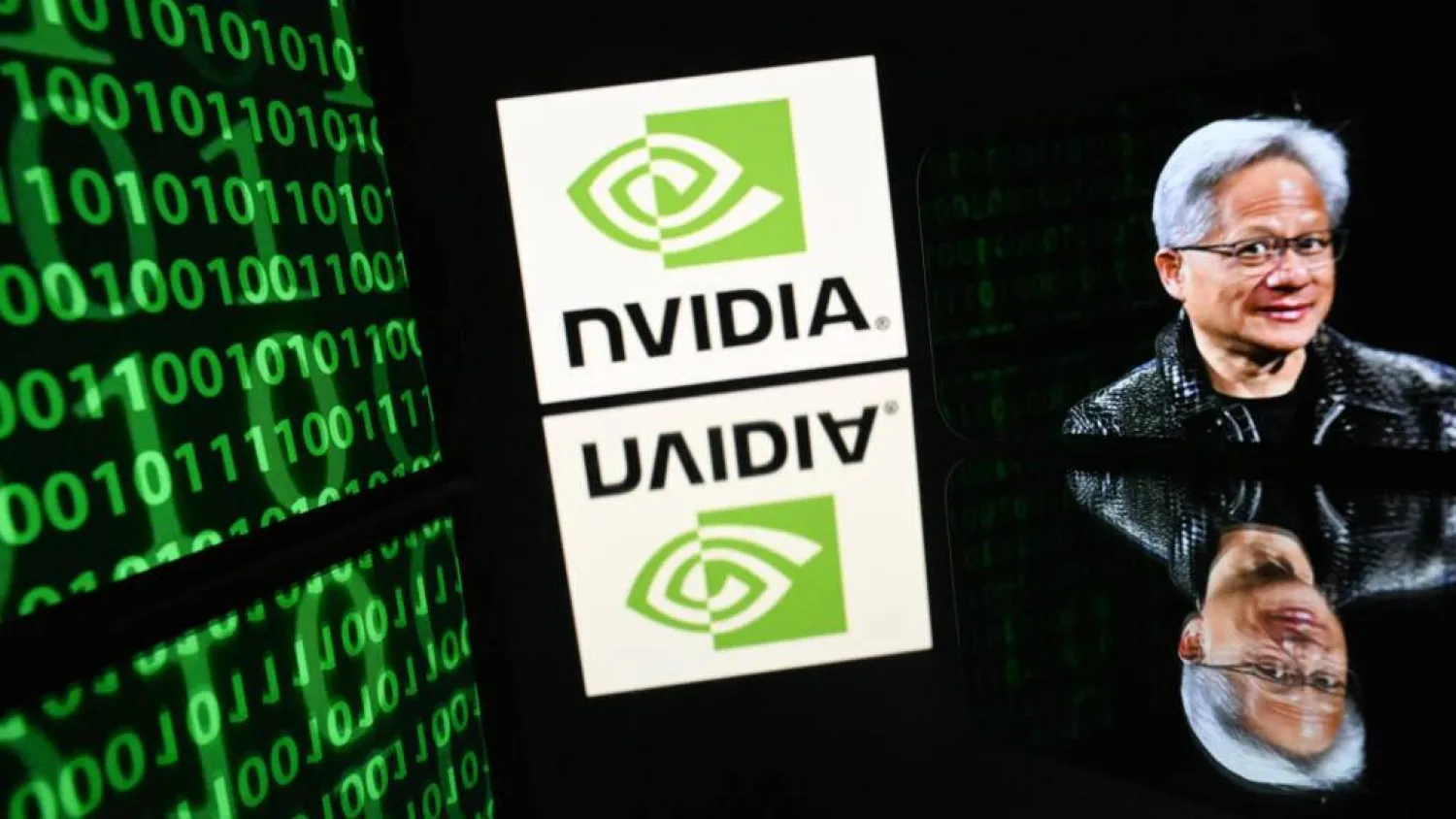

Report: Nvidia Nears Deal for Scaled-down Investment in OpenAI

Nvidia chief executive Jensen Huang has insisted that the AI chip powerhouse is committed to a big investment in ChatGPT-maker OpenAI. Lionel BONAVENTURE / AFP
TT

Report: Nvidia Nears Deal for Scaled-down Investment in OpenAI

Nvidia chief executive Jensen Huang has insisted that the AI chip powerhouse is committed to a big investment in ChatGPT-maker OpenAI. Lionel BONAVENTURE / AFP

Nvidia is on the cusp of investing $30 billion in OpenAI, scaling back a plan to pump $100 billion into the ChatGPT maker, the Financial Times reported Thursday.

The AI-chip powerhouse will be part of OpenAI's new funding round with an agreement that could be concluded as early as this weekend, according to the Times, which cited unnamed sources close to the matter.

Nvidia declined to comment on the report.

Nvidia chief executive Jensen Huang has insisted that the US tech giant will make a "huge" investment in OpenAI and dismissed as "nonsense" reports that he is unhappy with the generative AI star.

Huang made the remarks late in January after the Wall Street Journal reported that Nvidia's plan to invest up to $100 billion in OpenAI had been put on ice.

Nvidia announced the plan in September, with the investment helping OpenAI build more infrastructure for next-generation artificial intelligence.

The funding round is reported to value OpenAI at some $850 billion.

Huang told journalists that the notion of Nvidia having doubts about a huge investment in OpenAI was "complete nonsense."

Huang insisted that Nvidia was going ahead with its investment in OpenAI, describing it as "one of the most consequential companies of our time".

"Sam is closing the round, and we will absolutely be involved in the round," Huang said, referring to OpenAI chief executive Sam Altman.

"We will invest a great deal of money."

Nvidia has become the coveted supplier of processors needed for training and operating the large language models (LLM) behind chatbots like OpenAI's ChatGPT or Google Gemini.

LLM developers like OpenAI are directing much of the mammoth investment they have received into Nvidia's products, rushing to build GPU-stuffed data centers to serve an anticipated flood of demand for AI services.

The AI rush, and its frenzy of investment in giant data centers and the massive purchase of energy-intensive chips, continues despite signs of concern in the markets.



AI Agent 'Lobster Fever' Grips China Despite Risks

A man wears a lobster hat that represents the OpenClaw logo, an open-source AI assistant at the Baidu headquarters in Beijing on March 11, 2026. (Photo by ADEK BERRY / AFP)
TT

AI Agent 'Lobster Fever' Grips China Despite Risks

A man wears a lobster hat that represents the OpenClaw logo, an open-source AI assistant at the Baidu headquarters in Beijing on March 11, 2026. (Photo by ADEK BERRY / AFP)

Chinese entrepreneur Frank Gao used to spend long hours running his social media accounts but now outsources the chore to AI agent tool OpenClaw, which is taking the country by storm despite official warnings over cybersecurity.

OpenClaw, created in November by an Austrian coder, differs from bots like ChatGPT because it can execute real-life tasks such as sending emails, organizing files or even booking flight tickets.

"Since January, I've spent hours on the lobster every day," Gao told AFP, referring to OpenClaw's red crustacean mascot. "We're family."

After downloading OpenClaw, users connect it to existing artificial intelligence models of their choice, then give it simple instructions through instant messaging apps, as if to a friend or colleague.

The tool has fascinated tech circles worldwide but particularly in China, gripping tech-savvy companies and individuals keen to keep up with the next big thing in AI.

Hundreds of people queued at tech giant Baidu's Beijing headquarters this week for an OpenClaw event where engineers helped attendees set up their "little lobsters".

It was one of many similar meetups to experiment with the tool, which are drawing crowds from Shanghai to Shenzhen.

Some municipalities, including the eastern cities of Wuxi and Hangzhou, have pledged hundreds of thousands of dollars to support the adoption and development of OpenClaw and other AI agents.

But the lobster fever, as it has been dubbed, has also sparked security concerns.

"What's truly scary about agents like OpenClaw is this: once they have your digital keys, they can theoretically access all the services you've authorized, and can autonomously decide when to activate them," Gao warned.

"The attacker effectively gains a 'master key' to your digital identity," said the engineer, who has named his OpenClaw agent "Q" after his business name QLab.

- 'Use with caution' -

Chinese national cybersecurity authorities and Beijing's ministry of industry and IT have warned of the risks of OpenClaw hacks.

"Use intelligent agents such as 'lobster' with caution," national IT research institute expert Wei Liang advised government agencies, public institutions, companies and individuals in a message on state media.

The mixed signals of rolling out policy incentives while issuing warnings "reflects the authorities' cautious tolerance towards 'lobster fever'," Zhang Yi, founder of tech consultancy iiMedia, told AFP.

Austrian programmer Peter Steinberger, who built OpenClaw to help organize his digital life, was hired last month by ChatGPT maker OpenAI.

Meanwhile, a separate team of coders that made Moltbook, a Reddit-like pseudo social network where OpenClaw agents converse, are joining Meta.

Top Chinese tech companies have also been quick to get involved.

The likes of Tencent, Alibaba, ByteDance and Baidu are offering simplified installation and affordable coding plans to help users who want to host OpenClaw agents on their cloud servers -- seen as safer than downloading it onto a personal computer.

In recent days AI companies big and small have also launched their own competing agent tools, such as ByteDance's ArkClaw, Tencent's WorkBuddy and Zhipu AI's AutoClaw.

The relatively low cost for cloud deployment of OpenClaw in China, subsidised by big tech firms, is one factor behind its popularity, said Gao Rui, a senior product manager at Baidu AI Cloud.

"For most people, it's likely just the price of a cup of coffee... which is why people will probably be keen to give it a try," she told AFP.

- FOMO -

Fear of missing out is also a big driver behind OpenClaw's success in China, said Chen Yunfei, an AI developer who created a popular online guide for using the tool.

"Most Chinese people are quite studious and forward-looking, so when confronted with new things, they might have stronger feelings" of so-called FOMO, he said.

Xie Manrui, a programmer whose latest project is a visualized system for managing OpenClaw agents, said the tool had arrived "at the right moment" to change perceptions in China of what AI can do.

"For many, AI is merely a clever chatbot that talks all the time but cannot act," he said.

Either way, it has piqued the curiosity of many young users.

At the Baidu event in Beijing, 24-year-old college student Zheng Huimin was waiting patiently in line with her friends.

"I'd like to give it a go to see what tasks it can actually help me accomplish," she told AFP.


EU Spokesperson: X Submits Remedies Relating to Blue Check Mark

FILE PHOTO: A 3D-printed miniature model of Elon Musk and the X logo are seen in this illustration taken January 23, 2025. REUTERS/Dado Ruvic/Illustration/File Photo
TT

EU Spokesperson: X Submits Remedies Relating to Blue Check Mark

FILE PHOTO: A 3D-printed miniature model of Elon Musk and the X logo are seen in this illustration taken January 23, 2025. REUTERS/Dado Ruvic/Illustration/File Photo

Elon Musk's social media platform X has submitted remedies in relation to its blue checkmark verification feature following a fine of 120 million euros ($137.63 million), a European Commission spokesperson said on Friday.

EU tech regulators fined X in December for breaching online content rules, the first such action under a landmark legislation that drew criticism from the US government.

Here are the details:

The Commission will ⁠now carefully assess ⁠the proposed remedies, European Commission spokesperson Thomas Regnier added, without giving details.

X did not immediately respond to Reuters requests for comment.

The EU action against X had followed a two-year-long investigation under ⁠the bloc's Digital Services Act (DSA), which requires online platforms to do more to tackle illegal and harmful content.

The European Commission in July 2024 had charged X with deceiving users, saying that the blue checkmark does not correspond to industry practices and that anyone can pay to get a "verified" status.

Bloomberg News first reported on ⁠Thursday ⁠that X has agreed to change its verification mechanism in the European Union.

The blue checkmark had previously indicated that an account belonged to a public figure whose identity was verified, but Musk changed it to indicate it belonged to a paid subscriber after acquiring X, formerly known as Twitter, in 2022.


One-Fifth of Australian Teens Still Use TikTok, Snapchat After Social Media Ban

 Instagram, TikTok, Snapchat, Kick, YouTube, Facebook, Twitch, Reddit, Threads and X applications are displayed on a mobile phone ahead of new law banning social media for users under 16 in Australia, in this picture illustration taken on December 9, 2025. (Reuters)
Instagram, TikTok, Snapchat, Kick, YouTube, Facebook, Twitch, Reddit, Threads and X applications are displayed on a mobile phone ahead of new law banning social media for users under 16 in Australia, in this picture illustration taken on December 9, 2025. (Reuters)
TT

One-Fifth of Australian Teens Still Use TikTok, Snapchat After Social Media Ban

 Instagram, TikTok, Snapchat, Kick, YouTube, Facebook, Twitch, Reddit, Threads and X applications are displayed on a mobile phone ahead of new law banning social media for users under 16 in Australia, in this picture illustration taken on December 9, 2025. (Reuters)
Instagram, TikTok, Snapchat, Kick, YouTube, Facebook, Twitch, Reddit, Threads and X applications are displayed on a mobile phone ahead of new law banning social media for users under 16 in Australia, in this picture illustration taken on December 9, 2025. (Reuters)

One-fifth of Australian teenagers under 16 were still using social media two months after the country banned platforms from allowing minors, industry data showed, raising questions about the effectiveness of their age-gating methods.

The number of 13-to-15-year-olds using TikTok and Snapchat, among the most popular social media apps with Australian teenagers, fell from before the ban took effect in December to February, but still more than 20% used the apps, according to a report by parental control software maker Qustodio provided to Reuters.

The data is among the first to show the effects on youth online ‌behavior since Australia ‌rolled out the ban, which is being copied by governments ‌around ⁠the world. The ⁠Australian government and at least two university studies are tracking the ban's impact but none has published data yet.

"Among children whose parents haven't blocked access, a meaningful number continue to use restricted platforms in the months following the ban," Qustodio said in the report, which was based on data collected from Australian families from late 2024 to February.

Under the ban, platforms including Meta's Instagram, Facebook and Threads, Google's YouTube, TikTok and Snapchat must block people aged under ⁠16 or face a fine of up to A$49.5 million ($35 ‌million).

A spokesperson for internet regulator the eSafety Commissioner said ‌the office was aware of reports some under-16s remained on social media and was "actively engaging with platforms ‌and their age assurance providers ... while continuing to monitor for any systemic failures ‌that may amount to a breach of the law".

The regulator was "actively drawing on a range of insights to assess compliance," the spokesperson added.

A spokesperson for communications minister Anika Wells said the government had always been clear "that increasing the minimum age to access social media is a cultural change that will ‌take time".

A representative for Snapchat was not immediately available for comment. A TikTok spokesperson declined to comment.

The Qustodio data showed ⁠the number of ⁠Australians aged 13-15 using Snapchat tumbled 13.8 percentage points to 20.3% from November to February, while the number in that age group using TikTok fell 5.7 percentage points to 21.2%.

The number in that age group using YouTube dipped by one percentage point to 36.9%, although the data did not specify whether the users were logged into accounts. The Australian ban allows people of all ages to use YouTube without logging in.

Australian teenage social media use typically dips in December and January due to the country's long summer school break, but the data showed a steeper decline than the previous year, suggesting the ban had an impact, Qustodio said.

But "some dips seen in December-January are slowly beginning to recover," the report added.

Fears that teenagers might migrate to unregulated platforms have not materialized, the data showed, although WhatsApp recorded a small uptick in use among 13-15-year-olds.