


Asian Economies Weigh Impact of Fresh Trump Tariff Moves, Confusion

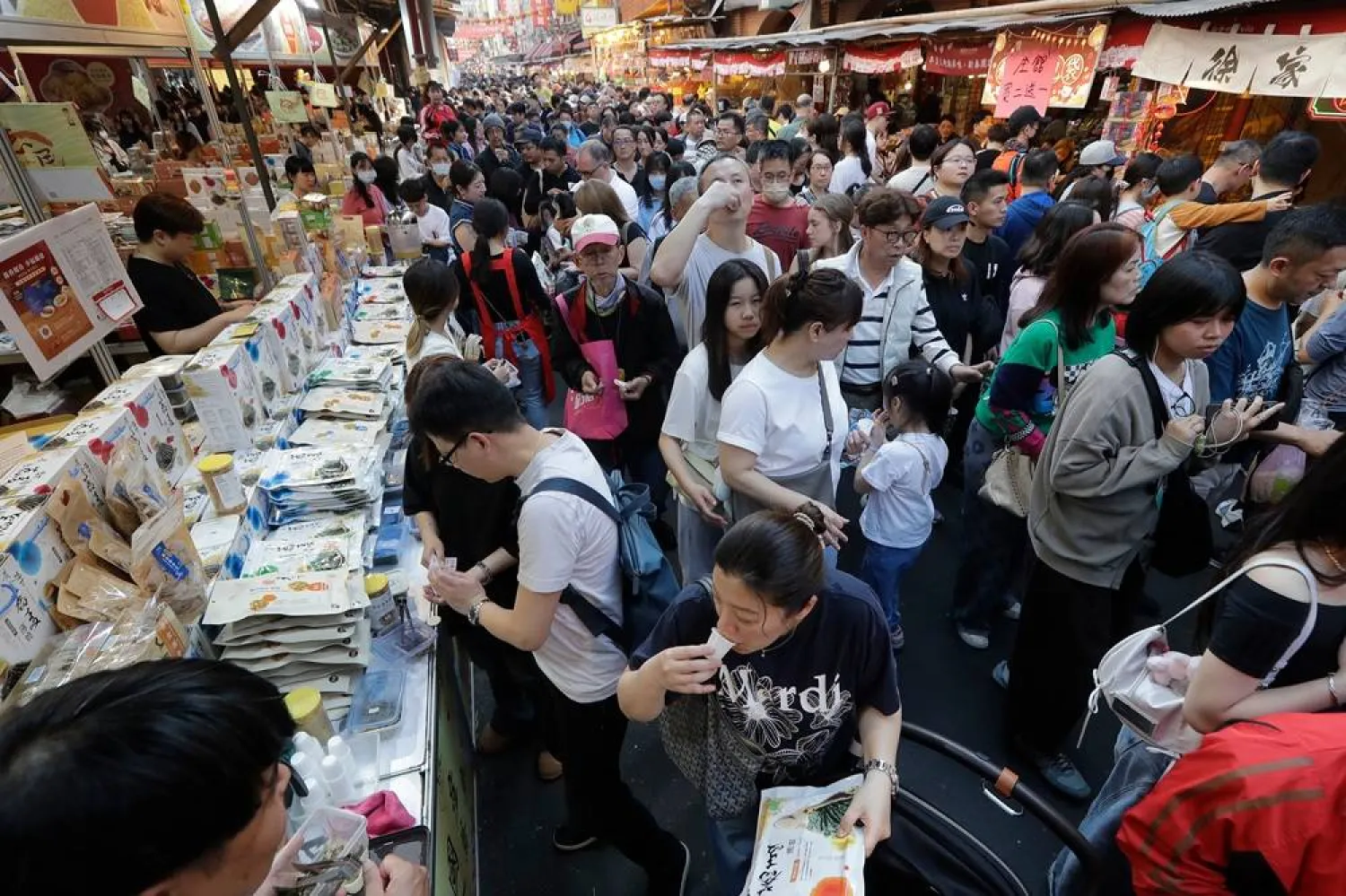
 Shoppers crowd for the upcoming Chinese Lunar New Year celebrations at the Dihua Street market in Taipei, Taiwan, Sunday, Feb. 15, 202. (AP)
Shoppers crowd for the upcoming Chinese Lunar New Year celebrations at the Dihua Street market in Taipei, Taiwan, Sunday, Feb. 15, 202. (AP)
TT

Asian Economies Weigh Impact of Fresh Trump Tariff Moves, Confusion

 Shoppers crowd for the upcoming Chinese Lunar New Year celebrations at the Dihua Street market in Taipei, Taiwan, Sunday, Feb. 15, 202. (AP)
Shoppers crowd for the upcoming Chinese Lunar New Year celebrations at the Dihua Street market in Taipei, Taiwan, Sunday, Feb. 15, 202. (AP)

US trading partners in Asia started weighing fresh uncertainties on Saturday after President Donald Trump vowed to impose a new tariff on imports, hours after the Supreme Court struck down many of the sweeping levies he used to launch a global trade war.

The court's ruling invalidated a number of tariffs that the Trump administration had imposed on Asian export powerhouses from China and South Korea to Japan and Taiwan, the world's largest chip maker and a key player in tech supply chains.

Within hours, Trump said he would impose a new 10% duty on US imports from all countries starting on Tuesday for an initial 150 days under a different law, prompting analysts to warn that more measures could follow, threatening more confusion for businesses and investors.

In Japan, a government spokesman said Tokyo "will carefully examine the content of this ruling and ‌the Trump administration's response ‌to it, and respond appropriately."

China, which is preparing to host Trump in ‌late ⁠March, has yet to ⁠formally comment or launch any counter moves with the country on an extended holiday. But a senior financial official in China-ruled Hong Kong described the US situation as a "fiasco".

Christopher Hui, Hong Kong's secretary for financial services and the treasury, Trump's new levy served to underscore Hong Kong's "unique trade advantages", Hui said.

"This shows the stability of Hong Kong's policies and our certainty ... it shows global investors the importance of predictability," Hui said at a media briefing on Saturday when asked how the new US tariff's would affect the city's economy.

Hong Kong operates as a separate customs territory from mainland China, a ⁠status that has shielded it from direct exposure to US tariffs targeting Chinese goods.

While ‌Washington has imposed duties on mainland exports, Hong Kong-made products have ‌generally faced lower tariff rates, allowing the city to maintain trade flows even as Sino-US tensions escalated.

Before the Supreme Court's ruling, Trump's ‌tariff push had strained Washington's diplomatic relations across Asia, particularly for export-reliant economies integrated into US-bound supply chains.

Friday's ruling ‌concerns only the tariffs launched by Trump on the basis of the International Emergency Economic Powers Act, or IEEPA, intended for national emergencies.

Trade policy monitor Global Trade Alert estimated that by itself, the ruling cuts the trade-weighted average US tariff almost in half from 15.4% to 8.3%.

For those countries on higher US tariff levels, the change is more dramatic. For China, Brazil and ‌India, it will mean double-digit percentage point cuts, albeit to still-high levels.

In Taiwan, the government said it was monitoring the situation closely, noting that the US government ⁠had yet to determine how ⁠to fully implement its trade deals with many countries.

"While the initial impact on Taiwan appears limited, the government will closely monitor developments and maintain close communication with the US to understand specific implementation details and respond appropriately," a cabinet statement said.

Taiwan has signed two recent deals with the US - one was a Memorandum of Understanding last month that committed Taiwan to invest $250 billion and the second was signed this month to lowering reciprocal tariffs.

Analysts say the Supreme Court's ruling against Trump's more aggressive tariff measures may offer little relief for the global economy. They warned of looming confusion as trading nations brace for moves by Trump to find other means of using levies to circumvent the ruling.

Thailand's Trade Policy and Strategy Office head Nantapong Chiralerspong said the ruling might even benefit its exports as uncertainty drove a fresh round of "front loading", where shippers race to move goods to the US, fearing even higher tariffs.

In corporate disclosures tracked by Reuters, firms across the Asia-Pacific region reported financial hits, supply shifts and withdrawals as levies escalated through 2025 and early 2026.



Iraq Could Restore Oil Exports to Pre-war Level within a Week if Hormuz Reopens, Basra Oil Chief Says

A cargo ship in the Gulf, near the Strait of Hormuz, as seen from northern Ras al-Khaimah, near the border with Oman’s Musandam governance, amid the US-Israeli conflict with Iran, in United Arab Emirates, March 11, 2026. REUTERS/Stringer/File Photo
TT

Iraq Could Restore Oil Exports to Pre-war Level within a Week if Hormuz Reopens, Basra Oil Chief Says

A cargo ship in the Gulf, near the Strait of Hormuz, as seen from northern Ras al-Khaimah, near the border with Oman’s Musandam governance, amid the US-Israeli conflict with Iran, in United Arab Emirates, March 11, 2026. REUTERS/Stringer/File Photo

Iraq could restore crude oil exports to around 3.4 million barrels per day within a week provided the Iran war ends and the Strait of Hormuz reopens, the head of the country’s state-run Basra Oil Company said.

Among Gulf oil producers, Iraq has suffered the biggest drop in oil revenue as a result of the effective closure of the Strait, a Reuters analysis has found, because it lacks alternative shipment routes.

But the country, the second biggest producer in the Organization of the Petroleum Exporting Countries, can quickly restore output to levels before US-Israeli attacks on Iran at the end of February led to the effective closure of the waterway. The Strait typically is the route for about a fifth of global oil and LNG flows.

SO FAR IRAN HAS MADE ONLY VERBAL PROMISES

Bassem Abdul Karim said Iran has so far provided only verbal guarantees that would allow Iraqi tankers permission to transit the Strait.

“We have not received any formal documents regarding permission for Iraqi tankers to pass,” he said in an interview with Reuters.

He said production from Iraq's southern oilfields was around 900,000 barrels per day, but if the war ends and safe passage through the Strait is guaranteed exports could reach 3.4 million bpd within a week.

US President Donald Trump has threatened to rain "hell" on Tehran unless it makes a deal by the end of Tuesday that would allow traffic to move through the Strait of Hormuz.

STEEP DROP IN IRAQI OIL OUTPUT

Last month, Iraq’s oil production dropped by about 80% to around 800,000 barrels per day, Iraqi energy officials told Reuters last month as the war meant Iraq could not export and storage tanks filled.

With limited outlets for Iraqi oil, production from the Rumaila field fell to around 400,000 bpd, down from about 1.35 million bpd before the conflict, and at the Zubair field the level was about 300,000 bpd, down 340,000 bpd before the war, Abdul Karim said.

Several smaller fields are being operated at limited levels to ensure continued production of associated gas, used in domestic power generation, while shutdowns at other sites have been used as an opportunity to carry out maintenance work, he added.

Production from Iraq's fields was around 4.3 million bpd before the war, which should leave enough leeway to export 3.4 million bpd even allowing for war-related damage.

Gas output from fields in Basra has dropped to around 700 million standard cubic feet per day, compared with about 1.1 billion standard cubic feet mscf per day before the war, largely because of the reduced oil production, Abdul Karim said.

MEETING REFINERY DEMAND

To supply domestic demand, BOC is sending around 400,000 bpd of crude to northern Iraq. That includes about 150,000 bpd by truck and roughly 250,000 bpd via a domestic pipeline, to supply refineries that have demand of around 500,000 bpd.

Production from the northern Kirkuk fields is roughly 380,000 barrels per day, Abdul Karim said.

Asked about the impact of drone attacks, Abdul Karim said strikes on oil facilities had caused “major losses to the continuity of production and oil operations,” adding that both foreign and Iraqi service companies had been targeted.

A two-drone attack that targeted the Rumaila oilfield on Saturday wounded three Iraqi workers, security and energy sources told Reuters.

Abdul Karim said the attack on the northern part of the Rumaila field hit sites used by US oilfield services companies Schlumberger and Baker Hughes, causing a fire that was later brought under control.

Neither Schlumberger nor Baker Hughes immediately responded to requests for comment.


Gold Holds Nearly Steady with Focus on US-Iran Tensions

Gold jewelry in a Korean gold exchange store in Seoul (AFP)
TT

Gold Holds Nearly Steady with Focus on US-Iran Tensions

Gold jewelry in a Korean gold exchange store in Seoul (AFP)

Gold prices were nearly steady on Monday, as market participants stayed cautious and awaited further signals on the evolving US-Iran situation and its impact on global interest rates.

Spot gold was little changed at $4,669.13 per ounce by 9:26 a.m. ET (1326 GMT) after falling 1% earlier in the session. US gold futures rose 0.3% to $4,694.20 per ounce, Reuters reported.

On the eve of a US deadline, the United States and Iran were weighing the framework of a plan to end their five-week-old conflict, even as Tehran pushed back against pressure to swiftly reopen the Strait of Hormuz. President Donald Trump has threatened to rain "hell" on Tehran if it did not make a deal by the end of Tuesday.

"Focus is likely to remain on the war and interest rates. If the conflict drags on, oil will grind higher amid tightening supply conditions, adding to inflationary pressures," said Bart Melek, global head of commodity strategy at TD Securities.

"That leaves central banks, particularly the Federal Reserve, with less room to ease policy and could even revive discussions about higher rates if energy prices rise further, which is negative for gold."

Oil prices fell in choppy trading on Monday, though they have risen sharply since the conflict began.

Gold is widely regarded as a hedge against geopolitical risks and inflation, but because it yields no interest, it tends to be less attractive when interest rates are high. Other items on investors’ radar include minutes of the Fed’s March policy meeting due on Wednesday, US Personal Consumption Expenditures (PCE) data due on Thursday, and the Consumer Price Index (CPI) on Friday.

The US central bank held rates steady last month and a majority of traders now see no chance of the Fed cutting interest rates this year, according to CME’s FedWatch tool. Among other metals, spot silver fell 0.4% to $72.67 per ounce, platinum lost 1% to $1,969.81, and palladium was down 1% at $1,488.58.


Morocco Launches Financial Futures Trading with Contract on MASI 20 Index  

File photo of a police officer standing near a Moroccan national flag near the main stadium during preparations for the FIFA Club World Cup in Agadir, December 10, 2013. REUTERS/Amr Abdallah Dalsh
TT

Morocco Launches Financial Futures Trading with Contract on MASI 20 Index  

File photo of a police officer standing near a Moroccan national flag near the main stadium during preparations for the FIFA Club World Cup in Agadir, December 10, 2013. REUTERS/Amr Abdallah Dalsh

Morocco on Monday began futures trading in financial instruments with its first listing of a standard futures contract on the MASI 20 equity index, the central bank and the AMMC - the capital markets regulator - said.

The contract, called the "MASI 20 Future," is based on an index that tracks the 20 largest and most liquid stocks listed on the Casablanca Stock Exchange, they said in a joint statement, AFP reported.

The contract's launch coincided with the unveiling of an institutional website by the Futures Market Coordination Body, a joint authority established to coordinate oversight of the futures market between the central bank and the AMMC.

The introduction of a futures contract represents the first step under Morocco's regulatory framework for derivatives trading, which will also allow for the development of other instruments such as options and swaps.