

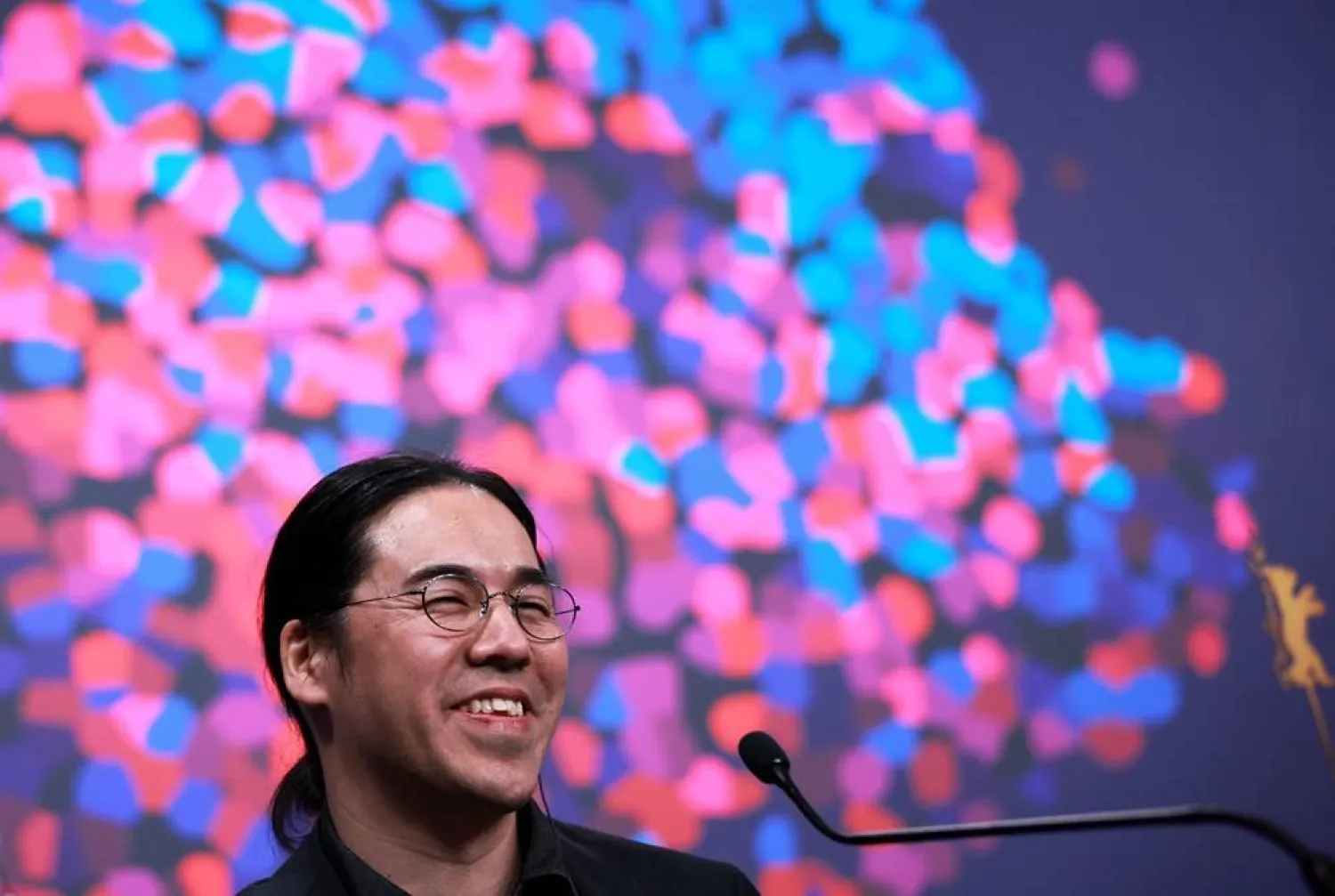

AI Revolution Looms Over Berlin Film Fest

Director and screenwriter Yoshitoshi Shinomiya attends a press conference for “A New Dawn” during the 76th Berlin International Film Festival, in Berlin, Germany, 18 February 2026. (EPA)
TT

AI Revolution Looms Over Berlin Film Fest

Director and screenwriter Yoshitoshi Shinomiya attends a press conference for “A New Dawn” during the 76th Berlin International Film Festival, in Berlin, Germany, 18 February 2026. (EPA)

The artificial intelligence revolution sweeping through the entertainment sector was at first glance not evident at this year's Berlin Film Festival, but the potential for widespread changes was still on people's minds.

The festival has had the air of an arthouse bubble when it comes to the topic of AI and the event's leadership is keeping above the fray.

"At present, we do not intend to issue any statements regarding the use of AI in the film industry," the festival said in a statement sent to AFP, adding: "We are monitoring developments with great interest."

Nevertheless, some of the filmmakers present addressed the question of how the technology is changing the industry.

Yoshitoshi Shinomiya, director of the only animated feature in competition, "A New Dawn," told reporters he had briefly considered using AI in his film.

"During production, we weren't entirely sure we would be able to complete the film. At one point we wondered whether we should use AI for the backgrounds," he said.

But Shinomiya concluded that AI is not yet "well-developed enough" to do that sort of work.

Juliette Prissard from Eurocinema, an organization representing French film and TV producers, said it's only a matter of time until the tools improve.

"It's reasonable to think that in one, two or three years... you won't be able to tell the difference anymore," she told AFP.

AI can already "write scripts" and replace extras in crowd scenes or even generate "digital replicas" of someone.

- 'No choice' -

In France, where foreign-language films are frequently shown with dubbing, voice actors have already been raising the alarm about AI's impact on their profession.

But Prissard warns other film industry jobs could be replaced in the "near" future, such as "technicians, the set designers" and even "the producers themselves".

Sevara Irgacheva, secretary general of the European Film Agency Directors' association (EFAD), said that already "junior jobs are disappearing: all the assistant editors, assistant screenwriters".

Despite this, the industry "is leaning toward accepting" AI "because, in any case, we have no choice".

The tools have the potential to help the sector become more efficient and "save time at every stage of production", particularly in the more "bureaucratic" aspects of the process.

A survey carried out in early 2025 by France's National Center for Cinema (CNC) found that 90 percent of film and audiovisual professionals surveyed were already using AI tools in their work.

In Berlin, Austrian director Georg Tiller presented a short film mixing filmed footage and AI-generated images, saying it was an attempt to encourage his fellow filmmakers to fight for a place in the new "digital cinema".

"If we don't then I fear that that we will die a slow death, because it will just steamroll over us," Tiller told AFP.

- The 'temptation' of deregulation -

The issue garnered some relief with a December agreement between OpenAI and Disney, which allowed the use of the entertainment giant's characters on Sora, the AI-generated video platform.

In return, Disney now has "privileged access" to OpenAI's "highly sophisticated" tools, giving it a "technological advantage over the rest of the sector," said Prissard.

But the use of AI in cinema has prompted thorny legal questions over intellectual property and the very notion of authorship, at a time when legislation is only just beginning to grapple with the subject.

Under EU rules, streaming platforms such as Netflix and Amazon Prime must carry at least 30 percent of European content in their catalogues.

Prissard questioned how those enforcing the rules "will be able to tell the difference" between original creations and "synthetic" ones.

Given "the fear of falling behind" the United States and China in developing AI technologies, Prissard said that Europe may succumb to the "temptation to allow more leeway to innovate without obstacles".



Ten Years Later, the Cult of ‘The Nice Guys’ Keeps Growing

This image released by Warner Bros. shows Ryan Gosling, left, and Russell Crowe in a scene from "The Nice Guys." (Daniel McFadden/Warner Bros. via AP)
TT

Ten Years Later, the Cult of ‘The Nice Guys’ Keeps Growing

This image released by Warner Bros. shows Ryan Gosling, left, and Russell Crowe in a scene from "The Nice Guys." (Daniel McFadden/Warner Bros. via AP)

When “The Nice Guys” debuted 10 years ago, the writing was on the wall for the big-screen comedy. It came out sandwiched between “Captain America: Civil War” and “X-Men: Apocalypse.” It opened against “Angry Birds.” The cartoon birds, Ryan Gosling has lamented, “just destroyed us.”

“They’re just so angry,” Gosling once sighed.

And yet, marking its upcoming 10th anniversary this month, “The Nice Guys” has established itself as one of the most beloved comedies of the last decade — a decade in which Hollywood studios largely left the genre for dead. A 1970s-set comic noir directed and co-written by Shane Black, “The Nice Guys” paired Gosling and Russell Crowe as private eyes in a Los Angeles crime caper that, a decade later, keeps getting better.

“There’s a lot of interest in ‘The Nice Guys’ today that wasn’t there when it opened. And the box office will attest to that,” Black deadpanned in a recent interview. “But people find these things. I think there’s kind of a joy of finding a movie on streaming or rental and then suddenly kind of realizing: How did I miss this? And ‘The Nice Guys’ was easy to miss.”

Now, “The Nice Guys” is almost always on, in reruns on cable or streaming services. Whenever it’s on Netflix, it ranks among the most viewed on the platform. As more have become familiar with the comic talents of Gosling, in “Barbie” or “Project Hail Mary,” fans inevitably ask: “But have you seen ‘The Nice Guys?’”

Black has known box-office smashes; he originated the “Lethal Weapon” movies. But he’s come to view films of his that didn’t make money as his favorites. A year before “The Nice Guys,” he made another cult favorite in “Kiss Kiss Bang Bang,” which helped revive Robert Downey Jr.’s career. (Downey makes a cameo as a corpse in “The Nice Guys.”)

“There’s something to being the king of the midnight movie,” says Black. “It’s not the most lucrative thing in the world.”

Comedies go dark

Earlier in the 2000s, comedy was a moviegoing staple. The films of Will Ferrell, Judd Apatow and Melissa McCarthy were some of Hollywood’s most lucrative. Movies like “The Hangover” and “Bridesmaids” helped define the era.

But as the franchise film grew, and international ticket sales took on greater importance, the big-screen comedy began falling out of favor right around the time Warner Bros.’ “The Nice Guys” (with a $50 million budget) reached theaters, earning about $71 million worldwide at the time. Tastes were also changing. Horror took comedy’s place as the genre of the day.

There are signs that trends may be shifting. This year, “Project Hail Mary” and the just-launched “The Devil Wears Prada 2” have put comedies in front at the multiplex. But over the last decade, funny movies have largely migrated to streaming (Netflix’s pact with Adam Sandler was an early coup) or turned into the stuff of easy-to-miss cult.

Black's initial germ for the film, writing with Anthony Bagarozzi, was inspired by detective stories like those of William Campbell Gault and Brett Halliday. He’s read so many of them, he says, that “it’s almost a superpower.”

“I thought: There’s so much joy here,” Black says. “There’s so much fun in plot and twists and capers. You light a fuse and these guys go on this wild caper, and in the end, it’s just these two guys that are important. You can’t really remember the caper but it was there to service the idea, the shape of: These guys are at it again.”

If “Chinatown” is a detective tale about a Los Angeles private eye without a car, “The Nice Guys” is about a gumshoe who can’t smell. Gosling’s Holland March reluctantly joins with Crowe’s Jackson Healy, an enforcer, on a missing girl case. The movie is bright and colorful but set against a seedy LA and the film industry. With Holland also is his young but wise daughter, Holly (a preternaturally good Angourie Rice).

An heir to ‘Midnight Run’

“The Nice Guys” had an expansive cast, including Kim Basinger, Keith David and, in one of her first big roles, Margaret Qualley. But the heart of the movie is Gosling and Crowe. Neither was especially known for their comic skills at that point. Crowe was coming off the not-exactly-hysterical biblical epic “Noah.” But Black, a believer in the Lowell Ganz-Babaloo Mandel school of comedy (“Splash,” “Parenthood”), had an instinct they’d work well together.

“The thing is, Ryan is just a good actor,” says Black. “He’s funny in everything he does. But he didn’t do a lot of outright comedies. For this, the character was not like a ‘Talladega Nights’ or ‘Step Brothers.’ It’s not that kind of comedy where everything is pushed. It was a story that an actor could do and basically play a real character.”

The key for Black is centering the comedy on grounded characters, like the classic buddy movie “Midnight Run,” which paired Robert De Niro and Charles Grodin. That approach may have gone missing in a decade where most of the few studio comedies that got made went for high-concept laughs. (See “Tag,” a 2018 comedy about adult friends playing tag.)

But “The Nice Guys,” sleazy and silly, gave Gosling a jumping-off point for some of the most sublime pratfalls in recent memory. Gosling had shown a knack for comedy before, but “The Nice Guys” is his arrival. No one has ever had his arm broken, or reached the same high-pitched squeal of pain, like Gosling does in the film. In another scene, on a toilet, he tries to balance a pointed gun and a lit cigarette while lifting his pants and repeatedly kicking the stall door open. It's a ballet worthy of Buster Keaton.

“My favorite that he walked in with one day was where he said, ‘I saw this movie last night with Abbott and Costello where they meet Frankenstein,’” Black recalls. “He said, ‘I’d like to maybe give that type of energy a try.’ When he said that, what he really meant was: I’m going to do a pitch-perfect Lou Costello impression sitting next to a tree for 60 seconds.”

What about a sequel?

Black is most proud of how much Gosling and Crowe were anxious to do anything that made them look cowardly or stupid or inept. “They wanted to be antiheroes,” says Black. Crowe has spoken fondly of his experience on the film, crediting Gosling as his only co-star to ever regularly get him to break character.

Thus, the inevitable question: So why not a sequel?

“It’s one of the most common questions I get,” says Black. “The answer, unfortunately, is nebulous.”

“You’re saying to a studio: Hey, we want to get these two big stars. It’s going to cost even more this time. You’re going to spend maybe twice the money on a sequel to a movie that didn’t get you what you wanted back,” says Black. “It’s a tough sell to take a movie that bombed and make a sequel.”

But would he do it if he could?

“Of course,” replies Black. “This was designed for that. Like I said, it’s a caper. There’s these two and they get in a bunch of trouble and here they go again. You want to see them do it again. There’s a whole bunch of mystery capers you could throw at these guys. You could make a grounded, potentially very interesting, touching movie set not in the ’70s, but perhaps in the ’80s.”

In 2016, Gosling called the London premiere of “The Nice Guys” a momentous occasion.

“I wasn't at the premiere of ‘The Godfather’ or ‘Apocalypse Now,’ but I got a feeling it felt pretty much the same as it does today,” Gosling said. “You're looking down the barrel of cinematic history.”

Gosling, of course, was kidding. But cinematic history? Maybe.


Beyoncé, Bad Bunny and Janelle Monáe Take Artistic Liberties with Met Gala Dress Code

US singer and daughter of Jay-Z and Beyonce Blue Ivy Carter arrives for the 2026 Met Gala celebrating "Costume Art" at the Metropolitan Museum of Art, in New York, on May 4, 2026. (Photo by ANGELA WEISS / AFP)
TT

Beyoncé, Bad Bunny and Janelle Monáe Take Artistic Liberties with Met Gala Dress Code

US singer and daughter of Jay-Z and Beyonce Blue Ivy Carter arrives for the 2026 Met Gala celebrating "Costume Art" at the Metropolitan Museum of Art, in New York, on May 4, 2026. (Photo by ANGELA WEISS / AFP)

Met Gala guests from Beyoncé and Naomi Osaka to Emma Chamberlain did not play it safe this year for the Met Gala, delivering custom works of art in honor of the dress code “Fashion is art.”

Beyoncé left the cowboy hat at home and dazzled in a custom Olivier Rousteing sculptural skeleton dress with a cream and dust blue feathered train fitted with a diamond crown for “Queen Bey.” The Grammy winner and her husband Jay-Z and daughter Blue Ivy stopped to pose together on the Metropolitan Museum of Art steps, The Associated Press said.

Osaka stunned in a edgy Robert Wun white sculptural fitted dress featuring exaggerated shoulders and adorned with red feathers and a matching headpiece. To complete her show-stopping look, Osaka wore two-toned red gloves. A similar look by Wun sits inside the Met's Costume Institute exhibit, “Costume Art.”

On the carpet, Osaka opened her dress and removed her headpiece for a grand reveal underneath. She wowed in a sleek red beaded gown embellished with the human anatomy.

Chamberlain arrived in a breathtaking Mugler by Miguel Castro Freitas hand-painted dress. The star was dipped in a rainbow of colors from her décolletage down to the spiral train of her body-hugging dress with fringe falling down the cuffs of the long-sleeve gown.

With all the fanfare around “The Devil Wears Prada 2,” Met Gala co-Chair Anna Wintour opted for a cool mint ensemble — not the trendy cerulean blue from the first film. Wintour’s look featured a feathered cape and a beaded dress by Matthieu Blazy for Chanel that she classically paired with her signature bob and oversized sunglasses.

Other co-Chairs of the evening Nicole Kidman and Venus Williams chose more subdued glamorous looks. Williams wore a sparkling black off-the-shoulder gown with a dazzling Swarovski neckpiece in homage to a painting of herself done by Robert Pruitt for the National Portrait Gallery. Event sponsor Lauren Sánchez Bezos arrived in a form-fitting Schiaparelli gown, which she told Vogue was influenced by John Singer Sargent’s 1884 painting “Madame X.”

Artistic references

When guests were not wearing art, they were making references to it. Head of Editorial Content for US Vogue Chloe Malle wore an apricot orange Colleen Allen dress inspired by Sir Frederic Leighton’s “Flaming June” painting. Actor and author Lena Dunham collaborated with Valentino designer Alessandro Michele for her red feathered dress to depict his interpretation of “Judith Slaying Holofernes.” As a child, Dunham told Vogue, she would visit the Met museum on Sundays and admire the paintings in the Renaissance section.

“One of my favorite painters from that era is Artemisia Gentileschi, who was one of the only women painting professionally in that moment,” she told Vogue. “So I sent some of the images to Alessandro, and because he’s a genius, instead of dressing me like her, he said, ‘You are actually the blood spatter as ... Judith cuts the neck off a man.’”

Stars also celebrated the dress code with their accessories. Actor and fashion muse Gwendoline Christie playfully covered her face on the carpet with a mask of her own face while pop star Katy Perry opened and closed her fencing-like mask on the carpet to smile at the cameras.

Venus Williams was not the only guest to break the fourth wall with an artistic reference to herself. It was a trend of the night, with gala host committee members Amy Sherald in a Thom Browne look inspired by her own work of art and singer Sabrina Carpenter wearing a Dior dress designed with film strips from the 1954 movie “Sabrina.”

Fashion as canvas

Some guests brought out their artistic side as they transformed their dresses into works of art. TikTok followers watched along as Jessica Kayll, who designs colorful silk robes, finished painting her dress in the days leading up to the gala. Kayll painted her own take on the famous Monet water lily scene right on top of her dress for the gala.

While her “The Devil Wears Prada 2” castmates kept it classic in black, Anne Hathaway made a statement in her custom Michael Kors Grecian-inspired strapless dress, which was hand-painted with a dove of peace.

“She is the goddess of peace,” Kors told Vogue.

Performance art Madonna makes any carpet her stage. A group of women circled around her in colorful dresses as they held onto sheer fabric wrapped around her pirate ship headpiece on the carpet.

Janelle Monáe also knows how to stand out. The performer delivered a message with her sculptural art piece that featured cords overtaken by moss wrapped around her form with moving animatronic butterflies.

“Remember what made you human,” Monáe told The Associated Press. “Nature is talking to us.”

Dressed body Rather than wear art, models showed off their toned bodies as part of the “Costume Art” exhibit's theme celebrating artistic representations of the body. Supermodels Gigi Hadid and Irina Shayk both wore revealing looks on the carpet.

Bad Bunny went full costume, carrying a cane and dressing up as an older version of himself with gray hair and special effects makeup to add years to his face. The artist joked with Vogue that it took 53 years to finish the look. Supermodel Heidi Klum, known for taking her Halloween costume to new heights, brought that same dedication to the Met Gala as she arrived as a draped statue.

Instead of opting for a body-hugging gown, Kim Kardashian wore a bright orange metallic body plate from the '60s designed by Allen Jones.

The physical form was modeled throughout the night with body parts draped over gowns or overlaid on garments in printed form in a trompe l’oeil. Theater producer and performer Jordan Roth had a 3D figure looming behind him as part of his velvet Wun getup while other celebrities had carefully placed sculpted hands attached to their gowns.

For her first Met Gala, Chase Infiniti donned a colorful sequined Thom Browne gown with the female form embellished with sequins on the front and back of her dress.

In typical fashion, singer and fashion powerhouse Rihanna shut down the carpet as the final guest to arrive, much earlier than in years past. Dressed in a metallic jewel-encrusted cocoonlike dress, Rihanna emerged onto the carpet with her partner A$AP Rocky.

“I feel like a pearl out of an oyster,” Rihanna said to reporters on the carpet.


Theater Operator AMC Beats Revenue Estimates

FILE PHOTO: People gather outside the AMC theatre at The Grove  in Los Angeles, California, US, January 20, 2026. REUTERS/Mario Anzuoni/File Photo
FILE PHOTO: People gather outside the AMC theatre at The Grove in Los Angeles, California, US, January 20, 2026. REUTERS/Mario Anzuoni/File Photo
TT

Theater Operator AMC Beats Revenue Estimates

FILE PHOTO: People gather outside the AMC theatre at The Grove  in Los Angeles, California, US, January 20, 2026. REUTERS/Mario Anzuoni/File Photo
FILE PHOTO: People gather outside the AMC theatre at The Grove in Los Angeles, California, US, January 20, 2026. REUTERS/Mario Anzuoni/File Photo

AMC Entertainment beat quarterly revenue estimates on Tuesday, as a recovering box office and strong demand for its premium movie formats helped the cinema chain draw more moviegoers.

Shares of the Leawood, Kansas-based company rose over 2% in extended trading.

The results suggest AMC's strategy to lean into its network of premium large format screens is paying off, allowing it to capture a larger share ⁠of a recovering market, Reuters reported.

⁠The company benefited from a stronger film slate in early 2026, including Ryan Gosling-starrer "Project Hail Mary."

The theater chain reported first-quarter revenue of $1.05 billion compared with analysts' average estimate of $968.5 million, according to ⁠data compiled by LSEG.

AMC has focused on maximizing revenue from moviegoers through innovative pricing and its popular loyalty programs.

The theater operator also announced "Arena One at AMC," a live entertainment platform launching in June, transforming AMC theater auditoriums into interactive, real-time "arenas."

The exhibitor has also been expanding its footprint of premium screens, including IMAX ⁠and Dolby ⁠Cinema, as well as its own "XL" branded screens.

"We are optimistic about the entire 2026 film slate, especially in the second half of 2026, which we believe will see more continued robust growth, adding up to a record post-pandemic box office for full year 2026," CEO Adam Aron said.

AMC posted a loss of 36 cents per share, in line with estimates.