

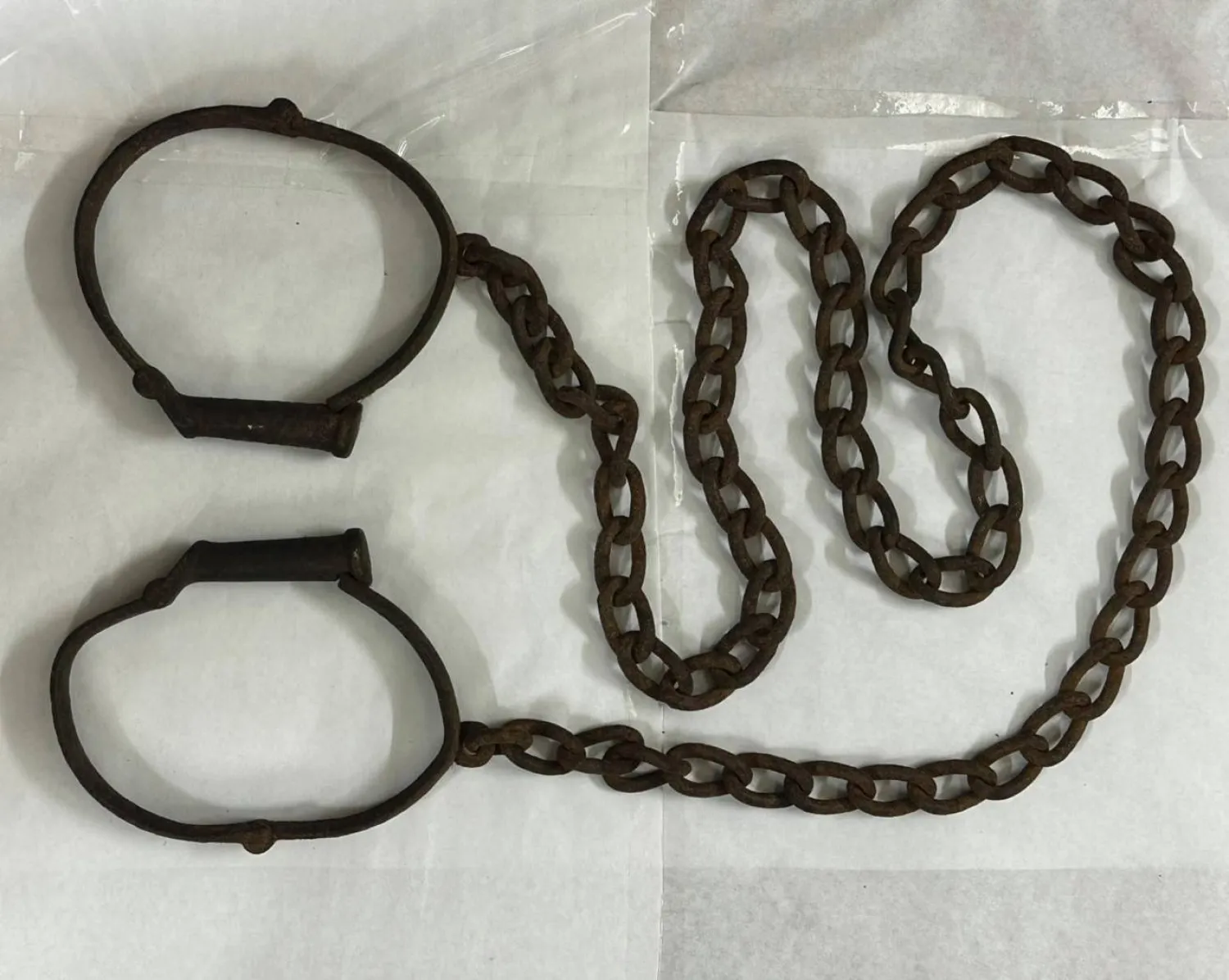

Scottish Antiques Auction Selling Neck Shackles Accused of ‘Profiting from Slavery’

“I think it’s important not to upset and offend, but shock people into learning the whole truth,” the auctioneer, Marcus Salter, said. (Cheeky Auctions Tain)
TT

Scottish Antiques Auction Selling Neck Shackles Accused of ‘Profiting from Slavery’

“I think it’s important not to upset and offend, but shock people into learning the whole truth,” the auctioneer, Marcus Salter, said. (Cheeky Auctions Tain)

An antiques auction selling chains linked to the enslavement of African people in Zanzibar has been accused of “profiting from slavery,” according to The Guardian.

The shackles, dated to 1780 and valued at about £1,000, are among objects listed in the auction, called “Challenging History.”

The auctioneer Marcus Salter, of Cheeky Auctions in Tain, Ross, said he wanted to ensure history was confronted with the sale of the “sensitive artifact” and did not wish to offend.

“I think it’s important not to upset and offend, but shock people into learning the whole truth,” Salter said. “There are certain things we’re not allowed to sell at auction. We had to check with the platform we’re selling with that we could do this. They consider the slave chains to be a historical artefact, therefore we can.

But Labour MP Bell Ribeiro-Addy, who chairs the all-party parliamentary group for Afrikan reparations, said trading in such items meant people were “continuing to profit from the slave trade.”

She said, “If they were to be put in a museum I would understand, but buying and selling them like oddities is the same thing that people do when it comes to human remains– treating them as collector’s items, something to be fetishized rather than items that should be looked at in horror.”

Salter said he was selling the chains for a dealer whose father had owned them for 50 years, adding: “No matter what happens there’s going to be money made out of it from somewhere.”

He claimed if the item was donated to a museum, it could be “put into storage and never seen again”, and that slavery-linked mahogany was sold and used without controversy.

In 2024, the Antiques Roadshow expert Ronnie Archer-Morgan refused to value an ivory bangle linked to enslavement.

Caecilia Dance, an associate at London law firm Wedlake Bell, has advised on the restitution of Nazi-looted art. Dance said she could not comment on the auction, but that there was “no specific law against” trading objects linked to slavery.

She added that “public interest stewardship” – donation, sale, or long-term loan to a museum with relationships with affected communities – would be the “ideal management pathway” for an item linked to slavery.



Fans of Niche Japanese Crisps Brand Panic After Oil Shortage Halts Production

A shopper checks food items at a supermarket in Tokyo, Japan January 20, 2023. (Reuters)
TT

Fans of Niche Japanese Crisps Brand Panic After Oil Shortage Halts Production

A shopper checks food items at a supermarket in Tokyo, Japan January 20, 2023. (Reuters)

Die-hard fans of ‌a niche Japanese crisps brand took to the internet on Tuesday to lament a production halt the snack maker Yamayoshi Seika blamed on a shortage of cooking oil caused by the conflict in the Middle East.

The US and Israel's war on Iran and the resulting effective closure of the vital Strait of Hormuz have fuelled fears of a knock-on impact on prices in ‌Japan. But news ‌of the crisps brand's suspension is ‌among ⁠the first tangible ⁠fallout for consumers.

Once the news spread, Yamayoshi Seika's "Wasabeef" became the third-most trending buzzword in Japan on social media platform X, with the company name trailing not far behind.

"I never expected the closure of the Strait of Hormuz to result in ⁠the production stoppage of Wasabeef," ‌user @JoshuaGboyega5 posted on X. "I ‌can't imagine life without Wasabeef!"

CEO Satoshi Kada said Yamayoshi ‌Seika's heavy oil wholesaler had warned him in ‌early March of an expected price hike of 20% to 30% and soon after said it could no longer send any supplies.

"We had no choice but ‌to stop the factory," he told Reuters, adding that he did not know ⁠when ⁠production could resume.

Yamayoshi Seika, which was established in 1953, calls Wasabeef a "national brand" characterized by a flavor blending wasabi and savory beef essence. The company has monthly sales of about 400 million to 500 million yen ($2.5 million to $3 million), Kada said.

Japan, which depends on the Middle East for around 95% of its crude oil supplies, this week began releasing about 80 million barrels of oil from its strategic reserves to mitigate disruptions.


Shigeaki Mori, Hiroshima Atomic Bomb Survivor Embraced by Obama, Dies at 88

US President Barack Obama (L) hugs atomic bomb survivor Shigeaki Mori as he visits Hiroshima Peace Memorial Park in Hiroshima, Japan May 27, 2016. (Reuters)
TT

Shigeaki Mori, Hiroshima Atomic Bomb Survivor Embraced by Obama, Dies at 88

US President Barack Obama (L) hugs atomic bomb survivor Shigeaki Mori as he visits Hiroshima Peace Memorial Park in Hiroshima, Japan May 27, 2016. (Reuters)

Shigeaki ‌Mori, the survivor of the Hiroshima atomic bombing whom former US President Barack Obama embraced during a historic visit to the city in 2016, has died at 88, Jiji Press reported on Tuesday.

The image of Obama's arms wrapped around a tearful Mori at the Hiroshima Peace Memorial ‌Park became ‌a defining moment of that ‌visit - ⁠the first ever ⁠by a sitting US president.

Mori was eight years old when the US dropped the atomic bomb on Hiroshima, flattening the city on August 6, 1945 and knocking him ⁠unconscious with the force ‌of its ‌blast.

Thirty years later, Mori embarked on a ‌multi-decade quest to find victims who ‌were cremated at his school playground. His work also identified 12 Americans who died in the bombing.

He died in ‌a hospital in Hiroshima on March 14, Jiji reported.

Many nuclear ⁠bomb ⁠survivors - known as "hibakusha" in Japanese - despite their advanced age and dwindling numbers have tried to keep alive the legacies of Hiroshima and Nagasaki, the only two cities to ever suffer a nuclear attack.

The cities have counted some 550,000 deaths from the attacks to date, including from illnesses related to acute radiation exposure.


People with Diabetes Have a Higher Dementia Risk

A person taking a blood sugar test (University of British Columbia) 
TT

People with Diabetes Have a Higher Dementia Risk

A person taking a blood sugar test (University of British Columbia) 

A US study has shown that people with type 1 diabetes are more likely to develop dementia than the general population, highlighting the importance of following up on brain health as we age.

Researchers from Boston University highlighted a potential way to thwart the disease in adults with diabetes. The findings were published on Monday at the Neurology Journal.

Type 1 diabetes is a chronic condition that affects the insulin making cells of the pancreas.

It is often diagnosed in children and adolescents, characterized by the pancreas producing little to no insulin, and often requires lifelong management, including daily insulin injections (or pumps) and frequent blood sugar monitoring to avoid dangerous complications.

The study was conducted on about 284,000 people, with an average age of 64, including 5,442 suffering from type 1 diabetes, and about 51,000 with type 2 diabetes.

Over an average of 2.4 years follow-up, the researchers examined cases of dementia, a brain disorder that slowly destroys a person's memory and thinking skills.

They found that 2,348 people developed dementia, including 144 with type 1 diabetes (2.6%) and 942 with type 2 diabetes (1.8%), while only 1,262 cases were recorded among non-diabetics (0.6%).

Taking into account factors such as age and education, researchers found that individuals with type 1 diabetes face a significantly elevated risk of developing dementia, with estimates suggesting they are up to three times more likely to develop the condition compared to those without diabetes, while individuals with type 2 diabetes were nearly twice as likely to develop dementia.

The researchers noted that previous studies have shown a link between type 2 diabetes and an increased risk of dementia, but the new findings suggest that this link may be stronger in people with type 1 diabetes.