


Brazil's Lula Urges Trump to Treat All Countries Equally

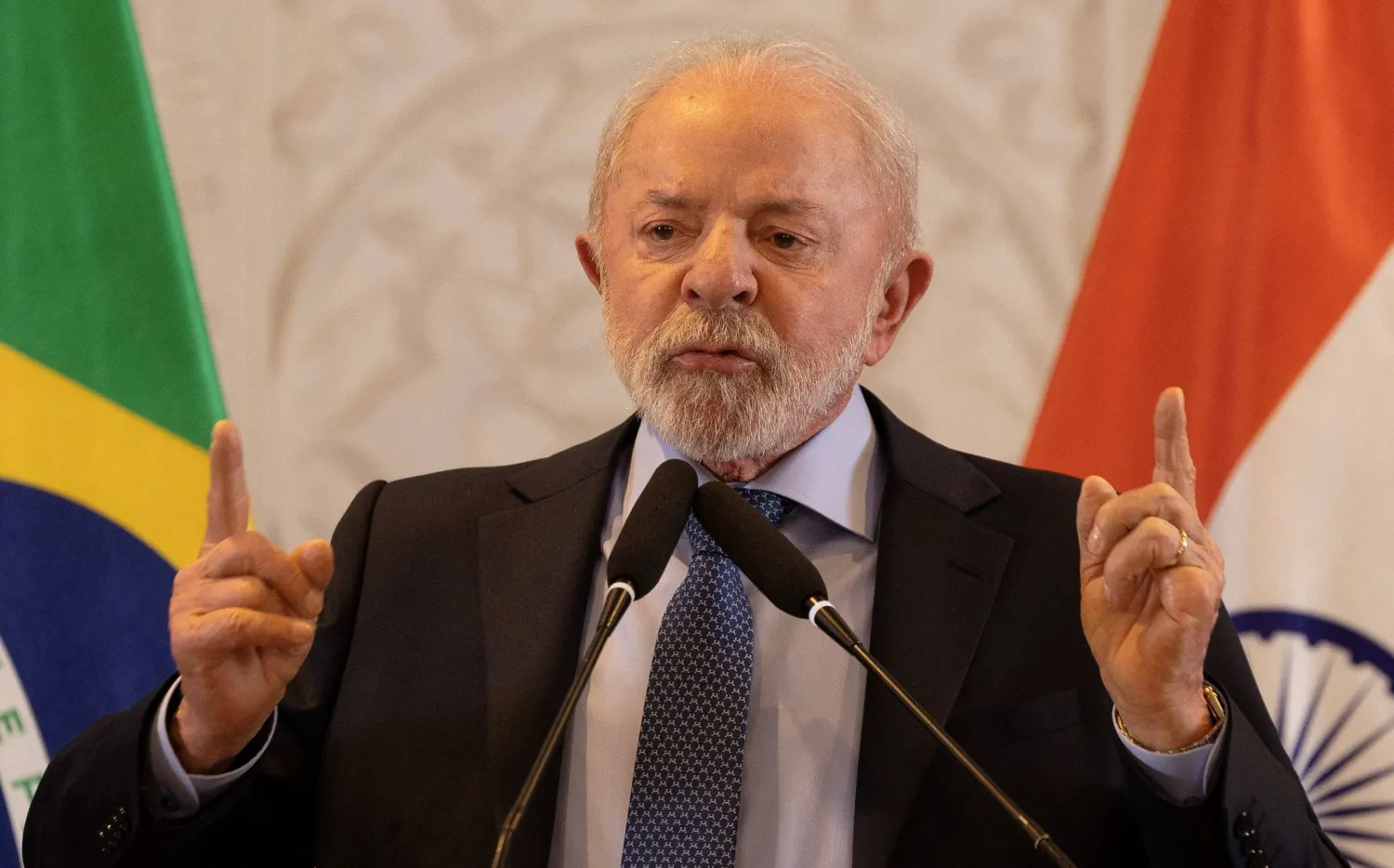
Brazilian President Luiz Inacio Lula da Silva gestures during a press conference in New Delhi, India, February 22, 2026. REUTERS/Adnan Abidi
TT

Brazil's Lula Urges Trump to Treat All Countries Equally

Brazilian President Luiz Inacio Lula da Silva gestures during a press conference in New Delhi, India, February 22, 2026. REUTERS/Adnan Abidi

Brazil's President Luiz Inacio Lula da Silva on Sunday urged Donald Trump to treat all countries equally after the US leader imposed a 15 percent tariff on imports following an adverse Supreme Court ruling.

"I want to tell the US President Donald Trump that we don't want a new Cold War. We don't want interference in any other country, we want all countries to be treated equally," Lula told reporters in New Delhi.

The conservative-majority Supreme Court on Friday ruled six to three that a 1977 law Trump has relied on to slap sudden levies on individual countries, upending global trade, "does not authorize the President to impose tariffs".

According to AFP, Lula said he would not like to react to Supreme Court decisions of another country, but hoped that Brazil's relations with the United States "will go back to normalcy" soon.

The veteran leftist Brazilian leader is expected to travel to Washington next month for a meeting with Trump.

"I am convinced that Brazil-US relation will go back to normalcy after our conversation," Lula, 80, said, adding Brazil only wanted to "live in peace, generate jobs, and improve lives of our people".

Ties between Brazil and the United States appear to be on the mend after months of animosity between Washington and Brasilia.

As a result, Trump's administration has exempted key Brazilian exports from 40 percent tariffs that had been imposed on the South American country last year.

"The world doesn't need more turbulence, it needs peace," said Lula who arrived in India on Wednesday to attend a summit on artificial intelligence.

On Saturday, India and Brazil agreed to boost cooperation on critical minerals and rare earths and signed a raft of other deals after a meeting between Lula and Prime Minister Narendra Modi.



Saudi Aramco: Oil Refining Has Been Underinvested

FILE PHOTO: Saudi Aramco logo and stock graph are seen through a magnifier displayed in this illustration taken September 4, 2022. REUTERS/Dado Ruvic/Illustration/File Photo
TT

Saudi Aramco: Oil Refining Has Been Underinvested

FILE PHOTO: Saudi Aramco logo and stock graph are seen through a magnifier displayed in this illustration taken September 4, 2022. REUTERS/Dado Ruvic/Illustration/File Photo

The current oil supply crisis shows there is underinvestment in oil refining as demand holds resilient, Saudi state-owned Aramco's vice president of market analysis and sustainability, Musaab Al Mulla, said on Tuesday.

Around 3 ⁠million barrels per ⁠day of refining capacity closed between 2020 and 2023, Al Mulla said at the S&P Global Energy Middle East ⁠Petroleum and Gas Conference in London.

"Now we realize if you have those refineries you may have definitely mitigated the impacts of the crisis today," he said.

The war in Iran, attacks on energy infrastructure and ⁠Iran's effective ⁠closure of the Strait of Hormuz followed by a US naval blockade, have removed around 14 million bpd of oil supply from Middle East producers to the global market.


OECD Cuts 2026 Global Growth Forecasts Over Mideast War Fallout

A drone view of vessels anchored in the Strait of Hormuz as seen from Musandam, Oman, June 3, 2026. (Reuters)
TT

OECD Cuts 2026 Global Growth Forecasts Over Mideast War Fallout

A drone view of vessels anchored in the Strait of Hormuz as seen from Musandam, Oman, June 3, 2026. (Reuters)

The war in the Middle East has dented economic growth prospects worldwide, with a more severe shock likely if no effective ceasefire is agreed before 2027, the OECD warned Wednesday.

Global economic growth is now forecast to slip to 2.8 percent for 2026 if Gulf exports of oil and gas return to pre-conflict levels in the third quarter, the group of 38 industrialized countries said in its quarterly update.

Previously the OECD had forecast full-year global growth of 2.9 percent.

But if the Middle East war continues into next year, however, global growth could slow to 2.1 percent, the OECD said -- well below the average annual growth of 3.4 percent seen from 2013 to 2019, before the Covid pandemic.

"The longer the disruptions last, the larger the economic and social costs become," the group's chief economist Stefano Scarpetta said in the report.

Many countries would risk falling into recession, he noted, and a drop in investment spending -- "including in energy-intensive AI" -- would likely push up unemployment.

Sustained high prices for energy as well as fertilizer and other key products from hydrocarbon production in the Gulf would weigh especially hard on developing countries that have "higher shares of energy and food in household consumption".

Even if the war sparked by US and Israeli strikes on Iran in late February ends in the coming weeks, the OECD forecast global inflation rising to 4.0 percent this year from 3.4 percent in 2025.

In this "time-limited disruption scenario", the group expects US growth to slow to 2.0 percent this year and 1.8 percent in 2027, after growing 2.1 percent last year.

In the eurozone, where many countries are highly dependent on energy imports, GDP growth will slump to 0.8 percent this year after 1.4 percent last year, assuming a Mideast ceasefire is secured in the coming weeks.


Saudi Non-oil Private Sector Activity Hits 3-month High in May

The Saudi capital, Riyadh (Reuters)
TT

Saudi Non-oil Private Sector Activity Hits 3-month High in May

The Saudi capital, Riyadh (Reuters)

Saudi Arabia's non-oil private sector expanded at the fastest pace in three months in May as domestic demand improved and supply chains stabilized, while business optimism remained subdued amid conflict in the region, a survey showed on Wednesday.

The seasonally adjusted Riyad Bank Saudi Arabia Purchasing Managers' Index, compiled by S&P Global, rose to 52.8 in May from 51.5 in April. The 50 mark separates growth from contraction, Reuters reported.

Output accelerated at the ⁠fastest pace in ⁠three months after March's downturn following the start of the Iran war, as firms cited normalizing working conditions, revived contracts and stronger local demand.

Export sales fell for a third straight month, hit by shipping disruption, higher freight and fuel costs, geopolitical tensions and stronger competition. The pace of decline eased only modestly from April's survey-record contraction.

However, supply chains improved, with suppliers' delivery times shortening for the first time in three months as ⁠firms relied ⁠more on local vendors. Backlogs of work rose for an 11th consecutive month, albeit moderately.

“Overall, the latest PMI reading supports the expectation that Saudi Arabia’s non-oil economy will continue its upward trend during the remainder of 2026," said Naif Al-Ghaith, Riyad Bank's chief economist.