


UN Chief Decries Global Rise of ‘Rule of Force’ 

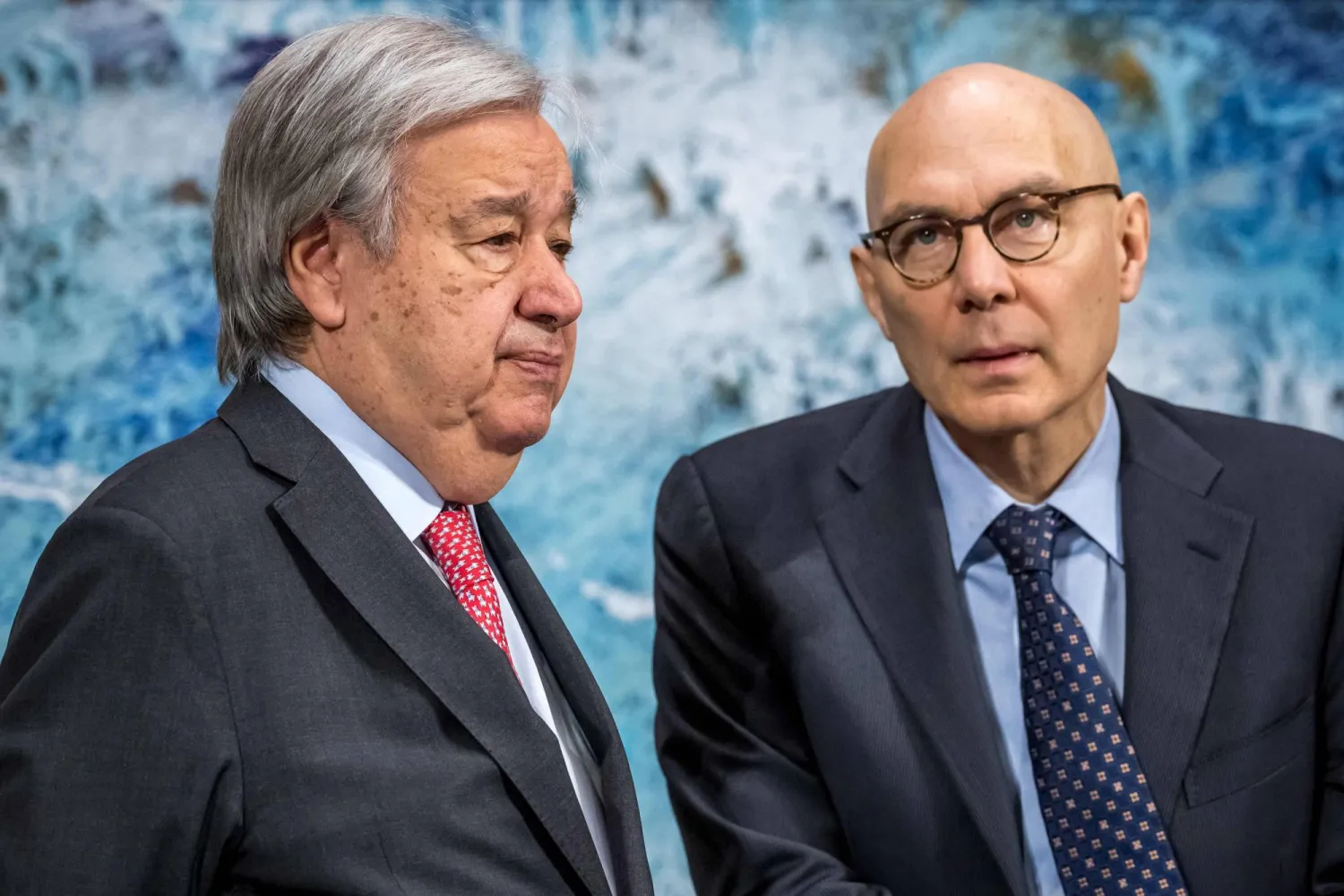
UN Secretary-General Antonio Guterres (L) stands next to UN High Commissioner for Human Rights Volker Turk at the opening of the 61st session of the UN Human Rights Council at the United Nations office in Geneva on February 23, 2026. (AFP)
TT

UN Chief Decries Global Rise of ‘Rule of Force’ 

UN Secretary-General Antonio Guterres (L) stands next to UN High Commissioner for Human Rights Volker Turk at the opening of the 61st session of the UN Human Rights Council at the United Nations office in Geneva on February 23, 2026. (AFP)

The United Nations leader warned Monday that "the rule of force" was spreading, as the powerful trample on international law and wield artificial intelligence and other technologies to attack human rights.

"Human rights are under a full-scale attack around the world," Antonio Guterres told the opening of the UN Human Rights Council's annual session in Geneva.

"The rule of law is being outmuscled by the rule of force."

The UN secretary-general stressed that "this assault is not coming from the shadows, or by surprise. It is happening in plain sight -- and often led by those who hold the greatest power."

He did not mention specific situations, although he did voice outrage at Russia's war in Ukraine, where he said more than 15,000 civilians had been killed in four years of violence.

"It is more than past time to end the bloodshed," he said.

Guterres also highlighted the "blatant violations of human rights, human dignity and international law in the Occupied Palestinian Territory".

He charged that the trajectory in the conflict-torn territories under Israeli occupation was "stark, clear and purposeful: the two-state solution is being stripped away in broad daylight".

"The international community cannot allow it to happen," he insisted.

- Rights attacked 'deliberately, strategically' -

In his final in-person address to the UN's top rights body, Guterres said the worst conflict-hit areas were not the only places where rights were eroding.

"Around the world, human rights are being pushed back deliberately, strategically and sometimes proudly," he said.

"We are living in a world where mass suffering is excused away, where humans are used as bargaining chips, where international law is treated as a mere inconvenience."

UN rights chief Volker Turk echoed the concerns.

In a "deeply worrying trend", he warned that "domination and supremacy are making a comeback".

"A fierce competition for power, control and resources is playing out on the world stage at a rate and intensity unseen for the past 80 years," he warned.

"The use of force to resolve disputes between and within countries is becoming normalized."

Turk highlighted how "the gears of global power are shifting", calling for people to band together to protect rights and create "a strong counterbalance to the top-down, autocratic trends we see today".

- 'Democracies eroding' -

While the UN says that conflicts are multiplying, impunity is spreading and humanitarian needs are exploding, its traditional top donor, Washington, has dramatically slashed its foreign aid spending since President Donald Trump's returned to power last year. Other major donors have followed.

"When human rights fall, everything else tumbles," Guterres warned.

The crisis of respect for human rights "mirrors and magnifies every other global fracture", he said, pointing out that "inequalities are widening at staggering speed."

At the same time, "climate chaos is accelerating, and technology, especially artificial intelligence, is increasingly being used in ways that suppress rights, deepen inequality and expose marginalized people to new forms of discrimination both online and offline," he warned.

Turk meanwhile lambasted leaders, without naming them, who seem to believe "that they are above the law, and above the UN Charter."

"They claim exceptional status, exceptional danger or exceptional moral judgement to pursue their own agenda at any cost," he said, pointing to how "some weaponize their economic leverage."

"They spread disinformation to distract, silence and marginalize," he charged.

What is clear, Guterres warned, was that "across every front, those who are already vulnerable are being pushed further to the margins."

"Democracies eroding... migrants harassed, arrested and expelled with total disregard for their human rights and their humanity. Refugees scapegoated," he pointed out.

Guterres, who is to step down this year after a decade at the UN helm, called for urgent action to reverse the trend.

"Do not let power write a new rulebook in which the vulnerable have no rights and the powerful have no limits," he said.



Trump Seeks $152 Mn to Revive Alcatraz as Federal Prison

FILE PHOTO: A view of Alcatraz prison complex located on Alcatraz Island in San Francisco Bay near San Francisco, California, US July 17, 2025. REUTERS/Carlos Barria/File Photo
TT

Trump Seeks $152 Mn to Revive Alcatraz as Federal Prison

FILE PHOTO: A view of Alcatraz prison complex located on Alcatraz Island in San Francisco Bay near San Francisco, California, US July 17, 2025. REUTERS/Carlos Barria/File Photo

US President Donald Trump asked Congress on Friday for $152 million to begin rebuilding the notorious Alcatraz prison, pressing ahead with his vision to return the former island lockup to active use.

The funding request, included in the White House's proposed 2027 budget, would cover the first year of converting the San Francisco Bay site into what officials describe as a "state-of-the-art secure prison facility."

Trump has pushed for reopening Alcatraz since last year, portraying it as a symbol of a tougher approach to crime, said AFP.

In a social media post at the time, he called for a "substantially enlarged and rebuilt" facility to house the country's most dangerous offenders.

The proposal comes as part of a broader Justice Department budget that emphasizes prison investment and law enforcement, though such requests are ultimately subject to approval by Congress.

Political news outlet Axios, citing administration officials, reported that any "supermax" prison complex at the site would have to be built from scratch -- putting the total cost at somewhere around $2 billion.

Alcatraz, which opened as a federal penitentiary in 1934, was once considered among the most secure prisons in the United States due to its isolated island location and the strong currents surrounding it.

It held a relatively small number of prisoners, including high-profile inmates such as Al Capone.

The island fortress entered American cultural lore after a 1962 escape by three inmates, which became an inspiration for the film "Escape from Alcatraz" starring Clint Eastwood.

It was closed in 1963 after officials determined it was too costly to maintain.

According to the Federal Bureau of Prisons, operating expenses were nearly three times higher than at other federal facilities, largely because all supplies -- including fresh water -- had to be transported to the island.

Since the early 1970s, Alcatraz has been managed by the National Park Service as part of the Golden Gate National Recreation Area and has become one of San Francisco's most popular tourist attractions, drawing more than a million visitors annually.

The White House argues that rebuilding the site would help modernize the federal prison system and expand capacity for high-risk inmates.

But critics have questioned both the practicality and cost of the plan, noting that the island's infrastructure would likely require extensive reconstruction.

Feasibility studies have already been conducted by federal agencies to assess whether a modern correctional facility could be established on the site, though no final decision has been made.

Any move to proceed could face political resistance given competing budget priorities and the site's current status as a major tourism and historical landmark.


French, Japanese Ships Cross Strait of Hormuz in First Since War

A cargo ship in the Gulf, near the Strait of Hormuz, as seen from northern Ras al-Khaimah, near the border with Oman’s Musandam governance, amid the US-Israeli conflict with Iran, in United Arab Emirates, March 11, 2026. (Reuters)
TT

French, Japanese Ships Cross Strait of Hormuz in First Since War

A cargo ship in the Gulf, near the Strait of Hormuz, as seen from northern Ras al-Khaimah, near the border with Oman’s Musandam governance, amid the US-Israeli conflict with Iran, in United Arab Emirates, March 11, 2026. (Reuters)

One French- and another Japanese-owned vessel are among a handful of vessels to have crossed the war-torn Strait of Hormuz, maritime tracking data showed Friday.

The passage, a vital maritime route for oil and liquified natural gas, has been virtually blocked by Iran since the start of the war, said AFP.

But both ships made the crossing on Thursday, according to ship tracking company Marine Traffic's website.

The Maltese-flagged Kribi belonging to the French maritime transport group CMA CGM crossed the waterway to leave the Gulf on Thursday afternoon, Marine Traffic's data showed.

By early Friday, it was off Muscat, Oman, still broadcasting the message "owner France" on its transponder system in the field usually used to give the destination.

The vessel's navigation data showed it had crossed via an Iranian-approved route through its waters, dubbed the "Tehran Toll Booth" by leading shipping journal Lloyd's List.

- Southern route -

In addition, three tankers -- including one co-owned by a Japanese company -- crossed the Strait of Hormuz on Thursday by taking an alternative, southern route.

They hugged close to the shore of Oman's Musandam Peninsula -- a first in nearly three weeks according to Lloyd's List.

Before the war, which started more than a month ago, about a fifth of global oil and liquefied natural gas (LNG) passed through the Strait.

All three ships signaled they were an "OMANI SHIP" in the message broadcast by their transponder as they crossed the strait.

The Sohar LNG, which was empty when crossing, is co-owned by Japanese shipping company Mitsui O.S.K.

That makes it the first Japanese vessel to exit the Gulf since the start of the war, according to a company statement quoted by Japanese media.

The Hong-Kong flagged New Vision, which crossed the strait on March 1 right after the war started, is expected in the French port of Le Havre on Saturday evening.

Since the conflict started however, that has dwindled to a trickle as Iran selectively attacks ships and energy facilities throughout the Gulf in retaliation for US and Israeli attacks.

A few commercial ships crossing the Strait of Hormuz recently have passed through the Iranian-approved route in the north of the waterway.

- Down to a trickle -

Just 221 commodities vessels have crossed the Strait of Hormuz since March 1, some more than once, according to Kpler data up to Friday morning.

In peacetime, the same waterway handles around 120 daily transits, according to Lloyd's List.

Of the vessels that made the crossing, 60 percent either came from Iran or were heading there.

It was not clear from the data how many had been cleared to make the crossing by Tehran.

But it did show that, among the 118 crossings by ships carrying cargo, 37 had left the Gulf carrying crude oil.

Most of those oil tankers -- 30 of them -- came from Iran or sailed under the Iranian flag. And most ships carrying Iranian oil did not specify their destination on their transponder.

Of those who did, all but one reported they were heading to China.

In the early days of the war, transponder data showed dozens of ships broadcasting messages such as "Chinese crew" or "Chinese owner" in the field usually used for their destination.

This appeared to be an attempt by the ships to avoid being targeted by Iran.


Iran Executes Two Linked to Opposition Group

Executions in Iran have surged in recent years - AFP
TT

Iran Executes Two Linked to Opposition Group

Executions in Iran have surged in recent years - AFP

Iran on Saturday executed two men it said were convicted of links to an opposition group, the People's Mojahedin Organization of ‌Iran, and ‌of carrying out armed ‌attacks, ⁠domestic media reported.

The ⁠executions were the latest in recent days of individuals with PMOI links.

The PMOI confirmed ⁠Saturday's executions, saying ‌in ‌a statement that Iran was "trying ‌to hide its ‌weakness by executing political prisoners, especially PMOI members and supporters." Four PMOI ‌members were executed earlier this week, ⁠it ⁠said.

The group said the two men executed on Saturday were arrested in January 2024 and had their death sentences upheld in December 2025.