


Mexico's Jalisco Cautiously Tries Returning to Normal after Cartel Violence

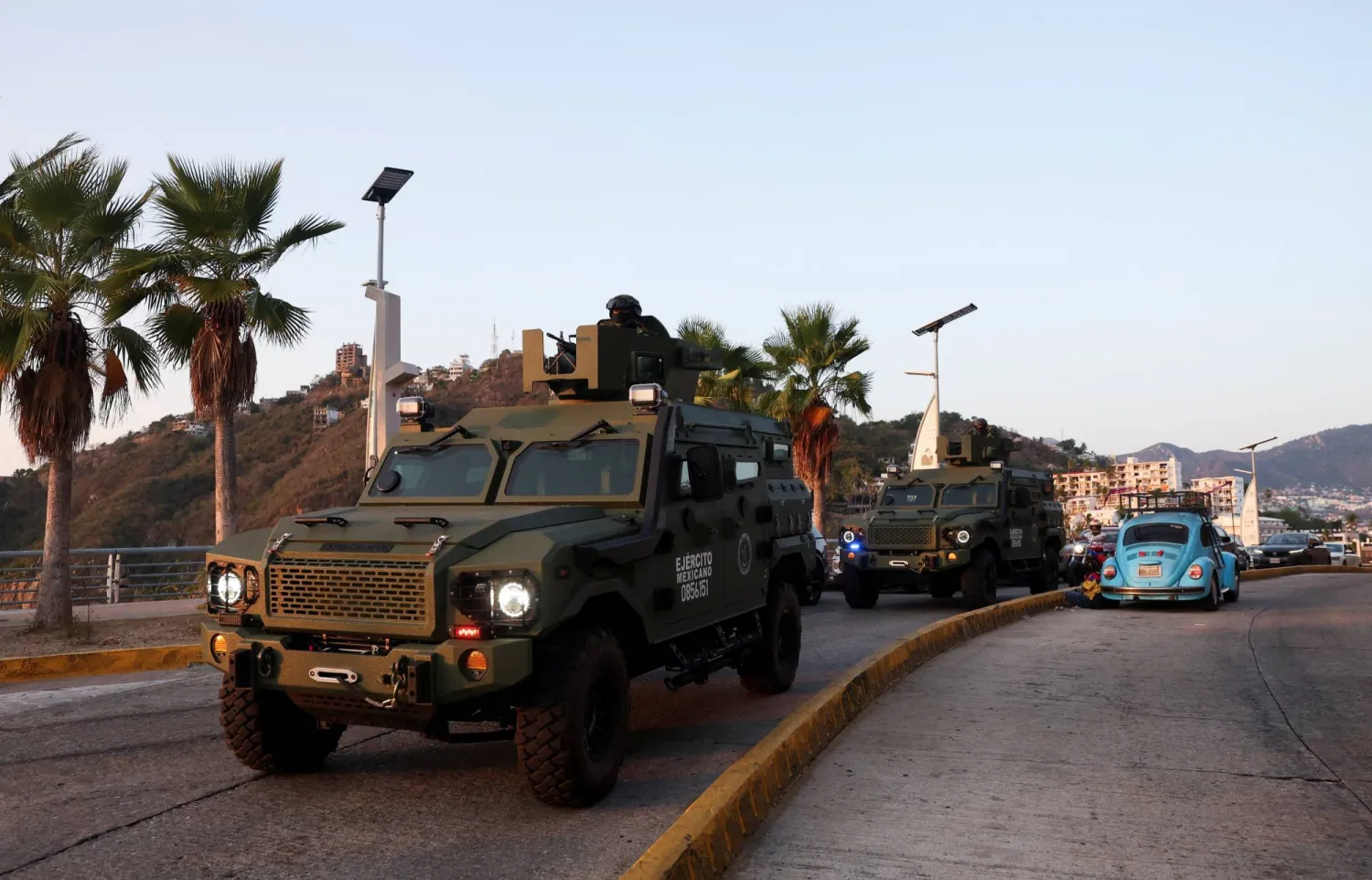
Mexican soldiers patrol in armored vehicles in Acapulco after authorities reinforced security following roadblocks and arson attacks carried out by organized crime in several states, in the aftermath of a military operation in which a government source said Mexican drug lord Nemesio Oseguera, known as "El Mencho," was killed in Jalisco state, in Acapulco, Mexico, February 22, 2026. REUTERS/Henry Romero
TT

Mexico's Jalisco Cautiously Tries Returning to Normal after Cartel Violence

Mexican soldiers patrol in armored vehicles in Acapulco after authorities reinforced security following roadblocks and arson attacks carried out by organized crime in several states, in the aftermath of a military operation in which a government source said Mexican drug lord Nemesio Oseguera, known as "El Mencho," was killed in Jalisco state, in Acapulco, Mexico, February 22, 2026. REUTERS/Henry Romero

Residents of Jalisco cautiously peeked their heads out Monday after waves of retaliatory cartel violence rocked the Mexican state over the weekend following the death of a major drug kingpin.

Schools were closed in state capital Guadalajara, as were many businesses, said AFP.

Public transportation partially resumed -- though buses carried few passengers.

Those going about town seemed to mostly be headed to the grocery store to stock up in case gang members decided to block roads and set fire to vehicles and shops again, as they did after the army announced it killed Nemesio "El Mencho" Oseguera.

The powerful leader of the Jalisco New Generation Cartel died from his wounds in a shootout with authorities Sunday, sparking a wave of retaliatory violence including a prison break.

In Guadalajara, Matias Mora was too scared to leave his home after "they burned down the pharmacy."

But cautiously, the taxi driver took to the streets for work Monday.

"We were short on food," he said.

Nearly "everything" is closed "and there are huge lines to buy things" at the few places that are open, Juan Soler, a retiree, told AFP.

"We were locked inside, terrified," Maria de Jesus Gonzalez said as she moved forward through a long line at the supermarket.

As shopping carts ran out, some patrons bought laundry baskets to load their groceries in.

In the city's streets, authorities removed burnt vehicles reduced to twisted, smoke-stained metal structures.

But not all was calm across the state of Jalisco.

On the road to Tapalpa, the city where Oseguera fought his last stand, cartel members still manned roadblocks.

Authorities have said the worst of the violence has passed, with most blockades ending across the country.

- More to come? -

Some 10,000 troops have been deployed to restore calm after violence erupted across 20 of Mexico's 32 states Sunday, including in the resort city of Puerto Vallarta, popular with international tourists.

Oseguera, 59, was considered the last of the drug lords who acted in the brutal mold of the now-imprisoned Joaquin "El Chapo" Guzman and Ismael "El Mayo" Zambada, of the rival Sinaloa cartel.

He was a founding member of New Generation, which was formed in 2009 and has grown into one of Mexico's most violent crime organizations.

During the raid on Oseguera and subsequent clashes, at least 27 members of security forces, 46 suspected criminals and one civilian were killed, authorities reported.

Though Oseguera's death is being hailed as a victory, the wave of violence over the weekend was perhaps a harbinger of things to come.

Experts have warned the "absence of a direct succession" within New Generation could lead to a power vacuum -- and violent fights to fill it.



French, Japanese Ships Cross Strait of Hormuz in First Since War

A cargo ship in the Gulf, near the Strait of Hormuz, as seen from northern Ras al-Khaimah, near the border with Oman’s Musandam governance, amid the US-Israeli conflict with Iran, in United Arab Emirates, March 11, 2026. (Reuters)
TT

French, Japanese Ships Cross Strait of Hormuz in First Since War

A cargo ship in the Gulf, near the Strait of Hormuz, as seen from northern Ras al-Khaimah, near the border with Oman’s Musandam governance, amid the US-Israeli conflict with Iran, in United Arab Emirates, March 11, 2026. (Reuters)

One French- and another Japanese-owned vessel are among a handful of vessels to have crossed the war-torn Strait of Hormuz, maritime tracking data showed Friday.

The passage, a vital maritime route for oil and liquified natural gas, has been virtually blocked by Iran since the start of the war, said AFP.

But both ships made the crossing on Thursday, according to ship tracking company Marine Traffic's website.

The Maltese-flagged Kribi belonging to the French maritime transport group CMA CGM crossed the waterway to leave the Gulf on Thursday afternoon, Marine Traffic's data showed.

By early Friday, it was off Muscat, Oman, still broadcasting the message "owner France" on its transponder system in the field usually used to give the destination.

The vessel's navigation data showed it had crossed via an Iranian-approved route through its waters, dubbed the "Tehran Toll Booth" by leading shipping journal Lloyd's List.

- Southern route -

In addition, three tankers -- including one co-owned by a Japanese company -- crossed the Strait of Hormuz on Thursday by taking an alternative, southern route.

They hugged close to the shore of Oman's Musandam Peninsula -- a first in nearly three weeks according to Lloyd's List.

Before the war, which started more than a month ago, about a fifth of global oil and liquefied natural gas (LNG) passed through the Strait.

All three ships signaled they were an "OMANI SHIP" in the message broadcast by their transponder as they crossed the strait.

The Sohar LNG, which was empty when crossing, is co-owned by Japanese shipping company Mitsui O.S.K.

That makes it the first Japanese vessel to exit the Gulf since the start of the war, according to a company statement quoted by Japanese media.

The Hong-Kong flagged New Vision, which crossed the strait on March 1 right after the war started, is expected in the French port of Le Havre on Saturday evening.

Since the conflict started however, that has dwindled to a trickle as Iran selectively attacks ships and energy facilities throughout the Gulf in retaliation for US and Israeli attacks.

A few commercial ships crossing the Strait of Hormuz recently have passed through the Iranian-approved route in the north of the waterway.

- Down to a trickle -

Just 221 commodities vessels have crossed the Strait of Hormuz since March 1, some more than once, according to Kpler data up to Friday morning.

In peacetime, the same waterway handles around 120 daily transits, according to Lloyd's List.

Of the vessels that made the crossing, 60 percent either came from Iran or were heading there.

It was not clear from the data how many had been cleared to make the crossing by Tehran.

But it did show that, among the 118 crossings by ships carrying cargo, 37 had left the Gulf carrying crude oil.

Most of those oil tankers -- 30 of them -- came from Iran or sailed under the Iranian flag. And most ships carrying Iranian oil did not specify their destination on their transponder.

Of those who did, all but one reported they were heading to China.

In the early days of the war, transponder data showed dozens of ships broadcasting messages such as "Chinese crew" or "Chinese owner" in the field usually used for their destination.

This appeared to be an attempt by the ships to avoid being targeted by Iran.


Iran Executes Two Linked to Opposition Group

Executions in Iran have surged in recent years - AFP
TT

Iran Executes Two Linked to Opposition Group

Executions in Iran have surged in recent years - AFP

Iran on Saturday executed two men it said were convicted of links to an opposition group, the People's Mojahedin Organization of ‌Iran, and ‌of carrying out armed ‌attacks, ⁠domestic media reported.

The ⁠executions were the latest in recent days of individuals with PMOI links.

The PMOI confirmed ⁠Saturday's executions, saying ‌in ‌a statement that Iran was "trying ‌to hide its ‌weakness by executing political prisoners, especially PMOI members and supporters." Four PMOI ‌members were executed earlier this week, ⁠it ⁠said.

The group said the two men executed on Saturday were arrested in January 2024 and had their death sentences upheld in December 2025.


Earthquake Kills 8 Members of Same Family near Afghan Capital

Previous earthquake in Afghanistan (Archive-Reuters)
TT

Earthquake Kills 8 Members of Same Family near Afghan Capital

Previous earthquake in Afghanistan (Archive-Reuters)

An earthquake that struck Afghanistan overnight killed eight members of the same family in Kabul province, the health ministry said on Saturday.

The 5.8-magnitude quake struck at 8.42 pm (1612 GMT) on Friday at a depth of 186 kilometers (115 miles) at the epicenter in northeastern Badakhshan province, according to the US Geological Survey (USGS).

Shaking was felt in multiple parts of the country, including the capital Kabul, according to AFP journalists.

"In the Gosfand Dara area of Kabul Province, eight members of a family died as a result of the earthquake," Health Ministry spokesman Sharafat Zaman said in a message to media.

He added that a child aged around two years old was the only survivor from the household and the country's disaster management agency said the boy had been injured in the tremor.

Afghanistan is frequently jolted by earthquakes, particularly along the Hindu Kush mountain range near where the Eurasian and Indian tectonic plates meet.

In August, a shallow magnitude 6 earthquake wiped out mountainside villages and killed more than 2,200 people in eastern Afghanistan, making it the deadliest tremor in the country's recent history.