
Maliki Says Has ‘Absolutely No Intention’ to Withdraw PM Candidacy as Barrack Visits Iraq 

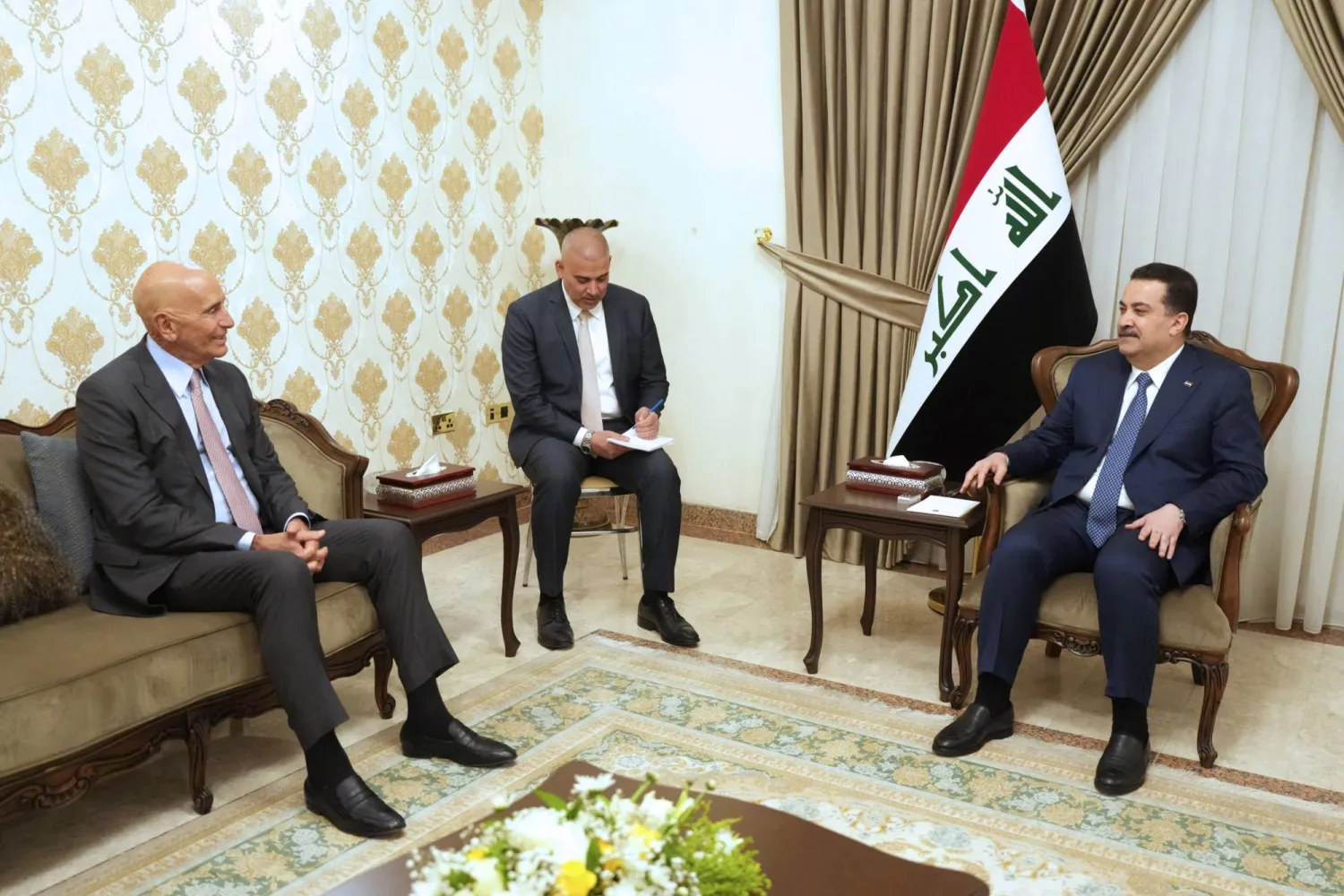
A handout picture made available by the Iraqi prime minister's office on February 22, 2026, shows US envoy to Syria Tom Barrack (L) meeting with Iraq's Prime Minister Mohammed Shia al-Sudani (R) in Baghdad's Green Zone. (Handout / Iraqi Prime Minister’s Press Office / AFP)
TT

Maliki Says Has ‘Absolutely No Intention’ to Withdraw PM Candidacy as Barrack Visits Iraq 

A handout picture made available by the Iraqi prime minister's office on February 22, 2026, shows US envoy to Syria Tom Barrack (L) meeting with Iraq's Prime Minister Mohammed Shia al-Sudani (R) in Baghdad's Green Zone. (Handout / Iraqi Prime Minister’s Press Office / AFP)

The leading candidate to become Iraq's next prime minister, former premier Nouri al-Maliki, told AFP on Monday that he will not withdraw his nomination after pressure from the US, while also seeking to allay Washington's concerns.

Since the US-led invasion that overthrew former ruler Saddam Hussein in 2003, Iraqi leaders have struggled to find a balance between two global powers competing for influence in the country: neighbor Iran and its arch-rival the United States.

Last month President Donald Trump intervened by issuing an ultimatum that if Maliki -- a two-time former premier with close ties to Iran -- was named Iraq's next prime minister, the US would no longer help the country.

"I have absolutely no intention of withdrawing out of respect for my country, its sovereignty, and its will," Maliki told AFP in an interview.

"No one has the right to say whom we can or cannot vote for," the powerbroker added.

"I will not withdraw until the end."

Trump's threat left Iraqi leaders at a loss, particularly within the Coordination Framework -- a ruling alliance of Shiite groups with varying degrees of links to Iran than nominated Maliki.

Maliki told AFP that "countries have the right to set conditions in their dealings with Iraq," but changing the nomination depends on the Coordination Framework, which still backs him.
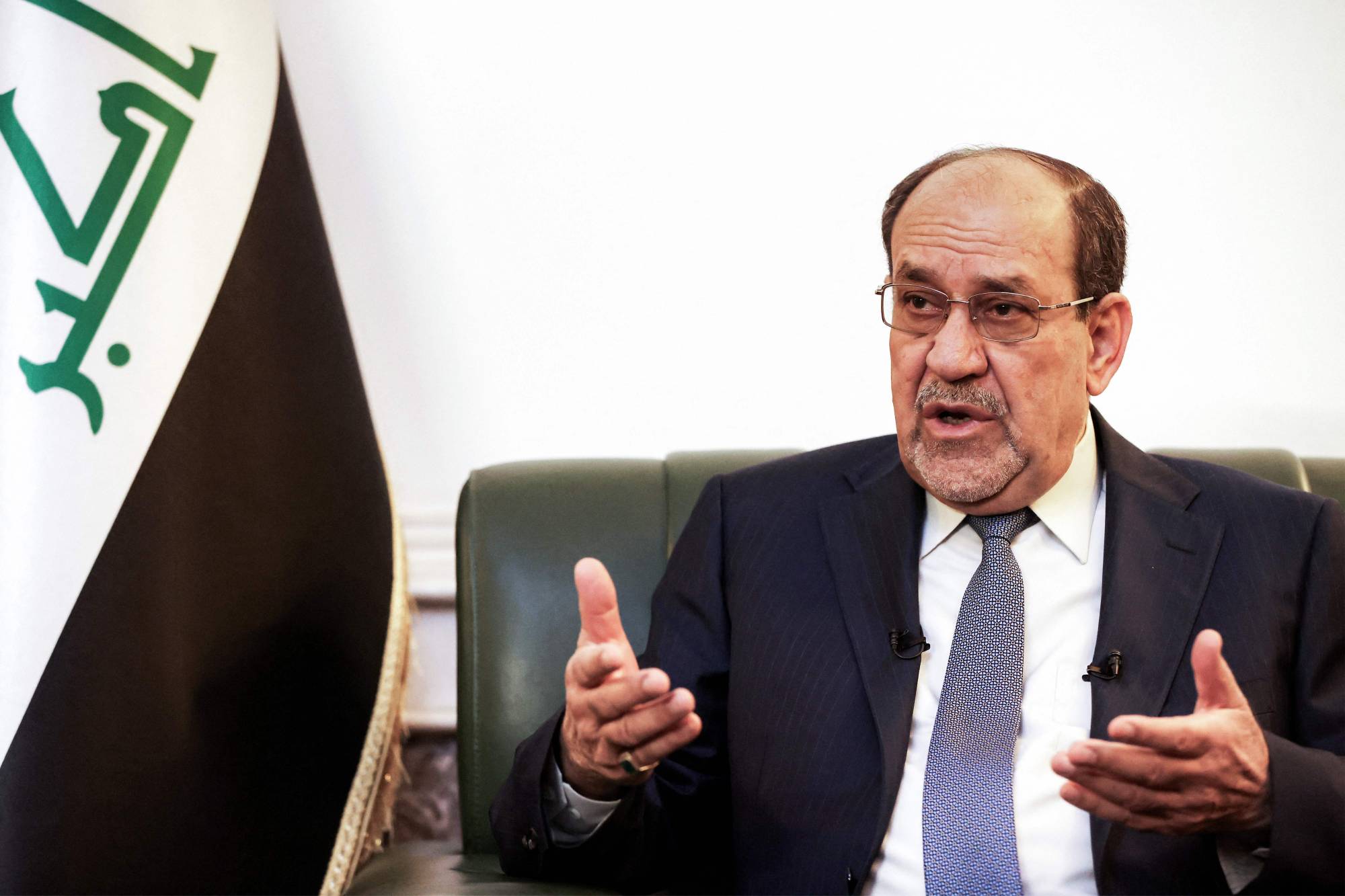
Iraq’s former PM and candidate for the premiership, Nouri al-Maliki, speaks during an interview with AFP at his office in the Green Zone in Baghdad on February 23, 2026. (AFP)

- 'One army under one command' -

Maliki -- who is Iraq's only two-term prime minister, serving from 2006 to 2014 -- also rejected claims that his relationship with the US was bad during his previous tenure.

Maliki at first enjoyed support from the American occupation following the 2003 invasion, but later fell out with Washington over his growing ties with Iran and allegations that he pushed a sectarian agenda.

Iraq's new premier will be expected to address Washington's longstanding demand that Baghdad rein in Tehran-backed factions that are designated terrorist groups by the US.

Maliki said that Washington has conveyed several messages to Iraqi leaders.

"They seek changes in the state's policies," he said.

Washington's concerns include the future of the Popular Mobilization Forces (PMF) -- a former paramilitary alliance that has integrated into the armed forces -- as well as disarming pro-Iran armed factions and accusations that some Iraqi entities are helping Iran evade US sanctions on oil exports.

Maliki sought to reassure the US on Monday.

"In fact, what America wants is not new. These are our demands," he said.

"We want weapons in the hands of the state. We want a centralized military force. We have said it repeatedly: we want one army under one command, directly under state authority.

"It's quite possible" to achieve a deal with pro-Iran armed factions, he added.

"There is a good basis for understanding with the factions" but this cannot happen "through force, war or confrontations," he said.

Maliki added that he believes factions "do not want to expose Iraq to any danger."

Washington has also demanded that the eventual Iraqi government exclude Iran-backed armed groups -- an issue that is under discussion, according to Maliki.

Some of these groups have increased their presence in the new parliament and have seen their political and financial clout increase.

"We want those who participate in the political process and the government to lay down their arms," Maliki said.

"Those who lay down their arms are welcome to be part of the next government."
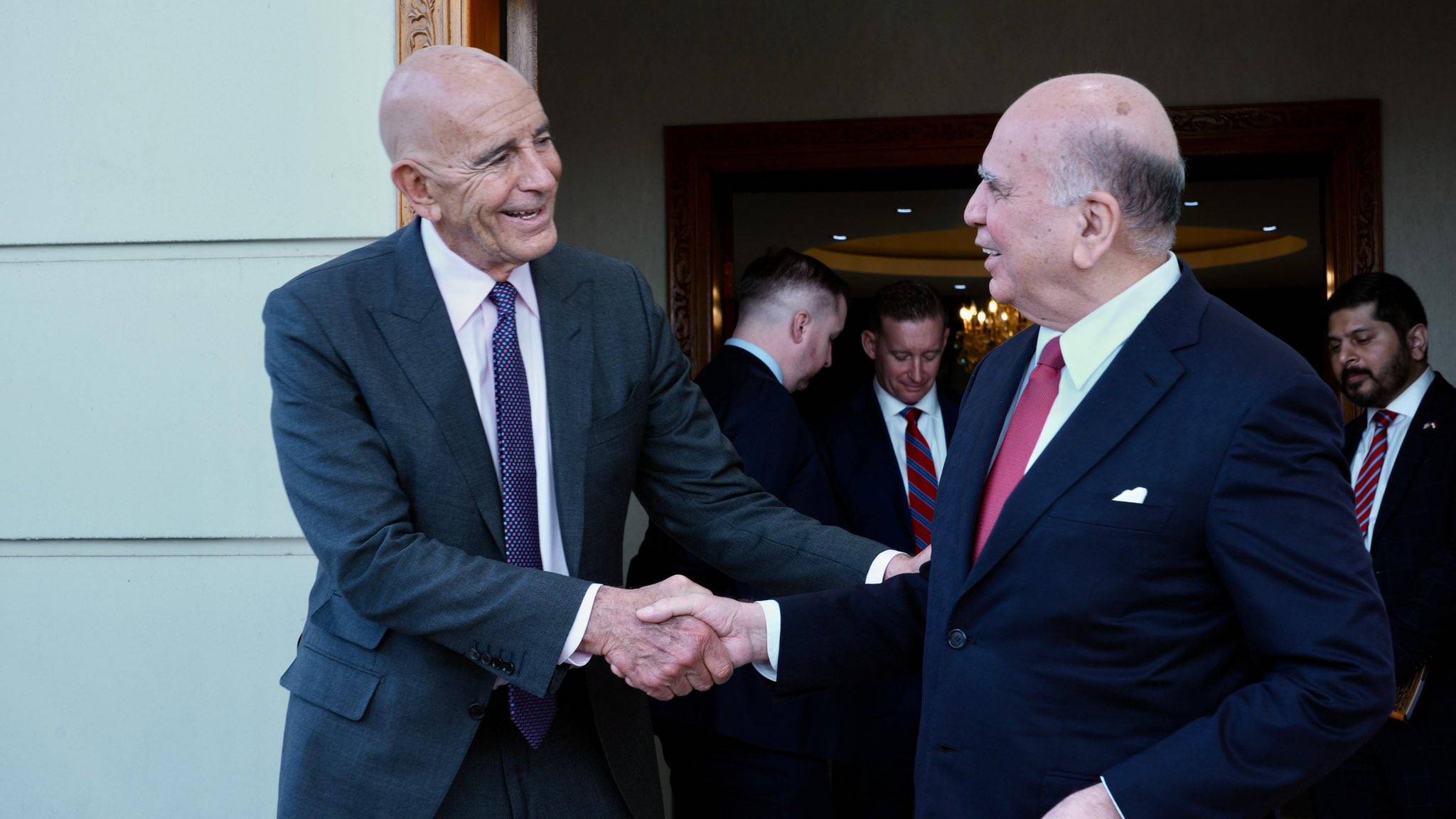
Iraqi Foreign Minister Fuad Hussein and US envoy Tom Barrack meet in Baghdad on Monday. (Iraq Foreign Ministry)

- No attacks -

After decades of conflict, Iraq has begun to enjoy some stability in recent years, yet its politics remain volatile, shaped not only by internal disputes but also by regional dynamics.

Today, all eyes are on negotiations between the US and Iran over Tehran's nuclear program, with a third round of talks scheduled for Geneva on Thursday.

With fears rising that Iraq could be dragged into a war if the US strikes Iran, Maliki vowed to prevent attacks on diplomatic missions in Iraq if he becomes prime minister.

"All countries can be assured that we will prevent any violation against their embassies or officially recognized interests in Iraq," Maliki said.

"We will not allow any party to target any country that maintains a diplomatic presence."

Previously, Iran-backed armed groups attacked US missions and troops in Iraq.

Maliki defended Iraq's relations with Iran, which he said "rest on the principle that Iraq's sovereignty is respected" and that "shared interests define this relationship".

"We share a 1,300-kilometer border and mutual interests with Iran," he added.

Despite its oil wealth, Iraq depends on imports from Iran to meet its energy needs.

Maliki warned that "if Iran cut off our natural gas supply... it would be a major catastrophe."
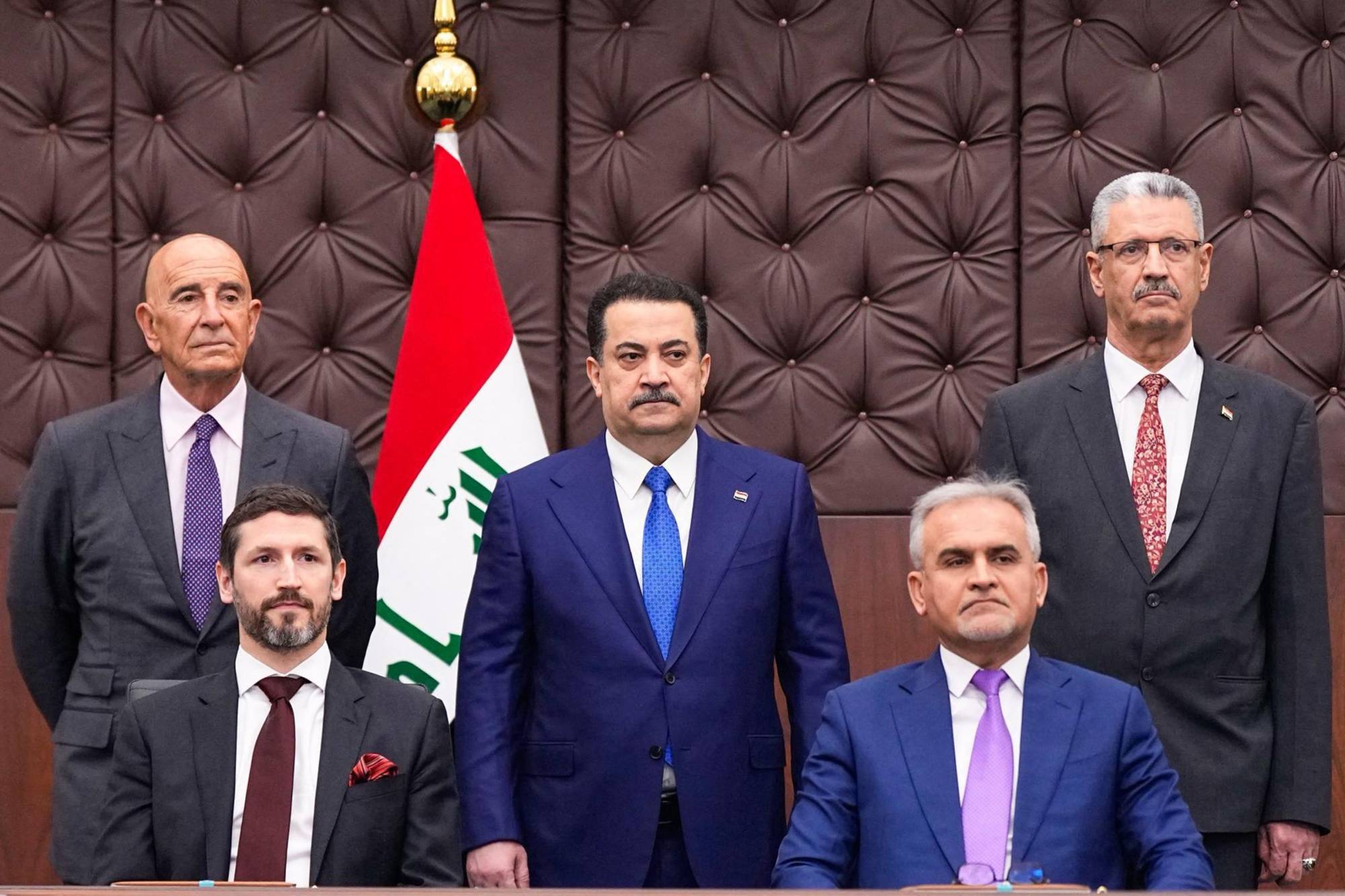
This handout picture made available by the Iraqi prime minister's office shows Iraq's Prime Minister Mohammed Shia al-Sudani (top C), Oil Minister Hayan Abdul Ghani al-Sawad (top R), US envoy Tom Barrack (top L), Chevron's Director of Business Development Joe Koch (bottom L), and the Basra Oil Company Director Bassem Abdul Karim (bottom R) attending the signing of agreements between Chevron Corporation and the Basra Oil Company at the government palace in Baghdad on February 23, 2026. (Iraqi Prime Minister’s Press Office / AFP)

- Barrack visits -

Meanwhile, US envoy Tom Barrack was in Iraq on Monday where he held talks with caretaker Prime Minister Mohammed Shia al-Sudani, Foreign Minister Fuad Hussein and President of the Supreme Judicial Council Faiq Zidan.

Sudani said the meeting with Barrack stressed the importance of dialogue and diplomacy to resolve disputes.

The officials discussed bilateral ties between Iraq and the US and developments in the region, as well as Baghdad’s efforts to support regional stability, especially in Syria, read a statement from Sudani’s office.

They also tackled opportunities for economic cooperation.

For his part, Barrack described the meeting with Sudani as "fruitful".

In a post on the X platform, he said he discussed with Sudani "continued Iraqi goals and objectives to build a sovereign, stable, and prosperous future that aligns with Trump’s desire and plan for peace and prosperity in the region."

"The necessity of effective leadership that aligns itself with the policies and practices of further stabilization for Iraq and the Iraqi people is key to our mutual goals," he remarked.

Barrack later held meetings with President of the Iraqi Kurdistan Region Nechirvan Barzani and Taqaddum Party leader Mohammed Halbousi.

During his visit, Iraq's foreign minister said Türkiye had agreed to take back Turkish citizens from among thousands of ISIS detainees transferred to Iraq from Syria when camps and prisons there were shut in recent weeks.

Also on Monday, Iraq and the US energy giant Chevron signed deals to manage and develop several oil fields, including one previously operated by Russia's Lukoil.

Sudani's media office said "two preliminary memoranda of principles" were signed with Chevron, the first of which was "concerning the transfer of management of the West Qurna 2 field," one of the world's largest oil fields.

The second agreement concerns the development of the Nasiriyah field and four exploratory blocks in Dhi Qar province in the country's south, as well as the Balad field in the northern province of Salah al-Din.

Sudani and Barrack attended the signing ceremony.


Egypt Urges Int’l Support for Lebanese Army to Ensure State Exclusivity over Arms

Egyptian Foreign Minister Badr Abdelatty (3rd L) speaks before representatives of participating countries during the preparatory meeting for the international conference in support of the Lebanese Armed Forces (LAF) and the Internal Security Forces (ISF) in Cairo on February 24, 2026. (AFP)
TT

Egypt Urges Int’l Support for Lebanese Army to Ensure State Exclusivity over Arms

Egyptian Foreign Minister Badr Abdelatty (3rd L) speaks before representatives of participating countries during the preparatory meeting for the international conference in support of the Lebanese Armed Forces (LAF) and the Internal Security Forces (ISF) in Cairo on February 24, 2026. (AFP)

Egypt on Tuesday urged the international community to better support Lebanon's armed forces to ensure that all weapons in the country come under the exclusive authority of the state.

Speaking at a preparatory meeting in Cairo ahead of next month's Paris conference in support of the Lebanese army, Egypt's Foreign Minister Badr Abdelatty praised "the success of the Lebanese army in completing the first phase of the plan".

"This achievement reflects the efficiency of the military institution and requires intensifying international support to complete the remaining phases of the plan," Abdelatty said.

Last year, Lebanon's government committed to disarming Hezbollah, which was severely weakened in its recent war with Israel, and tasked the army with drafting a plan to implement the decision.

In January, and in line with the 2024 truce, the army announced it had completed the first phase of the disarmament plan, covering the area between the Litani River and the Israeli border about 30 kilometers (20 miles) further south.

Abdelatty said that Tuesday's meeting aimed "to enable the Lebanese state to ensure that all weapons are held exclusively by the state".

The meeting brought together Lebanon's top security chiefs, including Army Commander General Rodolphe Haykal and Internal Security Forces Director-General Major General Raed Abdallah.

They were joined by representatives of the Quintet Committee on Lebanon, among them Qatar's Minister of State for Foreign Affairs Mohammed bin Abdulaziz al-Khulaifi, the French President's personal envoy Jean-Yves Le Drian and Saudi Arabia's envoy to Beirut Prince Yazid bin Farhan, along with senior officials from the United States.

The second phase of the plan focuses on the area between the Litani and Awali rivers, around 40 kilometers south of Beirut.

Hezbollah has so far refused to hand over its weapons north of the Litani.

The government said last week that the army would need at least four months to implement the plan's second phase to disarm Hezbollah in the country's south,


About 6.5 Million People in Somalia Face Acute Hunger Due to Drought, Govt and UN Say

 Lime is displayed for sale at an open-air grocery market as Muslims start the fasting month of Ramadan within Bakara market in Mogadishu, Somalia February 18, 2026. (Reuters)
Lime is displayed for sale at an open-air grocery market as Muslims start the fasting month of Ramadan within Bakara market in Mogadishu, Somalia February 18, 2026. (Reuters)
TT

About 6.5 Million People in Somalia Face Acute Hunger Due to Drought, Govt and UN Say

 Lime is displayed for sale at an open-air grocery market as Muslims start the fasting month of Ramadan within Bakara market in Mogadishu, Somalia February 18, 2026. (Reuters)
Lime is displayed for sale at an open-air grocery market as Muslims start the fasting month of Ramadan within Bakara market in Mogadishu, Somalia February 18, 2026. (Reuters)

About 6.5 million people in Somalia ‌face acute hunger due to drought, the government and the United Nations said on Tuesday, sounding the alarm days after the UN's food agency warned that food aid could grind to a halt by April without new funding.

Somalia declared a national drought emergency in November after years of failed rains, and other countries in the region have also been hit.

More than a third of those facing acute malnutrition are children, Somalia's government and the United Nations Somalia said in a joint statement. The crisis has forced tens of thousands of ‌people to ‌flee their homes, with many crowding into camps ‌in ⁠Mogadishu and other ⁠cities.

"The drought ... has deepened alarmingly, with soaring water prices, limited food supplies, dying livestock, and very little humanitarian funding," George Conway, the UN's Humanitarian Coordinator for Somalia, said in a statement.

Hawo Abdi said she lost two children to illness after the drought laid waste to her homeland in Somalia's Bay region.

"When I saw that the suffering ⁠was getting worse, I fled my home and ‌came to ... Mogadishu," she told Reuters ‌from her shelter on the outskirts of the capital.

Last week, the UN World Food Program put the number of those facing acute hunger ‌at 4.4 million, and said it had already cut back its assistance to just over 600,000 people from 2.2 million earlier this year.

It was not clear whether the new figure reflected a sharp increase in those ‌at risk or different counting methods.

The government and United Nations figures tally with those also released on ⁠Tuesday by ⁠the Integrated Food Security Phase Classification (IPC), which sets the global standard for determining the severity of a food crisis.

While rainfall in the April to June season could offer some relief, some 5.5 million people were expected to remain in the crisis level or worse, with 1.6 million people in the emergency level, the statement said.

Abdiyo Ali was forced to abandon her farm in the Lower Shabelle region.

"Our farms were destroyed, our livestock died, and water sources became too far away. We have nothing left to bring with us," Ali told Reuters last week while preparing her food in a displaced people's camp outside Mogadishu.


Lebanon Fears Israeli Strikes if Iran Situation Escalates

 Lebanese Foreign Minister Youssef Raggi addresses the Human Rights Council in Geneva, Switzerland, Tuesday, Feb. 24, 2026. (AP)
Lebanese Foreign Minister Youssef Raggi addresses the Human Rights Council in Geneva, Switzerland, Tuesday, Feb. 24, 2026. (AP)
TT

Lebanon Fears Israeli Strikes if Iran Situation Escalates

 Lebanese Foreign Minister Youssef Raggi addresses the Human Rights Council in Geneva, Switzerland, Tuesday, Feb. 24, 2026. (AP)
Lebanese Foreign Minister Youssef Raggi addresses the Human Rights Council in Geneva, Switzerland, Tuesday, Feb. 24, 2026. (AP)

Lebanon's foreign minister said Tuesday his country feared its infrastructure could be hit by Israeli strikes if the situation with Iran escalates, as Israel has intensified its attacks on Tehran-backed Hezbollah.

Also on Tuesday, Lebanon's army accused the Israeli military of firing near a position it was setting up in the country's south, saying it had instructed troops to return fire.

"There are signs that the Israelis could strike very hard in the event of an escalation, potentially including strategic infrastructure such as the airport," foreign minister Youssef Raggi told reporters in Geneva.

His comments came amid a massive US military buildup in the Middle East that suggested Washington was prepared to wage a potentially sustained campaign against Iran.

Iran vowed on Monday to retaliate "ferociously" against any attack from the United States, and repeated its warning of a regional conflagration in response to President Donald Trump's latest threat of strikes.

"We are currently conducting diplomatic efforts to request that, even in the event of retaliation, Lebanese civilian infrastructure not be targeted," Raggi said.

He stressed that his country's leadership had been very clear: "This war does not concern us."

A Lebanese official who requested anonymity said "what the Lebanese fear is a chain reaction: an American strike against Iran, a Hezbollah retaliatory strike against Israel, followed by a massive Israeli response."

- Israeli strikes -

Israel has kept up regular strikes on Lebanon despite a November 2024 ceasefire that sought to halt more than a year of hostilities with Iran-backed Hezbollah, usually saying it was targeting the group.

Last Friday, Israel carried out deadly strikes on what it called Hezbollah positions in eastern Lebanon and targets linked to the Palestinian group Hamas in the south.

Hezbollah said Saturday that eight of its fighters had been killed, and vowed "resistance".

Its leader Sheikh Naim Qassem stated last month that any attack on Tehran would also be an attack on Hezbollah.

On Monday, Washington ordered non-emergency personnel to leave its embassy in Lebanon's capital Beirut as anticipation rose of a possible conflict with Iran.

On Tuesday, Lebanon's army said it was "establishing a new observation post on the southern border" when "the area surrounding the post was subjected to gunfire from the Israeli side".

"The army command issued orders to reinforce the post, remain there, and return fire."

On the same day in Cairo, a preparatory meeting was held ahead of a conference in Paris next month to back Lebanon's army, which is facing heavy pressure from Washington and Israel to disarm Hezbollah.

Egyptian Foreign Minister Badr Abdelatty said that Tuesday's meeting aimed "to enable the Lebanese state to ensure that all weapons are held exclusively by the state".

Lebanon's government last year committed to disarming Hezbollah, which was badly weakened in a recent war with Israel, and tasked the army with drawing up a plan to do so.

The army, which has limited capabilities, declared in January the completion of the first phase of its plan near the border with Israel.

It said last week it would need at least four months to complete the second phase.

Israel, which accuses Hezbollah of rearming, has criticized the army's progress as insufficient.