

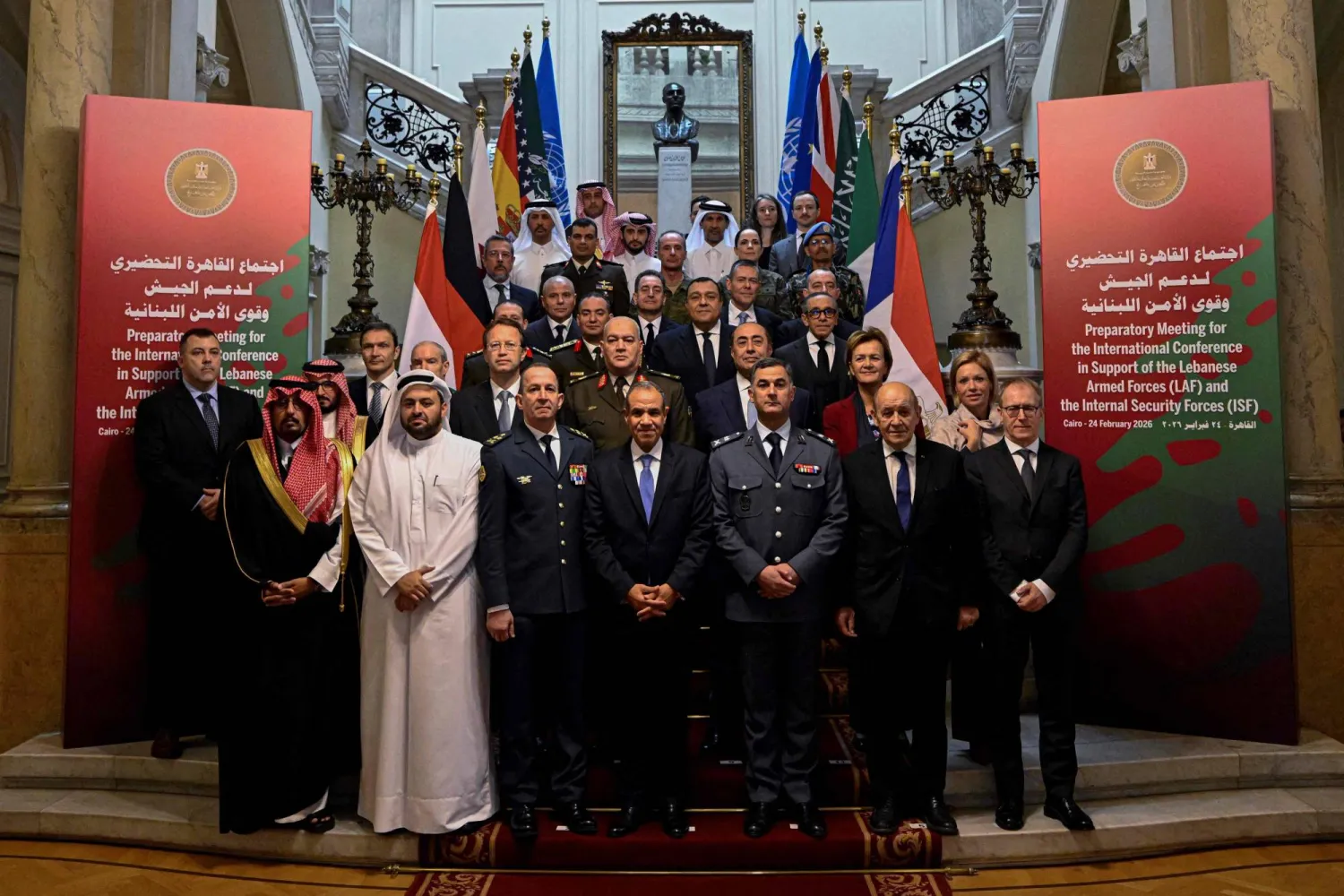

Paris Seeks Roadmap for Lebanese Army, Security Forces Needs

A group photo of participants at the Cairo meeting to support the Lebanese army and Internal Security Forces, with Egyptian Foreign Minister Badr Abdelatty at center (AFP)
TT

Paris Seeks Roadmap for Lebanese Army, Security Forces Needs

A group photo of participants at the Cairo meeting to support the Lebanese army and Internal Security Forces, with Egyptian Foreign Minister Badr Abdelatty at center (AFP)

Paris is pinning high hopes on a preparatory meeting held in Cairo on Tuesday under Egyptian Foreign Minister Badr Abdelatty, seen as a key step toward the conference France will host in Paris on March 5, to rally support for the Lebanese army and the Internal Security Forces.

French diplomatic sources said President Emmanuel Macron’s special envoy for Lebanon Jean-Yves Le Drian represented France at the meeting.

He was joined by General Valentin Seiler, France’s representative in the ceasefire supervision mechanism between Lebanon and Israel and in the Technical Military Committee for Lebanon, which also includes the United States, Italy, Britain, Spain and Germany.

Civilian-military coordination

Paris described the Cairo gathering as both civilian and military, calling it “the result of close coordination among the members of the Quintet in terms of content, format and objectives.”

The meeting followed intensive groundwork by the Technical Military Committee for Lebanon, working with Lebanese security institutions to precisely define the needs of the Lebanese army and the Internal Security Forces.

The expanded session was preceded by talks between Abdelatty and Le Drian.

France wants Cairo to deliver a clear, comprehensive assessment of Lebanon’s needs and a detailed priority map. Urgent requirements include logistical support — fuel, troop mobility, communications and training — to help the army carry out tasks assigned by the political leadership.

Foremost among them is the second phase of consolidating state control over weapons, between the Litani and Awali rivers. Army Commander General Rodolphe Haykal said the operation could take between four and eight months.

Paris believes coordination among the main stakeholders is essential to avoid duplication, ensure complementarity and clarify what each party can provide. Expected assistance ranges from weapons and equipment to training, communications tools and financial support.

With 50 countries and 10 regional and international organizations invited to the Paris conference, coordination is seen as urgent so Lebanon knows exactly what it can expect.

What can Lebanon expect?

Sources declined to spell out what Beirut may secure in Paris. Several parties are tying their pledges to the Lebanese army’s progress in implementing UN Security Council Resolution 1701 and advancing the weapons consolidation plan, which faces resistance from Hezbollah.

Countries engaged in Lebanon are betting on the army not only to consolidate state authority over arms, but as a cornerstone of security and stability. Lebanon is seeking to recruit more troops, while the Internal Security Forces are expected to shoulder internal security duties to ease pressure on the army.

Yet mounting regional tensions could complicate those efforts. The possibility of US strikes on Iran, potential Israeli involvement, and intensified operations against Hezbollah would deepen the challenges confronting Lebanese authorities, especially the army.

Hopes for the Paris conference rest not only on military and financial aid, but also on political backing to shield Lebanon from a repeat of what it endured during the “support war” and its aftermath, the consequences of which continue to weigh on Lebanese citizens almost daily.



Civilian Death Toll in Sudan War More than Doubled in 2025, UN Says

A displaced Sudanese woman who left El-Fasher after its fall with others, walks amid the remains of a fire that broke out at a camp in Tawila on February 11, 2026. (Photo by AFP)
TT

Civilian Death Toll in Sudan War More than Doubled in 2025, UN Says

A displaced Sudanese woman who left El-Fasher after its fall with others, walks amid the remains of a fire that broke out at a camp in Tawila on February 11, 2026. (Photo by AFP)

Killings of civilians in Sudan's war more than doubled in 2025 compared with the previous year, the United Nations rights chief said Thursday, warning that thousands more dead are unidentified or remain missing.

Since April 2023, Sudan has been engulfed in a conflict between the army and the Rapid Support Forces (RSF) that has killed tens of thousands, displaced 11 million people and triggered one of the world's worst humanitarian crises.

"This war is ugly. It's bloody and it's senseless," Volker Turk told the UN Human Rights Council, blaming both warring sides, which have so far rejected any form of humanitarian truce. He also blamed foreign sponsors funding what he called a "high-tech" conflict.

"In 2025, my office's documentation points to an over two and a half times increase in killings of civilians compared with the previous year. Many thousands are still missing or unidentified," Turk said.

There have been no official figures on the overall death toll in the conflict.

Turk condemned what he called the "heinous and ruthless" brutalities committed, including sexual violence, summary executions and arbitrary detentions, AFP reported.

He highlighted "carnage" inflicted by the RSF during an attack on the Zamzam displacement camp in April, and again in October in El-Fasher, which was the army's last foothold in western Darfur.

Sexual violence, including rape, gang rape, sexual torture and slavery, has also surged, Turk said, with more than 500 victims documented in 2025. "The bodies of Sudanese women and girls have been weaponised to terrorise communities."

He added that he is "extremely worried these crimes may be repeated".

Since January, escalating drone attacks in the southern Kordofan region and beyond have "killed or injured nearly 600 civilians", Turk said, including in attacks on humanitarian aid convoys.

The UN's resident and humanitarian coordinator for Sudan, Denise Brown, said on Thursday that access to the cities of Kadugli and Dilling in South Kordofan -- long cut off by an RSF siege until the army recently lifted it -- had been effectively impossible.

"We were not able to get supplies in. We had to remove our staff for their own safety," she said, after stepping off the first UN flight to Khartoum since the war began on Thursday.

Humanitarian deliveries resumed only last week, with more than 50 trucks carrying essential supplies for frontline Sudanese responders.

According to AFP, Brown echoed growing UN alarm over escalating hunger, saying that available data suggested there were currently famine conditions in Dilling, which has not been officially confirmed.

In El-Fasher and Kadugli, famine has already been confirmed by a UN-backed assessment.

"It's essential that the world understands the consequences of war," she said, urging global leaders to "put their heads together to find a solution".

Turk said both the army and the RSF continued to use "explosive weapons in densely populated areas, often without warning -- showing utter disregard for human life".

Turk highlighted the "increased use of advanced long-range drones", which has "expanded harm to civilians in areas far from the front lines that were previously peaceful".

Turk also voiced concern over "the growing militarization of society", including the recruitment of children and young people into the fighting.


UN Expert on Palestinian Territories Denounces 'Toxic' Attacks against Her

United Nations Special Rapporteur on the situation of human rights in the occupied Palestinian territory, Francesca Albanese, attends a press conference at the European headquarters of the UN in Geneva, Switzerland, September 15, 2025. REUTERS/Pierre Albouy/File Photo
TT

UN Expert on Palestinian Territories Denounces 'Toxic' Attacks against Her

United Nations Special Rapporteur on the situation of human rights in the occupied Palestinian territory, Francesca Albanese, attends a press conference at the European headquarters of the UN in Geneva, Switzerland, September 15, 2025. REUTERS/Pierre Albouy/File Photo

The UN expert on the Palestinian territories, Francesca Albanese, denounced on Thursday what she described as "toxic" attacks impacting her personal life and work, after a number of European states called for her resignation.

In recent weeks Germany, France, Italy and others have called for Albanese to step down over her criticism of Israel. Albanese, an Italian lawyer, said the remarks were taken out of context and misconstrued.

"I can tell you how toxic and personally damaging for me and for my family these past days, weeks and months have been," Albanese, Special Rapporteur on human rights in the occupied Palestinian territories, told reporters via video link from Jordan.

A letter seen by Reuters, sent by the permanent mission of Israel in Geneva to the Council's president on 15 February, stated that she had flagrantly violated the UN's code of conduct.

"As long as she holds a UN mandate, she fundamentally undermines the credibility and moral authority of the United Nations," the letter stated, adding that Albanese had repeatedly shared antisemitic tropes - allegations that Albanese has previously denied.

On Tuesday the ambassador to the French mission to the UN in Geneva reiterated concerns by the French foreign minister of "extremely problematic statements" by a United Nations Special Rapporteur - in an apparent reference to Albanese, without mentioning her by name.

"All those who speak under the auspices of the United Nations - including Special Rapporteurs - must exercise the restraint, moderation, and discretion required by their mandate," Céline Jurgensen told delegates at the UN Human Rights Council.

Albanese described sanctions imposed on her by the United States in July as being part of a broader strategy by the current US administration to weaken international accountability mechanisms.

The US sanctioned Albanese for what it described as "illegitimate and shameful efforts to prompt (International Criminal Court) action against US and Israeli officials, companies, and executives" in a report to the Human Rights Council.

"These smears, the sanctions, the continuous attacks from all over, from those very states who should use that energy as stamina to go after those who are accused by the highest court in the world of war crimes, crimes against humanity and genocide," Albanese stated.

The president of the UN Human Rights Council, Sidharto Reza Suryodipuro, on Monday expressed concern and regret at personal attacks directed "against certain mandate holders" at the Council and reiterated his support for them.

"Their independence and protection remains essential to the effectiveness, credibility and legitimacy of the council's collective action."


Syrian Government Forces and Druze Factions Exchange Prisoners in Sweida

A delegation from the Sweida Governorate inspects the service situation in the villages of the western countryside (SANA)
TT

Syrian Government Forces and Druze Factions Exchange Prisoners in Sweida

A delegation from the Sweida Governorate inspects the service situation in the villages of the western countryside (SANA)

The Syrian government and Druze factions controlling the southern city of Sweida on Thursday carried out ‌their first ‌prisoner exchange ‌since ⁠deadly clashes in the ⁠predominantly Druze city last summer, according to the Syrian ⁠government's Sweida media office.

The ‌swap ‌involved Damascus ‌releasing 61 ‌prisoners from the Druze factions detained in Adra ‌Central Prison near the capital, in ⁠return ⁠for the Druze's National Guard Forces freeing 25 Syrian government personnel, the media office said.