


Saudi Telecom Sector Solidifies Leadership with $28 Billion in Revenue in 2025

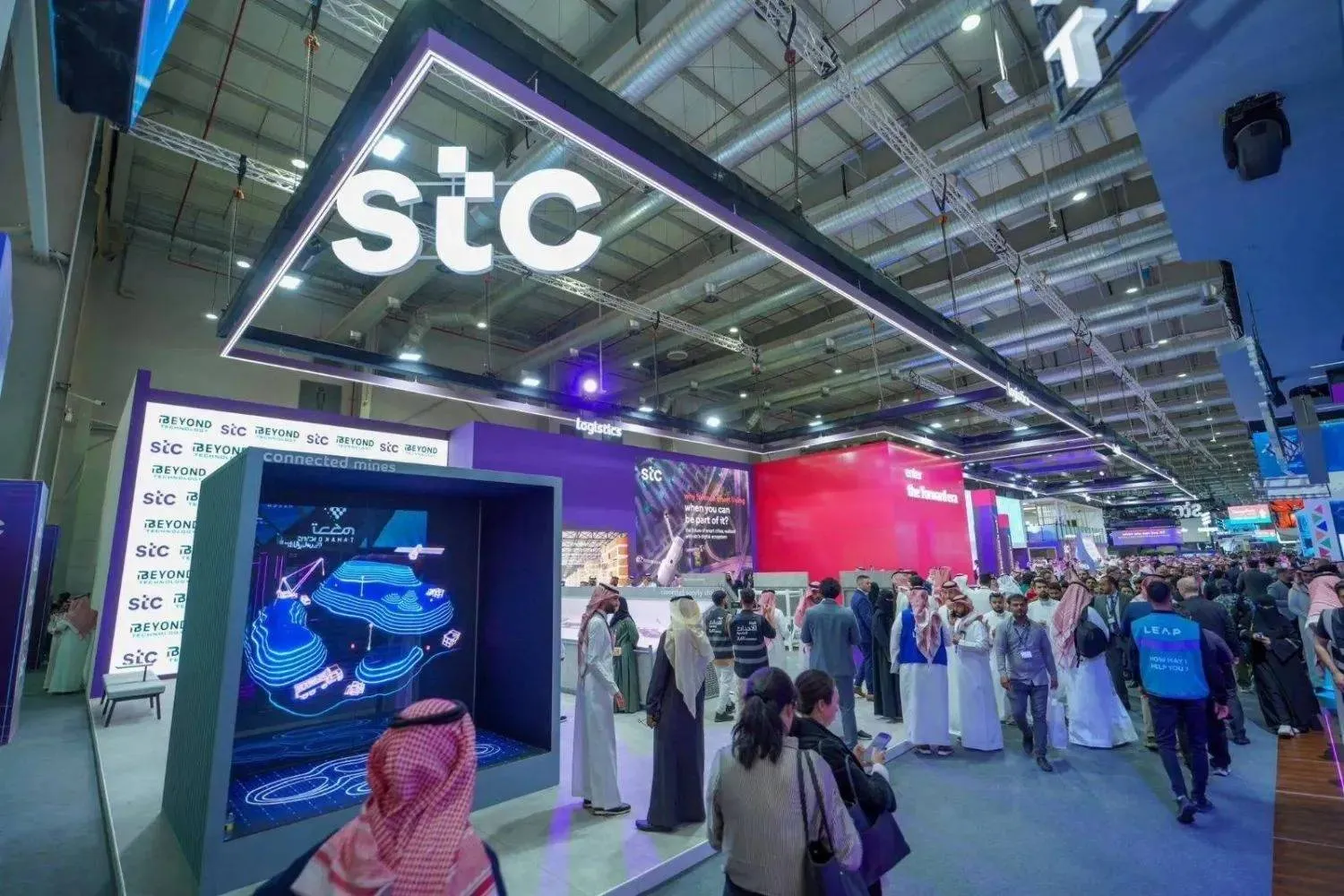
The Saudi Telecom Company (stc) pavilion at the LEAP International Conference in Riyadh (Asharq Al-Awsat)
TT

Saudi Telecom Sector Solidifies Leadership with $28 Billion in Revenue in 2025

The Saudi Telecom Company (stc) pavilion at the LEAP International Conference in Riyadh (Asharq Al-Awsat)

Saudi Arabia’s telecommunications sector has reaffirmed the strength of its operating model and growth potential, reporting a solid rise in combined revenues in 2025.

The performance reflects continued customer growth and an expanding portfolio of digital solutions, underscoring the sector’s central role in advancing Vision 2030.

Companies listed on the Saudi Exchange (Tadawul) posted a 3.8 percent increase in total revenue, exceeding SAR108.4 billion ($28.9 billion) in 2025, compared with SAR104.46 billion ($24.9 billion) in 2024.

However, despite strong top-line growth, aggregate net profits for the sector fell by 33.4 percent. The three largest operators — Saudi Telecom Company (stc), Etihad Etisalat Company (Mobily), and Mobile Telecommunications Company Saudi Arabia (Zain KSA) — reported combined earnings of SAR18.9 billion ($5 billion), down from SAR28.39 billion ($7.6 billion) the previous year.

The sector comprises four listed firms. Three — stc, Mobily and Zain KSA — follow a December fiscal year-end, while Etihad Atheeb Telecommunication Company (GO Telecom) closes its fiscal year at the end of March.

The decline in profitability was largely driven by stc, which accounts for 78 percent of the sector’s earnings. Its net profit fell 39.9 percent to SAR14.83 billion. Analysts attributed the drop mainly to a high comparison base in 2024, when exceptional and non-recurring items boosted profits to unusually elevated levels.

By contrast, Mobily reported an 11.55 percent increase in profit to SAR3.47 billion in 2025, up from SAR3.1 billion in 2024, supported by revenue growth across all business segments and an expanding customer base.

Zain KSA recorded a 1.3 percent rise in profit to SAR604 million, compared with SAR596 million the previous year. The improvement was driven by higher revenues from consumer and wholesale segments, the expansion of 5G services, and growth in Tamam Finance’s operations.

Rising Costs and Investment Pressures

Dr. Sulaiman Al-Humaid Al-Khaldi, a financial market analyst and member of the Saudi Economic Association, said the sector’s results highlight a clear divergence between revenue growth and declining profits, pointing to mounting operational and financial pressures.

Revenue growth has not translated into higher profits, as costs have increased at a faster pace than income.

Al-Khalidi expects short-term pressure on margins to persist due to continued high capital expenditure and strong price competition. Over the medium term, however, he anticipates gradual improvement supported by growing demand for data services, digital solutions and cloud computing, as well as expansion into non-traditional areas such as fintech and data centers.

He noted that the sector is undergoing a strategic shift from traditional telecom services toward integrated digital offerings, which could strengthen profitability in the future.

Profit Normalization After an Exceptional Year

Mohamed Hamdy Omar, chief executive of G World, described 2025 as a year of profit normalization following an exceptional 2024, when non-recurring gains significantly lifted stc’s net income.

He added that fourth-quarter earnings were weighed down by a strong comparison base and higher seasonal, marketing and financing costs tied to capital investments in networks and infrastructure.

At the same time, improved operational performance at Mobily and Zain KSA helped partially offset stc’s earnings decline. Omar stressed that the pressure on profits reflects accounting and financing factors rather than weakening demand or structural challenges in the sector.

Looking ahead, he expects the medium-term outlook to remain positive, driven by sustained demand for data, continued digital expansion and growth in telecom-linked financial and technology services. Profitability is projected to stabilize further in 2026 as operational efficiency improves.


IMF Says Syria Ended 2025 with a Small Budget Surplus

The International Monetary Fund logo is seen outside the headquarters building in Washington, US September 4, 2018. REUTERS/Yuri Gripas/File Photo
TT

IMF Says Syria Ended 2025 with a Small Budget Surplus

The International Monetary Fund logo is seen outside the headquarters building in Washington, US September 4, 2018. REUTERS/Yuri Gripas/File Photo

The International Monetary Fund said on Wednesday that the Syrian government ended 2025 with a small budget surplus and that its revenue projections were ambitious but feasible, as the agency's staff concluded a visit to Damascus.


"Syria’s economy continues to show signs of recovery, with activity increasing at an accelerating pace as consumer and investor sentiment continues to improve," the IMF said in its statement.


Oil Hovers Near Seven-month Highs Ahead of US-Iran Talks

FILE PHOTO: Chevron-chartered Ionic Anax oil tanker sits anchored in Lake Maracaibo, near the Bajo Grande crude port operated by state oil company PDVSA, in Maracaibo, Venezuela, February 9, 2026. REUTERS/Marco Bello/File Photo
TT

Oil Hovers Near Seven-month Highs Ahead of US-Iran Talks

FILE PHOTO: Chevron-chartered Ionic Anax oil tanker sits anchored in Lake Maracaibo, near the Bajo Grande crude port operated by state oil company PDVSA, in Maracaibo, Venezuela, February 9, 2026. REUTERS/Marco Bello/File Photo

Oil prices edged higher on Wednesday, as investors weighed the threat of military conflict between the US and Iran that could disrupt supply and a big build in US crude inventories.

Brent futures were up 6 cents at $70.83 per barrel at 0957 GMT. WTI futures rose 4 cents to $65.67 per barrel.

Brent prices reached their highest since July 31 on Friday, while WTI hit its highest since August 4 on Monday, as the US positioned military ‌forces in ‌the Middle East to try to compel Iran to ‌negotiate ⁠an end to ⁠its nuclear and ballistic missile program.

An extended conflict could disrupt supplies from Iran, the third-biggest crude producer in the Organization of the Petroleum Exporting Countries, and other countries in the key Middle East producing region.

Supporting oil prices, US President Donald Trump briefly laid out his case for a possible attack on Iran in his State of the Union speech on Tuesday, saying he would ⁠not allow a country he described as the world's biggest ‌sponsor of terrorism to have a nuclear ‌weapon.

"This uncertainty means the market will continue to price in a large risk premium ‌and remain sensitive to any fresh developments," ING commodities strategists said on ‌Wednesday.

US envoys Steve Witkoff and Jared Kushner are due to meet an Iranian delegation for a third round of talks on Thursday in Geneva.

Iran's Foreign Minister Abbas Araqchi said on Tuesday that a deal with the US was "within reach, but ‌only if diplomacy is given priority.”

"Trump has warned that without a deal, there will be 'very bad consequences'. Whether (Iran's) concessions ⁠will meet ⁠the US's 'zero enrichment' red line remains to be seen," Tony Sycamore, IG market analyst, said in a note.

Amid the heightened tensions, Iran has accelerated talks to purchase Chinese anti-ship cruise missiles, according to Reuters sources, which could target the US naval forces that have assembled near the Iranian coast.

While geopolitical tensions have supported prices, the market is also contending with concerns of large inventory gains as global supply exceeds demand.

According to market sources, the American Petroleum Institute late on Tuesday reported a massive increase in US oil stockpiles of 11.43 million barrels in the week ended February 20.


Iraq’s West Qurna 2 Oilfield Poised for Output Surge with Chevron, Minister Says 

This handout picture made available by the Iraqi prime minister's office shows Iraq's Prime Minister Mohammed Shia al-Sudani (top C), Oil Minister Hayan Abdel-Ghani (top R), US Special Envoy to Iraq Tom Barrack (top L), Chevron's Director of Business Development Joe Koch (bottom L), Iraq's North Oil Company Director Amer Khalil (bottom C), and the Director of the Dhi Qar Oil Company Said Zghair Shallagha (bottom R) attending the signing of agreements between Chevron Corporation and the Dhi Qar and North Oil Companies at the government palace in Baghdad on February 23, 2026. (Handout / Iraqi Prime Minister’s Press Office / AFP)
TT

Iraq’s West Qurna 2 Oilfield Poised for Output Surge with Chevron, Minister Says 

This handout picture made available by the Iraqi prime minister's office shows Iraq's Prime Minister Mohammed Shia al-Sudani (top C), Oil Minister Hayan Abdel-Ghani (top R), US Special Envoy to Iraq Tom Barrack (top L), Chevron's Director of Business Development Joe Koch (bottom L), Iraq's North Oil Company Director Amer Khalil (bottom C), and the Director of the Dhi Qar Oil Company Said Zghair Shallagha (bottom R) attending the signing of agreements between Chevron Corporation and the Dhi Qar and North Oil Companies at the government palace in Baghdad on February 23, 2026. (Handout / Iraqi Prime Minister’s Press Office / AFP)

Iraq could nearly double its output from West Qurna 2 oilfield to 800,000 barrels per day as Chevron enters exclusive talks to take over operations from Russia's Lukoil, Iraq's oil minister said on Wednesday.

Iraq has been seeking to increase its oil and gas production, with oil majors vying to expand their operations in Iraq, after they had previously scaled back due to years of political instability.

Oil Minister Hayan Abdel-Ghani told ‌Kurdish TV ‌channel Rudaw that output could rise to between 750,000 ‌and ⁠800,000 bpd after Chevron ⁠takes over the operations in the field. The US firm has secured one-year exclusive rights to negotiate taking over the project.

The deal would expand Chevron's footprint by giving it control of one of the world's largest oilfields, which accounts for nearly 10% of Iraq's production and about 0.5% of global supply.

Chevron had already agreed to develop several fields in the country as part of ⁠an international expansion.

The Chevron deal is the latest in ‌a string of agreements with global oil ‌majors such as Exxon, BP, and TotalEnergies, in which Baghdad offers more generous terms in ‌a bid to beef up production.

Iraq, the second-largest producer within the ‌OPEC+ group comprising the Organization of the Petroleum Exporting Countries and allies including Russia, plans to raise oil production capacity to more than 6 million barrels per day (bpd) by 2029.

It has frequently produced in excess of its agreed target with OPEC+.

The ‌deal could also bolster relations between Baghdad and Washington, which threatened to curb Iraq's access to oil revenues if ⁠Iranian-backed groups ⁠were included in the upcoming government.

The agreement with Chevron, however, aligns Iraq more closely with Western energy interests as a US major replaces a sanctioned Russian firm, Lukoil, within broader efforts to isolate Moscow over its war in Ukraine.

Lukoil declared force majeure in November at West Qurna 2 after it was hit with sanctions alongside Rosneft as part of US President Donald Trump's push to end the war in Ukraine.

Iraq stripped Lukoil of operatorship of the field in January and temporarily transferred the field to the state-run Basra Oil Company (BOC).

In January, Iraq's cabinet said an "amicable settlement" with Lukoil for the transfer was approved. A final deal requires approval from Iraq's cabinet and the US Office of Foreign Assets Control, Chevron has said.
