


GCC, India Launch Free Trade Agreement Negotiations  

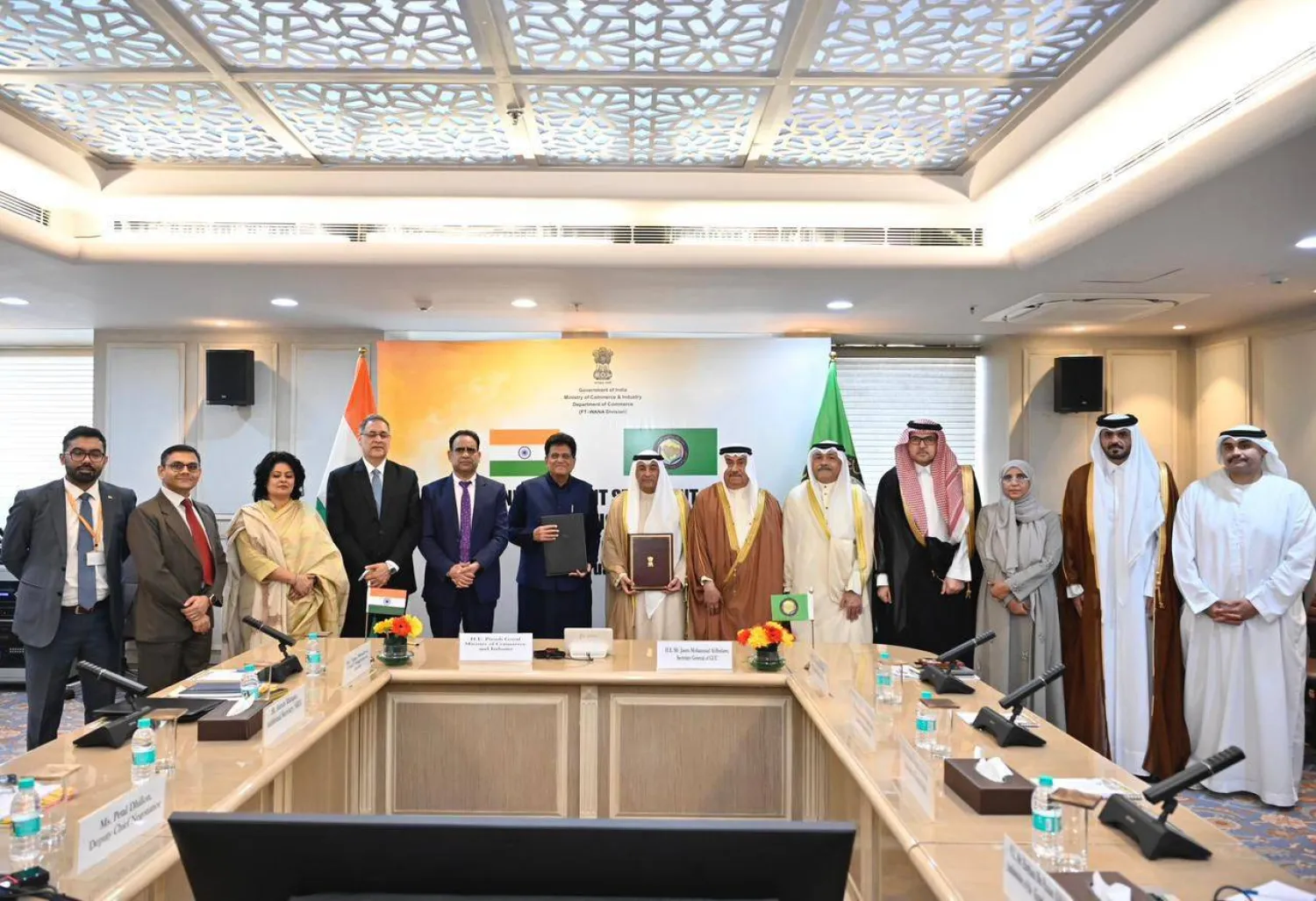
Officials pose for a photo following the signing of the agreement between the Gulf Cooperation Council and India. (Asharq Al-Awsat)
TT

GCC, India Launch Free Trade Agreement Negotiations  

Officials pose for a photo following the signing of the agreement between the Gulf Cooperation Council and India. (Asharq Al-Awsat)

The Gulf Cooperation Council (GCC) and India have formally launched negotiations for a free trade agreement (FTA), in a move officials described as a new chapter in their strategic partnership.

GCC Secretary-General Jasem Albudaiwi and India’s Minister of Commerce and Industry Piyush Goyal signed the joint statement initiating the talks during a meeting in New Delhi on Tuesday.

Albudaiwi said the launch of negotiations reflects the depth of ties between the Gulf states and India, stressing that the relationship extends beyond transient economic interests.

It is a longstanding partnership strengthened by centuries of cultural and social exchange and guided by a shared commitment to broad-based cooperation that serves mutual interests, he added.

India is one of the GCC’s most significant trading partners, Albudaiwi noted, pointing to steadily expanding trade volumes and growing integration in key sectors such as energy, food security and technology.

Deepening cooperation has become a strategic economic imperative, he remarked.
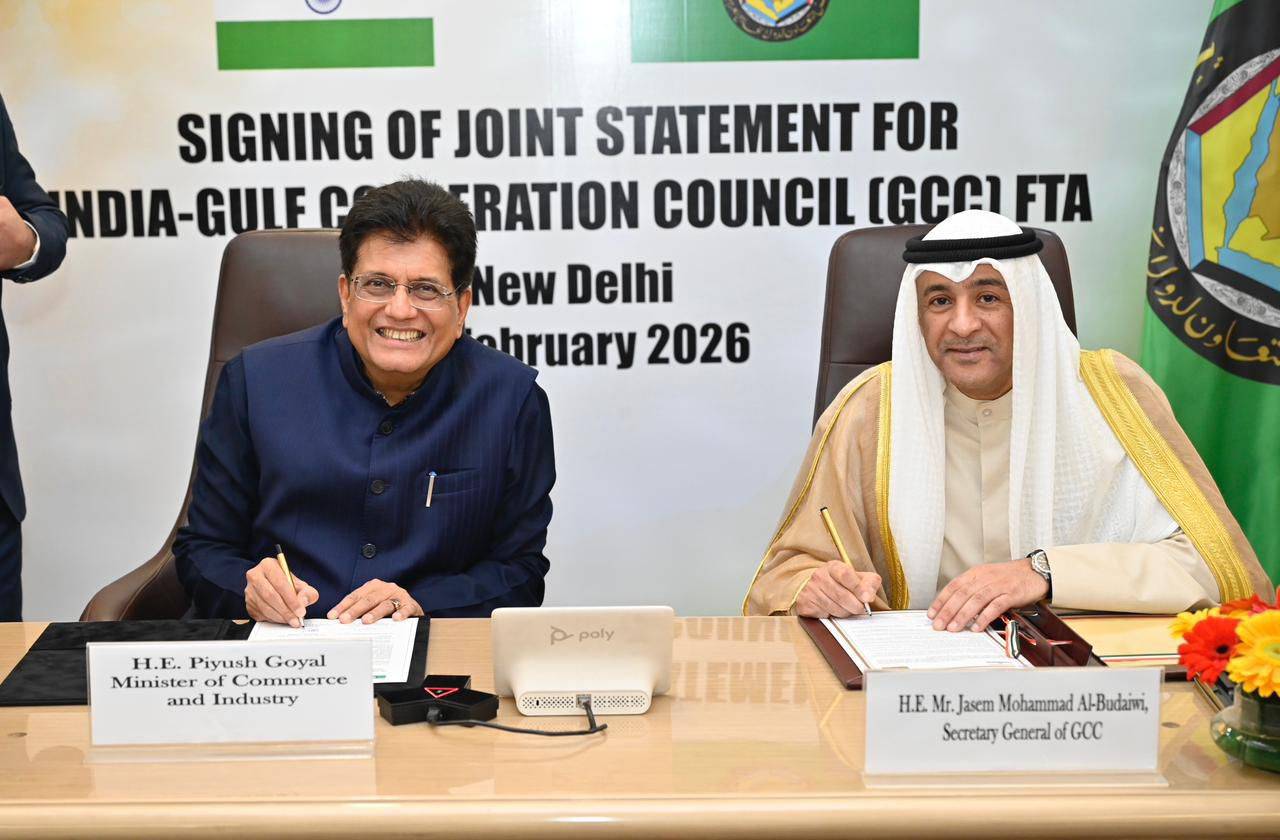
GCC Secretary-General Jasem Albudaiwi and India’s Minister of Commerce and Industry Piyush Goyal sign the agreement. (Asharq Al-Awsat)

“New Delhi is not only a vast and promising market, but also a global hub for innovation and industry,” he stated.

The terms of reference signed in February establish a comprehensive framework for the negotiations. The two sides agreed to explore cooperation across a wide range of areas, including trade in goods and services, customs procedures and digital trade.

The framework also addresses sanitary and phytosanitary standards, intellectual property rights, and support for micro, small and medium-sized enterprises, among other issues of mutual interest. Albudaiwi said the scope of the talks reflects an ambition to craft an agreement aligned with the evolving global economy.

He hoped that the negotiations would culminate in a comprehensive and forward-looking FTA that eliminates tariff and non-tariff barriers, facilitates investment flows in both directions and strengthens trade and investment liberalization between India and the GCC.

Such an agreement would create a more competitive business environment, expand private-sector opportunities, reinforce supply chains and accelerate economic growth in line with the Gulf states’ development strategies, he said.

The GCC General Secretariat is ready to host the first round of negotiations at its headquarters in Riyadh in the second half of this year, he added.



China, US Agree to $30 Billion Tariff Cut, AI Dialogue

WASHINGTON, DC - SEPTEMBER 25: US President Donald Trump (R) and President of China Xi Jinping (L) speak as they depart following a tour of the National Archives Museum on September 25, 2026 in Washington, DC. Win McNamee/Getty Images/AFP
TT

China, US Agree to $30 Billion Tariff Cut, AI Dialogue

WASHINGTON, DC - SEPTEMBER 25: US President Donald Trump (R) and President of China Xi Jinping (L) speak as they depart following a tour of the National Archives Museum on September 25, 2026 in Washington, DC. Win McNamee/Getty Images/AFP

China and the US have agreed to a $30 billion reciprocal tariff-reduction arrangement and to launch dialogue on AI, under an eight-point consensus reached during Chinese President Xi Jinping's visit to the US, China's Ministry of Foreign Affairs said.

The two sides recognized the work of their economic teams and endorsed steps including the establishment of a trade council, the tariff-reduction arrangement and an extension of outcomes from earlier talks in Kuala Lumpur, the ministry said.

The United ⁠States and China ⁠had earlier agreed to extend by two months a trade truce that was due to expire on November 10, allowing more time to work on a potentially bigger trade deal, US Treasury Secretary Scott Bessent said on Wednesday.

The leaders of ⁠the world's two largest economies ended a three-day summit that showcased personal diplomacy rather than big public breakthroughs. Xi has since landed in Beijing, Chinese state media Xinhua reported on Saturday.

On artificial intelligence, the two sides agreed to establish a dialogue to discuss the technology's risks and benefits, with the next round of discussion set for November, and to set up a communication channel for AI-related incidents, according to the ⁠ministry.

They ⁠also agreed to support each other in hosting the Asia-Pacific Economic Cooperation leaders' meeting and the Group of Twenty summit, with both leaders signaling their intention to attend the gatherings hosted by the other, Reuters reported.

On foreign policy, the leaders agreed that Iran should fulfil its commitment not to develop nuclear weapons, and that no country or entity should impose transit tolls on international waterways, the ministry said. They also recalled that China and the United States fought as allies in World War Two.


Gold Rises, but on Track for Weekly Loss as Fed Rate Hike Expectations Build

FILE PHOTO: A raw gold bar is displayed at Nigeria’s booth at the 8th China International Import Expo (CIIE) venue in Shanghai, China, November 5, 2025. REUTERS/Maxim Shemetov/File Photo
TT

Gold Rises, but on Track for Weekly Loss as Fed Rate Hike Expectations Build

FILE PHOTO: A raw gold bar is displayed at Nigeria’s booth at the 8th China International Import Expo (CIIE) venue in Shanghai, China, November 5, 2025. REUTERS/Maxim Shemetov/File Photo

Gold prices rose on Friday but was on track for a weekly loss, as rising US Treasury yields and growing expectations of Federal Reserve rate hikes weighed on the metal.

Spot gold was up 0.6% at $4,303.19 per ounce by 1210 GMT, but was down about 1.7% so far this week. US gold futures rose 1% to $4,339.

US and Iranian negotiators in New York are seeking a deal that would involve Tehran reopening the Strait of Hormuz and Washington lifting its economic blockade of Iran, sources close to the talks said.

"Gold finds support today as oil prices pull back on renewed hopes for a US-Iran deal," said Nikos Tzabouras, a senior market analyst at Jefferies-owned Tradu.com.

"That said, the precious metal is heading for weekly losses, as higher Fed rates and bond yields raise the opportunity cost of holding gold."

The Fed raised interest rates by a quarter-point last week, its first hike in three years, and flagged more hikes follow. Traders are pricing in a 71% chance of an October hike and a 95% chance of an increase in December, according to the CME FedWatch Tool.

Although gold is traditionally seen as a hedge against inflation, higher rates dampen demand as investors shift to yield-bearing assets.

Gold demand in India picked up modestly this week as lower prices drew in buyers ahead of the festive season.

Oil prices fell, and the dollar eased about 0.3%, making greenback-priced bullion more affordable for holders of other currencies.

"Lingering deficit fears could revive the debasement trend that drives investors toward hard assets like gold. Alongside persistent central bank demand, the precious metal has a credible case for a strong fourth-quarter recovery, should the macro winds begin to shift," said Tzabouras.

Spot silver gained 1.4% to $64.82 per ounce, platinum added 1.7% to $1,777.38 and palladium fell 0.4% to $1,269.77. All three metals were poised for weekly losses.


Dollar Falls as Oil Eases, Yen Rallies on Japan Remarks

US dollar banknotes (Reuters)
TT

Dollar Falls as Oil Eases, Yen Rallies on Japan Remarks

US dollar banknotes (Reuters)

The dollar fell on Friday as oil prices eased, but was poised for a second straight weekly advance on growing rate hike bets, while the yen rallied after Japan said Tokyo and Washington remain committed to the stance behind July's joint intervention.

The dollar was on track to snap a four-day streak of gains as crude prices fell more than 1%.

Global oil prices have eased but still they remain above $100 a barrel, maintaining upward pressure on inflation.

Comments from central bank officials flagging inflation concerns and support for more rate increases after last week's rate hike of 25 basis points have boosted market expectations for a more aggressive path of monetary policy and helped spark a jump in US Treasury yields.

"We've had like a pretty aggressive rally in the dollar over the last couple of days and maybe it's a little stretched, just taking a little breather. So I wouldn't really say that the dollar is really weakening materially today," said Eugene Epstein, head of trading and structured products at Moneycorp in Stamford, Connecticut.

"It's just a combination of those factors that you have not only a slight increase in odds of a second hike before year-end, but also just general bond yields going up and the market getting a bit concerned about that, so that's really what we have, what's been driving the dollar stronger overall."

DOLLAR INDEX POISED FOR BIGGEST DROP IN THREE WEEKS

The dollar index, which measures the dollar against five other currencies, fell 0.34% and was on track for its biggest daily percentage drop since September 3, to 100.95. The euro was up 0.2% at $1.1402 but on pace for a third straight weekly decline.

Expectations for a rate hike from the Fed at its October meeting stood at about 66%, according to CME FedWatch, up from about 58% a week earlier.

On the data front, new orders for US-manufactured capital goods increased more than expected in August and data for the prior month was revised sharply higher, pointing to another quarter of robust growth in business spending as part of artificial intelligence infrastructure is created.

In a separate report, the University of Michigan's Surveys of Consumers said its Consumer Sentiment Index ticked up to 48.1 from the prior reading of 47.8, above the 47.6 estimate of economists polled by Reuters.

Sterling strengthened 0.24% to $1.3247, supported by hawkish comments from Bank of England Governor Andrew Bailey. Yet it remained close to a three-month low hit on Thursday.

YEN STRENGTHENS AS JAPAN STEPS UP INTERVENTION WARNINGS

The Japanese yen strengthened 1.09%, on pace to snap a four-day streak of declines and its biggest daily gain against the dollar since September 7, to 157.13.

The currency rose after Japan's Finance Minister Satsuki Katayama said US President Donald Trump raised concern about yen weakness during a summit with Japanese Prime Minister Sanae Takaichi earlier this week.

Katayama said this reaffirmed the shared US-Japan stance behind July's joint intervention, adding she and Treasury Secretary Scott Bessent would stay in close contact as policymakers stepped up warnings over renewed yen weakness.

Still, the yen was on track for a second weekly fall, after markets judged the Bank of Japan's rate hike last week to a 31-year high and its latest guidance as insufficiently hawkish.

Elsewhere, the dollar strengthened 0.14% to 6.725 versus the offshore Chinese yuan, as a Trump-Xi summit in Washington showed no signs of breakthroughs at a closed-door meeting on thorny issues such as AI, trade, Taiwan and the Iran war.