


Ice Melt Threatens Emperor Penguins During Annual Molt, Say Researchers 

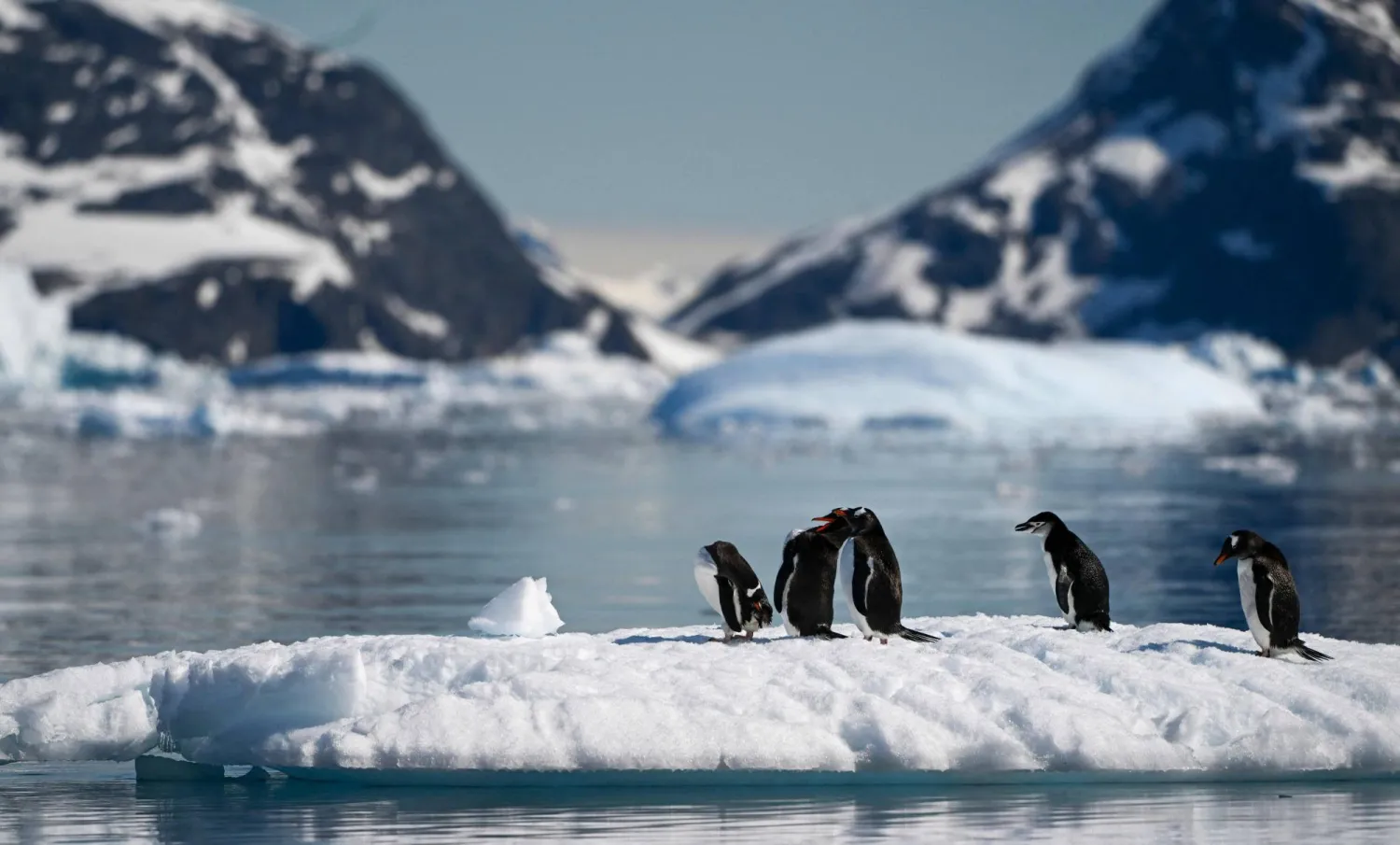
View of a chinstrap (Pygoscelis antarcticus) and gentoo (Pygoscelis papua) penguins at the Gerlache Strait, which separates the Palmer Archipelago from the Antarctic Peninsula, on January 15, 2024. (AFP)
TT

Ice Melt Threatens Emperor Penguins During Annual Molt, Say Researchers 

View of a chinstrap (Pygoscelis antarcticus) and gentoo (Pygoscelis papua) penguins at the Gerlache Strait, which separates the Palmer Archipelago from the Antarctic Peninsula, on January 15, 2024. (AFP)

Emperor penguins shed all their feathers once a year, a precarious ritual that may have become deadly as climate change pushes them into shrinking patches of Antarctic sea ice, researchers said Wednesday.

The flightless birds molt during summer, relying on stored fat to survive for several weeks until their waterproof coat grows back so they can swim and hunt in icy waters again.

Researchers from the British Antarctic Survey, analyzing seven years of satellite images, accidentally discovered several molting colonies along the extremely remote coastline of an area known as Marie Byrd Land.

As sea ice melted, the penguins were forced onto smaller spaces in increasingly large and tightly packed groups, the UK polar research organization said in a statement.

In 2025, only 25 small groups of penguins were visible in the satellite images, it said. Prior to 2022, more than 100 groups had been spotted in the same region.

"While we don't know for sure what happened to those penguins, we know they can find new suitable breeding sites after ice loss, so it's possible they have established new molting sites elsewhere," said Peter Fretwell, lead author and mapping expert at the British Antarctic Survey.

"But also it's possible that huge numbers of penguins perished after entering the Southern Ocean before they had replaced their waterproof feathers," Fretwell said.

"If this has happened, the situation for emperors as a species is even worse than we thought."

The researchers said that if emperor penguins are forced into the ocean before their feathers are replaced, they face exhaustion from increased energy use, hypothermia and increased risk from predators.

- Ice at record low -

Emperor penguin populations have shrunk by almost a quarter as global warming transforms their icy habitat, the British Antarctic Survey said in research published last year.

During the January-March Antarctic summer, emperor penguins from the Ross Sea in West Antarctica migrate as much as 1,000 kilometers (620 miles) to Marie Byrd Land to molt on stable sea ice, the researchers said Wednesday.

It is one of the few areas that historically retains its fast ice -- sea ice attached to the coast -- throughout the year.

The molting process takes about four to five weeks and the penguins cannot go in the freezing water during that time.

The extent of Antarctic Sea ice fell to record lows between 2022 and 2024, accompanied by a drastic decrease in fast ice, the British Antarctic Survey said.

In the region they observed, sea ice coverage fell from a 50-year average of 500,000 square kilometers -- roughly the size of Spain -- to 100,000 square kilometers in 2023. Only 2,000 square kilometers of fast ice were left near the coast.

During those years, the sea ice broke before the penguins had finished molting, raising fears that many may not have survived, the scientists said.

The survey's previous study found that some emperor penguin colonies lost all their chicks in recent years as the ice broke, plunging hatchlings into the sea before they were old enough to cope with the freezing ocean.

At current rates of warming, there is a 45 percent chance the species will become extinct by the turn of the century, the survey said.



Tunisia Court Blocks Closure of Factory Blamed for Pollution

File: One of previous demonstrations demanding halting all activities at the fertilizer factory - EPA
TT

Tunisia Court Blocks Closure of Factory Blamed for Pollution

File: One of previous demonstrations demanding halting all activities at the fertilizer factory - EPA

A Tunisian court on Thursday rejected demands to suspend operations at a fertilizer factory, a lawyer told AFP, after thousands of protesters blamed the plant for a rise in health problems.

The facility in the city of Gabes emits sulphur gases, nitrogen and fluorine, according to an audit last July for the African Development Bank, which reported "major non-compliance" on air and marine pollution.

Mounir Adouni, head of the Gabes bar association that launched the legal action, said Thursday's decision was an emergency ruling and a final verdict was pending.

"The court ruled that there was no sufficient proof of harm, saying allegations of pollution lacked technical and scientific evidence," Adouni said.

Locals in Gabes have for years rallied against the phosphate-processing factory, which makes fertilisers mainly for export.

The bar association lodged its complaint after thousands protested against the plant in October, blaming it for an increase in health problems in the local community.

This month local campaign group Stop Pollution said 12 of its members had been sentenced to a year in prison over a 2020 protest at the plant.

Adouni said the bar will file an appeal on Friday because no date had been set for a hearing on a final ruling.

Despite a 2017 promise to gradually shut the plant down, authorities last year said they were ramping up production.

Taking advantage of rising prices for fertilizer on global markets, Tunisia now wants its output to increase more than fourfold by 2030.

The African Development Bank last month said it would provide Tunisia with $110 million to "support the environmental upgrading and rehabilitation" of the factory.

President Kais Saied has long vowed to revive Tunisia's phosphate sector, hindered by years of underinvestment and unrest, calling it a "pillar of the national economy".


Barcelona Doubles Tourism Tax to One of Highest in Europe to Fund Housing

Tourists pose for a picture on a balcony of Casa Batllo, designed by architect Antoni Gaudi, at Passeig De Gracia in Barcelona, Spain February 24, 2026. REUTERS/Nacho Doce
TT

Barcelona Doubles Tourism Tax to One of Highest in Europe to Fund Housing

Tourists pose for a picture on a balcony of Casa Batllo, designed by architect Antoni Gaudi, at Passeig De Gracia in Barcelona, Spain February 24, 2026. REUTERS/Nacho Doce

Tourists in Barcelona could be taxed as much as 15 euros ($17.70) a night after the city raised its tourism fee to one of the highest in Europe on Wednesday as part of efforts to curb visitor numbers and help finance affordable housing.

Authorities in Catalonia have faced increasingly vocal protests from residents about excessive numbers of tourists they say are pushing up housing prices by driving a rise in short-term holiday leaves, said Reuters.

The regional parliament of Catalonia approved a law to double the tax for holiday rental guests to a maximum 12.5 euros per night, up from 6.25 euros, ahead of ‌an already ‌announced plan to ban all short-term rental accommodation by ‌2028.

Hotel ⁠guests will pay ⁠a maximum of between 10 and 15 euros per night from April, up from a current 5 euros to 7.5 euros, depending on the hotel category.

A two-night stay for a couple at one of the four-star hotels that make up nearly half of all hotels in Barcelona could now cost an extra 45.60 euros, as the local authority can charge up to 11.4 ⁠euros per night per person.

Guests at five-star hotels ‌could be charged up to 15 ‌euros a night and cruise passengers will continue to pay around 6 euros.

A quarter ‌of the revenue raised will help address the city's housing crisis, ‌according to the text of the law.

Irene Verrazzo, a 33-year-old nurse from Italy, said Barcelona was already very expensive and she doubted she'd return.

"I don’t think this added expense is fair. They already make money from tourists spending in shops, visiting ‌their monuments, etc.," she said.

The higher tax was unlikely to solve the housing crisis but the hike seemed ⁠reasonable, said 21-year-old ⁠student and local resident Ivan Liu.

Before the tax raise, Barcelona ranked 11th in holiday-rental platform Holidu's 2025 list, behind Amsterdam, where tourists paid the most in Europe at 18.45 euros per day.

Hotel owners are concerned the tax rise could drive away too many of the around 15.8 million tourists who visit Barcelona each year. The city ranks among the top four in the world for conventions, according to the local tourism board, and attendees will not be exempt from the levy.

Manel Casals, general director of Barcelona's hoteliers' group, said proposals to raise the tax gradually to monitor its effects were ignored.

"One day they will kill the goose that lays the golden eggs," he said.


Pakistani Sculptor Turns Scrap into Colossal Metal Artworks

Sculptor Ehtisham Jadoon spray paints a model of Optimus Prime, a film character from Transformers, made from scrap metal at his studio. Farooq NAEEM / AFP
TT

Pakistani Sculptor Turns Scrap into Colossal Metal Artworks

Sculptor Ehtisham Jadoon spray paints a model of Optimus Prime, a film character from Transformers, made from scrap metal at his studio. Farooq NAEEM / AFP

Sparks fly and metal groans in a cavernous workshop on the outskirts of Islamabad, where Pakistani artist Ehtisham Jadoon fuses discarded car parts into colossal pieces inspired by "Transformers" movies and dinosaurs.

The 35-year-old sculptor's studio brims with cogs, chains, hubcaps and engine parts as his hulking creations -- a lion with a mane of twisted steel, a giant Tyrannosaurus rex and a towering Optimus Prime -- take shape.

"I have always been fascinated by metal objects," Jadoon told AFP after assembling the 14-foot (4-metre) "Transformers" character, his biggest creation yet.

"When I see metals in scrap, I imagine forms in which it could be utilized."

It took Jadoon and his team months of welding and warping to fashion his Optimus Prime, with over 90 percent of its parts sourced from discarded vehicle pieces.

The arms are forged from motorbike springs and gears, its shoulders are curve from car rims, the spine is molded from a fuel tank and its knees are pieced together with chains and suspension parts.

Even its piercing eyes are crafted from vehicle bearings, completing a sculpture that is both intricate and awesome.

"Whenever I see an object, I visualize a form," Jadoon said.

"I could imagine a block transforming into a shape, so I simply solve the puzzle and bring it to life."

- 'Waste becomes valuable' -

Jadoon, a former martial artist who once worked in the steel fabrication business, has never formally studied art. He designs his gargantuan models spontaneously while working.

He told AFP he has to visit a doctor almost every week due to sparks affecting his eyes and burns on his hands and arms, yet he insists this is the only work in which he can channel the energy of his training as a fighter.

Jadoon's work primarily focuses on crafting giants, beasts and powerful forms, which he describes as a reflection of aggression.

"Setting the anatomy and proportions requires visualization from multiple angles and repeated adjustments," he said.

Every week, Jadoon tours scrapyards in Islamabad, sifting through tons of discarded metal in search of pieces that fit into his imagination and then become sculptures.

"What is waste to us became something valuable in his hands," scrapyard owner Bostan Khan told AFP.

"It's incredible to witness."