


Oil Hovers Near Seven-month Highs Ahead of US-Iran Talks

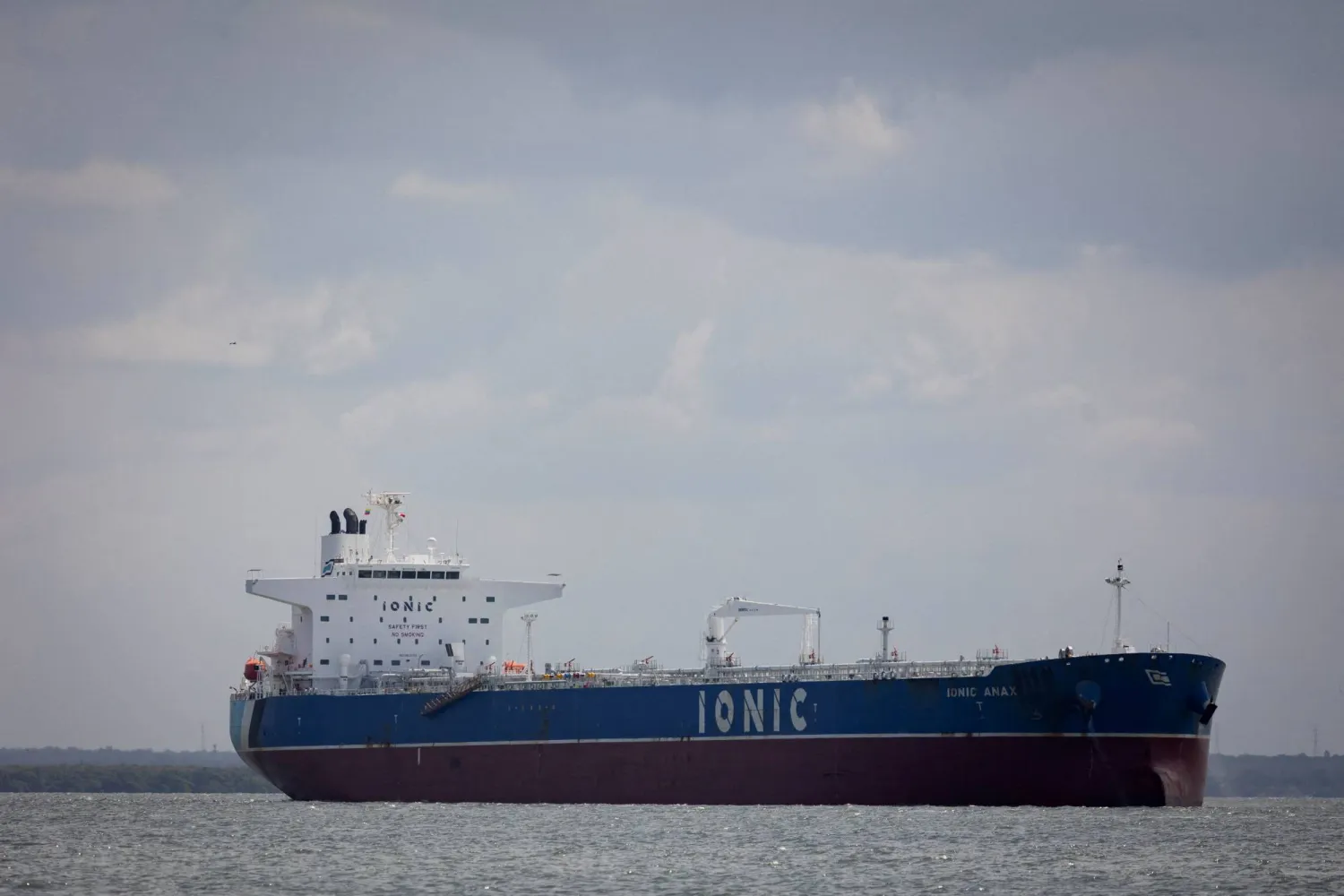
FILE PHOTO: Chevron-chartered Ionic Anax oil tanker sits anchored in Lake Maracaibo, near the Bajo Grande crude port operated by state oil company PDVSA, in Maracaibo, Venezuela, February 9, 2026. REUTERS/Marco Bello/File Photo
TT

Oil Hovers Near Seven-month Highs Ahead of US-Iran Talks

FILE PHOTO: Chevron-chartered Ionic Anax oil tanker sits anchored in Lake Maracaibo, near the Bajo Grande crude port operated by state oil company PDVSA, in Maracaibo, Venezuela, February 9, 2026. REUTERS/Marco Bello/File Photo

Oil prices edged higher on Wednesday, as investors weighed the threat of military conflict between the US and Iran that could disrupt supply and a big build in US crude inventories.

Brent futures were up 6 cents at $70.83 per barrel at 0957 GMT. WTI futures rose 4 cents to $65.67 per barrel.

Brent prices reached their highest since July 31 on Friday, while WTI hit its highest since August 4 on Monday, as the US positioned military ‌forces in ‌the Middle East to try to compel Iran to ‌negotiate ⁠an end to ⁠its nuclear and ballistic missile program.

An extended conflict could disrupt supplies from Iran, the third-biggest crude producer in the Organization of the Petroleum Exporting Countries, and other countries in the key Middle East producing region.

Supporting oil prices, US President Donald Trump briefly laid out his case for a possible attack on Iran in his State of the Union speech on Tuesday, saying he would ⁠not allow a country he described as the world's biggest ‌sponsor of terrorism to have a nuclear ‌weapon.

"This uncertainty means the market will continue to price in a large risk premium ‌and remain sensitive to any fresh developments," ING commodities strategists said on ‌Wednesday.

US envoys Steve Witkoff and Jared Kushner are due to meet an Iranian delegation for a third round of talks on Thursday in Geneva.

Iran's Foreign Minister Abbas Araqchi said on Tuesday that a deal with the US was "within reach, but ‌only if diplomacy is given priority.”

"Trump has warned that without a deal, there will be 'very bad consequences'. Whether (Iran's) concessions ⁠will meet ⁠the US's 'zero enrichment' red line remains to be seen," Tony Sycamore, IG market analyst, said in a note.

Amid the heightened tensions, Iran has accelerated talks to purchase Chinese anti-ship cruise missiles, according to Reuters sources, which could target the US naval forces that have assembled near the Iranian coast.

While geopolitical tensions have supported prices, the market is also contending with concerns of large inventory gains as global supply exceeds demand.

According to market sources, the American Petroleum Institute late on Tuesday reported a massive increase in US oil stockpiles of 11.43 million barrels in the week ended February 20.



War Weighs on Egypt’s Private Sector as PMI Hits Near Two-Year Low in March

People walk past a closed cinema as shops close early under a government-ordered curfew aimed at reducing energy costs in downtown Cairo on April 2, 2026. (AFP)
TT

War Weighs on Egypt’s Private Sector as PMI Hits Near Two-Year Low in March

People walk past a closed cinema as shops close early under a government-ordered curfew aimed at reducing energy costs in downtown Cairo on April 2, 2026. (AFP)

Egypt's non-oil private ‌sector deteriorated at its sharpest pace in almost two years in March, as the Middle East war drove up costs and dampened client demand, a closely watched business survey showed on Sunday.

The headline S&P Global Egypt Purchasing Managers' Index fell for a fourth consecutive month, dropping to 48.0 in March from 48.9 in February — its lowest reading since April 2024.

The ‌figure remained below ‌the 50.0 threshold that ‌separates growth ⁠from contraction, though ⁠it was broadly in line with the survey's long-run average of 48.2.

Output and new orders were the chief drags on the index, with both measures also hitting their lowest levels for nearly two years. Firms frequently blamed ⁠the Middle East conflict for dampening client ‌demand, partly through ‌intensifying price pressures.

In a first, business expectations for the ‌coming 12 months slipped into negative territory, with ‌companies citing uncertainty over the war as a key reason for pessimism, though the degree of gloom was described as mild.

David Owen, senior economist at ‌S&P Global Market Intelligence, nevertheless noted that "the latest figure of 48.0 still relates ⁠to ⁠annual GDP growth of around 4.3%," adding that "recent data suggests the domestic non-oil sector is on a solid underlying growth path."

Cost pressures remained a serious concern, however. Input prices surged at their joint-sharpest pace in one-and-a-half years, as firms cited fuel costs and other war-related commodity price increases, compounded by a stronger US dollar.

In response, companies raised their selling prices at the fastest rate in 10 months, though the increase remained modest overall.


Middle East War Presents ‘Serious Risk’ for Africa, Warns Report

Festus Mwirotsi, 34, scouts for pests and diseases in roses meant for export at Isinya Roses farm in Kajiado, Kenya, March 24, 2026, as Kenya's flower industry is losing up to $1.4 million a week as the Iran war cuts demand and disrupts shipping. (AP)
TT

Middle East War Presents ‘Serious Risk’ for Africa, Warns Report

Festus Mwirotsi, 34, scouts for pests and diseases in roses meant for export at Isinya Roses farm in Kajiado, Kenya, March 24, 2026, as Kenya's flower industry is losing up to $1.4 million a week as the Iran war cuts demand and disrupts shipping. (AP)

The Middle East war "presents a serious risk to Africa", the African Union and the African Development Bank (AfDB) said in a report seen by AFP Saturday.

The conflict threatens to increase the cost of living and curtail growth on the continent, the report warned.

The Middle East accounts for 15.8 percent of Africa's imports and 10.9 percent of its exports, the report noted.

"The conflict, which already has triggered a trade shock, could quickly turn into a cost-of-living crisis across Africa through higher fuel and food prices, rising shipping and insurance costs, exchange rate pressures, and tighter fiscal conditions," it added.

The growth rate of most African countries continues to be slower than before the Covid pandemic, it noted.

"A loss in output growth of 0.2 percentage points on Africa's GDP is projected for 2026 if it (the conflict) exceeds six months," it said.

"The longer the conflict lasts and the more severe the disruption to shipping routes and energy and fertilizer supplies, the greater the risk of a significant growth slowdown across the continent."

Reduced deliveries of liquefied natural gas (LNG) from the Gulf will impact fertilizer production, limiting its availability during the crucial planting period up to May, it added.

- Currencies hit -

The report was compiled by the UN Development Program (UNDP) and the United Nations Economic Commission for Africa (UNECA).

According to recent data from the AfDB, the currencies of 29 African countries have already depreciated, increasing the cost of servicing external debt, making imports more expensive and reducing foreign exchange reserves,

Some countries could see some short-term gains, such as Nigeria for its oil exports or Mozambique for its LNG.

The rerouting of ships around Cape of Good Hope could benefit ports in Mozambique, South Africa, Namibia and Mauritius.

Kenya is establishing itself as a logistics hub in East Africa, while Ethiopian Airlines, the leading carrier in Africa, is serving as an "emergency air bridge" between the continent, Asia, and Europe, the report noted.

But these gains are likely to be uneven and will not offset the consequences for inflation, budgets, and food security in Africa, they warned.

Above all, the current crisis could hit the costs of humanitarian aid and divert donor funds towards other priorities.


Taiwan Says It Has Assurances over LNG Supplies from 'Major' Country

The Taipei 101 skyscraper is seen lit up before the Earth Hour in Taipei, Taiwan, Saturday, March 28, 2026. (AP Photo/ Chiang Ying-ying)
TT

Taiwan Says It Has Assurances over LNG Supplies from 'Major' Country

The Taipei 101 skyscraper is seen lit up before the Earth Hour in Taipei, Taiwan, Saturday, March 28, 2026. (AP Photo/ Chiang Ying-ying)

Taiwan has received ‌supply assurances from the energy minister of a "major" liquefied natural gas-producing country, the island's economy minister said on Saturday, speaking about the Iran war's impact on Middle East energy imports.

Taiwan, a major semiconductor producer, had relied on Qatar for around a third of its LNG before the conflict, and has said it has secured alternate supplies for the months ahead from countries including Australia and the United States, said Reuters.

Speaking to ‌reporters in Taipei, ‌Economy Minister Kung Ming-hsin said that ‌because ⁠Taiwan has good ⁠relationships with its crude oil and natural gas suppliers, neither adjusting shipment origins nor purchasing additional spot cargoes would be a problem.

Kung said that about two weeks ago the energy minister of a certain "major energy-producing country" proactively contacted him.

The person "explained to us that they ⁠would fully support our natural gas needs. ‌If we have any ‌demand, we can let them know," he added.

"Another country even ‌said that some countries have released strategic petroleum ‌reserves, and they could also help coordinate matters if Taiwan needs assistance," Kung said.

"This shows that Taiwan has in fact earned considerable goodwill internationally through the long-term trust ‌it has built over the years," he said.

He declined to name the countries involved.

Angela ⁠Lin, ⁠spokesperson for state-owned refiner CPC, said at the same news conference that crude oil inventories were being maintained at pre-conflict levels and overall petrochemical feedstock supplies have remained stable.

CPC Chairman Fang Jeng-zen said that to reduce dependence on the Middle East, a new contract with the US will see 1.2 million metric tons of LNG supplied annually, with even more to come in the future, including eventually from Alaska.

However, Taiwan is not considering importing crude or LNG from Russia, he added.