IMF Unlocks Around $2.3 Billion for Egypt

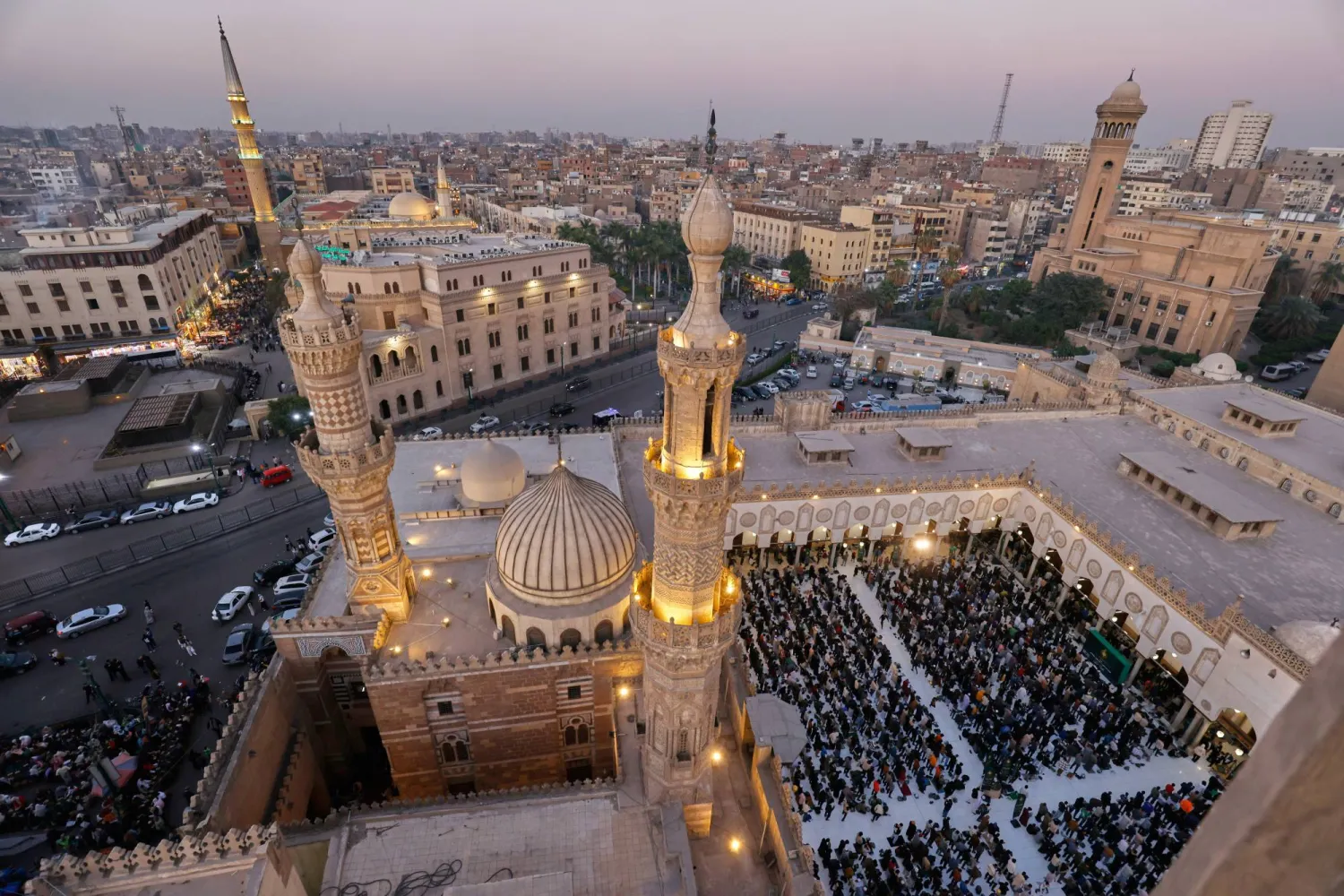
Thousands of Muslim students break their fast during the Muslim holy fasting month of Ramadan, at a free meal distributing point in Al-Azhar mosque in Cairo, Egypt, Wednesday, Feb. 25, 2026. (AP Photo/Ahmed Yosri )
TT

IMF Unlocks Around $2.3 Billion for Egypt

Thousands of Muslim students break their fast during the Muslim holy fasting month of Ramadan, at a free meal distributing point in Al-Azhar mosque in Cairo, Egypt, Wednesday, Feb. 25, 2026. (AP Photo/Ahmed Yosri )

The International Monetary Fund (IMF) has unlocked around $2.3 billion for Egypt after its latest program reviews, it said on Wednesday.

Egypt secured an expanded $8 billion package over nearly four years from the IMF in March 2024, contingent on a series of economic reforms.

In March last year, the global lender approved a new loan worth $1.3 billion for Egypt.

After completing the fifth and sixth reviews of the Extended Fund Facility, the IMF said on Wednesday around $2 billion will be unlocked for Egypt.

It will be able to draw an extra $273 million under the Resilience and Sustainability Facility (RSF) after the first review was completed, the IMF said in a statement.

"Egypt's macroeconomic situation has improved amid sustained stabilization efforts," it said. "A broad-based economic recovery has lifted real GDP growth to 4.4 percent in FY2024/25 while inflation declined markedly to 11.9 percent in January 2026, supported by tight monetary and fiscal policies."

"The current account deficit narrowed further to 4.2 percent of GDP, reflecting strong remittances and tourism receipts, while market confidence continued to improve, as evidenced by successful external issuances, foreign direct investment inflows, and record nonresident inflows into domestic debt markets."

"Tight monetary and fiscal policies together with exchange rate flexibility have helped restore macroeconomic stability, reduce inflation, and strengthen the external position."

But the IMF warned that structural reforms under the program have been "uneven.”

"Efforts to reduce the state's footprint, particularly progress on the divestment agenda, have been slower than envisaged, while high public debt and elevated gross financing needs continue to constrain fiscal space and weigh on medium-term growth prospects," the IMF added.


Saudi Privatization Strategy Lifts Logistics Development

Jeddah Islamic Port (SPA)
TT

Saudi Privatization Strategy Lifts Logistics Development

Jeddah Islamic Port (SPA)

The launch of the National Privatization Strategy at the end of last month marked a decisive shift toward a sustainable, private sector-led model across Saudi Arabia’s economy, positioning it as a catalyst for advancing the Kingdom’s transport and logistics system and reinforcing the private sector’s role as a central development partner.

More than an administrative step, the strategy acts as a legislative engine designed to boost international competitiveness and translate the National Transport and Logistics Strategy from long-term ambition into measurable economic impact.

At its core is a clear objective: entrench Saudi Arabia’s position as a global logistics hub linking three continents under Vision 2030.

The momentum began in 2018 with the launch of the Privatization Program, one of Vision 2030’s flagship initiatives aimed at accelerating implementation and strengthening coordination across government entities.

By the end of 2025, the program had completed its plan, becoming the second Vision 2030 program to achieve its targets. It identified assets and resources for privatization across key sectors, including water, transport, health and education, improving service quality while creating jobs and attracting high-value investment.

The program laid firm institutional foundations, notably through the establishment of the National Center for Privatization and the approval of the Privatization Law. Together, they streamlined procedures, cataloged assets and services, and prepared sectors for public-private partnerships.

With the program formally concluded, the National Privatization Strategy and the Center now spearhead the next phase, expanding delivery and unlocking further opportunities.

Partnership at the core

Saudi Arabia’s model rests on Public-Private Partnerships (PPPs), aimed at improving economic performance while increasing private-sector participation in managing and owning public facilities and services.

The target is clear: lift the logistics sector’s contribution to GDP to 10% by 2030 by opening facilities to domestic and foreign investors, improving service quality and sharpening the Kingdom’s competitive edge in global trade.

Investment has already followed. Minister of Transport and Logistics Services Saleh Al-Jasser said private investments in the sector have surpassed 280 billion riyals ($74.7 billion), raising transport and logistics’ share of GDP to 6.2%.

In a further step, Airports Holding Company, in cooperation with the National Center for Privatization, announced a PPP project to develop Prince Naif bin Abdulaziz International Airport in Qassim.

Revitalizing logistics

Nashmi Al-Harbi, a logistics and supply chain specialist, said privatization policies have become the primary driver of the transformation of Saudi logistics into a magnet for global investment.

More than 18 billion riyals ($4.8 billion) have been injected into ports and logistics zones, while customs clearance times have been cut to under 24 hours through the FASAH platform. Port capacity has climbed to 40 million containers.

The results have been visible internationally. Saudi Arabia advanced 17 places in the World Bank’s Logistics Performance Index, strengthening confidence among major global shipping lines.

Al-Jasser told the Public Investment Fund and Private Sector Forum that 80% of targeted investments in transport and logistics will come from the private sector. Recently signed maritime and port contracts with private operators exceed 18 billion riyals, with most port investments now executed through private participation.

Al-Harbi said privatization is not simply a supportive policy but a core guarantee of Saudi Arabia’s transformation into a global logistics hub. It attracts financing and international operational expertise while accelerating adoption of technologies such as artificial intelligence and the Internet of Things, driving higher service standards and lower costs.

He said privatizing ports and airports has addressed longstanding bottlenecks, eliminating customs clearance delays that once stretched to nine days. Port operational efficiency has increased by 71%, alongside stronger integration between rail and road networks to ensure smoother cargo flows.

Boosting competitiveness

Logistics expert engineer Hassan Al-Halil said privatization has reshaped the sector, making it more attractive to leading global shipping companies through structural reforms.

Transferring port and airport management to private operators reduced shipping times and operating costs, enhancing market competitiveness. Significant investments modernized ports, warehouses and smart transport systems, offering advanced, user-friendly facilities.

Private sector participation also reduced operational bottlenecks, making shipping, unloading and storage faster and more organized. The introduction of private operators in customs clearance cut bureaucracy, accelerated procedures and increased transparency — key factors in attracting international players. Clear legal frameworks have reinforced investor confidence in major logistics projects.

Linking three continents

Al-Halil described privatization as a foundational pillar for connecting Asia, Europe and Africa, though part of a broader ecosystem. Sustained investment in technological infrastructure, airports and smart warehouses, combined with integrated land, sea and air networks, remains essential.

He stressed the need to align flexible regulation with specialized human capital. In this framework, privatization provides the necessary base, working alongside technology and policy to support the Kingdom’s global logistics ambitions.

Innovation and growth

Competition driven by privatization has spurred innovation, including digital tracking and integrated transport and storage services, strengthening international appeal. The mixed public-private model in ports and airports has created a more efficient, flexible and investment-ready environment that supports economic growth.

The transformation extends beyond seaports. Air cargo volumes have risen 34% annually to 1.2 million tons. Saudi Arabia ranked fourth among emerging markets in the 2025 Agility Logistics Index, reinforcing its ambition to enter the global top 10.

Domestically, 30 new logistics centers have been added, supporting an ecosystem that now employs more than 651,000 people.

Structural enablers

These gains reflect institutional efforts led by the National Industrial Development and Logistics Program (NIDLP), launched in 2019 to strengthen infrastructure and expand capacity. The program serves as a structural enabler linking domestic and regional networks, facilitating cross-border goods movement and ensuring competitively priced services for investors and consumers.

By engaging the private sector, NIDLP aims to reduce shipping costs through network integration, streamline customs procedures and ease cross-border trade while maintaining competitive domestic distribution services.

To sustain progress and address private-sector challenges, the Logistics Partnership Council was established as a bridge between investors and policymakers, turning on-the-ground feedback into policies that enhance competitiveness.

Saudi Arabia is moving beyond its traditional role as a facility operator to redefine its place in global logistics. Privatization and strategic partnerships are not only improving efficiency but positioning the Kingdom as a critical link in future supply chains, advancing Vision 2030’s goal of building a diversified and sustainable economy.


Aramco’s Gas Strategy Builds Momentum with Major Progress Towards Growth Target

This picture shows Aramco tower at the King Abdullah Financial District (KAFD) in Riyadh on April 16, 2023. (Photo by Fayez Nureldine / AFP)
TT

Aramco’s Gas Strategy Builds Momentum with Major Progress Towards Growth Target

This picture shows Aramco tower at the King Abdullah Financial District (KAFD) in Riyadh on April 16, 2023. (Photo by Fayez Nureldine / AFP)

Aramco announced Thursday major progress in its ambitious gas expansion strategy, with the start of production at Jafurah, the Middle East’s largest unconventional gas field, and the commencement of operations at Tanajib Gas Plant, one of the largest gas plants in the world.

This will contribute to Aramco’s plan to increase sales gas production capacity by approximately 80% by 2030, over 2021 production levels, reaching approximately 6 million barrels of oil equivalent per day of total gas and associated liquids production. This is expected to generate incremental operating cash flows of $12 billion to $15 billion in 2030, subject to future sales gas demand and liquids prices, SPA reported.

Aramco President and CEO Amin H. Nasser said: “Jafurah and Tanajib significantly strengthen Aramco’s gas portfolio and expand our capacity at scale. These projects are a major step forward for our company and for the Kingdom’s energy future.

Gas is central to our long-term growth strategy. It is expected to generate substantial earnings, meet rising domestic demand, support development across key sectors, and deliver significant volumes of high-value liquids. Together, these investments make Aramco stronger, more diversified, and better positioned to deliver sustained value to our shareholders. We value the continued leadership and support of the Ministry of Energy in advancing these strategic projects.”

Gas from Jafurah is expected to support the Kingdom’s broader growth ambitions across key sectors such as energy, artificial intelligence, and major industries, including petrochemicals, potentially providing a significant boost to the economy and solidifying Saudi Arabia’s position as one of the world’s top 10 gas producers.

Aramco began producing the first unconventional shale gas at Jafurah in December 2025, with technology playing a key role in unlocking Jafurah’s potential and establishing it as a global benchmark for unconventional gas development. Since its inception, the project has leveraged technology to reduce drilling and stimulation costs and boost well productivity, contributing to its strong economic outlook.

Covering an area of 17,000 square kilometers, Jafurah is estimated to contain 229 trillion standard cubic feet of raw gas and 75 billion stock tank barrels of condensate. By 2030, it aims to deliver 2 billion standard cubic feet of sales gas per day, 420 million standard cubic feet of ethane per day, and approximately 630,000 barrels of high-value liquids per day.

Tanajib Gas Plant is a key component of Aramco’s strategy to increase gas processing capabilities and diversify its energy product portfolio, thereby supporting long-term economic growth. Operations commenced in December 2025, and it is expected to reach a raw gas processing capacity of 2.6 billion standard cubic feet per day in 2026.

The commencement of operations at Tanajib coincided with the start of production at Aramco’s Marjan crude oil increment. The plant, which features digital integration, enhanced operational efficiency, complex project delivery, and maximum resource utilization, processes associated raw gas from crude oil production at the offshore Marjan and Zuluf oil fields.

Aramco’s gas expansion is expected to create thousands of direct and indirect job opportunities, potentially generating substantial added value and reinforcing Aramco’s position as a reliable energy supplier.

In addition to helping meet rising demand for natural gas and enhancing supplies to national industries, Aramco’s gas growth strategy supports efforts to achieve a more optimal energy mix for domestic electricity production. It also advances the Kingdom’s liquid fuel displacement program, complements the Kingdom’s 2060 net-zero ambition, reinforces energy security, and contributes to the development of a diverse national economy.


Oil Prices Slip about 1.5% on High US Crude Stocks, US-Iran Positivity

A worker examines pipe valves connected to oil tanks at the Turkish Ceyhan port on the Mediterranean Sea (Reuters)
TT

Oil Prices Slip about 1.5% on High US Crude Stocks, US-Iran Positivity

A worker examines pipe valves connected to oil tanks at the Turkish Ceyhan port on the Mediterranean Sea (Reuters)

Oil prices fell on Thursday after the biggest jump in US crude inventories in three years, with signs of weakness in the physical oil market also weighing on prices, while traders assessed US-Iran talks.

Brent crude futures were down 95 cents, or 1.3%, at $69.90 a barrel by 1351 GMT. WTI futures lost $1.06, or 1.6%, to $64.36.

US crude inventories rose by 16 million barrels last week, Energy Information Administration data showed on Wednesday.

Weakness in the North Sea physical oil market is also weighing on oil prices, said UBS analyst Giovanni Staunovo, adding that markets would focus on the outcome of Thursday's third round of US-Iran talks.

Mediator Oman voiced hope that Iran and the United States would make more progress at talks on their nuclear dispute on Thursday after exchanging "positive and creative ideas" while a senior Iranian official said the talks were "serious", Reuters reported.

The North Sea physical market underpins the Brent futures contract, prices of which have advanced by about 15% so far this year as potential military conflict between the US and Iran has outweighed expectations of oversupply. OPEC+, which groups members of the Organization of the Petroleum Exporting Countries and allies including Russia, is likely to consider raising oil output by 137,000 barrels per day in April, three sources with knowledge of OPEC+ thinking said as the group prepares for peak summer demand while prices remain strong.

Brent rose on Monday to its highest since July 31 as Washington positioned military forces in the Middle East to press Iran to negotiate an end to its nuclear and ballistic missile programme.

An extended conflict could disrupt supplies from Iran, OPEC's third-biggest crude producer, and other Middle East exporters.

"A constructive resolution would likely prompt the market to gradually unwind as much as a $10 per barrel risk premium," ING analysts said in a note.