Gold Ticks Up on Safe‑haven Bids; Markets Eye US-Iran Talks

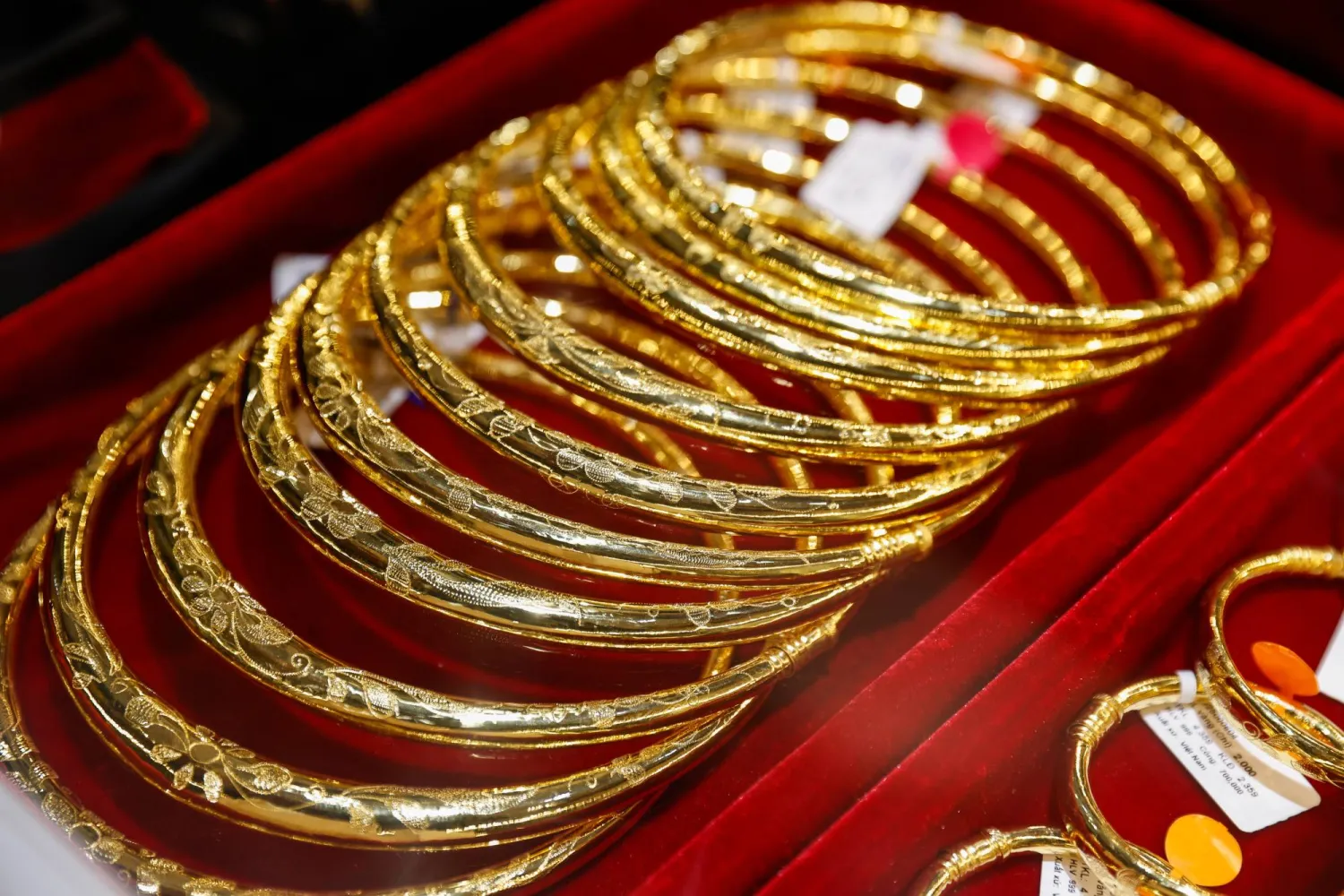
Gold items are displayed at a jewelry shop in Hanoi, Vietnam, 26 February 2026.  EPA/LUONG THAI LINH
Gold items are displayed at a jewelry shop in Hanoi, Vietnam, 26 February 2026. EPA/LUONG THAI LINH
TT

Gold Ticks Up on Safe‑haven Bids; Markets Eye US-Iran Talks

Gold items are displayed at a jewelry shop in Hanoi, Vietnam, 26 February 2026.  EPA/LUONG THAI LINH
Gold items are displayed at a jewelry shop in Hanoi, Vietnam, 26 February 2026. EPA/LUONG THAI LINH

Gold prices edged up on Thursday as uncertainty over US tariff policy boosted the metal's safe-haven appeal, while investors awaited further details on US-Iran talks later in the day.

Spot gold was up 0.4% at $5,190.01 per ounce, as of 0816 GMT. Bullion had hit a more-than-three-week high on Tuesday.

US gold ‌futures for April ‌delivery were down 0.4% at $5,206.80, said Reuters.

The US dollar ‌eased, ⁠making dollar-denominated commodities more ⁠affordable for holders of other currencies.

"Iran-US persisting tensions and the uncertainty surrounding the global economy with (President Donald) Trump's tariffs are a bullish catalyst," said Carlo Alberto De Casa, external analyst at banking group Swissquote.

US envoy Steve Witkoff and Trump's son-in-law Jared Kushner are due to meet an Iranian delegation for ⁠a third round of nuclear talks later in the ‌day in Geneva.

Trump briefly ‌laid out his case for a possible attack on Iran in his ‌State of the Union speech on Tuesday, saying ‌he would not allow a country he described as the world's biggest sponsor of terrorism to have a nuclear weapon.

Non-yielding gold is seen as a safe store of value during times of geopolitical and ‌economic uncertainty.

The US tariff rate for some countries will rise to 15% or higher from ⁠the newly ⁠imposed 10%, US Trade Representative Jamieson Greer said on Wednesday, without naming any specific trading partners or giving further details.

Gold prices scaled a record high of $5,594.82 on January 29 and were up 20% so far this year.

"The global gold rush does not seem to be over... Overall the sentiment remains positive with strong buys coming from Asia and from Central Banks," De Casa said.

On the data front, investors await the weekly US jobless claims data, due later in the day.

Spot silver fell 1.4% to $88.18 per ounce. Spot platinum added 0.9% to $2,308.11 per ounce, while palladium rose 0.3% to $1,800.14.


Egypt Says Close to Issuing $500 Million Japan Samurai Bond

A minibus moves along a main road underneath new Cairo Monorail track as a train moves above in the Fifth Settlement, a neighborhood of the New Cairo suburb of Cairo, on May 22, 2026. (Photo by Khaled DESOUKI / AFP)
TT

Egypt Says Close to Issuing $500 Million Japan Samurai Bond

A minibus moves along a main road underneath new Cairo Monorail track as a train moves above in the Fifth Settlement, a neighborhood of the New Cairo suburb of Cairo, on May 22, 2026. (Photo by Khaled DESOUKI / AFP)

Egypt is finalizing plans for its first yen-denominated bond sale in three years, Foreign Minister Badr Abdelatty told Reuters on a trip to Japan on Thursday.

The African Development Bank said in December it would partially guarantee Cairo's planned $500 million-equivalent Samurai bonds on the Japanese markets this year.

"We are completing the final ⁠steps," Abdelatty said ⁠on the sidelines of an event in Tokyo, adding that he had been promoting the sale and other investment opportunities while in Japan.

"We had extensive discussions ⁠with our Japanese friends on monetary, fiscal, financial support, especially with regard to budget support and samurai bonds as well."

Egypt's economy has been boosted in recent years by major real estate investments and an $8 billion IMF loan, though the Iran war is piling pressure ⁠on ⁠its finances.

The bond sale would be Egypt's third in the currency, following issuances in 2022 and 2023.

"It will be very important, despite the fact that we've been hit hard with implications of the (Iran) war," Abdelatty said.


Oil Falls as Lebanon and Israel Agree on a Ceasefire

FILE PHOTO: A drone view shows an offshore oil platform in Guanabara Bay in Niteroi, Rio de Janeiro state, Brazil, March 18, 2026.  REUTERS/Pilar Olivares/File Photo
FILE PHOTO: A drone view shows an offshore oil platform in Guanabara Bay in Niteroi, Rio de Janeiro state, Brazil, March 18, 2026. REUTERS/Pilar Olivares/File Photo
TT

Oil Falls as Lebanon and Israel Agree on a Ceasefire

FILE PHOTO: A drone view shows an offshore oil platform in Guanabara Bay in Niteroi, Rio de Janeiro state, Brazil, March 18, 2026.  REUTERS/Pilar Olivares/File Photo
FILE PHOTO: A drone view shows an offshore oil platform in Guanabara Bay in Niteroi, Rio de Janeiro state, Brazil, March 18, 2026. REUTERS/Pilar Olivares/File Photo

Oil prices fell on Thursday as a ceasefire deal between Israel and Lebanon boosted hopes for a broader agreement to end the US-Israeli war with Iran that could lead to a reopening of the Strait of Hormuz.

Brent futures were down 87 cents, or 0.89%, at $96.92 a barrel by 0458 GMT, while US West Texas Intermediate crude fell 78 cents, or 0.81%, to $95.24, paring gains from earlier in the week, said Reuters.

Both Brent and WTI rose about 2% on Wednesday after renewed Middle East hostilities including Iranian attacks on Kuwait ‌and US military strikes ‌near the Strait of Hormuz.

Israel and Lebanon ‌said ⁠late on Wednesday ⁠they had agreed to implement a ceasefire, raising hopes for a deal between Washington and Tehran, which has conditioned any agreement in part on an end to fighting between Israel and Lebanon.

US President Donald Trump suggested on Wednesday that there could be progress in negotiations with Iran as soon as this weekend.

Iranian Foreign Minister Abbas Araghchi on Wednesday said Tehran's ⁠contacts with Washington have not been cut ‌off, but no progress has been made ‌in the negotiations, adding both sides were studying the texts that were exchanged.

In ‌the US, the Republican-led House approved a resolution on Wednesday to ‌block Trump from continuing the war against Iran. To take effect, the resolution would need Senate approval and two-thirds majorities in both chambers to override an almost certain Trump veto.

Meanwhile, US crude stockpiles fell by 8 million barrels to ‌433.7 million barrels in the week ended May 29, the Energy Information Administration said on Wednesday. ⁠That was a ⁠much bigger drop than the 4-million-barrel draw analysts had expected in a Reuters poll.

The International Energy Agency warned on Tuesday that global oil inventories could hit critical levels ahead of peak summer demand if stock draws continue at their current pace, despite Chinese crude imports falling by 6 million barrels a day in May compared to March.

“Inventories have provided a cushion for the oil market. However, even if we see an imminent restart of oil flows through the Strait of Hormuz, the recovery will be slow and gradual,” a note from ING said.

“This suggests inventories are likely to continue to tighten into the third quarter, leaving upside risk to prices.”


IMF Praises Saudi Economy’s Resilience

The Saudi capital, Riyadh (Reuters)
TT

IMF Praises Saudi Economy’s Resilience

The Saudi capital, Riyadh (Reuters)

The International Monetary Fund (IMF) affirmed that the Saudi economy has demonstrated high resilience in the face of regional geopolitical tensions that have obstructed navigation in the Strait of Hormuz.

The Fund praised the Kingdom's ability to contain the fallout from the navigation disruption through a swift logistical response, which involved redirecting oil shipments towards the East-West pipeline and Red Sea ports, leveraging the legacy of its Vision 2030 structural reforms.

“The Saudi economy is demonstrating agility and resilience, supported by robust and diversified infrastructure and the authorities’ concerted efforts to redirect shipments and ease logistical bottlenecks,” mission head Azim Sadikov said on Wednesday in the IMF's latest Article IV mission report following a visit to the Kingdom from April 28 to May 13.

“A prompt rerouting of oil through the East-West pipeline and Red Sea ports, combined with Aramco’s overseas inventories, has helped limit the drop in oil deliveries," it said.

"Saudi Arabia's strong fundamentals—low government debt, ample reserves, and a large sovereign wealth fund—provide important buffers,” the report added.

“Assuming maritime shipments through the Strait of Hormuz normalize in the coming months, a recovery could take hold, with growth this year notably lower but holding up at about 2 percent. Non-oil activity would be supported by domestic demand, underpinned by stable public employment, government spending, and the steady execution of private and public capital projects. Average inflation is projected to increase to about 2.3 percent as higher shipping and insurance costs add upward pressure on prices. Higher oil prices are expected to offset volume losses, generating a windfall that would reduce the current account and fiscal deficits in 2026.”

In its April 2026 World Economic Outlook, the IMF projected Saudi Arabia’s real GDP growth at 3.1% for 2026, 1.4 percentage points lower than a January estimate. It had said that the Kingdom was expected to be less severely affected by the war.

In the Outlook, the IMF also upgraded Saudi Arabia's 2027 GDP growth forecast to 4.5%, a 0.9% increase from previous projections. This upward revision reflected anticipated normalizations in energy output and logistics.

In Wednesday’s report, the IMF said given the Saudi economy’s resilience, “the mission considers that a modest reduction in the non-oil primary deficit in 2026 remains appropriate, with spending reprioritization as the first line of action to accommodate any fiscal response to the conflict.”

The report lauded Saudi Arabia's strong fundamentals—low government debt, ample reserves, and a large sovereign wealth fund— that provide important buffers.

It said that should the shock prove more prolonged, Saudi Arabia has the space to loosen the fiscal stance to cushion the economy, with support to affected businesses and households that should be temporary, targeted, and transparent.

As the economy normalizes, an ambitious medium-term fiscal consolidation anchored on non-oil revenue mobilization and spending rationalization is needed, it said.

On the banking sector, the IMF said: “The peg to the US dollar provides a credible monetary policy anchor and helps underpin financial stability, particularly in the current environment of heightened uncertainty.”

“The banking sector is well-positioned to weather the shock, supported by strong capital and liquidity buffers,” it added.

The mission welcomed the efforts of the Saudi Central Bank (SAMA) to step up the monitoring of liquidity, credit conditions, and asset quality. It also supported “SAMA's decision to proceed with the implementation of the 100 basis points countercyclical capital buffer, its proactive approach to containing risks from FX borrowing, and continued progress in strengthening its resolution and emergency liquidity assistance frameworks.”

The report added: “Ten years since its launch, Vision 2030 reforms have helped strengthen institutions and improve policymaking, boosting economic performance and reducing dependence on oil.”

“Sustaining the reform momentum to remove remaining impediments to diversification and to expand the role of the private sector will be key to maintaining strong growth prospects for the medium term,” it said.

In this regard, the IMF lauded PIF's recalibrated 2026–30 strategy, with its shift toward more selective capital allocation and greater private-sector crowding-in.

The report called for “improving the business environment, deepening capital markets, supporting small and medium enterprises, aligning education with labor market needs, strengthening governance, and scaling AI adoption while mitigating associated risks.”