

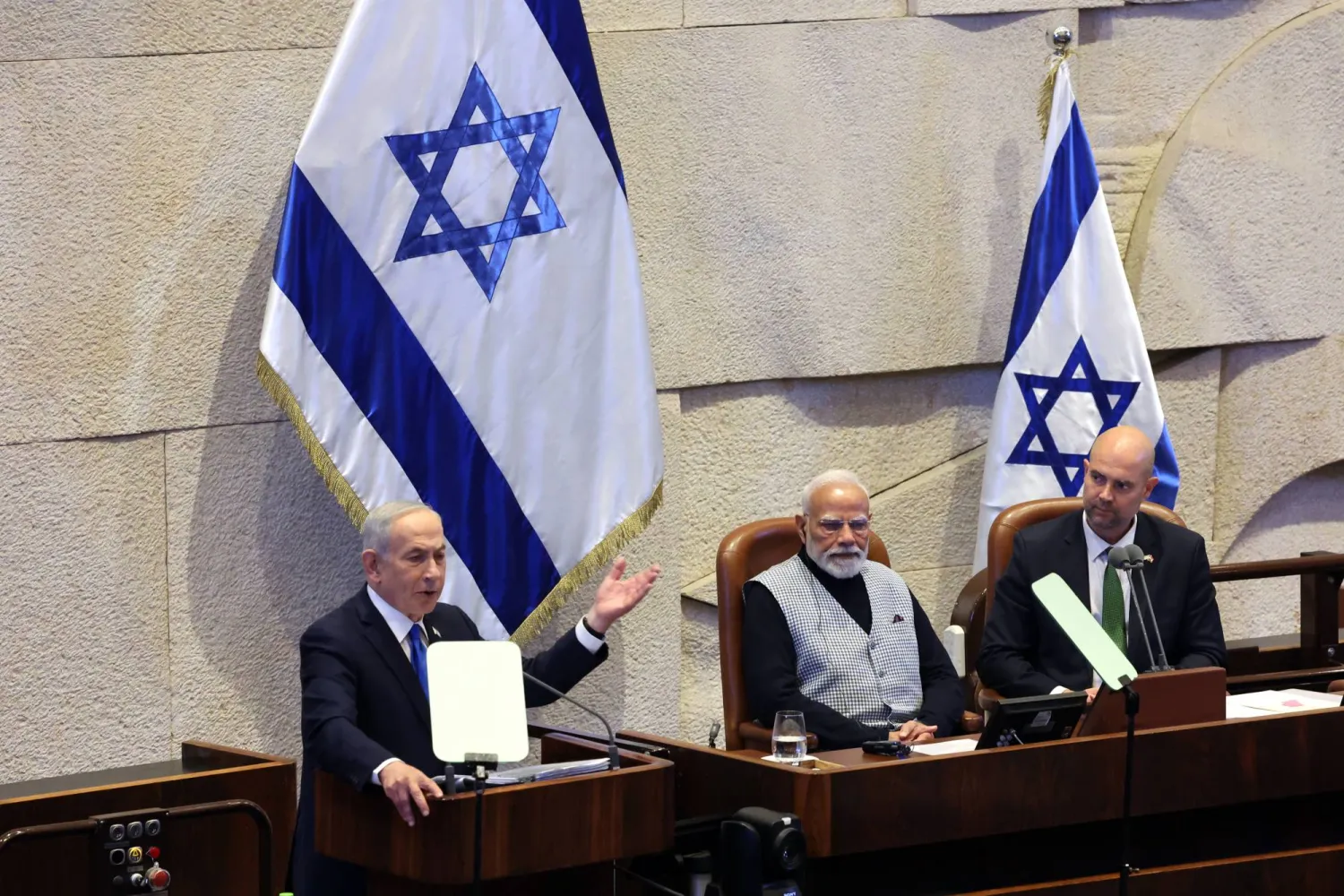

Modi Breaks Netanyahu’s Isolation with 16 Cooperation Agreements

The Indian Prime Minister listens to the Israeli Prime Minister during an exceptional session of the Knesset on Wednesday (EPA)
TT

Modi Breaks Netanyahu’s Isolation with 16 Cooperation Agreements

The Indian Prime Minister listens to the Israeli Prime Minister during an exceptional session of the Knesset on Wednesday (EPA)

In a move seen as breaking Israel’s relative international isolation amid its ongoing war in Gaza, Indian Prime Minister Narendra Modi signed 16 agreements with Israel during a two-day visit to the country.

Modi arrived in Israel on Wednesday for talks aimed at strengthening ties in trade and defense. The visit was marked by an unusually warm reception. Israeli Prime Minister Benjamin Netanyahu personally welcomed Modi at the airport and later accompanied him to address the Knesset, Israel’s parliament, where lawmakers applauded and cheered.

Netanyahu hailed Modi as “a great global leader and a great friend; more than that, a great brother.”

He added: “They say India has achieved tremendous accomplishments. That is not accurate. It should be said that thanks to your leadership, your wisdom, and your determination, India has achieved its successes.”

The Israeli premier also thanked Modi for India’s assistance during the recent Gaza war, noting that New Delhi had supplied Israel with ammunition and drones.

Sixteen Agreements and a Historic Honor

The Israeli government announced the signing of 16 bilateral agreements during the visit. In a symbolic gesture, Knesset Speaker Amir Ohana awarded Modi the “Knesset Medal,” marking the first time the honor has been bestowed on a visiting leader.

This is Modi’s second visit to Israel since taking office, nearly nine years after his first trip in 2017.

Beyond political symbolism, the relationship carries significant economic weight. India is Israel’s second-largest trading partner in Asia. According to India’s Ministry of Commerce and Industry, total bilateral trade reached $3.62 billion in fiscal year 2025.

Renewed Indian Condemnation of October 7

For his part, Modi declared that “India stands with Israel at this moment and beyond.” Addressing the Knesset plenary, he offered condolences for those killed in the Oct. 7, 2023 attack launched by Hamas, describing it as a “terrorist and brutal attack.”

Modi also praised a plan proposed by US President Donald Trump that he said would safeguard Palestinian national rights.

Expanding Strategic Ties, Secrecy

Observers view the visit not merely as a reflection of improved relations, but as a major step in advancing strategic cooperation. The agreements include memoranda of understanding designed to deepen coordination across several sectors, particularly in security, with officials describing the partnership as a “distinguished strategic relationship.”

Security sources revealed that the two sides reached an arrangement establishing a “confidentiality framework,” allowing India access to previously restricted Israeli systems. These reportedly include advanced air defense systems and integration into Israel’s laser-based air defense network. India is also expected to receive licenses to manufacture certain Israeli weapons systems domestically.

The Israeli daily Yedioth Ahronoth quoted a senior political official as saying the agreement would provide greater flexibility to security agencies and enable both countries to rely on one another when necessary, calling it “a major revolution.”

Writing in the right-leaning newspaper Israel Hayom, columnist and former lawmaker Zvi Hauser, a political ally of Netanyahu, said one of the key issues Modi and Netanyahu would discuss is Iran’s future and the prospects for the fall of its regime. Hauser suggested that Israel, India, and a post-Revolution Iran could form a powerful strategic alliance in the region.



World Economic Forum Head Steps Down Over Epstein Links

FILED - 21 January 2025, Switzerland, Davos: World Economic Forum president and CEO Borge Brende speaks during the Uncertain Times session at the World Economic Forum Annual Meeting. Photo: Faruk Pinjo/World Economic Forum/dpa
TT

World Economic Forum Head Steps Down Over Epstein Links

FILED - 21 January 2025, Switzerland, Davos: World Economic Forum president and CEO Borge Brende speaks during the Uncertain Times session at the World Economic Forum Annual Meeting. Photo: Faruk Pinjo/World Economic Forum/dpa

World Economic Forum head Børge Brende said Thursday that he is stepping down after facing pressure over his contacts with the late US sex offender Jeffrey Epstein.

Brende, a former Norwegian foreign minister, said in a statement that he had decided “after careful consideration” to step down as president and chief executive of the forum, known for its annual January summit in the Swiss Alpine resort of Davos.

“I am grateful for the incredible collaboration with my colleagues, partners, and constituents, and I believe now is the right moment for the Forum to continue its important work without distractions,” Brende said in a statement released by the WEF.

The US Justice Department has released more than 3 million pages of documents relating to Epstein, who died by suicide in jail in 2019 while awaiting trial on sex-trafficking charges.

Brende was Norway’s foreign minister from 2013-2017 and is one of several prominent Norwegians who have faced scrutiny following the latest release of Epstein files.

He didn't refer directly to that controversy in Thursday's statement, but the WEF announced earlier this month that it was opening an internal review into Brende to determine his relationship with Epstein after files indicated the two had dined together several times and exchanged messages.

Brende told Norwegian broadcaster NRK at the time that he was cooperating with the investigation, that he only met Epstein in business settings and that he had been unaware of Epstein’s criminal background.

WEF co-chairs André Hoffmann and Larry Fink said in a statement that “the independent review conducted by outside counsel has concluded. The findings stated that there were no additional concerns beyond what has been previously disclosed.”

They said that Alois Zwinggi will serve as the forum's interim president and CEO, and the forum's Board of Trustees would oversee the leadership transition, including a plan to identify a permanent successor.

Brende's resignation follows the departure last year of the WEF's founder and longstanding chair Klaus Schwab after he came under pressure from a whistleblower alleging misconduct.

The WEF subsequently said an internal investigation had found no evidence of material wrongdoing by Schwab.


US Moves to Cut Off Swiss Bank from Financial System over Alleged Iran, Russia Links

FILE PHOTO: A bronze seal for the Department of the Treasury is shown at the US Treasury building in Washington, US, January 20, 2023.  REUTERS/Kevin Lamarque/File Photo
FILE PHOTO: A bronze seal for the Department of the Treasury is shown at the US Treasury building in Washington, US, January 20, 2023. REUTERS/Kevin Lamarque/File Photo
TT

US Moves to Cut Off Swiss Bank from Financial System over Alleged Iran, Russia Links

FILE PHOTO: A bronze seal for the Department of the Treasury is shown at the US Treasury building in Washington, US, January 20, 2023.  REUTERS/Kevin Lamarque/File Photo
FILE PHOTO: A bronze seal for the Department of the Treasury is shown at the US Treasury building in Washington, US, January 20, 2023. REUTERS/Kevin Lamarque/File Photo

The US Treasury Department proposed a rule on Thursday that, if finalized, would sever MBaer Merchant Bank AG's access to the US financial system on the grounds the Swiss bank had supported illicit actors linked to Iran and Russia.

The Treasury alleged MBaer and its employees had facilitated corruption linked to Venezuelan and Russian money laundering as well as money laundering and terrorist ⁠financing on behalf ⁠of Iran's Revolutionary Guard Corps and its Quds Force, which are under sanctions from the US.

"MBaer has funneled over a hundred million dollars through the US financial system on behalf of illicit actors tied to Iran and ⁠Russia," Reuters quoted Treasury Secretary Scott Bessent as saying in a statement. "Banks should be on notice that the US Treasury will aggressively protect the integrity of the US financial system using the full force of our authorities."

The Treasury said that if finalized, the proposed rule would prohibit covered US financial institutions from opening or maintaining a correspondent account for, or on behalf of, MBaer. The Treasury's Financial ⁠Crimes ⁠Enforcement Network anti-money laundering bureau published a notice of proposed rulemaking that invites written comments for 30 days on the plan to cut off the small Swiss private bank from the US dollar-based financial system.

FinCEN said in the notice that for years, MBaer "has directly or indirectly facilitated money laundering for or on behalf of illicit actors, including through processing transactions related to Venezuelan corruption and Russian and Iranian illicit activities."


Cuba Vows to Defend Itself Against 'Terrorist and Mercenary Aggression'

(FILES) Cuban President Miguel Diaz-Canel delivers a speech during the closing of the IV Conference "Nation and Emigration" at the Convention Palace in Havana on November 19, 2023. (Photo by YAMIL LAGE / AFP)
TT

Cuba Vows to Defend Itself Against 'Terrorist and Mercenary Aggression'

(FILES) Cuban President Miguel Diaz-Canel delivers a speech during the closing of the IV Conference "Nation and Emigration" at the Convention Palace in Havana on November 19, 2023. (Photo by YAMIL LAGE / AFP)

President Miguel Diaz-Canel said on Thursday that Cuba will defend itself against "terrorist and mercenary aggression," a day after Havana said it had killed four exiles aboard a Florida-registered speedboat that entered Cuban waters and opened fire on a patrol.

The Cuban government said the people on the speedboat in Wednesday's incident were anti-government Cubans, some of whom were previously wanted for plotting attacks. Six people on the speedboat were wounded, Cuba says.

"Cuba ⁠does not attack ⁠nor threaten," Diaz-Canel wrote on X. "We have stated this on repeated occasions and reaffirm it today: Cuba will defend itself with determination and firmness."

The incident took place at a time of heightened tensions with the United States, which has ⁠blocked oil shipments to the island to pressure the Communist-run government, after capturing and jailing Venezuelan President Nicolas Maduro, an ally of Cuba.

A man fishes in Havana Bay across from the Nico Lopez oil refinery, in Havana, Cuba February 25, 2026. REUTERS/Norlys Perez

The fuel shortages have hit transport and worsened power cuts on the Caribbean's largest island, where the electricity grid relies on imported oil.

Venezuela had been Cuba's top oil supplier, but has not sent shipments since December, Reuters reported.

The UN has warned of a humanitarian crisis if Cuba's energy ⁠needs are ⁠not met.

On Thursday, Russia - one of Cuba's last oil suppliers, though it has not given a date for its next shipment - called for restraint and called the incident an "aggressive provocation by the United States".

US Secretary of State Marco Rubio said his government was going to independently investigate the incident.

"We're still gathering facts," he told reporters. "We don't generally make decisions in the United States on the basis of what Cuban authorities are saying."