


At Least 25 Killed in Extremist Attacks in Northeast Nigeria

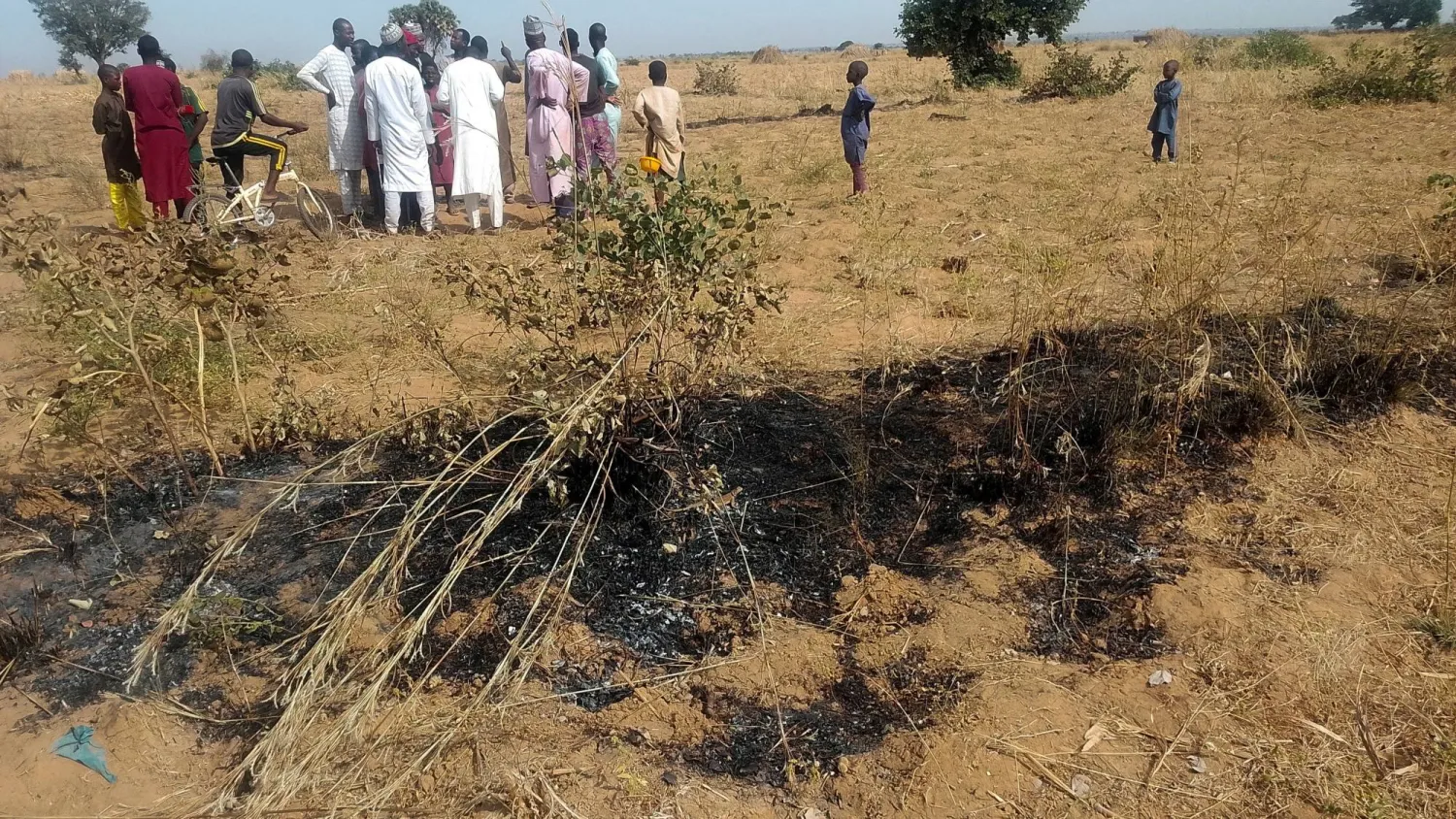
FILE PHOTO: People gather at a site where burnt grass is seen in Jabo village, after US forces had launched a strike against ISIS militants in northwest Nigeria at the request of Nigeria's government, as US President Donald Trump announced on Truth Social on December 25, in Sokoto state, Nigeria, December 26, 2025. REUTERS/Stringer/File Photo
TT

At Least 25 Killed in Extremist Attacks in Northeast Nigeria

FILE PHOTO: People gather at a site where burnt grass is seen in Jabo village, after US forces had launched a strike against ISIS militants in northwest Nigeria at the request of Nigeria's government, as US President Donald Trump announced on Truth Social on December 25, in Sokoto state, Nigeria, December 26, 2025. REUTERS/Stringer/File Photo

At least 25 people were killed in two separate extremist attacks in northeastern Nigeria's Adamawa state, local sources told AFP on Thursday. 

The attacks in the towns of Madagali and Hong in the border region with Cameroon, were attributed to Boko Haram extremists, whose fighters have been active in the area since the group began its violent insurgency in 2009. 

"Gunmen we believed to be Boko Haram on many motorcycles... attacked the market. They opened fire on people and killed 21," a Madagali local government official told AFP about the Tuesday evening attack, on the condition of anonymity. 

"We are still searching for more bodies as some might have died in the bush from gunshot wounds while trying to find safety." 

The attackers also looted a market and stole food items and motorcycles, the source said. 

Four others, including three troops, were killed in neighboring Hong, resident Ezekiel Musa told AFP. 

"Boko Haram attacked us after they left the town. We saw the corpses of three soldiers and one woman was killed," Musa said. 

"Now the town has security personnel but some of us have already started leaving the town because of fear of what happened." 

State governor Adamu Umaru Fintiri condemned the attack without providing an official toll in a statement. 

"We will not let terrorists undermine our efforts to restore peace and stability," the statement said. "I warn perpetrators: desist from these senseless attacks or face the full weight of our collective resolve." 

Since 2009, the extremist insurgency in Nigeria, led primarily by Boko Haram and its rival faction, the ISIS West Africa Province (ISWAP), has left more than 40,000 dead and two million displaced in the northeast of the country, according to the UN. 

The conflict has spread to neighboring Niger, Chad, and Cameroon, prompting the formation of a regional military coalition to fight these groups. 


Cuba Says It Is Communicating with US after Fatal Boat Shooting but Seeks More Details

Cuba suffers from high levels of poverty... Pictured are people in a neighborhood of Havana on February 24 (AP)
TT

Cuba Says It Is Communicating with US after Fatal Boat Shooting but Seeks More Details

Cuba suffers from high levels of poverty... Pictured are people in a neighborhood of Havana on February 24 (AP)

Cuba’s deputy foreign minister said Thursday that the island’s government is communicating with US officials following the fatal shooting of a US boat in Cuban waters.

Carlos Fernández de Cossío said the Cuban government is willing to exchange information with US officials, adding that Cuba plans to ask them for information on the suspects involved and what means they used to organize the trip.

The deputy foreign minister added that the US government has shown willingness “to cooperate in clarifying the facts.”

Cuba’s Ministry of the Interior said that on Wednesday morning, a Florida-registered speedboat carrying 10 armed Cubans from the US opened fire on soldiers off the island’s north coast, and that troops responded, killing four suspects and injuring six others. One Cuban official also was injured, the government said.

A US official said Thursday that at least one American citizen was killed and another wounded in the incident, The Associated Press reported.

The official, who spoke on condition of anonymity due to the sensitivity of the ongoing investigation into Wednesday’s firefight, said another member of the 10-person crew was in the US on a visa and several others may have been green card holders.

Boat reported stolen

The official said the owner of the boat has alleged that it was stolen by one of his employees.

The 1981 Pro Line boat was reported stolen from the Florida Keys, according to a report from the Monroe County Sheriff's Office.

It stated that the owner told authorities he lives in Miami-Dade County but keeps his boat at a Big Pine Key house, whose owner allows him to keep it in exchange for construction work.

The report states that the man reported the boat stolen after receiving calls from reporters and said he had not seen his 24-foot boat docked at the property in more than a week.

Cuba promises more details soon

Cuba's government has released a list with the names of the alleged suspects and accused them of planning to invade the island and unleash terrorism.

Cossío said authorities found assault and sniper rifles, pistols, night vision equipment, bayonets, camouflage clothing, combat rations, communication equipment “and a large number of insignia from counterrevolutionary terrorist organizations.”

He added: “This information is still preliminary. More details will be provided in the coming days.”

On Wednesday evening, US Secretary of State Marco Rubio said that the US Department of Homeland Security and the US Coast Guard are investigating the incident.

“The majority of the facts being publicly reported are those by the information provided by the Cubans. We will verify that independently as we gather more information, and we’ll be prepared to respond accordingly,” Rubio said.

Cossío noted that Cuban authorities have regularly provided the US with information on people he asserted “have been involved in promoting, financing, and organizing violent and terrorist acts against Cuba.”

He noted that two of the boat passengers detained were on that list “and enjoyed impunity within US territory.”

“The Cuban government is still awaiting responses to requests for information about them and the other individuals and organizations included in the list issued,” Cossío said.

He did not take questions from journalists at the press briefing.

Havana abuzz with opinions on shooting

Meanwhile, across Havana and beyond, the streets were abuzz with opinions over what had happened.

“What the hell,” said 88-year-old street musician Efraín Scotland of the alleged attempt of 10 people to invade the island. “No, my friend, no, that’s not going to bring down a nation.”

Some, like 48-year-old construction worker Roberto Henry Figueredo, praised the way Cuba defended itself.

“That hail of bullets that we unleashed was good,” he said, adding that if it were to happen again, Cubans would withstand the attack. “If they fire at us, we’re going to eat those bullets.”

People in Cuba and beyond awaited more information about the motive behind the alleged attempted boat trip to the Caribbean island.

Cuban political scientist Rafael M. Hernández told reporters in an online briefing Thursday that many questions remain unanswered: “What were they doing? What were they looking for? Were they starting a liberation movement in Cuba? Were they trying to sabotage the Cuban economy?”

He described the alleged operation as “silly and counterproductive.”

However, some worried that the shooting could worsen an already frayed relationship between Cuba and the United States, which has tightened sanctions.

Last month, US President Donald Trump also threatened to impose a tariff on any country that sells or provides oil to Cuba, which depended heavily on petroleum from Venezuela. But those shipments were halted after the US attacked the South American country and arrested its then-leader.

Cuba has since imposed severe fuel-saving measures.

“I expect things to get more tense,” said 54-year-old Havana resident Rosa Larrondo, who described Wednesday’s shooting as “a violation of the sovereignty of the Cuban people.”


US-Iran Talks End with No Deal but Potential Signs of Progress

Omani Foreign Minister Badr Albusaidi meets with US Special Envoy Steve Witkoff and US President Donald Trump's son-in-law Jared Kushner, in Geneva, Switzerland, February 26, 2026. Oman News Agency/Handout via REUTERS
TT

US-Iran Talks End with No Deal but Potential Signs of Progress

Omani Foreign Minister Badr Albusaidi meets with US Special Envoy Steve Witkoff and US President Donald Trump's son-in-law Jared Kushner, in Geneva, Switzerland, February 26, 2026. Oman News Agency/Handout via REUTERS

The United States and Iran made progress in talks over Tehran's nuclear program on Thursday, mediator Oman said, but hours of negotiation ended with no sign of a breakthrough that could avert potential US strikes amid a massive military buildup.

The two sides plan to resume negotiations soon after consultations in their countries' capitals, with technical-level discussions scheduled to take place next week in Vienna, Omani Foreign Minister Sayyid Badr Albusaidi said in a post on X after the day's meetings in Switzerland.

Badr Albusaidi will hold talks with US Vice President JD Vance and other US officials in Washington on Friday, MS NOW reported late on Thursday. Neither the White House nor Oman's embassy in Washington immediately responded to requests for comment, Reuters said.

Any substantial move toward an elusive agreement between longtime foes Washington and Tehran could reduce the imminent prospects for US President Donald Trump to carry out a threatened attack on Iran that many fear could escalate into a wider war.

But Tuesday's indirect talks wrapped up without a deal, still leaving the region on edge.

The Omani minister's upbeat assessment followed indirect talks between Iranian Foreign Minister Abbas Araghchi and US envoys Steve Witkoff and Jared Kushner in Geneva, with ‌one session in the ‌morning and the second in the afternoon. "We have finished the day after significant progress in the negotiation between ‌the United ⁠States and Iran," ⁠Badr Albusaidi said.

But with many analysts seeing the latest diplomacy as the last chance before Trump could decide to go to war, Badr Albusaidi provided no details and stopped short of saying the two sides had overcome their biggest stumbling blocks to a deal.

Describing the talks as some of the most serious that Iran has had with the US, Araghchi told Iranian state television: "We reached agreement on some issues, and there are differences regarding some other issues."

“It was decided that the next round of negotiations will take place soon, in less than a week," he said. The Iranians, he added, had clearly expressed their demand for lifting of US sanctions, which Washington has long insisted will only come after deep concessions from Tehran.

There was no immediate comment from the US negotiating team on the outcome of the talks. But Axios quoted a senior US official as ⁠saying the Geneva negotiations were “positive.”

The discussions about the decades-long dispute over Iran's nuclear work come as fears grow of ‌a Middle East conflagration. Trump has repeatedly threatened action if there is no deal, and the US military ‌has amassed its forces in waters near the Iranian Republic.

'INTENSE AND SERIOUS' TALKS

A senior Iranian official told Reuters earlier on Thursday that the US and Iran could reach a ‌framework for a deal if Washington separated "nuclear and non-nuclear issues."

The Trump administration has insisted that Iran's ballistic missile program and its support for armed groups in ‌the region must be part of the negotiations.

After the morning session, Badr Albusaidi said the two sides had exchanged "creative and positive ideas".

But a senior Iranian official said at the time that some gaps still had to be narrowed.

Washington, which believes Tehran seeks the ability to build a nuclear bomb, wants Iran to give up all uranium enrichment, a process that makes fuel for atomic power plants but that can also yield material for a warhead.

Iran has long denied wanting a bomb and said earlier on Thursday it would show flexibility at ‌the talks. Reuters reported on Sunday that Tehran was offering undefined new concessions in return for removal of sanctions and recognition of its right to enrich uranium.

US Secretary of State Marco Rubio said on Wednesday that Iran's refusal ⁠to discuss its ballistic missile program was ⁠a "big problem" which would have to be addressed eventually.

The missiles were "designed solely to strike America" and pose a threat to regional stability, he said, but offered no proof to back the claim that US territory could be targeted.

TRUMP THREATENS 'REALLY BAD THINGS'

Trump said on February 19 that Iran must make a deal in 10 to 15 days, warning that "really bad things" would otherwise happen.

He briefly laid out his case for a possible attack on Iran in his State of the Union speech on Tuesday, underlining that while he preferred a diplomatic solution, he would not allow Tehran to obtain a nuclear weapon.

In June, the US joined Israel in hitting Iranian nuclear sites and has been ramping up the pressure on Tehran again since January, when Trump threatened to intervene over its crushing of nationwide protests with thousands killed.

Since then, Trump has deployed fighter jets and aircraft carrier strike groups in the region.

Iran responded to last summer's strikes by firing fusillades of missiles at Israel and has threatened to retaliate fiercely if attacked again, raising fears of a wider regional conflict.

Within Iran, Supreme Leader Ali Khamenei faces the gravest crisis of his 36-year tenure, with an economy buckling under tightened sanctions and renewed protests following the major unrest and crackdown in January.

President Masoud Pezeshkian said on Thursday that Khamenei has banned weapons of mass destruction, which "clearly means Tehran won't develop nuclear weapons," reiterating a religious decree issued in the early 2000s.


World Economic Forum Head Steps Down Over Epstein Links

FILED - 21 January 2025, Switzerland, Davos: World Economic Forum president and CEO Borge Brende speaks during the Uncertain Times session at the World Economic Forum Annual Meeting. Photo: Faruk Pinjo/World Economic Forum/dpa
TT

World Economic Forum Head Steps Down Over Epstein Links

FILED - 21 January 2025, Switzerland, Davos: World Economic Forum president and CEO Borge Brende speaks during the Uncertain Times session at the World Economic Forum Annual Meeting. Photo: Faruk Pinjo/World Economic Forum/dpa

World Economic Forum head Børge Brende said Thursday that he is stepping down after facing pressure over his contacts with the late US sex offender Jeffrey Epstein.

Brende, a former Norwegian foreign minister, said in a statement that he had decided “after careful consideration” to step down as president and chief executive of the forum, known for its annual January summit in the Swiss Alpine resort of Davos.

“I am grateful for the incredible collaboration with my colleagues, partners, and constituents, and I believe now is the right moment for the Forum to continue its important work without distractions,” Brende said in a statement released by the WEF.

The US Justice Department has released more than 3 million pages of documents relating to Epstein, who died by suicide in jail in 2019 while awaiting trial on sex-trafficking charges.

Brende was Norway’s foreign minister from 2013-2017 and is one of several prominent Norwegians who have faced scrutiny following the latest release of Epstein files.

He didn't refer directly to that controversy in Thursday's statement, but the WEF announced earlier this month that it was opening an internal review into Brende to determine his relationship with Epstein after files indicated the two had dined together several times and exchanged messages.

Brende told Norwegian broadcaster NRK at the time that he was cooperating with the investigation, that he only met Epstein in business settings and that he had been unaware of Epstein’s criminal background.

WEF co-chairs André Hoffmann and Larry Fink said in a statement that “the independent review conducted by outside counsel has concluded. The findings stated that there were no additional concerns beyond what has been previously disclosed.”

They said that Alois Zwinggi will serve as the forum's interim president and CEO, and the forum's Board of Trustees would oversee the leadership transition, including a plan to identify a permanent successor.

Brende's resignation follows the departure last year of the WEF's founder and longstanding chair Klaus Schwab after he came under pressure from a whistleblower alleging misconduct.

The WEF subsequently said an internal investigation had found no evidence of material wrongdoing by Schwab.
