Israel Says Struck 8 Hezbollah Compounds in East Lebanon, Syrian Teen Killed

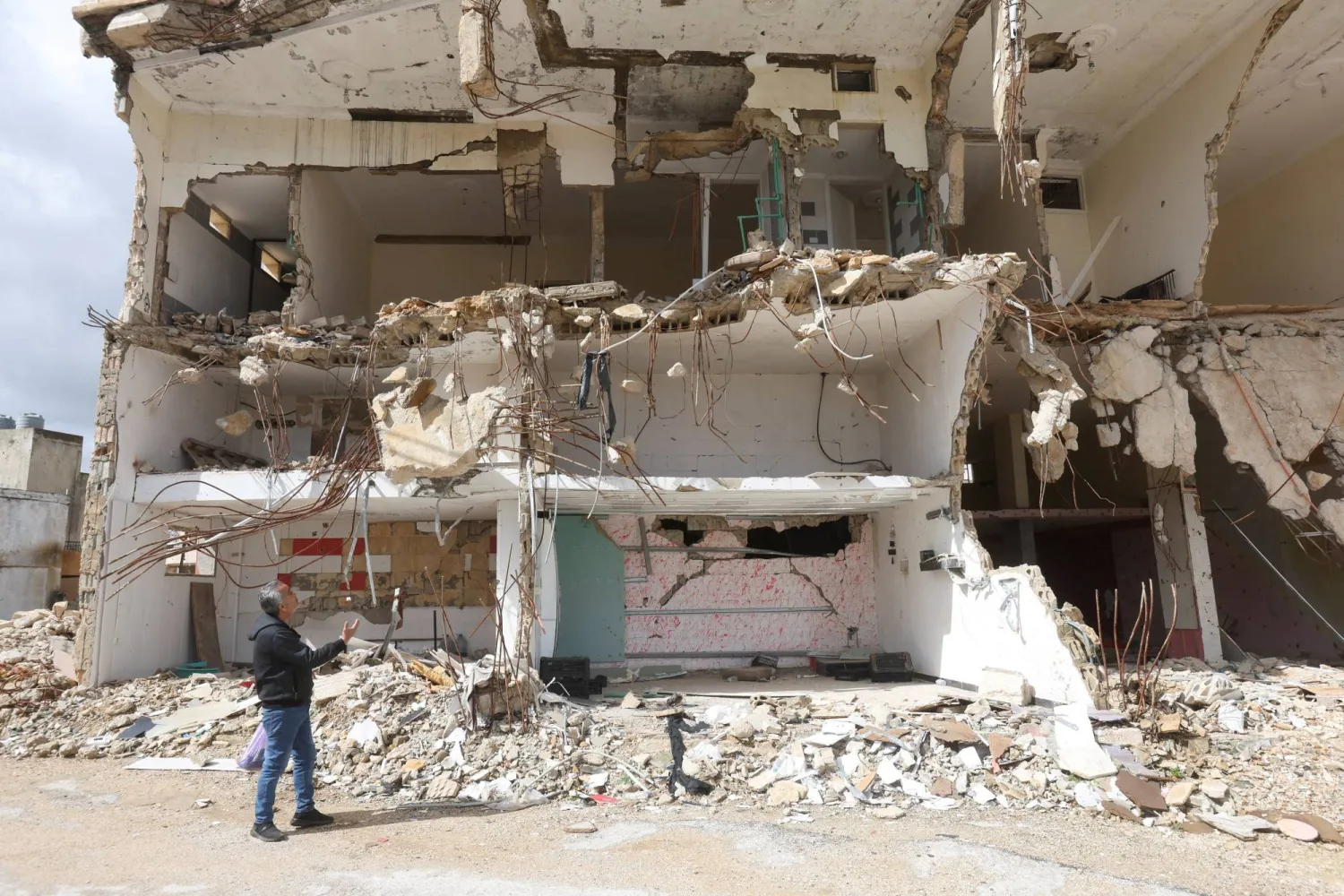
Khiam resident, Hussain Khrais stands in front of his store that was damaged during the latest hostilities between Israel and Lebanon, in Khiam village, near the border with Israel, southern Lebanon, February 19, 2026. REUTERS/Aziz Taher
TT

Israel Says Struck 8 Hezbollah Compounds in East Lebanon, Syrian Teen Killed

Khiam resident, Hussain Khrais stands in front of his store that was damaged during the latest hostilities between Israel and Lebanon, in Khiam village, near the border with Israel, southern Lebanon, February 19, 2026. REUTERS/Aziz Taher

The Israeli military said on Thursday it struck eight compounds belonging to Hezbollah’s Radwan Force in eastern Lebanon's Baalbek area, as the Lebanese Health Ministry reported a Syrian teenager killed.

The military said the compounds were being utilized to prepare and plan for attacks against its troops and Israeli civilians.

"Within the compounds, numerous weapons were stored, including firearms and rockets belonging to Hezbollah," it said.

"The terrorists' activities at these compounds and Hezbollah's attempts to rearm constitute a violation of the ceasefire understandings between Israel and Lebanon, and pose a threat to the state of Israel."

Lebanese state media reported several strikes on mountainous areas in the country's east, mainly in the outskirts of the city of Hermel.

"Israeli enemy airstrikes on the Bekaa this evening resulted, according to an initial toll, in the killing of a 16-year-old Syrian boy and the injury of another person," the Lebanese Health Ministry said in a statement.

Hezbollah and Israel agreed to a ceasefire in November 2024 after a year of war, but Israel has continued to strike it on a near-daily basis, saying it is enforcing ceasefire provisions against the group rearming.

Hezbollah and the Lebanese government have protested the attacks as ceasefire violations.


Gaza Civil Defense Says Israeli Strikes Kill at Least 5

SENSITIVE MATERIAL. THIS IMAGE MAY OFFEND OR DISTURB Mourners gather next to the bodies of two Palestinians killed by an Israeli strike on Thursday, according to medics, during their funeral at Shifa hospital in Gaza City, February 26, 2026. REUTERS/Dawoud Abu Alkas
TT

Gaza Civil Defense Says Israeli Strikes Kill at Least 5

SENSITIVE MATERIAL. THIS IMAGE MAY OFFEND OR DISTURB Mourners gather next to the bodies of two Palestinians killed by an Israeli strike on Thursday, according to medics, during their funeral at Shifa hospital in Gaza City, February 26, 2026. REUTERS/Dawoud Abu Alkas

Gaza's civil defense ministry said Israeli strikes killed at least five people on Friday.

Violence has continued in the Palestinian territory despite a US-brokered truce that entered its second phase last month, with Israel and Hamas trading accusations of violating the agreement.

The civil defense agency, which operates as a rescue force under Hamas authorities, told AFP that an air strike in the early hours of Friday morning killed at least two people and seriously injured one in central Gaza.

A drone strike in the south of the strip shortly after midnight killed three and injured several more people, the agency added.

Under the terms of the ceasefire, which took effect on October 10, Israeli troops withdrew to positions behind a so-called "Yellow Line", though they remain in control of more than half of the territory.

Gaza's health ministry, which operates under Hamas authorities, has previously said at least 601 people had been killed since the truce began.

The Israeli military says at least four of its soldiers have been killed in the same period.

Media restrictions and limited access in Gaza have prevented AFP from independently verifying casualty figures or freely covering the fighting.


Sudan's War Puts Charity Kitchen Workers Feeding Displaced Families at Risk

A woman carries food as she leaves a charity kitchen in Khartoum, Sudan, Wednesday, Jan. 21, 2026. (AP Photo/Marwan Ali)
TT

Sudan's War Puts Charity Kitchen Workers Feeding Displaced Families at Risk

A woman carries food as she leaves a charity kitchen in Khartoum, Sudan, Wednesday, Jan. 21, 2026. (AP Photo/Marwan Ali)

Enas Arbab fled Sudan's western region of Darfur after her hometown fell to Sudanese paramilitary forces, taking only her year-old son with her and the memory of her father, who was killed, she said, simply for working at a charity kitchen serving people displaced by the fighting.

The Rapid Support Forces — or RSF, a paramilitary group that has been at war with the Sudanese army since April 2023 — had laid siege on el-Fasher in the western Darfur region, starving people out before it overran the city.

UN officials say several thousand civilians were killed in the RSF takeover of el-Fasher last October. Only 40% of the city’s 260,000 residents managed to flee the onslaught, thousands of whom were wounded, the officials said. The fate of the rest remains unknown.

During the fighting, Arbab says RSF fighters took her father, Mohamed ِArbab, from their home after beating him in front of the family, and demanded a ransom. When the family couldn't pay, they told them they had killed him, she says. To this day, the family doesn't know where his body is.

When her husband disappeared a month later, Enas Arbab decided to flee north, to Egypt. “We couldn’t stay in el-Fasher," she said. "It was no longer safe and there was no food or water.”

Her father was one of more than 100 charity kitchen workers who have been killed since the war began, according to workers who spoke with The Associated Press and the Aid Workers Security database, a group that tracks major incidents around the world impacting aid workers.

In areas of intense fighting — especially in Darfur — famine is spreading and food and basic supplies are scarce. The community-led public kitchens have become a lifeline but many working there have been abducted, robbed, arrested, beaten or killed.

Grim numbers in a brutal war

Volunteer Salah Semsaya with the Emergency Response Rooms — a group that emerged as a local initiative and now operates in 13 provinces across Sudan, with 26,000 volunteers — acknowledges the dangers faced by workers in charity kitchens.

The real number of workers killed is likely far higher than the estimated 100, he says, but the war has prevented reliable data collection and record-keeping.

Semsaya shared records showing that 57% of the documented killings of charity kitchen workers occurred in Khartoum, mainly while the Sudanese capital was under RSF control, before the army retook it last March. At least 21% of the killings were in Darfur.

More than 50 of those killed in Khartoum worked with his group, Semsaya said.

Sudan’s war erupted after tensions between the army and the RSF escalated into fighting that began in Khartoum and spread nationwide, killing thousands and triggering mass displacement, disease outbreaks and severe food insecurity. Aid workers were frequently targeted.

Dan Teng’o, communications chief at the UN office for humanitarian affairs, says it's unclear whether charity kitchen workers are targeted because of their work or because of their perceived affiliation with one side or other in the war.

The kitchen workers are prominent in their communities because of the work they do, making them obvious targets, activists say. Ransom demands typically range from $2,000 to $5,000, often rising once families make initial payments.

“A clear deterioration in the security context ... has significantly affected local communities, including volunteers supporting community kitchens,” Teng’o said.

Kitchen workers face risks

Farouk Abkar, a 60-year-old from el-Fasher, spent a year handing out sacks of grain at a charity kitchen in Zamzam camp, just 15 kilometers (9 miles) south of the city. He survived drone strikes and remembers the day RSF fighters attacked his kitchen. One of them punched him in the face, knocking some of his teeth out.

Abkar said he fled el-Fasher at night with his daughter, walking for 10 days. Along the way, some RSF fighters fired birdshot, which hit him in the head, leaving a chronic headache.

Now in Egypt, he shares an apartment with at least 10 other Sudanese refugees and can't afford medical care. The harrowing images from his hometown still haunt him.

“Many things happened in el-Fasher," he said. "There was death. There was starvation."

Mustafa Khater, a 28-year-old charity kitchen worker, fled with his pregnant wife to Egypt a few days before el-Fasher fell to the RSF.

During the 18-month siege, some el-Fasher residents collaborated with the RSF, telling the paramilitary fighters who the kitchen workers were, Khater said. Many disappeared.

"They would take you to an area where there is a dry riverbed and kill you there,” Khater said.

A volunteer working with Semsaya's aid group in Darfur said some of his colleagues were beaten, arrested and interrogated, with their attackers accusing them of receiving “illicit funds” for the kitchen. The volunteer spoke on condition of anonymity for fear of reprisals.

Despite the challenges, many charity kitchens remain the only reliable food source in areas gripped by conflict and a place people can come to and give each other support, Semsaya said.

Struggling to feed thousands

The town of Khazan Jedid in East Darfur province has three charity kitchens feeding about 5,000 people daily, said Haroun Abdelrahman, a spokesperson for the Emergency Response Rooms' branch in the area.

Abdelrahman says he was once interrogated by RSF fighters, while several of his colleagues have been robbed at knifepoint. Despite the fear and harassment, many kitchen workers are still volunteering and working, he said.

In Kassala in eastern Sudan, military agents questioned a volunteer with the branch there and his colleagues in January 2024, he said, after their kitchen started serving food and providing shelter to people who escaped nearby Wad Madani when RSF seized that town. He also spoke anonymously for fear of reprisals.

Khater, the 28-year-old who fled el-Fasher, said he heard from friends back home that after the RSF takeover, all charity kitchens in the city closed and his colleagues were either "killed or fled.”

Teng’o says the closures in areas of fighting have left “vulnerable households with no viable alternatives” and forced people to shop at local "markets where food prices are unaffordable.”

Arbab, the pregnant 19-year-old who fled with her baby boy, had hoped to rebuild her life in Egypt, her friends and a humanitarian worker said, speaking on condition of anonymity to talk about the young mother.

But while on the road to the northern city of Alexandria last month, she and her son were stopped by Egyptian authorities and deported back to Sudan.


Trump Administration Asks the Supreme Court to Allow an End to Legal Protections for Syrian Migrants

The US Supreme Court has allowed President Donald Trump's administration to resume deportations of migrants to countries that are not their own. Anna Moneymaker / GETTY IMAGES/AFP/File
TT

Trump Administration Asks the Supreme Court to Allow an End to Legal Protections for Syrian Migrants

The US Supreme Court has allowed President Donald Trump's administration to resume deportations of migrants to countries that are not their own. Anna Moneymaker / GETTY IMAGES/AFP/File

The Trump administration asked the Supreme Court on Thursday to allow it to move ahead with ending legal protections for migrants from Syria, in the latest emergency appeal to the nation's highest court.

The Department of Justice wants the court to lift a New York judge's ruling halting the Department of Homeland Security's decision to end temporary protected status for Syrians while lawsuits play out.

The government is also asking for a broader ruling that could affect other cases over protections for people from other countries as the administration pursues its immigration crackdown, The Associated Press said.

The conservative-majority court has previously allowed immigration authorities to end legal protections for migrants from Venezuela as litigation continues.

About 6,100 people from Syria have temporary legal status after fleeing armed conflict, according to court documents. Ending those protections could halt their authorization to work legally in the United States and expose more to possible deportation, especially the 800 people with pending applications, according to the International Refugee Assistance Project.

Protections for Syrians were first granted protected status in 2012, during a civil war that lasted for more than a decade before the fall of President Bashar Assad’s government in late 2024.

Homeland Security Secretary Kristi Noem acted to revoke protected status less than a year later, finding that the situation "no longer meets the criteria for an ongoing armed conflict that poses a serious threat to the personal safety of returning Syrian nationals."

Immigration lawyers challenged that decision, arguing that Syria was still wrestling with a humanitarian crisis and the swift revocation of legal protections would force Syrians in the United States to confront “impossible choices.”

Judge Katherine Polk Failla, who was nominated by democratic President Barack Obama, agreed to delay the termination in November. The 2nd US Circuit Court of Appeals left her decision in place.

The administration argues that the department can grant or revoke the temporary protections and judges should not interfere. A response to the administration's appeal is due March 4.

DHS has taken steps to withdraw legal protections that have allowed immigrants from multiple countries to remain in the United States and work legally. That includes a combined total of more than a million people from Venezuela and Haiti. A different judge in Washington recently blocked the administration from ending protections for 350,000 Haitians.

The administration has scored a series of wins on the Supreme Court's emergency docket allowing it to move ahead with key parts of Trump's agenda, though the justices handed him a significant defeat on tariffs last week.

Congress created TPS in 1990 to prevent deportations to countries suffering from natural disasters, civil strife or other dangerous conditions. The designation is granted in 18-month increments by the homeland security secretary.