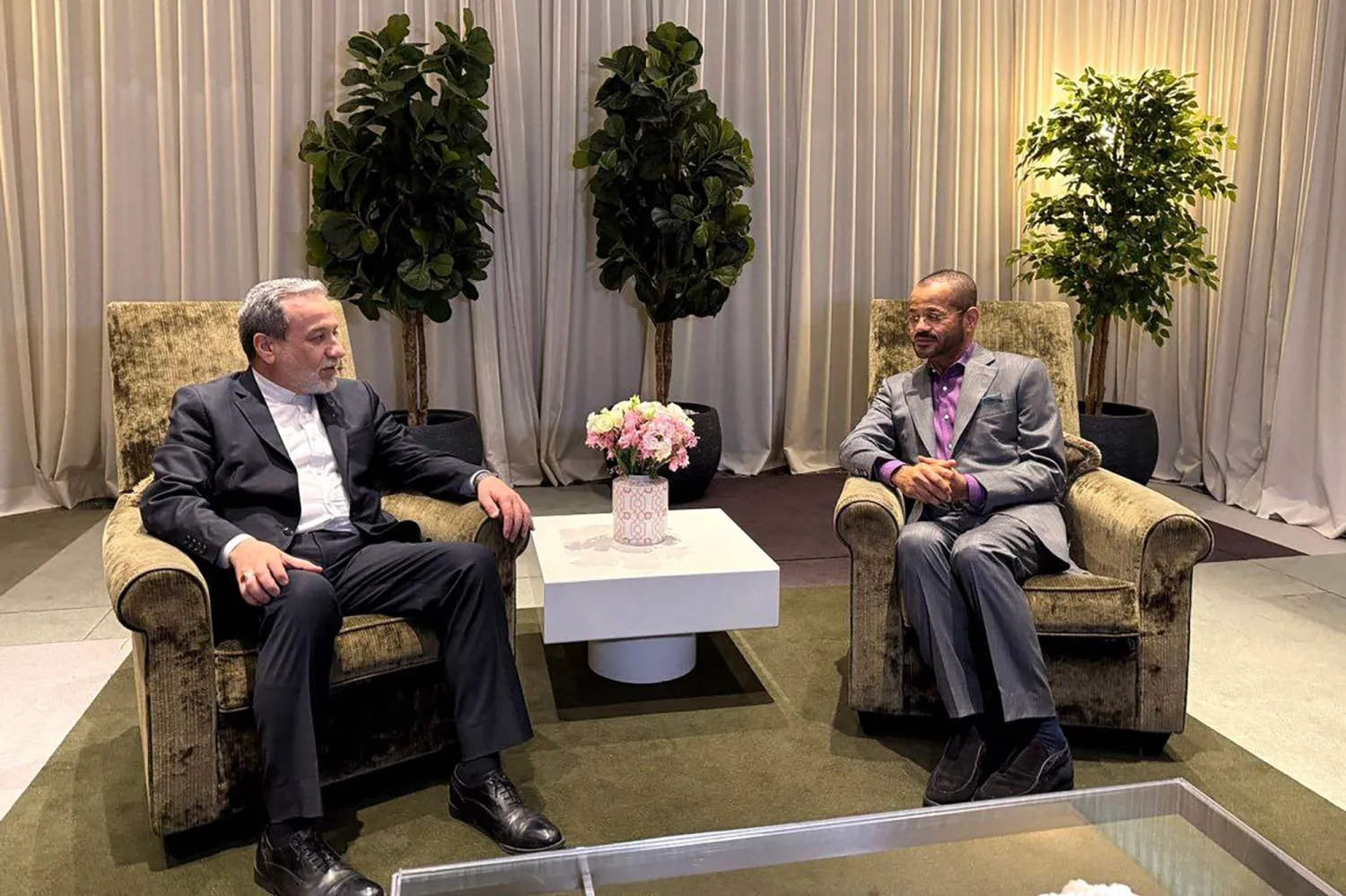
Iran Urges US to Drop 'Excessive Demands' to Reach Deal

In this handout photo released by the Iranian Foreign Ministry on February 26, 2026, Iran's Foreign Minister Abbas Araghchi (L) speaks with Oman's FM Badr Albusaidi during their meeting in Geneva. (Photo by Iran's Foreign Ministry / AFP)
TT

Iran Urges US to Drop 'Excessive Demands' to Reach Deal

In this handout photo released by the Iranian Foreign Ministry on February 26, 2026, Iran's Foreign Minister Abbas Araghchi (L) speaks with Oman's FM Badr Albusaidi during their meeting in Geneva. (Photo by Iran's Foreign Ministry / AFP)

Iran's Foreign Minister Abbas Araghchi said on Friday that in order to reach a deal, the United States will have to drop its "excessive demands", after the two sides held talks in Geneva.

In a phone call with Egypt's top diplomat Badr Abdelatty, Araghchi said "success in this path requires seriousness and realism from the other side and avoidance of any miscalculation and excessive demands."

Araghchi did not clarify what demands he was referring to, but Washington has pointed to Iran's ballistic missile program and has repeatedly described Tehran's uranium enrichment capability as a red line.

US President Donald Trump said on Wednesday that Tehran had "already developed missiles that can threaten Europe and our bases overseas, and they're working to build missiles that will soon reach the United States of America."

Also on Wednesday, US Secretary of State Marco Rubio said Iran is "not enriching right now, but they're trying to get to the point where they ultimately can", adding that Tehran "refuses" to discuss its ballistic missile program and "that's a big problem."

Iran has repeatedly said its missile program is part of its defensive capabilities and has ruled out abandoning uranium enrichment, insisting its nuclear program is solely for peaceful purposes.

Longtime adversaries Iran and the United States held their third round of Omani-mediated nuclear talks on Thursday in Geneva, seeking to avert military escalation as Washington expands its military build-up in the region.

Both Iran and Oman cited progress after the talks, with technical discussions scheduled for Monday in Vienna ahead of a fourth round expected next week.


US Service Member Missing After Iran Shot Down Fighter Jet Has Been Rescued

In this US Air Force handout photo released by US Central Command public affairs, a US Air Force F-15E Strike Eagle aircraft takes off for a mission during Operation Epic Fury on March 14, 2026. (US Central Command and US Airforce Handout / AFP)
TT

US Service Member Missing After Iran Shot Down Fighter Jet Has Been Rescued

In this US Air Force handout photo released by US Central Command public affairs, a US Air Force F-15E Strike Eagle aircraft takes off for a mission during Operation Epic Fury on March 14, 2026. (US Central Command and US Airforce Handout / AFP)

A US service member who has been missing since Iran shot down a fighter jet has been rescued, President Donald Trump wrote in a social media post early Sunday.

The crew member has been missing since Friday, when Iran downed a US F-15E Strike Eagle. A second crew member was rescued earlier.

Trump wrote that the aviator is injured but “will be just fine,” adding that he took refuge “on the treacherous mountains of Iran.”

Trump added that the rescue involved “dozens of aircraft” and that the US had been monitoring his location “24 hours a day, and diligently planning for his rescue.”

The war began with joint US-Israel strikes on Feb. 28 and has killed thousands, shaken global markets, cut off key shipping routes and spiked fuel prices. Both sides have threatened, and hit, civilian targets, bringing warnings of possible war crimes.

The fighter jet was the first US aircraft to have crashed in Iranian territory since the conflict in late February.

Trump said last week that the US had “decimated” Iran and would finish the war “very fast.” Two days later, Iran shot down two US military planes, showing the ongoing perils of the bombing campaign and the ability of a degraded Iranian military to continue to hit back.

The other jet to go down was a US A-10 attack aircraft. Neither the status of the crew nor exactly where it crashed was immediately known.

A frantic US search-and-rescue operation unfolded after the crash of the F-15E jet on Friday, focusing on a mountainous region in Iran’s southwestern province of Kohgiluyeh and Boyer-Ahmad.

Iran also promised a reward for anyone who turned in the “enemy pilot.” Iran’s joint military command on Saturday said that it also struck two US Black Hawk helicopters Friday, but The Associated Press couldn’t independently verify that.

Trump renews threat

Trump renewed his threats for Iran to open up the Strait of Hormuz, a crucial waterway for global energy shipments that has been choked off by Tehran, by Monday or face devastating consequences, writing Saturday in a social media post: “Remember when I gave Iran ten days to MAKE A DEAL or OPEN UP THE HORMUZ STRAIT. Time is running out — 48 hours before all Hell will reign down on them.”

“The doors of hell will be opened to you” if Iran’s infrastructure is attacked, Gen. Ali Abdollahi Aliabadi with the country’s joint military command said late Saturday in response to Trump’s renewed threat, state media reported. In turn, the general threatened all infrastructure used by the US military in the region.

But Pakistan’s Foreign Ministry spokesperson, Tahir Andrabi, told The Associated Press that his government’s efforts to broker a ceasefire are “right on track” after Islamabad last week said that it would soon host talks between the US and Iran.

Iran’s foreign minister, Abbas Araghchi, said that Iranian officials “have never refused to go to Islamabad.”

Mediators from Pakistan, Türkiye and Egypt were working to bring the US and Iran to the negotiating table, according to two regional officials.

A second US Air Force combat aircraft went down in the Middle East on Friday, according to a US official, who spoke on condition of anonymity to discuss a sensitive military situation. It wasn’t clear if the aircraft crashed or was shot down, or whether Iran was involved.

Iranian state media said a US A-10 attack aircraft crashed in the Gulf after being struck by Iran’s defense forces.

The Bab el-Mandeb Strait Iran’s parliamentary speaker, Mohammad Bagher Qalibaf, issued a veiled threat late Friday to disrupt traffic through a second strategic waterway in the region, the Bab el-Mandeb.

The strait, 32 kilometers (20 miles) wide, links the Red Sea with the Gulf of Aden and the Indian Ocean. More than a tenth of seaborne global oil and a quarter of container ships pass through it.

“Which countries and companies account for the highest transit volumes through the strait?” Qalibaf wrote.

More than 1,900 people have been killed in Iran since the war began.

In Gulf Arab states and the occupied West Bank, more than two dozen people have died, while 19 have been reported dead in Israel and 13 US service members have been killed. In Lebanon, more than 1,400 people have been killed and more than 1 million people have been displaced. Ten Israeli soldiers have died there.


Russia Evacuates 198 Workers from Iran Nuclear Plant Amid Airstrike

Rosatom State Atomic Energy Corporation Director General Alexey Likhachev arrives to attend the talks between Russian President Vladimir Putin and Armenian Prime Minister Nikol Pashinyan at the Kremlin in Moscow, Russia, 01 April 2026. (EPA/Pavel Bednyakov/AP Pool)
TT

Russia Evacuates 198 Workers from Iran Nuclear Plant Amid Airstrike

Rosatom State Atomic Energy Corporation Director General Alexey Likhachev arrives to attend the talks between Russian President Vladimir Putin and Armenian Prime Minister Nikol Pashinyan at the Kremlin in Moscow, Russia, 01 April 2026. (EPA/Pavel Bednyakov/AP Pool)

Russia started a planned evacuation of 198 workers from Iran's Bushehr atomic plant shortly after a US-Israeli projectile hit near the facility, Russian state media said on Saturday.

This was a third evacuation from the facility in southern Iran on the Gulf coast, which was built with Moscow's help, with about 100 Russian staff remaining there by now.

The area around Bushehr has been struck four times during this war. The latest attack on Saturday saw one person -- a guard at the facility -- killed, but did not damage the plant itself, according to Iranian state media.

"As planned, we began the main phase of the evacuation today," Russia's nuclear agency Rosatom head Alexey Likhachev was quoted as saying by Russia's TASS news agency.

"About 20 minutes after that ill-fated strike, buses set off from Bushehr station towards the Iranian-Armenian border (with) 198 people, to be precise -- this is the largest evacuation," he added.

Likhachev also said that Russia informed the US and Israel about the evacuation.

"The likelihood of a risk of damage or a potential nuclear incident is, unfortunately, only increasing, as has been confirmed by this morning's events," the Rosatom CEO said.

The agency plans to keep only a skeleton staff at Bushehr amid the threat of further strikes.

The Russian foreign ministry slammed the "evil" US-Israeli attack and urged a cessation of hostilities on Iranian nuclear facilities immediately.


Erdogan Says Middle East War Has Caused ‘Geostrategic Impasse’

This handout photograph taken and released by the Turkish presidential press service on April 4, 2026, shows Türkiye's President Recep Tayyip Erdogan (R) welcoming and shaking hands Ukraine's President Volodymyr Zelensky (L) upon arrival for a bilateral meeting on security at Dolmabahce Presidential Office, in Istanbul. (Turkish Presidential Press Service / AFP)
TT

Erdogan Says Middle East War Has Caused ‘Geostrategic Impasse’

This handout photograph taken and released by the Turkish presidential press service on April 4, 2026, shows Türkiye's President Recep Tayyip Erdogan (R) welcoming and shaking hands Ukraine's President Volodymyr Zelensky (L) upon arrival for a bilateral meeting on security at Dolmabahce Presidential Office, in Istanbul. (Turkish Presidential Press Service / AFP)

Türkiye's President Recep Tayyip Erdogan said the war in the Middle East had led to a "geostrategic impasse", during a telephone conversation with NATO chief Mark Rutte, his office said Saturday.

"President Erdogan said the process started by the intervention against Iran had led to a geostrategic impasse and that the international community had to redouble its efforts to bring an end to this war," said the statement.

Türkiye has attempted to mediate an end to the hostilities, notably through negotiations conducted with Pakistan and Egypt.

Erdogan said his country was also continuing efforts "to reach a peaceful outcome" to the conflict between Russia and Ukraine.

Ukrainian President Volodymyr Zelensky arrived in Istanbul Saturday for talks with Erdogan.

A senior Ukrainian official told AFP that the talks would not only be about drone interceptors but also about security cooperation in general.

The Turkish presidency said on X that the talks would focus "efforts towards a ceasefire and a lasting solution."