


Israel’s Top Court Allows Aid Groups to Keep Working in Gaza as Israeli Strikes Kill 5 There

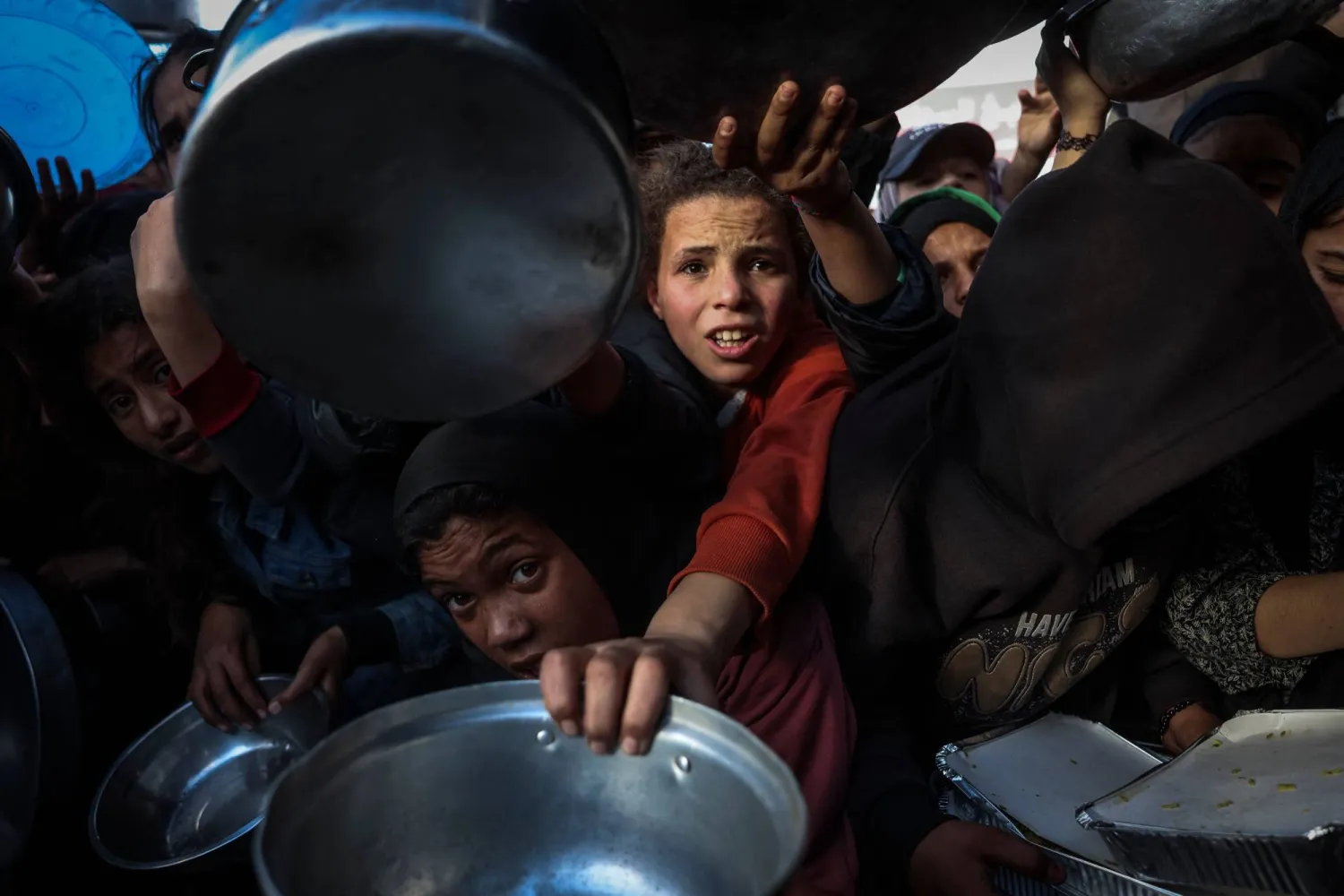
 Palestinians react as they wait to receive food at a soup kitchen in Khan Yunis, in the southern Gaza Strip, on February 26, 2026.  (Photo by BASHAR TALEB / AFP)
Palestinians react as they wait to receive food at a soup kitchen in Khan Yunis, in the southern Gaza Strip, on February 26, 2026. (Photo by BASHAR TALEB / AFP)
TT

Israel’s Top Court Allows Aid Groups to Keep Working in Gaza as Israeli Strikes Kill 5 There

 Palestinians react as they wait to receive food at a soup kitchen in Khan Yunis, in the southern Gaza Strip, on February 26, 2026.  (Photo by BASHAR TALEB / AFP)
Palestinians react as they wait to receive food at a soup kitchen in Khan Yunis, in the southern Gaza Strip, on February 26, 2026. (Photo by BASHAR TALEB / AFP)

Israel's top court on Friday moved to allow international aid groups to keep operating in the Gaza Strip and other Palestinian territories as Israeli strikes killed at least five people across the war-torn enclave. 

The Supreme Court's order, which followed a petition from 17 aid groups, effectively halted an earlier Israeli government decision that barred aid groups for refusing to comply with Israel's new rules. 

Israel had announced it will ban 37 aid groups by March 1 for not abiding by rules introduced last year that require aid groups to register names and contact information of employees, and provide details about their funding and operations. 

The groups view the rules as invasive and arbitrary, and say the ban would hinder critical assistance. Israel says the new measures are necessary to ensure armed groups do not infiltrate humanitarian organizations. 

A US-negotiated ceasefire reached in October has halted major military operations. But the two-year war triggered by Hamas' Oct. 7, 2023 attack on Israel has left much of the territory in ruins and most of Gaza's 2 million Palestinians reliant on international aid. 

Israel has also continued to strike what it says are gunmen, often killing civilians. 

Aid groups express relief Friday's order was a temporary injunction while the court considers the case. There was no timeline for a final decision. 

“This is, however, a step in the right direction — with a long, long way still to go. We will keep fighting to be able to do our jobs, and deliver life saving assistance to Palestinians in need,” said Athena Rayburn, the executive director of AIDA, an umbrella organization representing over 100 groups operating in the Palestinian territories. 

Lawyers representing the aid groups said the decision has given Palestinians in Gaza and the West Bank some “breathing room." 

The petition said the new rules violate international law, and that Israel, as an occupying power, has the obligation to ensure food and medicine reach people. It also says Israel does not have the authority to shutter organizations in areas under the nominal control of the Palestinian Authority. 

COGAT, the Israeli military body overseeing civilian affairs in Gaza, has said that the organizations whose licenses are to be revoked contribute less than 1% of the total aid going into the territory. More than 20 organizations will continue to operate after complying with the new regulations, it said. 

Airstrikes kill at least 5  

Israeli airstrikes overnight killed at least five people, four of them members of the Hamas-run police, officials said Friday. 

Such strikes have repeatedly disrupted the truce since it took effect in October. The escalating Palestinian death toll has left many in Gaza feeling as though the war never ended. 

Three of the five were killed by a strike on a police checkpoint in southern Gaza near Khan Younis, said Dr. Ahmed al-Farra at Nasser Hospital. Another died in a strike on a checkpoint in Bureij refugee camp, according to a statement from the Hamas-run Interior Ministry, which oversees police in Gaza. 

A separate strike in western Khan Younis killed one Palestinian, al-Farra said. 

The Israeli military said it killed several fighters in Rafah, on the border with Egypt. It said the strikes were in response to a violation of the ceasefire. 

The Hamas-run police force has continued to operate in the half the territory under the group's control. The ceasefire agreement calls for Hamas to disarm and hand over power to a committee of Palestinian administrators, and for Israel to withdraw as international forces are deployed. There is no firm timeline for implementing those aspects of the agreement. 

US Embassy provides services in settlement  

Meanwhile, in the occupied West Bank, the US Embassy began offering consular services for the first time Friday in an Israeli settlement. 

The move continues a shift in policy under US President Donald Trump, whose administration has been far friendlier to Israeli settlements in the West Bank than past US leaders. Most of the international community views the settlements as illegal and an obstacle to peace with the Palestinians. 

People lined up in the settlement of Efrat, where some 4,000 US citizens live. “The United States says Efrat is part of Israel, Efrat is going to be forever here,” the city’s mayor, Dovi Sheffler, said. 

More than 500,000 Israelis live in settlements across the West Bank, which is home to around 3 million Palestinians living under military rule, with the Palestinian Authority exercising limited autonomy in population centers. 

The US Embassy has previously provided consular services in Ramallah and other Palestinian cities in the West Bank, which is home to many Palestinian Americans. 

Israel captured the West Bank, Gaza and east Jerusalem in the 1967 Mideast war, territories the Palestinians want for a future state. 


PMF Spokesperson: Airstrikes Kill at Least 2 in Iraq’s Jurf al-Sakhar

Vehicles drive across a bridge following Israeli strikes in Tehran, Iran, Saturday, Feb. 28, 2026. (AP Photo/Vahid Salemi)
TT

PMF Spokesperson: Airstrikes Kill at Least 2 in Iraq’s Jurf al-Sakhar

Vehicles drive across a bridge following Israeli strikes in Tehran, Iran, Saturday, Feb. 28, 2026. (AP Photo/Vahid Salemi)

At least two Iraqi Popular Mobilization Forces fighters were killed and three others seriously wounded after explosions occurred following airstrikes ⁠in Jurf al-Sakhar, south ⁠of Baghdad, a PMF spokesperson told Reuters on ⁠Saturday.

Search operations are ongoing for possible casualties, he added.

The explosions took place as the United States and Israel launched strikes on Iran on Saturday.

Trump had built up a vast US military presence in the region to try to force Tehran to make concessions in the nuclear talks. He said the "massive" operation was intended to ensure Tehran does not obtain a nuclear weapon.

The attack follows a 12-day air war last June between Israel and Iran and repeated US-Israeli warnings that they would strike again if Iran pressed ahead with its nuclear and ballistic missile programs.


Lebanese Officials Warn Against Dragging Country into ‘Adventures’

Smoke rises from the site of an Israeli airstrike that targeted the southern Lebanese area of al-Qatrani on February 28, 2026. (Photo by Rabih DAHER / AFP)
TT

Lebanese Officials Warn Against Dragging Country into ‘Adventures’

Smoke rises from the site of an Israeli airstrike that targeted the southern Lebanese area of al-Qatrani on February 28, 2026. (Photo by Rabih DAHER / AFP)

Lebanese officials warned on Saturday against dragging Lebanon into the region’s conflict after the US and Israel launched attacks on Iran.

President Joseph Aoun said that “protecting Lebanon’s sovereignty, security, and stability, and shielding it from the disasters of external conflicts is an absolute priority.”

He called for unified efforts and solidarity to confront the challenges.

Prime Minister Nawaf Salam also said he would not accept anyone dragging "the country into adventures that threaten its security and unity,” in an indirect message to Hezbollah.

“In light of the serious developments unfolding in the region, I once ⁠again call on all Lebanese to act with wisdom and patriotism, placing Lebanon and the Lebanese people’s interests above any other consideration," Salam said in a statement.

"I reiterate that we will not accept anyone dragging the country into adventures that threaten its security and unity,” he added.

Salam’s statement came after the US and Israel launched an attack on Iran amid reports that Israel had warned Lebanon that it would strike the country hard, targeting civilian infrastructure including the airport, in the event that Hezbollah gets involved in any regional war.

United Nations Special Coordinator Jeanine Hennis-Plasschaert said that the Lebanese people “have survived and withstood crisis after crisis.”

“We cannot afford to be dragged into another one,” she warned, saying that all Lebanese parties “must prioritize, in words and actions, the need to shield the country and its people from unfolding regional developments.”

Earlier, Israel's military said that it carried out strikes on Hezbollah infrastructure in south Lebanon.


Humanitarian Crisis Deepens in Gaza

Son of Palestinian policeman Khaled al-Zayan, who was killed in an Israeli strike on a checkpoint, according to medics, reacts during his funeral in Khan Younis in the southern Gaza Strip, February 27, 2026. REUTERS/Ramadan Abed
TT

Humanitarian Crisis Deepens in Gaza

Son of Palestinian policeman Khaled al-Zayan, who was killed in an Israeli strike on a checkpoint, according to medics, reacts during his funeral in Khan Younis in the southern Gaza Strip, February 27, 2026. REUTERS/Ramadan Abed

Israel stepped up its airstrikes in the Gaza Strip, killing and wounding people while directly targeting police and faction-affiliated security personnel who were carrying out guard duties in central and southern areas of the enclave.

The escalation comes as humanitarian conditions continue to deteriorate, driven by stormy winter weather and compounding crises in Gaza as a result of Israeli measures and ongoing restrictions on the entry of key goods and supplies.

An Israeli reconnaissance drone carried out an airstrike shortly after midnight on Thursday-Friday, targeting three members of the “Field Control Force” affiliated with the Izz ad-Din al-Qassam Brigades, the armed wing of Hamas.

The men were on a guard and deployment mission in the al-Maslakh area, south of Khan Younis in the southern Gaza Strip, an area used by some armed gangs attempting to reach the city to carry out attacks or abduct Palestinians.

The bodies of the three were transferred to Nasser Medical Complex. Two wounded men arrived with the bodies, one of them in critical condition.

Field sources told Asharq Al-Awsat that the men operated under the “Joint Force” formed between the Izz ad-Din al-Qassam Brigades and the Al-Quds Brigades, the armed wing of the Islamic Jihad movement, to carry out security missions and guard dangerous areas at night amid the threat posed by armed gangs, as well as potential infiltration by Israeli special forces, as had occurred on several previous occasions.

Separately, a police officer affiliated with the Hamas-run Interior Ministry was killed and his colleague critically wounded when they were struck while guarding the entrance to Al-Bureij camp in central Gaza.

Police personnel affiliated with the Hamas government have been deployed in coordination with the Qassam and Al-Quds Brigades, with coordination among all bodies aimed at ensuring security and protecting various areas amid a complex security situation and intensified Israeli intelligence-gathering efforts, whether through Palestinians linked to it or through the use of armed gang elements.

The Israeli military said it had struck Hamas operatives in response to militants emerging from a tunnel in Rafah on Thursday evening.

The escalation coincided with heavy airstrikes targeting areas east of Gaza City and Khan Younis, and north of Rafah, alongside artillery shelling and gunfire from Israeli military vehicles.

Another Palestinian was killed after being targeted by drones that opened fire in the al-Atatra area northwest of Beit Lahia in northern Gaza. At least three others were wounded in similar incidents, including a woman shot in the head.

Israel has killed more than 620 Palestinians since a ceasefire took effect on Oct. 10, 2025, bringing the total death toll since Oct. 7, 2023, to more than 72,000.

Palestinian factions condemned what they described as ongoing Israeli violations and the targeting of civilians, armed wing members and police and security personnel affiliated with the Hamas-run government.

Hazem Qassem, a Hamas spokesperson, said the continued Israeli escalation reflected disregard for mediators’ efforts and for the role of the Board of Peace.

He added that “the occupation continues its war of genocide and destruction against the Palestinian people, and what has changed is limited to form and method, indicating that talk by guarantor states of ending the war lacks any real substance on the ground.”

Humanitarian situation

The Israeli escalation comes as humanitarian conditions continue to worsen, driven by stormy winter weather and compounding crises in Gaza as a result of Israeli measures and ongoing restrictions on the entry of key goods and supplies.

For the third consecutive day, tents sheltering displaced families have been flooded by intermittent heavy rainfall, damaging belongings and forcing residents to seek alternative shelter until the rain subsides.

UNRWA

In the same context, the United Nations Relief and Works Agency for Palestine Refugees in the Near East said forced displacement and aid restrictions in Gaza had led to overcrowding, deteriorating shelters and inadequate sanitation services, increasing the spread of disease.

Its teams in Gaza reported a sharp rise in skin infections and waterborne illnesses.

UNRWA is working to help people through health and sanitation services, but greater access is needed to meet the enormous needs, it said.

Israel bars the entry of supplies aimed at repairing infrastructure and building hospitals and schools, further complicating the humanitarian and health situation.

Doctors Without Borders

Doctors Without Borders called for a massive scale-up of lifesaving assistance and unhindered humanitarian access amid the ongoing catastrophe in Gaza, where lives continue to be lost due to sustained violence and persistent aid restrictions imposed by the Israeli authorities. Despite these policies, MSF is committed to remaining to provide assistance in Palestine for as long as possible, working under our registration with the Palestinian Authority.

Under international humanitarian law, as the occupying power, the Israeli authorities are obliged to ensure the provision of humanitarian assistance, it said.

However, the new restrictive rules requiring 37 NGOs to leave Palestine by March 1 threaten to drastically reduce aid, which is already insufficient, it added, urging governments worldwide to ensure respect for International Court of Justice rulings, including facilitating the provision of humanitarian assistance.

“MSF is working to preserve services for patients in an increasingly constrained environment,” said Christopher Lockyear, MSF Secretary General. “The needs are immense and drastic restrictions have deadly consequences. Hundreds of thousands of patients need medical and mental health care, and tens of thousands require long-term medical, surgical and psychological follow-up.”
