


Gold Climbs as US-Israel Strikes on Iran Spark Safe-haven Demand

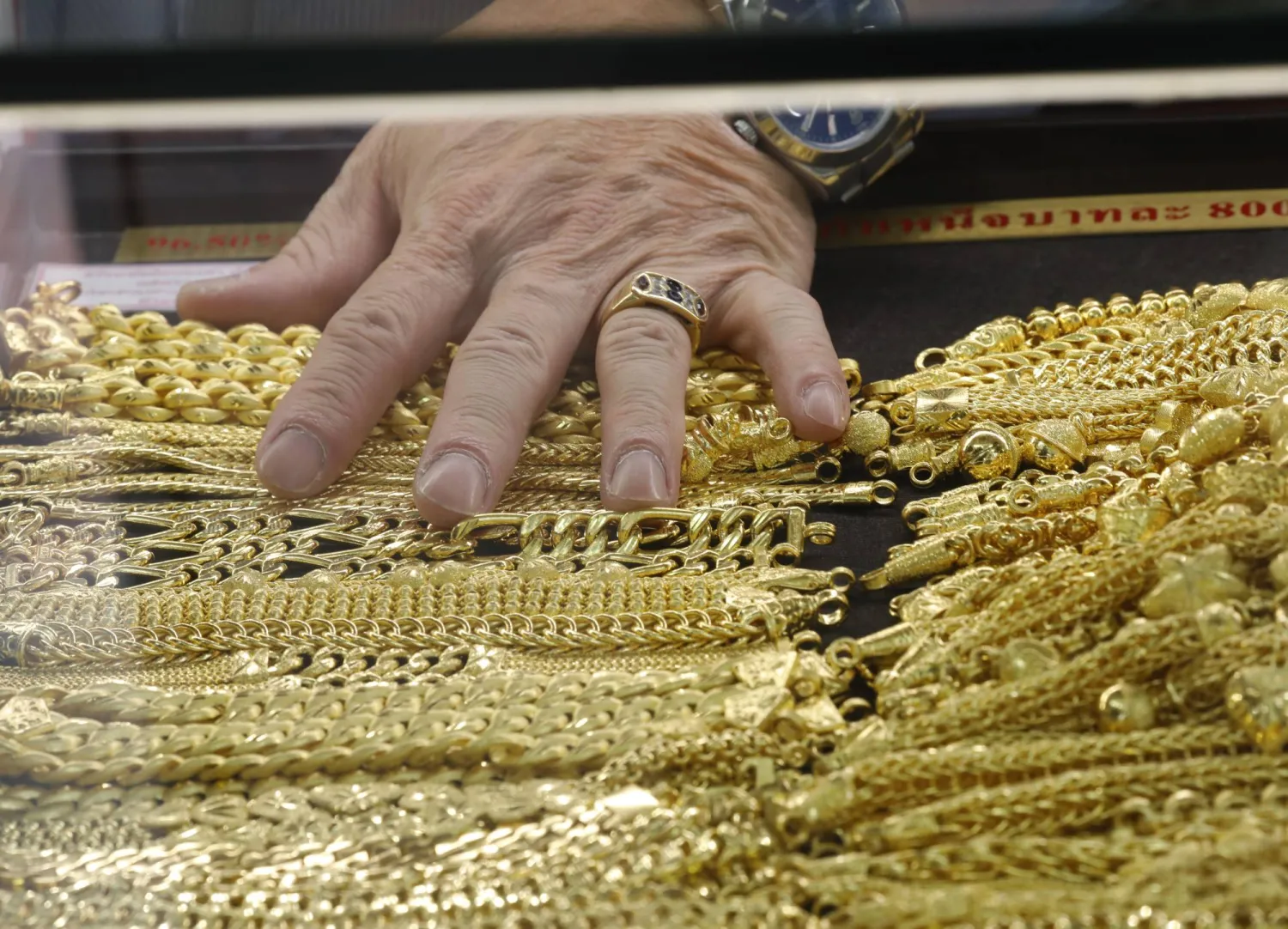
A goldsmith displays gold ornaments at the Hua Seng Heng gold shop in Bangkok, Thailand, 01 March 2026. EPA/NARONG SANGNAK
TT

Gold Climbs as US-Israel Strikes on Iran Spark Safe-haven Demand

A goldsmith displays gold ornaments at the Hua Seng Heng gold shop in Bangkok, Thailand, 01 March 2026. EPA/NARONG SANGNAK

Gold prices rose on Monday after the US and Israel launched major strikes on Iran, killing Supreme Leader Ali Khamenei, escalating geopolitical tensions and deepening global economic uncertainty.

Spot gold was up 1.37% at $5,349.44 an ounce, as of 0439 GMT, after hitting its highest point in more than four weeks. Earlier in the session, bullion prices climbed as much as 2%.

US gold futures rose 2.21% to $5,362.60 per ounce.

Israel launched a new wave of strikes on Tehran on Sunday and Iran responded with ‌more missile barrages, ‌a day after the killing of Khamenei ‌pitched ⁠the Middle East ⁠and the global economy into deepening uncertainty, Reuters said.

"Unlike previous escalations in this conflict, there is fairly strong incentive here for both sides to continue to escalate potentially - and that runs the risk of leading to a pretty chaotic, uncertain and therefore volatile environment for more than just a few days ... the dynamic for gold is pretty positive" ⁠said Kyle Rodda, senior financial market analyst at Capital.com.

However, ‌the US dollar index rose ‌0.27%, making gold more expensive for overseas buyers and capping the metal's ‌gains.

Bullion, a traditional safe-haven asset, has hit successive record highs ‌already this year due to heightened global political and economic uncertainty.

The latest rally builds on a 64% surge in 2025, driven by strong central bank buying, robust inflows into exchange-traded funds and expectations of US monetary ‌policy easing.

"Gold is perhaps the finest barometer to reflect global uncertainty and, to mix metaphors, the ⁠mercury is ⁠rising. We should expect gold to be repriced higher to fresh records as we enter a whole new era of geopolitical uncertainty," said independent analyst Ross Norman.

Meanwhile, data on Friday showed that US producer prices rose more than expected in January, suggesting inflation could pick up in coming months.

Investors will also watch a series of US labor market readings this week, including the ADP employment report, weekly jobless claims and the non-farm payrolls report.

Spot silver shed 0.3% to $93.54 per ounce, after registering a monthly gain in February.

Spot platinum was roughly steady at $2,363.26 per ounce, while palladium advanced 0.86% to $1,801.50.



Saudi Arabia Encourages Companies to Import Lebanese Products After Royal Order

 Saudi Ambassador to Beirut Fahd Al-Dosari and officials from both countries at Beirut port at the launch of Lebanese exports to Saudi Arabia. (SPA)
Saudi Ambassador to Beirut Fahd Al-Dosari and officials from both countries at Beirut port at the launch of Lebanese exports to Saudi Arabia. (SPA)
TT

Saudi Arabia Encourages Companies to Import Lebanese Products After Royal Order

 Saudi Ambassador to Beirut Fahd Al-Dosari and officials from both countries at Beirut port at the launch of Lebanese exports to Saudi Arabia. (SPA)
Saudi Ambassador to Beirut Fahd Al-Dosari and officials from both countries at Beirut port at the launch of Lebanese exports to Saudi Arabia. (SPA)

Saudi Arabia has officially begun encouraging its private sector to import Lebanese goods, a concrete step to revive trade between the two countries after years of disruption.

The step implements directives from Prince Mohammed bin Salman, Crown Prince and Prime Minister, and follows a request from Lebanon’s presidency and government.

Beirut port recently saw the first shipment leave for the Kingdom, in a ceremony officials said marked the rebuilding of economic trust, backed by modern and strict security controls to safeguard exports.

According to information obtained by Asharq Al-Awsat, Saudi Arabia’s General Authority of Foreign Trade informed the Federation of Saudi Chambers that a royal order had approved the resumption of Lebanese exports to the Kingdom.

It asked that the decision be circulated across the private sector so companies could benefit from it.

The move is expected to spur Saudi companies to tap the Lebanese market and push trade between the two countries toward broader horizons in line with their ambitions.

First export shipment

Acting on the Saudi royal order, Lebanese products were shipped again to Saudi Arabia on June 20, in the presence of the Saudi Ambassador to Lebanon, Fahd Al-Dosari. The shipment carried more than goods and merchandise.

It carried “a message of trust rebuilt after years of disruption, and an economic opportunity Lebanon eagerly awaits at a time when the need to stimulate production and increase exports is growing.”

The return of the Saudi market, which alone represents about 85% of the Gulf market, is not only a recovery of what was lost when exports stood at about $378 million before the ban. It also opens the door to greater ambitions to expand Lebanon’s presence in this vast market.

Al-Dosari said in a speech: “In implementation of the directives of Crown Prince Mohammed bin Salman to resume Lebanese exports to the Kingdom, and in response to the request of Lebanese President General Joseph Aoun and Prime Minister Nawaf Salam, and in line with the positive steps taken by the government toward rebuilding state institutions and the work completed by the specialized teams, we gather today to witness the departure of the first exports bound for Jeddah Islamic Port through Beirut port.”

He added: “As an embodiment of brotherly relations and out of the Kingdom’s keenness to stand by its brothers, this decision to resume Lebanese exports to the Kingdom confirms beyond doubt its support for Lebanon’s stability, its sovereignty over all its territory and the welfare of its brotherly people.”

Security screening

Prime Minister Nawaf Salam said Lebanon would not be allowed to again become “a launchpad for any harm against its Arab brothers,” and thanked Crown Prince Mohammed for lifting the ban on Lebanese exports.

The attendees then inspected modern scanning devices recently installed at Beirut port to examine goods and containers with precision. The equipment is designed to tighten security controls and speed up customs clearance.

Saudi Arabia had been Lebanon’s top export market before the ban. In 2014 and 2015, it ranked first, accounting for about 12% of Lebanon’s total exports, with a value of around $378 million in 2014, according to Lebanese customs and Chamber of Commerce data.

Bilateral trade was estimated at hundreds of millions of dollars annually.


Türkiye and Iraq Discuss Energy Cooperation Ahead of Pipeline Deal Expiry

A general view of Türkiye's Mediterranean port of Ceyhan, Adana, southern Türkiye, Feb. 19, 2014. (Reuters)
TT

Türkiye and Iraq Discuss Energy Cooperation Ahead of Pipeline Deal Expiry

A general view of Türkiye's Mediterranean port of Ceyhan, Adana, southern Türkiye, Feb. 19, 2014. (Reuters)

Türkiye's ‌Energy Minister Alparslan Bayraktar said on Wednesday that he met senior Iraqi oil and foreign ministry officials to discuss energy cooperation, including on the Iraq-Türkiye Crude Oil Pipeline that runs from Kirkuk to Ceyhan.

The decades-old Türkiye-Iraq Crude Oil ‌Pipeline Agreement, which governs ‌exports through the ‌pipeline, ⁠is due to ⁠expire on July 27. Baghdad and Ankara are still discussing a new draft agreement.

The Iraqi delegation included Deputy Foreign Minister Hussein Bahr Al-Uloom, Deputy ⁠Oil Minister Naser Azez ‌Jabbar, and ‌Iraq's Ambassador to Ankara Majid Al-Lachmawi.

Bayraktar said in a ‌post on X that Türkiye aims to work closely with the new Iraqi government on more effective ‌use of existing energy infrastructure.

Türkiye also seeks to ⁠support ⁠existing infrastructure with new connections, Bayraktar said.

Baghdad last month asked Ankara to extend the pipeline agreement for at least a year to allow time for more talks, but Ankara said it does not want an extension under current conditions.


Gold Falls as Higher Treasury Yields, Fed Rate Hike Bets Weigh

Gold bracelets and necklaces displayed for sale in a gold shop at Istanbul's Grand Bazaar (AFP)
TT

Gold Falls as Higher Treasury Yields, Fed Rate Hike Bets Weigh

Gold bracelets and necklaces displayed for sale in a gold shop at Istanbul's Grand Bazaar (AFP)

Gold fell for a third consecutive session on Wednesday, as rising US Treasury yields and growing bets that the Federal Reserve will raise interest rates pressured the non-yielding metal.

Spot gold was down 0.8% at $3,974.75 per ounce as of 0849 GMT, after touching its lowest level since last November at $3,942.99 in the previous session. US gold futures for August delivery lost 1.3% to $3,987.70/oz.

The yellow metal ‌on Tuesday recorded ‌its first quarterly loss since January 2024, Reuters reported.

A selloff ‌in ⁠US Treasuries on ⁠Tuesday pushed the benchmark 10-year yield up as much as 9 basis points before it backed off the highs. By Wednesday, yields were rising again, up 4 bps at 4.465%, outpacing increases in euro zone bond yields.

A stronger US dollar makes bullion less affordable for overseas buyers.

"The weakness is a bit driven by comments from ⁠Fed's Hammack, suggesting a rate hike might be ‌needed and market participants pricing in ‌a bit more rate hikes for this year," said UBS analyst Giovanni Staunovo. Federal ‌Reserve Bank of Cleveland President Beth Hammack said on Tuesday ‌she may advocate for higher rates if inflation pressures don’t moderate. According to CME FedWatch tool, traders see a nearly 67% chance of a rate hike by September.

Expectations for more hikes are not helping investment demand, and ‌ETF holdings have seen renewed outflows in recent days, said Staunovo, noting that price volatility is ⁠expected around economic ⁠data releases this week.

June ADP employment data, due at 1215 GMT, and Thursday's nonfarm payrolls report could give further clues on the Fed's policy path.

Markets will also closely watch the European Central Bank's annual Sintra conference on Wednesday, where Fed Chair Kevin Warsh and ECB President Christine Lagarde are due to speak. On the geopolitical front, concerns persisted over the prospects for US-Iran diplomacy after Tehran said it would not meet senior US envoys who travelled to the region following the recent outbreak of hostilities.

Spot silver fell 1.4% to $57.75 per ounce.

Platinum slipped 0.6% to $1,542.70, after hitting its lowest point since November. Palladium slid 1.4% to $1,187.01.