

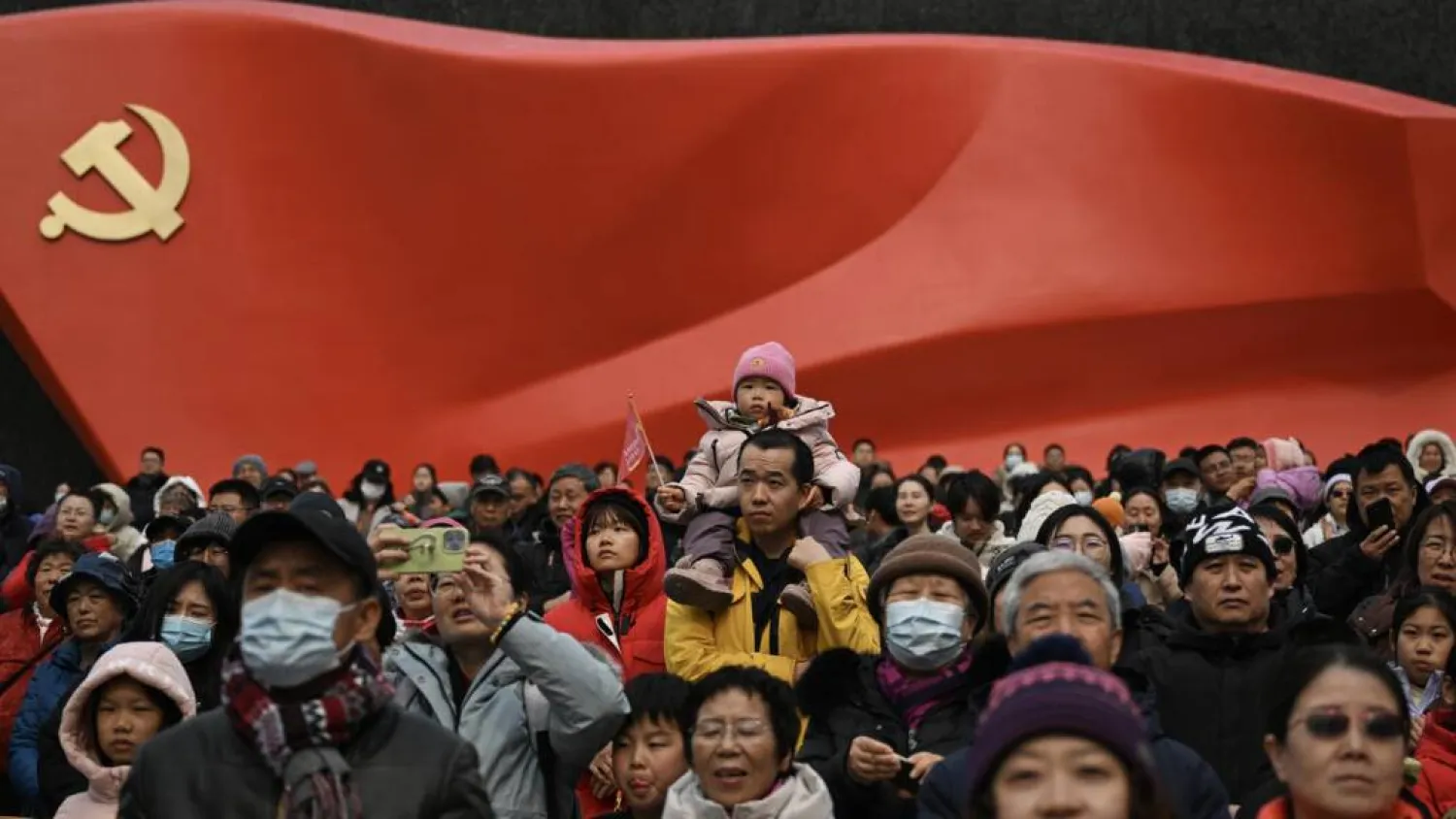

China's Leaders Gather for Key Strategy Session as Challenges Grow

Beijing this week will host China's carefully orchestrated annual strategy meetings known as "Two Sessions". Pedro PARDO / AFP
TT

China's Leaders Gather for Key Strategy Session as Challenges Grow

Beijing this week will host China's carefully orchestrated annual strategy meetings known as "Two Sessions". Pedro PARDO / AFP

China's leaders are set to unveil strategies to confront challenges that include sluggish consumption, a shrinking population and shifting geopolitical landscapes when they gather in Beijing this week for the annual Two Sessions political meeting.

Thousands of delegates from across China will convene for a carefully orchestrated affair in Beijing's Great Hall of the People, largely to rubber-stamp decisions by the ruling Communist Party under leader Xi Jinping.

The nation's 15th Five-Year Plan -- a blueprint for the world's second-largest economy through to 2030 -- will also be released.

With most of the decisions already made, the Two Sessions are mainly a talking shop with little room for spontaneity or off-the-cuff comments.

However, they do provide a rare glimpse into the party's priorities on matters ranging from the economy to defense and foreign policy.

This year's gathering begins on Wednesday with the start of the Chinese People's Political Consultative Conference, a political advisory body.

It is generally overshadowed by the next day's opening of the National People's Congress, China's parliament, at which Premier Li Qiang will outline key growth targets.

China's economy expanded by five percent in 2025, in line with Beijing's target but one of the slowest rates in decades.

Analysts expect this year's target to be set even lower -- between 4.5 and five percent -- with 14 provinces reducing their GDP targets in recent weeks compared to 2025.

China's leaders say the country's economic model must shift towards consumption-based growth, rather than traditional drivers, including production and exports.

But factors such as the flagging property market, deflation and youth unemployment have left consumers tightening their purse strings.

Over-production spurred by state support and low demand, as well as international trade tensions, have also loomed over industrial output.

- 'Double down' -

Beijing's five-year plan for 2026-2030 will aim to address such issues, with officials vowing it will "create new demand through new supply and provide strong innovative measures".

Analysts, however, are skeptical.

"The thrust of it is to double down on the direction of travel Xi had already set," Steve Tsang, director of the SOAS China Institute, told AFP.

Expected measures are "unlikely to address the fundamental problem behind weak private consumption", he said.

The plan is expected to concentrate on high-tech manufacturing, green transition and supply chain resilience.

"This signals a shift away from debt-fueled expansion toward innovation-led growth", as well a response to trade tensions and global uncertainty, said Sarah Tan of Moody's Analytics.

However, strengthening social safety nets and boosting incomes, as well as addressing the long-running property crisis, would lead to "a more durable revival", she said.

- Priorities and credibility -

China is also facing serious demographic challenges: its population has shrunk for three years in a row.

Top leaders have pledged more childcare relief, including subsidies of around $500 per year for every child under the age of three -- but the measures so far have done little to boost births.

The Two Sessions is tightly controlled, but delegates in the past have used the opportunity to try to push pet policies, particularly social measures.

But when the "overarching objective politically is security... there's no desire to be innovative", former US defense official Drew Thompson said.

"So they're kind of stuck."

China's defense budget will also be announced, with the military reeling from a deep and long-running anti-corruption campaign.

The announcement in January that top general Zhang Youxia was under investigation sent shockwaves through defense observers, who saw it as a consolidation of power in Xi's hands.

However, the saga is not expected to feature heavily at the Two Sessions, according to SOAS' Tsang.

Ultimately, delegates are trying to turn the tide of low public confidence, analysts noted.

"There are some serious societal challenges that the party has to adapt to and the tools they're using are pretty traditional ones," Thompson said.

Tan from Moody's Analytics added that "credibility will rest on whether structural reforms, meaningful support for households and sustained fiscal backing follow the rhetoric".



Russia Evacuates 198 Workers from Iran Nuclear Plant Amid Airstrike

Rosatom State Atomic Energy Corporation Director General Alexey Likhachev arrives to attend the talks between Russian President Vladimir Putin and Armenian Prime Minister Nikol Pashinyan at the Kremlin in Moscow, Russia, 01 April 2026. (EPA/Pavel Bednyakov/AP Pool)
TT

Russia Evacuates 198 Workers from Iran Nuclear Plant Amid Airstrike

Rosatom State Atomic Energy Corporation Director General Alexey Likhachev arrives to attend the talks between Russian President Vladimir Putin and Armenian Prime Minister Nikol Pashinyan at the Kremlin in Moscow, Russia, 01 April 2026. (EPA/Pavel Bednyakov/AP Pool)

Russia started a planned evacuation of 198 workers from Iran's Bushehr atomic plant shortly after a US-Israeli projectile hit near the facility, Russian state media said on Saturday.

This was a third evacuation from the facility in southern Iran on the Gulf coast, which was built with Moscow's help, with about 100 Russian staff remaining there by now.

The area around Bushehr has been struck four times during this war. The latest attack on Saturday saw one person -- a guard at the facility -- killed, but did not damage the plant itself, according to Iranian state media.

"As planned, we began the main phase of the evacuation today," Russia's nuclear agency Rosatom head Alexey Likhachev was quoted as saying by Russia's TASS news agency.

"About 20 minutes after that ill-fated strike, buses set off from Bushehr station towards the Iranian-Armenian border (with) 198 people, to be precise -- this is the largest evacuation," he added.

Likhachev also said that Russia informed the US and Israel about the evacuation.

"The likelihood of a risk of damage or a potential nuclear incident is, unfortunately, only increasing, as has been confirmed by this morning's events," the Rosatom CEO said.

The agency plans to keep only a skeleton staff at Bushehr amid the threat of further strikes.

The Russian foreign ministry slammed the "evil" US-Israeli attack and urged a cessation of hostilities on Iranian nuclear facilities immediately.


Erdogan Says Middle East War Has Caused ‘Geostrategic Impasse’

This handout photograph taken and released by the Turkish presidential press service on April 4, 2026, shows Türkiye's President Recep Tayyip Erdogan (R) welcoming and shaking hands Ukraine's President Volodymyr Zelensky (L) upon arrival for a bilateral meeting on security at Dolmabahce Presidential Office, in Istanbul. (Turkish Presidential Press Service / AFP)
TT

Erdogan Says Middle East War Has Caused ‘Geostrategic Impasse’

This handout photograph taken and released by the Turkish presidential press service on April 4, 2026, shows Türkiye's President Recep Tayyip Erdogan (R) welcoming and shaking hands Ukraine's President Volodymyr Zelensky (L) upon arrival for a bilateral meeting on security at Dolmabahce Presidential Office, in Istanbul. (Turkish Presidential Press Service / AFP)

Türkiye's President Recep Tayyip Erdogan said the war in the Middle East had led to a "geostrategic impasse", during a telephone conversation with NATO chief Mark Rutte, his office said Saturday.

"President Erdogan said the process started by the intervention against Iran had led to a geostrategic impasse and that the international community had to redouble its efforts to bring an end to this war," said the statement.

Türkiye has attempted to mediate an end to the hostilities, notably through negotiations conducted with Pakistan and Egypt.

Erdogan said his country was also continuing efforts "to reach a peaceful outcome" to the conflict between Russia and Ukraine.

Ukrainian President Volodymyr Zelensky arrived in Istanbul Saturday for talks with Erdogan.

A senior Ukrainian official told AFP that the talks would not only be about drone interceptors but also about security cooperation in general.

The Turkish presidency said on X that the talks would focus "efforts towards a ceasefire and a lasting solution."


Several Injured in Israel by Iran Missile Fire

A picture shows the damage at a factory that got hit by a missile in Petah Tikva, east of Tel Aviv, on April 3, 2026. (AFP)
TT

Several Injured in Israel by Iran Missile Fire

A picture shows the damage at a factory that got hit by a missile in Petah Tikva, east of Tel Aviv, on April 3, 2026. (AFP)

Israeli emergency services said its crew treated five people who were injured Saturday in Tel Aviv and surrounding areas after Iran fired several rounds of missiles toward Israel.

Since midnight, seven waves of Iranian missiles have been launched towards Israel, according to the Israeli military.

Israel's Magen David Adom emergency services said a 45-year-old man was treated for minor injuries from glass shrapnel in the central city of Bnei Brak and taken to hospital.

As the day progressed, rescue teams said they had treated three additional casualties -- two men in their 20s hit by glass fragments and one injured by blast.

A 52-year-old man "lightly injured by the blast wave" was also transferred to a hospital in Ramat Gan, in central Israel, the emergency service said.

In a residential neighborhood of Ramat Gan, AFP images showed the top floor of a house completely blown out, exposing its gutted interior, with a crushed bookcase and an exercise bike amid the debris.

Numerous impact marks were visible on the walls.

Nearby, another home was largely destroyed, stripped of its outer walls, according to AFP photographs.

"All this is from shrapnel," Joy Frankel, a social worker told AFP near one of the impacted sites.

According to several local media outlets, including The Times of Israel, a cluster munition missile fired from Iran on Saturday morning landed near the Kirya military base in Tel Aviv, not far from the defense ministry.

The military said its air defenses were working to down missiles fired from Iran, each a time it announced incoming projectiles.

Since February 28, the United States and Israel have conducted joint strikes against Iran, prompting the Tehran to retaliate with daily missile barrages targeting Israel and several neighboring countries across the region.