


UAE Bourses Slide as Markets Reopen after 2-day Halt

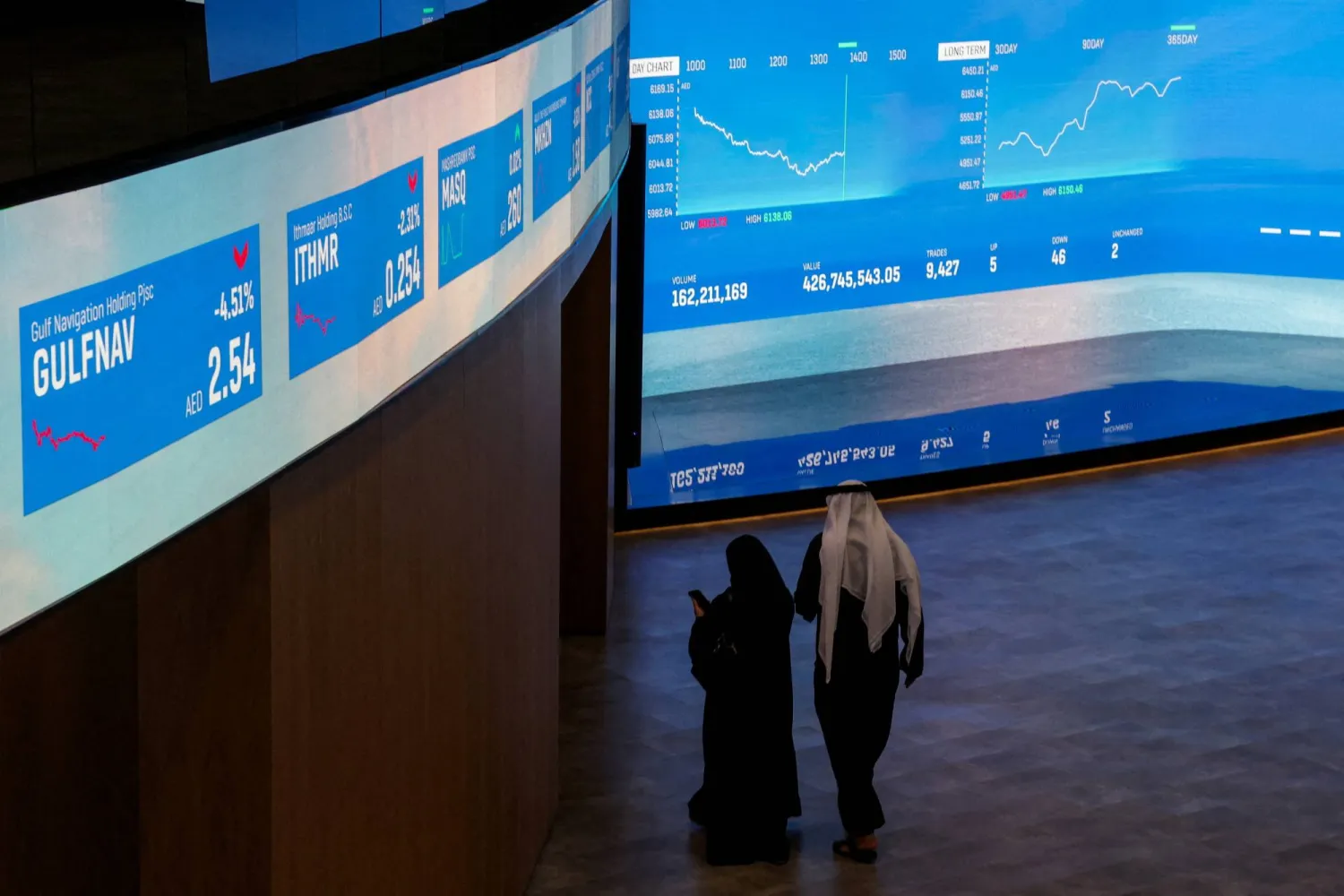
People walk near screens displaying stock information at the Dubai Financial Market, in Dubai, United Arab Emirates, December 30, 2025. REUTERS/Amr Alfiky
TT

UAE Bourses Slide as Markets Reopen after 2-day Halt

People walk near screens displaying stock information at the Dubai Financial Market, in Dubai, United Arab Emirates, December 30, 2025. REUTERS/Amr Alfiky

Dubai and Abu Dhabi stocks tumbled on Wednesday as they reopened after a two-day halt following Iran's unprecedented wave of missile and drone attacks on the Gulf nation on Sunday.

The closure froze trading in billions of dollars' worth of listed assets as investors awaited clarity on the scale of damage from the ⁠weekend strikes, which ⁠hit airports, ports and residential areas across both emirates.

Dubai's main share index slid 4.7%, its biggest intraday drop since May 2022, in broad-based declines led ⁠by blue-chip developer Emaar Properties 4.9%, while budget airliner Air Arabia retreated 5%.

In Abu Dhabi, the index fell 3.6%, also the steepest decline since May 2022, with the country's biggest lender First Abu Dhabi Bank losing 5%.

Both exchanges said they will temporarily set the lower price limit ⁠for ⁠securities at -5%.

In a separate statement, the Dubai Financial Services Authority (DFSA) said that Nasdaq Dubai would also resume trading on the day.

The Abu Dhabi Securities Exchange has instructed all listed companies to immediately assess their financial and operational exposure and promptly disclose any material information that could influence investor decisions.



Trump Says Did Not Discuss Tariffs During Summit with Xi

Shipping containers are piled at the Port of Los Angeles, California, on May 9, 2026. (AFP)
TT

Trump Says Did Not Discuss Tariffs During Summit with Xi

Shipping containers are piled at the Port of Los Angeles, California, on May 9, 2026. (AFP)

US President Donald Trump said Friday he did not bring up the issue of tariffs during a landmark summit with Chinese counterpart Xi Jinping.

Returning to Washington after making what he called "fantastic trade deals" with Beijing, Trump said on tariffs: "We didn't discuss those... It wasn't brought up."

The pair had been widely expected to discuss extending the one-year tariff truce reached during their last meeting in October in South Korea.

The truce brought a pause to a blistering trade war that had seen tariffs on many goods exceed 100 percent.

Conditions have shifted since.

The deal saw Washington maintain some tariffs over China's alleged role in global fentanyl supply chains and accusations of unfair practices.

But the US Supreme Court in February struck down many of Trump's duties, including those imposed over drug trafficking.

The White House quickly moved to impose a 10-percent global tariff using temporary powers, and opened investigations that could lead to more lasting duties.

The 10-percent global tariff has also been challenged in US courts.

Trump had arrived in Beijing earlier this week seeking to seal accords in sectors including agriculture, aviation and artificial intelligence.

After the first day wrapped, Trump said Xi had agreed to help open the Strait of Hormuz, as well as buy Boeing jets and American oil and soybeans.

But there have been no formal announcements, and the Chinese foreign ministry would not confirm or deny Trump's statements when asked on Friday afternoon.


Britain's Pound, Stocks and Bonds Fall on Political Uncertainty, Global Inflation Angst

A view of 10 Downing Street in London, Britain, 14 May 2026. EPA/NEIL HALL
TT

Britain's Pound, Stocks and Bonds Fall on Political Uncertainty, Global Inflation Angst

A view of 10 Downing Street in London, Britain, 14 May 2026. EPA/NEIL HALL

British government bonds, stocks and sterling fell on Friday, as domestic political uncertainty clashed with global worries about an inflationary shock, leaving UK assets in the mire.

Sterling fell to a five-week low and is down almost 2% against the dollar this week, set for its biggest weekly drop since November 2024.

British Prime Minister Keir Starmer was in a battle to hold on to power after his health minister Wes Streeting resigned from government, while others positioned themselves to challenge his leadership, following disastrous local election results last week.

Markets are concerned that a ⁠new leader may ⁠be willing to loosen fiscal policy more, with British government borrowing costs up sharply again and UK bank stocks selling off on Friday.

Greater Manchester Mayor Andy Burnham has been offered a path for a possible leadership challenge after another Labour lawmaker said he would resign his parliamentary seat. If Burnham were to win the seat, he could then challenge for ⁠the party leadership.

"Market's fear is that Burnham would be more left leaning, and we could see further increase in deficits," Reuters quoted Jefferies economist Mohit Kumar as saying.

"Our base case is one of a managed exit for Starmer and Burnham likely becoming the next PM," he added.

The domestic political drama has coincided with another rise in energy prices on Friday and growing evidence that the economic damage from the Iran war is hurting.

US inflation data this week has shown consumers and factories are starting to see big increases in price pressures as a result of the war, which has ⁠pushed up the ⁠price of crude by over 50%.

The pound has tended to suffer against the dollar when tensions between Washington and Tehran flare or oil prices rise, given Britain's dependence on energy imports and the economy's sensitivity to higher fuel costs.

It was last down 0.3% on the day at $1.3364 after earlier touching $1.3335, its lowest level in over five weeks.

British bond yields jumped across the curve. The 10-year yield was last up almost 12 basis points (bps) at around 5.11%. Bond yields move inversely with prices.

Stocks also fell. The blue-chip FTSE 100 was last down 0.6%, while the more domestic-oriented FTSE 250 index of midcap stocks was down 1.1%.

UK banks were also down sharply, with Barclays and Lloyds down over 2% each.


Oil Gains after Trump Says Xi Agrees Iran Cannot Have Nuclear Weapons

The current price of gasoline is shown at a gas station in Encinitas, California, US, May 11, 2026.  REUTERS/Mike Blake
The current price of gasoline is shown at a gas station in Encinitas, California, US, May 11, 2026. REUTERS/Mike Blake
TT

Oil Gains after Trump Says Xi Agrees Iran Cannot Have Nuclear Weapons

The current price of gasoline is shown at a gas station in Encinitas, California, US, May 11, 2026.  REUTERS/Mike Blake
The current price of gasoline is shown at a gas station in Encinitas, California, US, May 11, 2026. REUTERS/Mike Blake

Oil prices gained about 2% after US President Donald Trump said he and China's Xi Jinping agree Iran cannot have nuclear weapons and as concerns persisted over ship attacks and seizures despite Tehran saying about 30 vessels crossed the Strait of Hormuz.

Brent crude oil futures were up $1.77, or 1.67%, to $107.49 a barrel at 0642 GMT. Prices hit a session high of $107.99 earlier in the day.

US West Texas Intermediate futures were up $2.13, or 2.11%, ‌to $103.30 a ‌barrel.

For the week, Brent has climbed nearly 6%, ‌while ⁠WTI has jumped more ⁠than 7%, on uncertainty over the shaky ceasefire in the Iran conflict.

Trump said his patience with Iran is running out and he had agreed in talks with Xi that Tehran cannot be allowed to have a nuclear weapon and must re-open the Strait of Hormuz.

Xi did not comment on his discussions with Trump about Iran, although China's foreign ministry issued a statement.

"This conflict, which ⁠should never have happened, has no reason to continue," ‌the ministry said.

"With the Beijing summit not ‌delivering any breakthrough on Iran, market focus is back on the deadlock and ‌a blockaded Strait, with a tail risk of renewed military escalation," said Vandana ‌Hari, founder of oil market analysis provider Vanda Insights.

Among deals the market was looking for from the summit, Trump said China wants to buy oil from the United States.

In incidents around the Strait of Hormuz, a ship was reported seized by Iranian ‌personnel off the United Arab Emirates and headed for Iranian waters on Thursday, and an Indian cargo vessel carrying ⁠livestock from ⁠Africa to the UAE was sunk on Wednesday in waters off the coast of Oman.

The White House said Trump and Xi had agreed on the need to keep the shipping lane open.

Iran's Revolutionary Guards said 30 vessels had crossed the Strait of Hormuz since Wednesday evening, still far short of 140 that were typical daily before the war, but a substantial increase if confirmed.

Yang An, analyst at Haitong Futures, said the main driver of oil prices was still tight supply.

"Oil prices swung several times yesterday but still closed near the day's high," he said.

"Ships passing through the strait eased some market concerns, but not enough to change the strong trend driven by tight supply."